



Rating and value of paintings by Wilfrid Gabriel de Glehn

Key takeaways
- Wilfrid Gabriel de Glehn, a British Post-Impressionist artist of the early 20th century, enjoys well-established recognition, particularly among French collectors.
- Oil paintings fetch between €170 and €236,600, while drawings and watercolors range from €40 to €30,000, with Mediterranean landscapes being the most sought-after.
- His style is characterized by a subtle mastery of light and atmosphere, favoring soothing compositions and fluid transitions rather than dramatic contrasts.
If you own a work by artist Wilfrid de Glehn or based on his work and would like to know its value, our state-approved experts and auctioneers will guide you.
Our specialists will carry out a free appraisal of your work, and provide you with an accurate estimate of its value on the current market.
Then, should you wish to sell your work, we'll direct you to the best possible arrangement to obtain the optimum price.
Rating and value of the artist
An artist of the early post-impressionist movement, Wilfrid Gabriel de Glehn enjoyed artistic renown during his lifetime, especially on a regional scale.
Today, the artist's works are rare but rated on the market. Landscape scenes from the south of France are particularly sought-after by collectors.
A work by Wilfrid Gabriel de Glehn can fetch thousands of euros, as shown by his oil on canvas L'escalade - canots et voiliers, which fetched €236,600, whereas it was estimated at between €55,000 and €78,900.
Order of value from the most basic to the most prestigious
Technique used | Result |
|---|---|
Drawing - watercolor | From €40 to €30,000 |
Painting | From €170 to €236,600 |
Estimate in less than 24h
The works and style of Wilfrid Gabriel de Glehn
Wilfrid Gabriel de Glehn, influenced by movements such as Impressionism, Neo-Impressionism and Synthetism, is distinguished by his bold handling of color and play with light.
His works don't just depict realistic scenes: they seek to capture the particular atmosphere and light of the landscapes of southern France, particularly Provence and the Côte d'Azur, where he loved to paint. His color palette is often vivid, reflecting the intensity of Mediterranean landscapes, while his marked contours emphasize forms with elegance and simplicity.
What makes his canvases so unique is his desire to move beyond purely realistic detail to express impressions. His sun-drenched landscapes exude a sense of warmth and calm, as if he were trying to convey the emotions these places evoke.
By playing with light contrasts, he manages to give each scene a special, almost poetic aura, where the viewer feels not only what he sees, but also the mood and energy of the moment.
Wilfrid Gabriel de Glehn, a British painter of the late 19th and early 20th centuries, shares an approach in which light and atmosphere are central to composition with several other artists of Impressionism and Post-Impressionism, in the French and British context.
A friend and collaborator of John Singer Sargent, De Glehn follows in the footsteps of Impressionism, while retaining an academic rigor in his treatment of forms and figures.
Like Sargent or Claude Monet, he favors outdoor scenes, capturing fleeting moments with a luminous palette and light brushstrokes.
Artists such as Philip Leslie Hale or Cecilia Beaux also show stylistic affinities with De Glehn, adopting this same subtle mastery of chiaroscuro and transparent color to create works vibrant with energy and life.
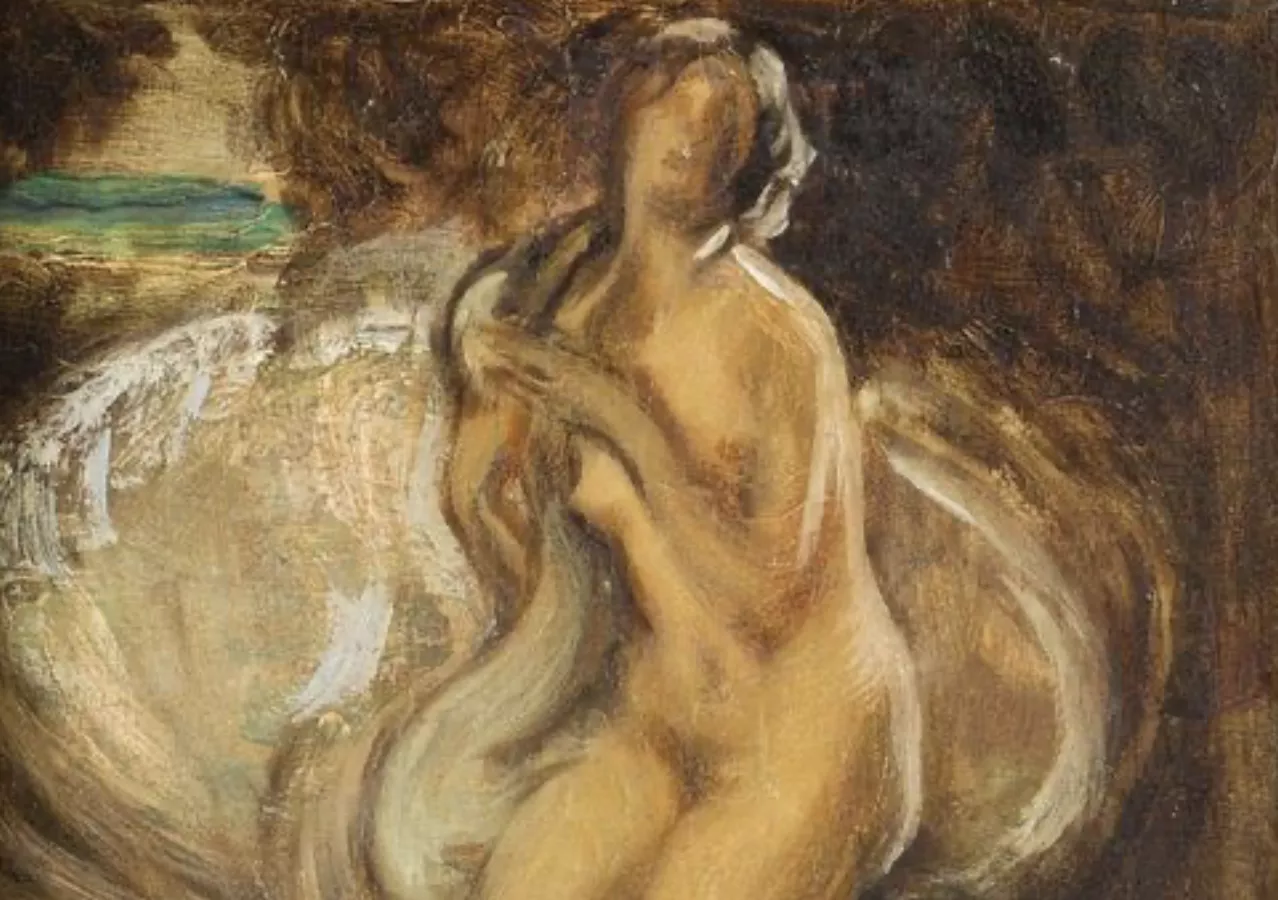
The life of Wilfrid Gabriel de Glehn
Wilfrid Gabriel de Glehn, British artist of the early 20th century, was renowned for his subtle mastery of light and landscapes, often inspired by his travels across Europe.
A close friend of John Singer Sargent, with whom he shared a passion for plein-air painting, de Glehn forged a reputation for vibrant scenes bathed in soft light and a serene atmosphere.
His works, halfway between Impressionism and a certain realism, are characterized by light touches and a rich palette, where every color seems to breathe. Although influenced by the Impressionists, he retains a concern for form and structure that gives his canvases a timeless elegance.
Wilfrid Gabriel de Glehn, although close to Impressionism, stands out for a more structured approach than that of many French artists such as Jacques Gautherin, Paul Signac or Suzanne Valadon.
While de Glehn favors soft light and soothing compositions, Gautherin and Valadon often opt for more intense scenes, with more forthright brushstrokes and a sometimes more dramatic touch.
With de Glehn, light envelops forms without jarring contrasts, whereas Valadon plays more on volumes and textures with an almost raw energy.
Paul Signac, a pioneer of pointillism, meanwhile offers a more fragmented view of the world, with each color broken down into distinct points. De Glehn, by contrast, prefers more fluid transitions, giving a sense of continuity in his landscapes.
Where Signac celebrates the vibration of pure color, de Glehn remains closer to a naturalistic reality, even if light and atmosphere remain at the heart of his work.
Thus, although all these artists share a sensibility for color and light, each approaches it in his own way. De Glehn anchors himself in a pictorial serenity, where Valadon, Signac and Gautherin explore more daring and contrasting paths, whether through material, form or technique.
Digital retrospective of W.G. de Glehn
Wilfrid Gabriel de Glehn's imprint on his period
Wilfrid Gabriel de Glehn is a fairly well-known Impressionist in the UK, since it was there that he mostly worked and exhibited. On the other hand, he is not known to the general public in France, nor exhibited much.
On the other hand, as paintings by the artist and more generally by the 20th century possess a high quotation on the art market, many French collectors appreciate his work and are willing to bid in order to own one of his paintings.
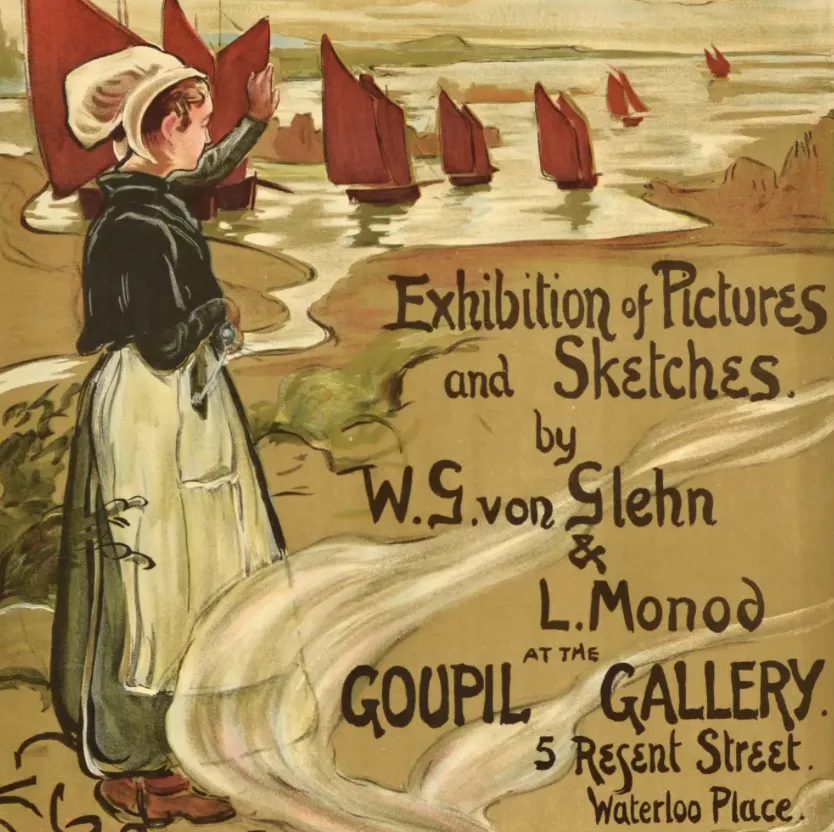
Focus on the cover view of Venice, W.G. de Glehn
This painting by Wilfrid Gabriel de Glehn perfectly illustrates the soothing atmosphere and subtle luminosity that characterize his work. The scene depicts a seaside, probably in Venice, where the elegant buildings and boats moored at the quay create a harmonious, balanced composition.
De Glehn, true to his Impressionist style, captures here a moment of calm, where the soft light of day grazes the surfaces with elegance.
The palette used is both luminous and soft, dominated by light shades of beige, ochre and blue. The building's walls seem almost to melt into the pale sky, an effect that testifies to the way de Glehn incorporates natural light into his compositions.
The fluidity of the brushstrokes, particularly visible in the sky and water, reinforces this sense of harmony between the elements. We sense that the artist is seeking to convey an impression of tranquility rather than dwelling on overly precise details.
The boats, in the foreground, are painted with simple shapes and dark colors, creating a contrast with the luminosity of the building and the sky. This play of contrasts adds depth to the scene, without upsetting the overall balance of the painting.
The water, for its part, is rendered in subtle reflections, reinforcing the idea of a moment of calm, almost suspended in time. Also noticeable is the absence of clearly defined human figures, a frequent choice for de Glehn, who seems to prefer letting natural and architectural elements speak for themselves rather than focusing his works on human activity.
The artist's impressionistic touch is reflected in his use of color to suggest light and atmosphere, rather than to describe objects realistically. De Glehn does not hesitate to leave certain parts of the canvas open, as if the viewer were invited to complete the image mentally.
This approach, very characteristic of the Impressionists, allows the focus to be on sensation rather than form.
The composition of the painting is carefully built around the imposing building, which occupies a large part of the space. The eye is naturally drawn to this structure, whose architecture is suggested by a few precise lines and touches of light.
The windows and arches are barely sketched, but their presence lends an impression of monumentality, almost solemnity, to this otherwise simple scene. The blurred background, where we can barely make out the silhouettes of other buildings, contributes to this serene, airy atmosphere.
In short, this painting by Wilfrid Gabriel de Glehn demonstrates the artist's talent for capturing the ephemeral beauty of a landscape, without overloading the canvas with detail. The emphasis is on the harmony of colors and shapes, and on this ability to capture a moment of calm, where everything seems bathed in a soft, diffused light.
What strikes above all is the way de Glehn manages to convey an almost tactile sense of atmosphere, where the gaze loses itself between glistening water and walls bathed in light.
His signature
W.G. de Glehn's works are not all signed, which is why expertise is important.

Expertise your property
If you own a work by Wilfrid Gabriel de Glehn, please feel free to request a free appraisal by filling out our online form.
A member of our team of experts and licensed auctioneers will contact you to provide an estimate of the market value of your work.
If you are considering selling your work, our specialists will also guide you through the various alternatives available to obtain the best possible price, taking into account market trends and the specific features of each work.
Estimate in less than 24h
Discover in the same theme

Rating and value of sculptures, bronzes and marbles by Augus...
Auguste Clésigner is a French sculptor who has produced a number of sculptures that are highly valued at auction.
Learn more >

Rating and value of paintings by Jules Lefebvre
Jules Lefebvre is a French academic artist who produced many works that are highly valued at auction.
Learn more >

Rating and value of paintings, drawings and sculptures by Er...
Ernest Meissonier was a 19th-century artist who produced many small-scale works and sculptures, which are now listed at auction.
Learn more >
Similar works sold at auction

Estimated 5.000 - 10.000
Jean Roger SOURGEN (1883-1978), Lake and pine forest, oil on canvas

Estimated 2.000 - 3.000
Raymond THIBÉSART (1874-1968) Apple trees in blossom, oil on canvas

Estimated 1.000 - 2.000
Lucien GOUBERT (1887-1964), Rochers à Fermanville, oil on canvas

Estimated 2.000 - 4.000
Charles LACOSTE (1870-1959) Starry night, Oil on paper mounted on canvas

Estimated 5.000 - 8.000
Robert PINCHON (1886-1943) View of a port on the banks of the Seine, Oil on canvas

Estimated 800 - 1.500
Georges MASSON (1875-1948) La cour fleurie du couvent des Récollets à Ciboure, oil on panel

Secure site, anonymity preserved

Auctioneer approved by the State

Free and certified estimates
Frequently asked questions
-
Who was Wilfrid Gabriel de Glehn, and what was his artistic movement?Wilfrid Gabriel de Glehn was a British painter of the late 19th and early 20th centuries, associated with the Post-Impressionist movement. A friend and collaborator of John Singer Sargent, he was distinguished by his subtle mastery of light and atmosphere, particularly in his landscapes of southern France. His approach emphasized soft light and soothing compositions, while maintaining a rigorous treatment of form.
-
What is the estimated value of Wilfrid Gabriel de Glehn's paintings?Wilfrid Gabriel de Glehn’s works fetch thousands of euros on the current market. A drawing or watercolor can range from €40 to €30,000, while a painting ranges from €170 to €236,600. For example, his oil on canvas painting *L'escalade – canots et voiliers* sold for €236,600, far exceeding its initial estimate of €55,000 to €78,900.
-
How can you authenticate and appraise a work by Wilfrid Gabriel de Glehn?To authenticate and appraise a work by Wilfrid Gabriel de Glehn, we recommend that you request a free appraisal from Auctie's by filling out our online form. Our experts and state-certified auctioneers will examine your artwork and provide you with an accurate estimate of its market value within 48 hours, with no obligation on your part.
-
Why are de Glehn's landscapes of southern France particularly sought after?Wilfrid Gabriel de Glehn’s landscape scenes of southern France are particularly prized by collectors because they capture the distinctive atmosphere and light of Provence and the French Riviera. His vivid palette and bold outlines reflect the intensity of Mediterranean landscapes, conveying impressions and emotions rather than mere realistic depictions.
-
How do I sell a work by Wilfrid Gabriel de Glehn through Auctie's?If you’d like to sell a work by Wilfrid Gabriel de Glehn, Auctie’s will guide you through the process from appraisal to auction. After you receive a free appraisal, our specialists will help you choose the best options available, taking into account market trends and the specific characteristics of your work to ensure you get the best possible price.
