



Rating and value of works, drawings, paintings by Suzanne Valadon

Key takeaways
- Suzanne Valadon (1865–1938), the first woman admitted to the École des Beaux-Arts in Paris, developed a style that blended Impressionism and Naturalism, featuring vivid colors and expressive flat areas of color.
- Her oil-on-canvas works are the most sought-after, with prices ranging from €240 to €331,900; her market value has been rising sharply since 2021.
- The artist is distinguished by an innovative division of space and a bold use of color characteristic of the early 20th-century avant-garde.
Known for being the first woman to be admitted to the Ecole des Beaux-Arts in Paris, Suzanne Valadon (1865-1938) developed her own style, blending impressionist and naturalistic painting.
As well as being a talented artist, Suzanne Valadon was one of the most prized models among Parisian artists, due to her singular physique and distinctive features that leave no one indifferent.
If you own a work by or based on the artist Suzanne Valadon and would like to know its value, our state-approved experts and auctioneers will guide you.
Our specialists will carry out a free appraisal of your work, and provide you with a precise estimate of its value on the current market. Thereafter, if you wish to sell your work, we will direct you to the best possible arrangement to obtain the optimum price.
Rating and value of the artist Suzanne Valadon
Suzanne Valadon is a well-known artist among contemporary art enthusiasts. Now, the prices of her works are rising at the auctioneers' gavel.
Her oils on canvas are particularly prized, especially by French buyers, and the price at which they sell on the art market ranges from 30€ to 331,900€, a significant delta but one that speaks volumes about the value that can be attributed to the artist's works.
In 2021, his oil on canvas Nu à la draperie was sold for €331,900, while it was estimated at between €43,670 and €61,130. Its price has risen sharply.
Order of value from the most basic to the most prestigious
Technique used | Result |
|---|---|
Estamp - multiple | From €30 to €11,280 |
Drawing - watercolor | From €260 to €68,260 |
Oil on canvas | From €240 to €331,900 |
Estimate in less than 24h
Suzanne Valadon's style and technique
Suzanne Valadon's works are characterized by the use of bright colors and flat tints, reflecting her membership of the modern avant-garde. Influenced by the Impressionists, her works are luminous. Her bold, expressive artistic style captures intimate moments with originality and modernity.
Well-valued on the market, Suzanne Valadon's works can fetch tens of thousands of euros.
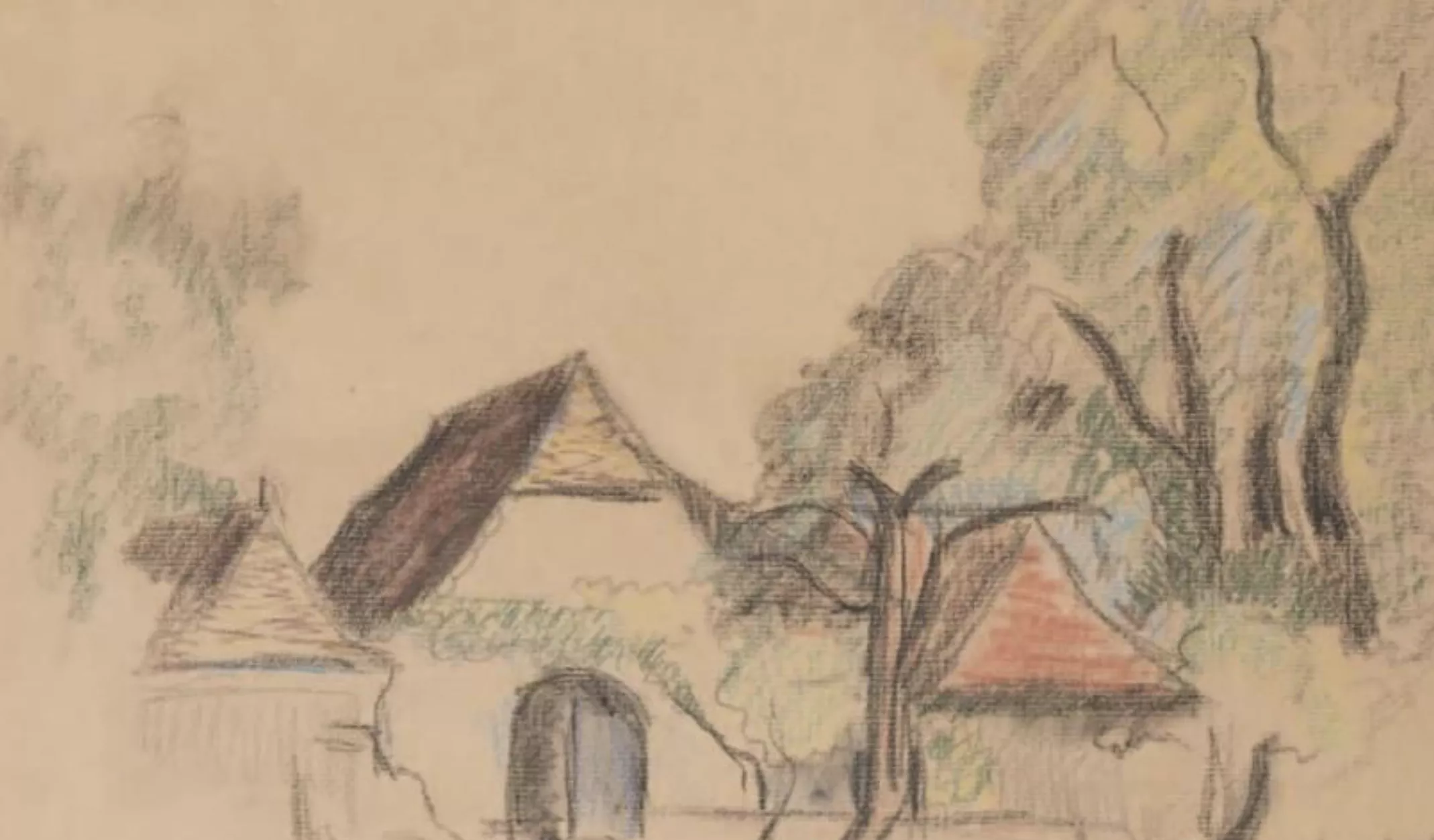
The life of Suzanne Valadon
Marie-Clémentine Valade, known as Suzanne Valadon, was born in Paris in 1865. As a child, she lived with her mother, a laundress in Montmartre.
Suzanne Valadon took her first steps in art as a model. She posed for painters such as Toulouse-Lautrec and Chavanne.
It wasn't until the early 1880s that the young model decided to move to the other side of the canvas and began painting. Impressed by her talent, Edgar Degas took her under his wing and taught her the basics of painting as well as printmaking.
In 1894, Suzanne Valadon became admitted to the Société Nationale des Beaux-Arts de Paris. She distinguished herself by her modern approach, being one of the first to depict nude men in monumental works.
The artist led an affluent life and a first exhibition was dedicated to her in 1911. This was the start of a series of exhibitions dedicated to her work. The post-war period proved extremely productive for the artist, who created numerous portraits, nudes and still lifes.
Inspired by her entourage, Suzanne Valadon produced numerous portraits, notably of her son, her mother, but above all of André Utter her lover and principal model.
She dies at the age of 73, surrounded by her friends Picasso, Derain and Braque.
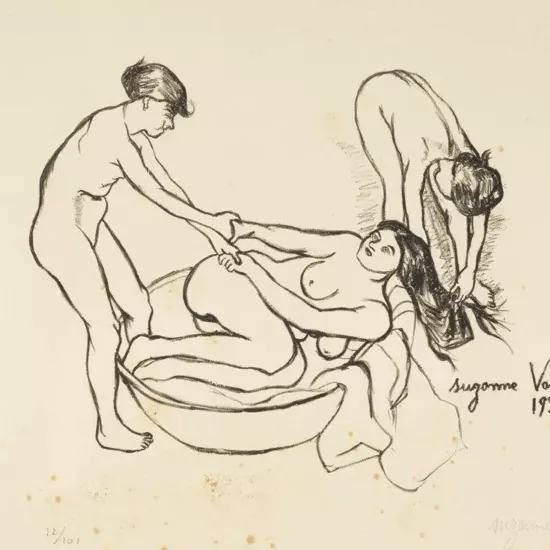
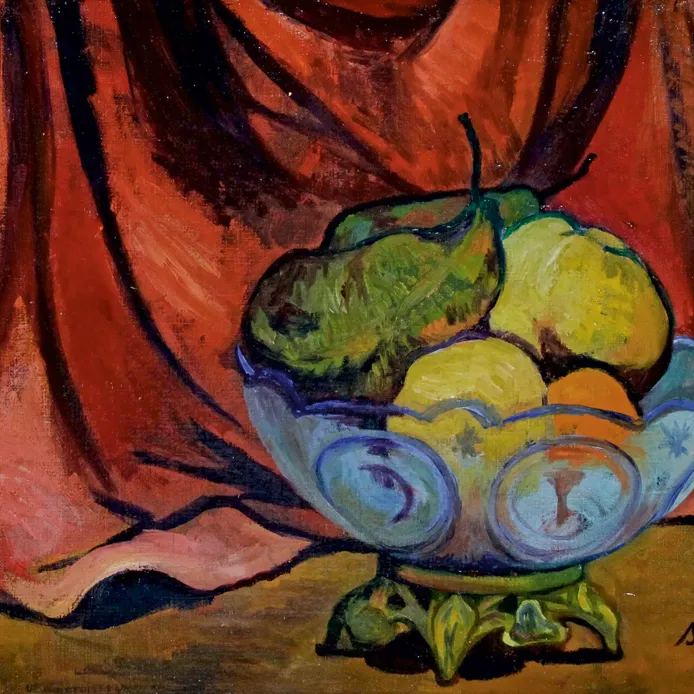
Her way of working
Suzanne Valadon's works are characterized by the use of bright colors and flat tints, reflecting her membership of the modern avant-garde. Influenced by the Impressionists, her works are luminous. Her bold, expressive artistic style captures intimate moments with originality and modernity.
Well valued on the market, Suzanne Valadon's works can fetch tens of thousands of euros.
Suzanne Valadon's compositions are distinguished by a bold, masterful use of colorimetry and an innovative division of space, characteristics that testify to her membership of the artistic avant-garde of the early 20th century.
The use of bright colors is one of the most striking elements in her work. Valadon does not hesitate to employ frank and contrasting tints, reinforcing the expressiveness of her subjects. This bold use of color, inherited in part from the Impressionists she worked alongside, gives her paintings a palpable energy.
Her vibrant flat tints of color, often deployed without intermediate nuances, create an effect of strength and simplicity that immediately captures the eye.
In her compositions, Valadon also shows great skill in the division of space. She structures her canvases in such a way as to direct the viewer's eye through the different parts of the scene, while maintaining a harmonious balance between the elements.
Her approach to composition moves away from traditional perspective in favor of a freer, more expressive spatial organization, reinforcing the modern character of her work. For example, in his nudes and portraits, Valadon often places his figures in the foreground, giving his models an almost sculptural presence.
This proximity to the viewer creates an immediate intimacy, making the work more accessible while emphasizing the emotional intensity of the subjects.
The artist manages to unify the different planes of his paintings through the use of firm lines that clearly delineate the contours of the forms. This technique, combined with her distinctive use of color, lends her works a clarity and strength that capture the essence of the subjects she depicts.
In addition, Valadon often incorporates decorative elements or repetitive motifs into her works, helping to give rhythm to the composition while adding an extra aesthetic dimension.
The works of Suzanne Valadon, well valued on the market, thus reflect a profoundly original and resolutely modern artistic vision, in which colorimetry and the division of space play a central role.
They embody a break with the pictorial conventions of her time, while affirming a unique sensibility that continues to inspire and fascinate.
Understanding Postimpressionism
Postimpressionism is a generalist term used to qualify a moment of transition in the history of twentieth-century art. This period is considered to run from 1880 to 1910, and covers the 30 years of experimentation that saw the emergence of several movements : pointillism, synthetism, symbolism and nabis.
Félix Fénéon, an art critic of the time, published Les impressionnistes en 1886, an essay that operated a break with Impressionism as it had been known in the 19th century. He felt that with the 1886 exhibition, " Impressionism was definitively dead ".
Art critic Roger Fry in turn used this theory in 1906 and popularized the term postimpressionnsite, following an exhibition at London's Crafton Galleries. It helped revive the art market, especially among American buyers, so that they became aware of the end of Impressionism.
It's important to understand that postimpressionism is not a pictorial trend, but a pictorial theory invented by art critics to describe a tipping point between Impressionism and the avant-garde, characterizing a search among artists.
It is therefore historically false to describe an artist as " postimpressionniste " to describe his or her movement. Suzanne Valadon's research is different, both in terms of the division of space within the painting and in terms of colorimetry. These were the two factors that would hold back the avant-garde for half a century.
Working with numerous genres, the artist produced still lifes and landscape paintings, but it was above all portraiture that held her attention for many years. Throughout his output, we can clearly see the hallmarks of Post-Impressionism.
In some canvases, we find Impressionist influences the strokes are fine, the colors faithful and the shapes in tune with reality. Gradually, Expressionism began to influence his work a little : the division of the painting changes, the strokes are thicker, and the faces more serious.
The division of space becomes so visible and the treatment of bodies and faces is so changeable that we almost approach the early experimental phases of Cubism.
Suzanne Valadon, from model to painter
The imprint of Suzanne Valadon
Suzanne Valadon was an artist who made a profound mark on her era, through her talent and quality as a model. She is also known for being the first woman to enter the Beaux-Arts in Paris, when regulations were very strict. Today, many of her works are exhibited in museums in France and around the world, but private collectors play the greatest role in preserving her work.
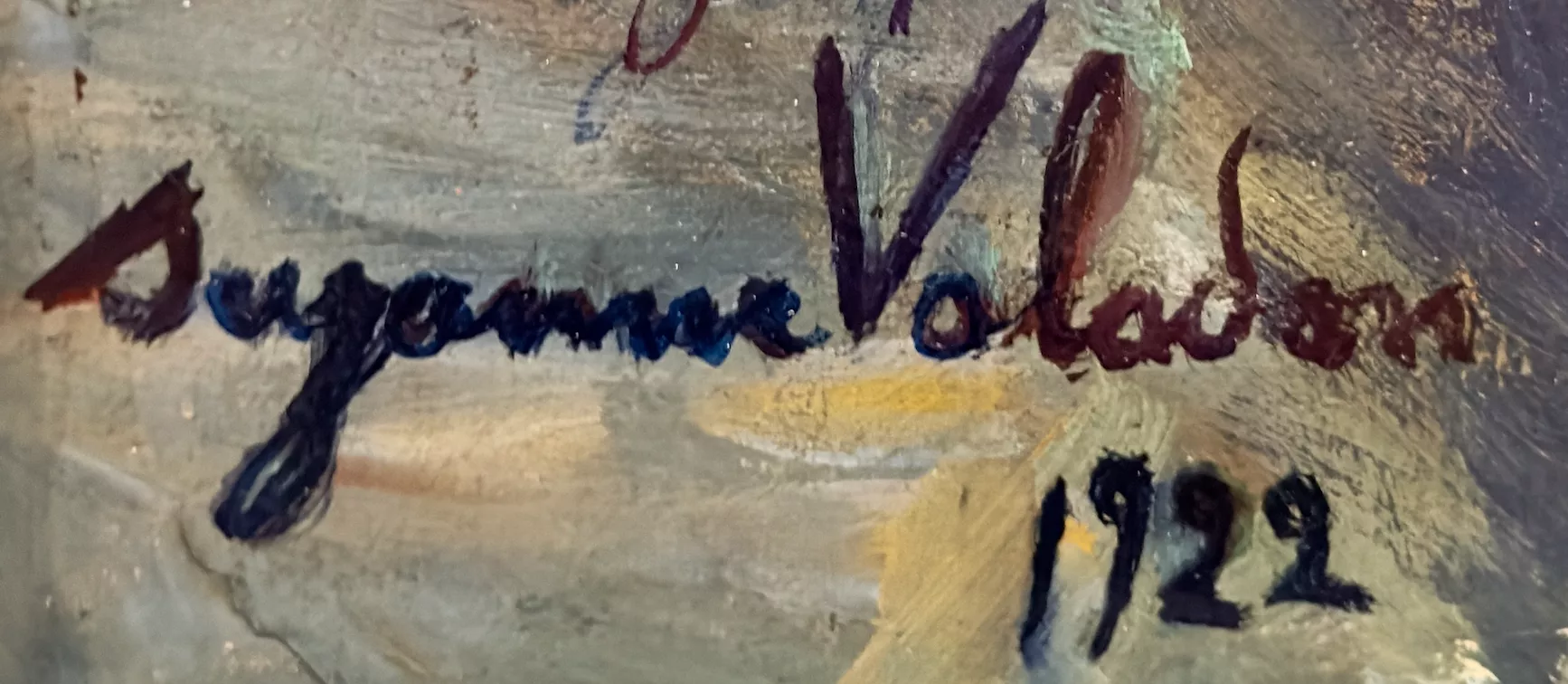
Her signature
Not all Suzanne Valadon's works are signed.
Although there are variations, here is a first example of her signature:
Expertise your property
If you own a Suzanne Valadon work, don't hesitate to request a free appraisal by filling in our online form. A member of our team of experts and licensed auctioneers will contact you to provide an estimate of the market value of your Suzanne Valadon work.
If you are considering selling your work, our specialists will also guide you through the various alternatives available to obtain the best possible price, taking into account market trends and the specific features of each work.
Estimate in less than 24h
Discover in the same theme

Value and quotation of works by Vassillew Slavik
Slavik is a 20th-century interior decorator, sculptor, cartonnier and painter. His works are highly prized at auction. Estimate in 24h
Learn more >

Rating and value of paintings, drawings, prints by François-...
François-Xavier Lalanne is a multi-talented artist whose paintings and drawings, often preparatory, are listed at auction.
Learn more >

Rating and value of works, sculptures and bronzes by Camille...
Camille Alaphilippe is a French sculptor who produced works in the Art Nouveau movement that are highly regarded and valued.
Learn more >
Works from the same period sold at auction


Secure site, anonymity preserved

Auctioneer approved by the State

Free and certified estimates
Frequently asked questions
-
Who was Suzanne Valadon, and what was her historical context?Suzanne Valadon (1865–1938) was the first woman admitted to the École des Beaux-Arts in Paris. After working as a model for painters such as Toulouse-Lautrec and Degas, she turned to creating her own art in the early 1880s. Influenced by Impressionism and the avant-garde, she distinguished herself in particular by depicting monumental male nudes—a revolutionary approach for her time. Her style blends Impressionism and Expressionism with a bold use of color and an innovative division of space.
-
What is the price range for Suzanne Valadon's works?Prices for works by Suzanne Valadon vary considerably depending on the medium and provenance. Prints range from €30 to €11,280, while drawings and watercolors range from €260 to €68,260. Oil paintings on canvas, the most sought-after works, range from €240 to €331,900, with a record set in 2021 for “Nu à la draperie,” which sold for €331,900 (estimated at between €43,670 and €61,130). His market value is rising sharply in the current market.
-
How do you authenticate and appraise a work by Suzanne Valadon?To authenticate and appraise a work by Suzanne Valadon, we recommend that you request a free appraisal from Auctie's by filling out our online form. A certified expert or auctioneer will contact you to examine the work and provide you with an accurate estimate of its market value, with no obligation on your part.
-
Is this the right time to sell a work by Suzanne Valadon?Yes, the current market conditions are favorable for selling a work by Suzanne Valadon. The artist’s market value is rising sharply; her oil-on-canvas paintings are particularly sought after by French collectors; and hammer prices regularly exceed initial estimates. The art market is increasingly recognizing her historical and artistic significance.
-
How does the sale of a work of art work at Auctie's?Auctie's supports sellers every step of the way: a free, no-obligation appraisal by an expert or certified auctioneer (response within 48 hours), followed by guidance on the best sales option based on the artwork and market trends. Our specialists will advise you on how to achieve the best possible price right up until the final sale.
