



Rating and value of works, lithographs, paintings by Henri de Toulouse Lautrec

Key takeaways
- Toulouse-Lautrec’s lithographs, his major body of work, sell for between €5 and 16.6 million on the auction market.
- His oil-on-canvas paintings range from €5,000 to 16.6 million euros, such as "The Laundress" (1866), which sold for 16.6 million in 2005.
- His Post-Impressionist-Expressionist style, influenced by Japanese prints, revolutionized advertising posters with bold compositions and flat areas of vivid color.
Famous for his paintings depicting the lively nightlife of Montmartre, as well as his portraits of brothels, Henri de Toulouse-Lautrec (1864-1901) embodied the spirit of decadence characteristic of the Belle Époque.
If you own a work by or based on the artist Henri de Toulouse-Lautrec and would like to know its value, our state-approved experts and auctioneers will guide you.
Our specialists will carry out a free appraisal of your work, and send you a precise estimate of its value on the current market.
Then, if you wish to sell your work, we will direct you to the best possible arrangement to obtain the optimum price.
Artist's rating and value
A popular artist of his time, Henri de Toulouse-Lautrec is highly sought after on the market. His lithographs made him famous and represented his biggest artistic output.
The price at which they sell on the auction market ranges from €5 to €16,580,000, a substantial delta but one that says a lot about the value that can be attributed to Toulouse-Lautrec's works.
In 2005, his oil on canvas La blanchisseuse dating from 1866 sold for €16,580,000 while it was estimated at between €16,580,000 and €20,725,000.
Order of value from the most basic to the most prestigious
Technique used | Result |
|---|---|
Estamp - multiple | From €5 to €1,114,490 |
Drawing - pastel | From €125 to €11,551,760 |
Oil on canvas | From €5,000 to €16,580,000 |
Estimate in less than 24h
The artist's works and style
Described as postimpressionist, symbolist and expressionist, Henri de Toulouse-Lautrec developed an immediately recognizable style, marked by a bold palette and powerful contrasts. His rapid, nervous touch, borrowed from the Impressionists, serves a more direct, incisive visual language.
Far from limiting himself to a faithful transcription of reality, he simplifies forms, accentuates contours and eliminates superfluous details to capture the essence of movement and expression.
This approach lends his works a singular energy, punctuated by bold color schemes and dynamic compositions.
Influenced by symbolism, Toulouse-Lautrec also sought to convey the interiority of his subjects. Behind the effervescence of his cabaret or theater scenes, he highlights human fragility, isolation and melancholy.
His portraits of dancers and singers, far from being mere festive representations, reveal the tension between pomp and social reality. His incisive strokes and bold framing recall the art of Japanese printmaking, which he particularly admired.
By blending sociological observation and exaggerated expressivity, Toulouse-Lautrec set himself apart from his contemporaries and imposed a new vision of modernity, where Parisian nightlife became a theater of emotions and contrasts.
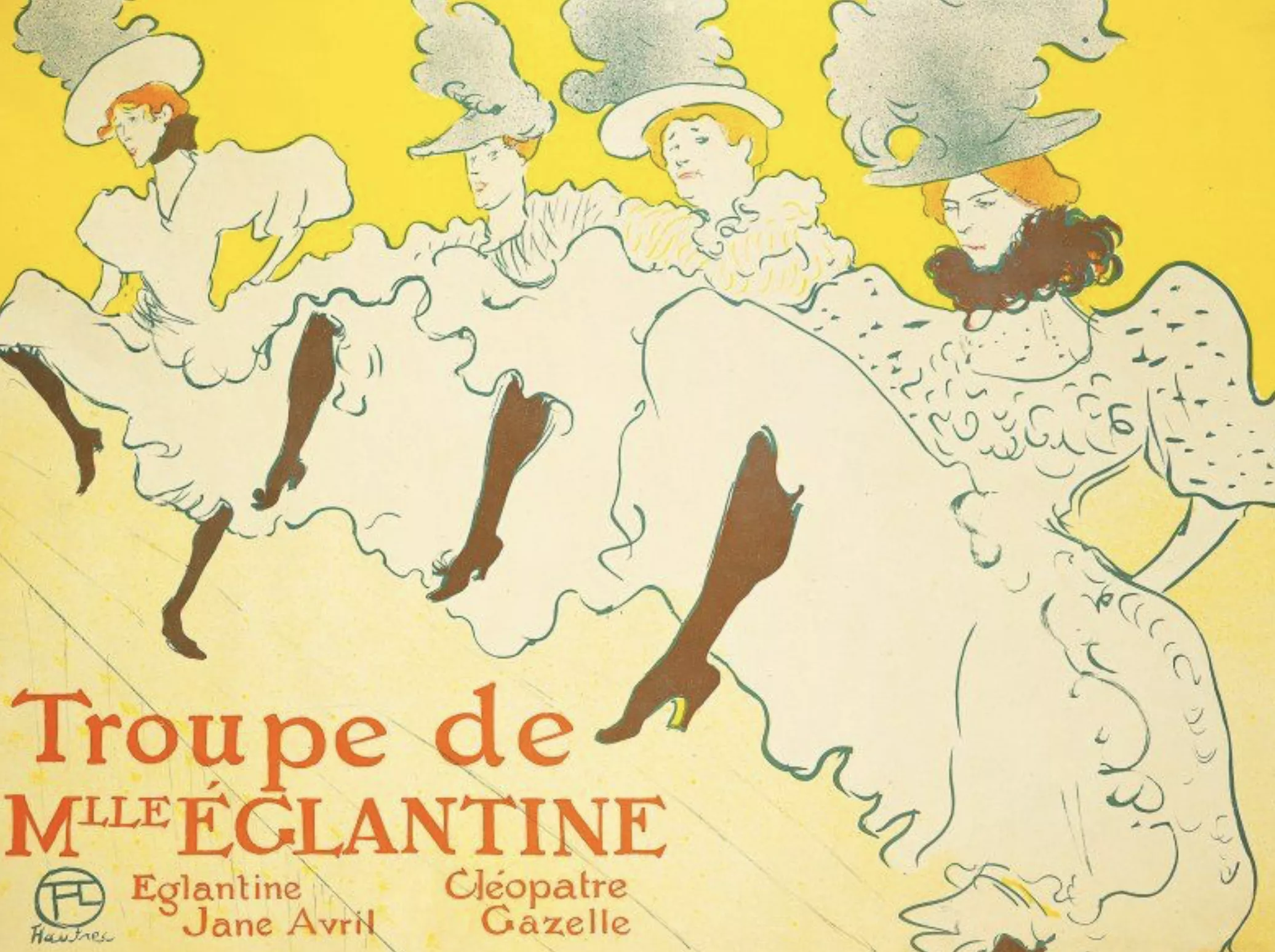
The life of Henri de Toulouse-Lautrec
Henri de Toulouse-Lautrec was born in 1864 into an aristocratic family in the south of France. A hereditary bone disease, aggravated by two fractures in his teens, hampered his growth and condemned him to an atypical stature.
This physical condition prompted him to devote himself entirely to art. Trained at Fernand Cormon's studio, he frequented the avant-garde circles of Montmartre and developed a passion for the world of show business.
It was in cabarets, theaters and brothels that he drew his inspiration. He captures the gestures of the dancers and the nocturnal fauna with acuity, translating the effervescence of fin-de-siècle Paris through nervous drawing and bold framing.
Influenced by Japanese prints, he simplifies forms, accentuates contrasts and favors flat tints of bright colors. His posters, notably those for the Moulin Rouge, marked a turning point in the history of graphic art, imposing an immediate and striking style.
But behind the bright lights and hectic scenes, Toulouse-Lautrec also expressed a deep melancholy. He was an uncompromising observer of the human condition, capturing the fatigue, weariness and artifice of a world in perpetual motion.
Worn out by alcohol and syphilis, he was institutionalized in 1899 before dying in 1901, aged just 36. His prolific and innovative work had a lasting influence on modern art, particularly in the fields of poster and advertising graphics.
Focus on La Goulue au Moulin Rouge, Henri de Toulouse-Lautrec
La Goulue entrant au Moulin Rouge is an interesting depiction of the nocturnal world that Toulouse-Lautrec never ceased to explore.
The composition is marked by bold framing and stylized forms that accentuate the dynamism of the scene. La Goulue, the central figure of the Parisian cabaret, strides forward, followed by Valentin le Désossé.
The artist's nervous brushstrokes, influenced by Japanese prints, encircle the silhouettes and highlight the contrast of the flat colors.
Far from a naturalistic representation, the work reflects a meticulous observation of movement and expression. Toulouse-Lautrec captures the moment with almost surgical precision, revealing both the energy and melancholy of this showbiz world.
The absence of modeling and the use of bright colors reinforce the painting's graphic effect, while the fragmented light contributes to the theatricalization of the scene.
Through this painting, Toulouse-Lautrec is not content with a simple cabaret portrait. He reveals its codes, artifices and latent tensions.
La Goulue, a figure of the Parisian party scene, appears here both triumphant and detached, embodying this society of entertainment where exuberance often masks a certain disillusionment.
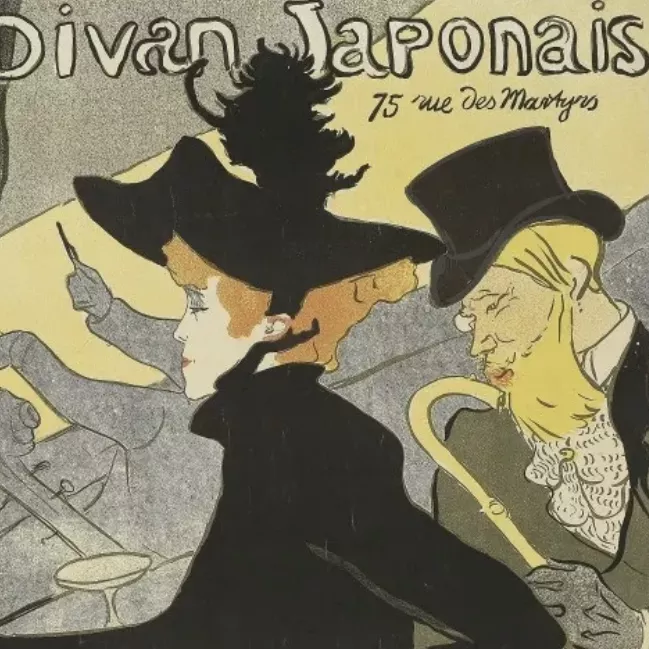
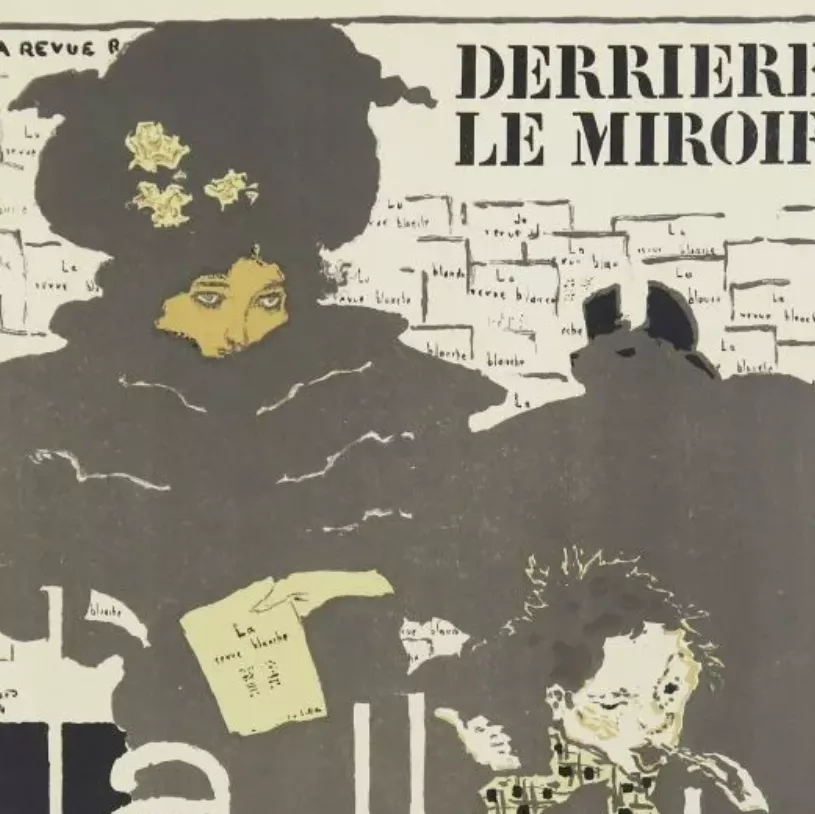
Toulouse-Lautrec's imprint on his time
Toulouse-Lautrec made a profound mark on his era, capturing the effervescence of late 19th-century Paris by night with unrivalled acuity. His work stands out as a vibrant testimony to modern life, where cabaret, circus and brothels become subjects in their own right.
Through his incisive eye, he renewed the approach to portraiture by avoiding all idealization, preferring to reveal the raw truth of faces and bodies.
His influence extends beyond painting. With his bold posters, he revolutionized graphic art, borrowing from Japanese prints their dynamic framing and use of solid color.
His work thus contributed to the rise of the advertising poster and the transformation of the visual language of his time. He inspired the artists of the following generation, from Fauvism to Expressionism, with his freedom of line and his resolutely modern approach to movement and composition.
By depicting the Paris of pleasure and excess without detour or complacency, Toulouse-Lautrec captured the soul of an era in the throes of change. His work, beyond its aesthetic appeal, stands out as a mirror of Belle Époque society, revealing its contrasts, frenzy and latent melancholy.
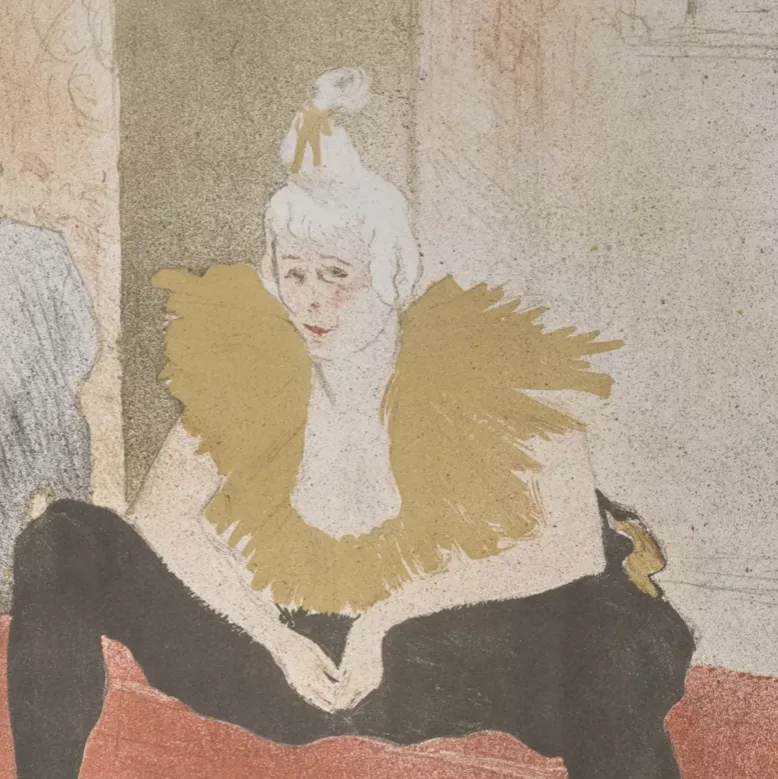
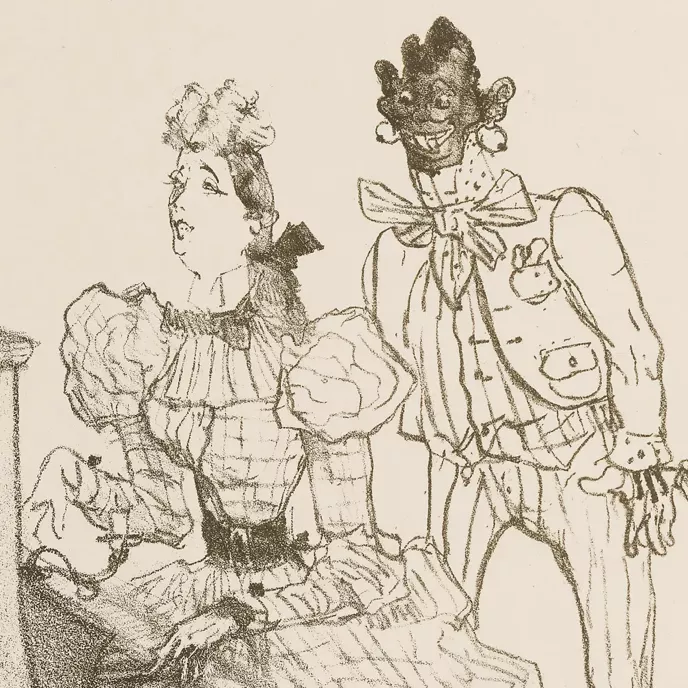
The artistic influences of Henri de Toulouse-Lautrec
Toulouse-Lautrec was part of a rich artistic heritage that he reinvented through a singular vision, marked by observation of reality and raw expressiveness.
His admiration for the masters of line, such as Ingres and Degas, is reflected in his precise, incisive line, capable of capturing the psychology of a model in just a few sketches.
Like Degas, he is interested in scenes of modern life, dancers and performers, but pushes further the destructuring of forms and the immediacy of gesture. Stylistically, he remains very close to Louis Anquetin and Émile Bernard.
His art also bears the imprint of Japanese prints, from which he retains bold framing, the use of colored solids and the elimination of traditional perspective.
Influenced by Hokusai and Utamaro, he favors unexpected angles of view, asymmetrical compositions and cut-out silhouettes, lending his works an innovative spontaneity and dynamism. This approach is echoed in his posters, where the economy of graphic means reinforces the visual impact.
Symbolism also exerts an influence on his work, although Toulouse-Lautrec distances himself from it by rejecting allegory and idealism. However, he shares with this movement a desire to translate the interiority of beings, exploring solitude and fragility under the glare of artificial lights.
In his portraits and cabaret scenes, color and line become carriers of emotion, revealing the underlying tensions behind the spectacle.
Finally, his plastic research heralds major developments of the twentieth century. With his formal simplification, his expressive use of line and his freedom of composition, he prefigured certain aspects of Fauvism and Expressionism.
His work, rooted in its time, thus goes beyond Post-Impressionism to pave the way for a painting freed from academic constraints, where the sincerity of the gaze takes precedence over fidelity to reality.
Today, he remains one of the most emblematic painters of his time, and one of the most sought-after artists of his century on the art market, whatever the medium.
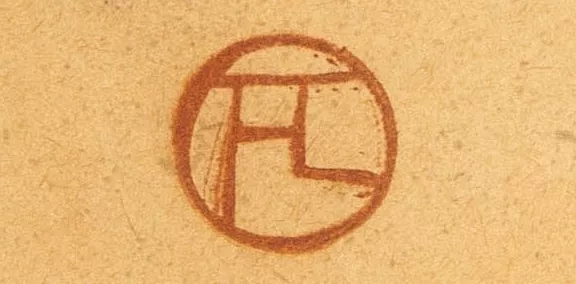
His signature
Not all of Henri de Toulouse-Lautrec's works are signed.
Although there are variations, here's a first example of his signature:
Expertise your property
If you own a work by Henri de Toulouse-Lautrec, don't hesitate to request a free appraisal by filling in our online form.
A member of our team of experts and licensed auctioneers will contact you to provide an estimate of the market value of your signed work by Henri de Toulouse-Lautrec.
If you are considering selling your work, our specialists will also guide you through the various alternatives available to obtain the best possible price, taking into account market trends and the specific features of each object.
Estimate in less than 24h
Discover in the same theme

Rating and value of works, watercolors, paintings by Nam Son...
Nguyen Nam Son is a 20th-century Vietnamese artist who produced watercolors and paintings. His works are quoted on the art market.
Learn more >

Rating and value of armchairs, chairs and stools by Pierre C...
Pierre Chapo is an iconic twentieth-century designer who has produced furniture that is quoted and valued on the auction market.
Learn more >

Rating and value of paintings by Anne Redpath
Anne Redpath is a Scottish artist who has produced works that are highly rated and valued at auction. 100% free estimate.
Learn more >
Works from the same period sold at auction

Estimated 2 000 € - 3 000 €
Delphin ENJOLRAS (1857-1945) "A Midsummer Night's Dream", Oil on canvas

Estimated 15 000 - 20 000 €
Jean HENNINGER (1916-1994) Hunting scene.

Estimated 4.000 - 6.000 €
GASTON CHAISSAC (1910-1964) Composition 1947, Gouache and Indian ink on paper.

Estimated 2.000 - 4.000
JONES Adrian. Buffalo Bills Wild West. 1903. Lithographic poster

Secure site, anonymity preserved

Auctioneer approved by the State

Free and certified estimates
Frequently asked questions
-
Who was Henri de Toulouse-Lautrec, and what was his artistic context?Henri de Toulouse-Lautrec (1864–1901) was a Post-Impressionist, Symbolist, and Expressionist artist, famous for his depictions of Montmartre’s nightlife and Parisian cabarets such as the Moulin Rouge. Despite a hereditary bone disease that affected his stature, he became one of the most iconic painters of the Belle Époque, influenced by Japanese prints and leaving a profound mark on graphic art and modern painting.
-
What are the market prices for Toulouse-Lautrec's works?Toulouse-Lautrec’s lithographs and paintings fetch prices that vary widely depending on the technique and provenance. Prints start at a few hundred euros, while drawings and pastels range from 125 to several million euros, and the most prestigious oil-on-canvas paintings can fetch up to 16,580,000 euros, such as “The Laundress,” sold in 2005.
-
How do you authenticate a work by Toulouse-Lautrec?To authenticate a work attributed to Toulouse-Lautrec, we recommend that you request a free appraisal from our state-certified experts and auctioneers. They will analyze the work in detail and provide you with an accurate estimate of its current market value, with no obligation on your part.
-
Is this the right time to sell a work by Toulouse-Lautrec?Yes, Toulouse-Lautrec remains one of the most sought-after artists on the art market, regardless of the medium used. His lithographs, paintings, and graphic works are in steady demand among collectors worldwide, making this an opportune time to consider selling.
-
How does the appraisal and sale process work at Auctie's?Auctie's offers a free, no-obligation appraisal—simply fill out our online form. An expert or auctioneer will contact you to assess your artwork and provide you with an accurate valuation. If you’d like to sell, we’ll guide you toward the best options for getting the highest price, based on market trends and the specific characteristics of your item.
