



Rating and value of works, drawings, paintings by Louis Anquetin

Key takeaways
- Louis Anquetin, a leading Post-Impressionist artist, has seen his works fetch several million euros; for example, *Woman at Her Toilet* sold for €1,300,063 in 2020.
- His oil-on-canvas paintings are the most prestigious (€100 to €1,300,060), followed by watercolors and drawings (€50 to €1,077,300), while his prints remain affordable (€65 to €6,000).
- A pioneer of Cloisonnism in the 1880s, he abandoned the avant-garde after 1890 to return to classical techniques, influencing the Nabis and Paul Gauguin.
If you own a work by or based on the artist Louis Anquetin and would like to know its value, our state-approved experts and auctioneers will guide you.
Our specialists will carry out a free appraisal of your work, and provide you with a precise estimate of its value on the current market.
Then, if you wish to sell your work, we will direct you to the best possible arrangement to obtain the optimum price.
Rating and value of the artist
A major artist of the early post-impressionist movement, Louis Anquetin enjoyed artistic renown during his lifetime.
Since then, many of his paintings have joined prestigious museums such as the Louvre, the National Gallery in London and the Hermitage Museum in St. Petersburg.
Today, the artist's works are rare but highly prized on the market. Works from his Cloisonnism period and his portraits of social scenes are particularly sought-after by collectors.
A work by Louis Anquetin can fetch millions of euros, as shown by his oil on canvas Femme à sa toilette, appraised at €1,300,063 in 2020.
Order of value from the most basic to the most prestigious
Technique used | Result |
|---|---|
Estamp - multiple | From €65 to €6,000 |
Drawing - watercolor | From € 50 to € 1,077,300 |
Oil on canvas | From € 100 to € 1,300,060 |
Estimate in less than 24h
The artist's works and style
ILouis Anquetin develops a singular style that oscillates between innovation and a return to tradition. Trained in the studio of Léon Bonnat, then with Fernand Cormon, he first explored Impressionism before turning to bolder research.
With Émile Bernard, he pioneered cloisonnism, a process inspired by Japanese prints and medieval stained glass, characterized by flat areas of vivid color surrounded by sharp outlines. His precise line and sense of chromatic harmonies give his compositions an unprecedented decorative force.
However, from the 1890s onwards, he turned away from the avant-garde to revive the art of the Old Masters, studying Rubens and Delacroix to perfect his modeling and sense of movement.
His work on light and materials reveals a fascination for classical techniques, making him an artist at the crossroads of influences, between modernity and academic heritage.
.
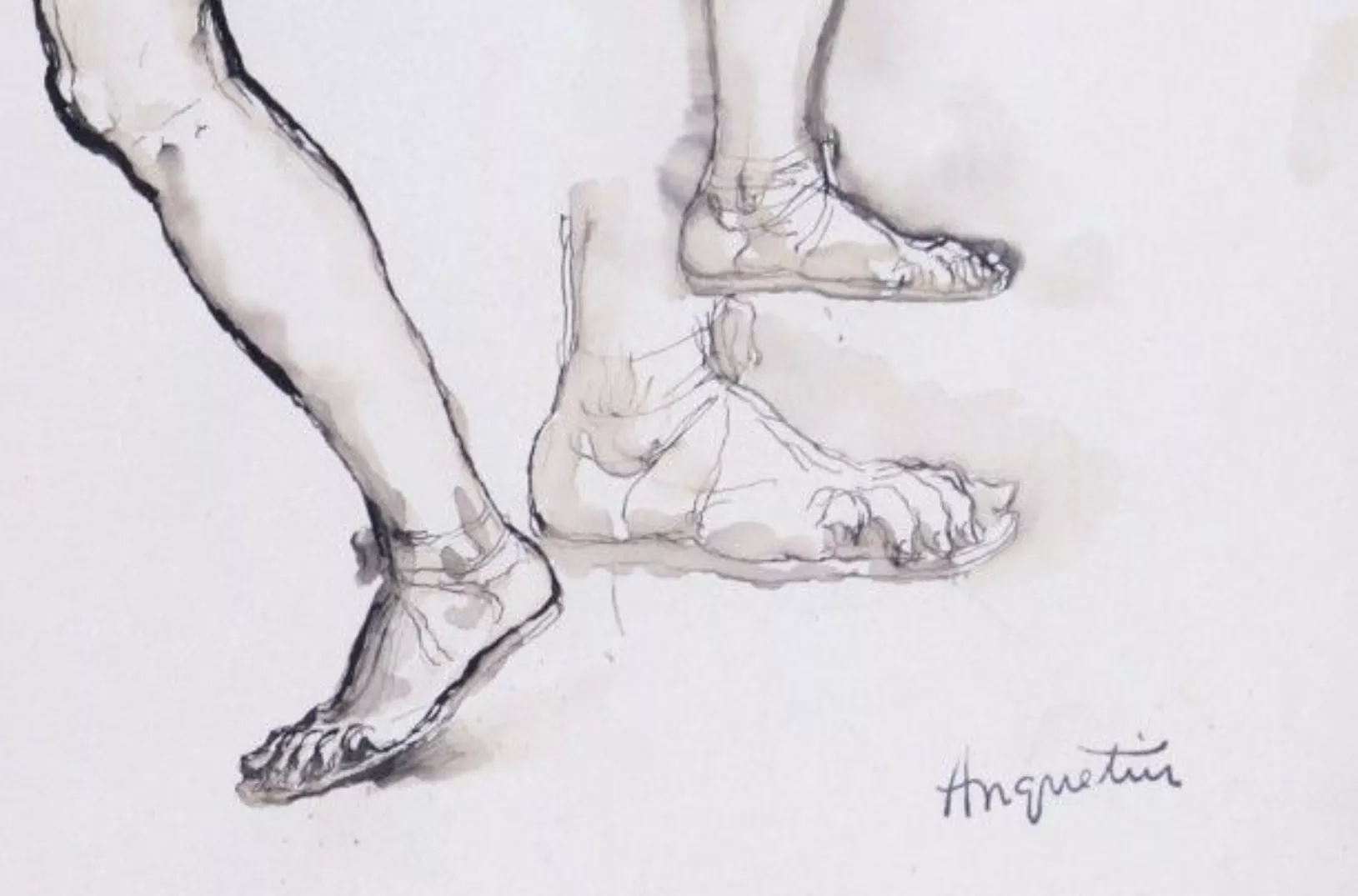
The life of Louis Anquetin
Louis Anquetin was born in 1861 in Étrépagny, Normandy. He grew up in a well-to-do family and was initially destined for an academic career before choosing painting.
In Paris, he joined Léon Bonnat's studio, then Fernand Cormon's, where he made friends with Henri de Toulouse-Lautrec and Émile Bernard. He soon moved away from academic teaching and explored new pictorial paths.
In the 1880s, he took part in the development of cloisonnism, a style distinguished by flat areas of color surrounded by marked lines, influenced by Japanese art and medieval stained glass.
His vibrant canvases seduced the art world and inspired the Nabis, as well as Paul Gauguin, who used them to develop synthetism.
However, as modern art asserted itself, Anquetin made a radical shift. Fascinated by the Old Masters, notably Rubens and Delacroix, he gradually abandoned the avant-garde to devote himself to the study of classical techniques.
This return to the past distanced him from his contemporaries and led to his relative oblivion. In the last decades of his life, he continued to paint and published essays on the history of art, asserting his desire to reconcile tradition and modernity.
He died in 1932 in Paris, leaving behind a paradoxical body of work, somewhere between audacity and conservatism, which bears witness to an artist in perpetual search of the absolute.
.Focus on Le Cabaret du Chat Noir, Louis Anquetin, 1889.
In Le Cabaret du Chat Noir (1889), Louis Anquetin, following in the footsteps of Toulouse-Lautrec, draws inspiration from the nocturnal scenes of Paris.
The work, while part of the Post-Impressionist movement, displays a vivid color palette that contrasts with the scene, where a familiar yet intriguing dynamic plays out.
The artist captures with finesse the effervescent energy of Parisian cabarets at the end of the 19th century, where pleasure, entertainment and the intimacy of the premises mingle.
This painting, almost luminous in its treatment of light, brings out human figures with sharp contours and a fluid atmosphere, where touches of color overlap to create a visual rhythm specific to the world of nightlife.
Anquetin uses strong lines and simplified forms to emphasize the theatrical aspect of the scene, amplifying the sensuality and intensity of the moment captured.
The composition, centered around the main character, a dancer or singer with an illuminated face, evokes both the isolation and singularity of the individual in the crowd.
The details of the costumes, the gestures of the spectators and the iconography of Le Chat Noir recall the specific identity of this cabaret, with its bohemian atmosphere and the creative élan that marked the era.
Anquetin succeeds in transcending the simple portrait of nightlife into a scene where every element vibrates with a particular energy.
The painting thus becomes much more than a simple representation; it captures the essence of an era and a place, while asserting the artist's personal touch, at the crossroads between intense color and stylized forms.
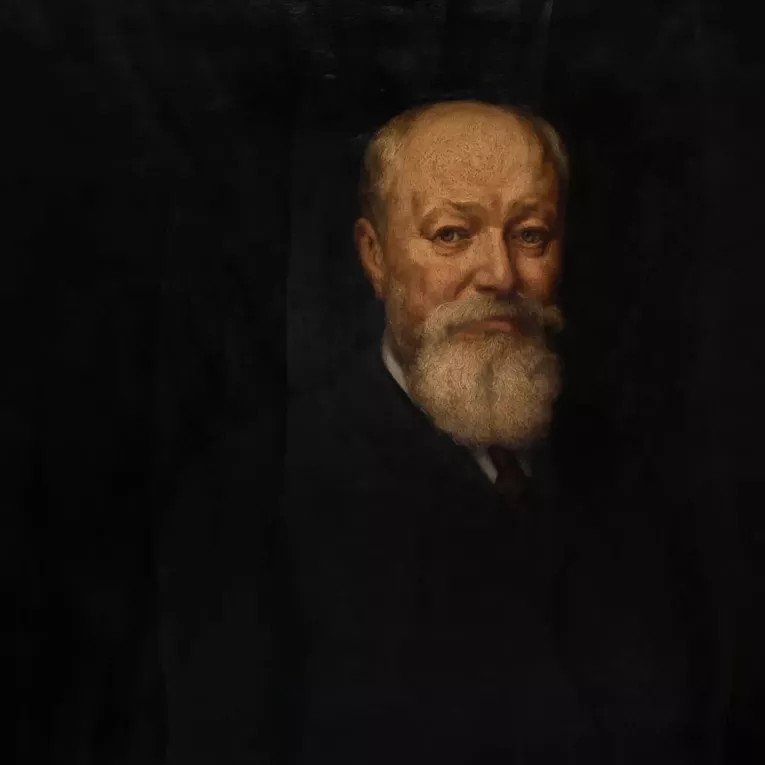
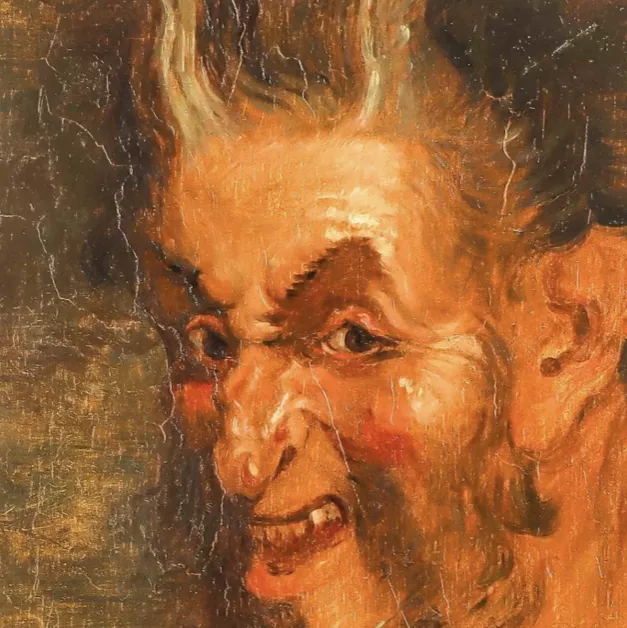
Louis Anquetin's imprint on his period
Louis Anquetin, a key figure at the end of the 19th century, left an indelible mark on the evolution of art through his exploration of themes of urban life, particularly in his cabaret and nightlife scenes.
He was part of an era in which the quest for modernity and more direct representations of reality became essential.
Through his approach, Anquetin brings out a unique visual language that, while remaining rooted in the postimpressionist tradition, frees itself from academic norms to plunge into a more marked abstraction of shapes and colors.
His influence is felt in the way he treats figures, isolating them in sharply defined and structured forms, as if he wanted to freeze the moment while amplifying the personality of his subjects.
This stylistic choice, first observed in scenes of city life, was quickly taken up by his contemporaries, who saw him as a pioneer in capturing the energy of a place and time while highlighting the psychology of individuals.
Anquetin goes beyond the simple social setting to offer a more intimate, almost introspective vision of the society of his time, and does so through works that, although anchored in the moment, carry timeless resonances.
The imprint he leaves is that of a pioneering artist, aware of the visual dynamics of his time, and who manages to respond to them in original ways while enriching the major themes of modern painting.
Today, his works are sought after by many collectors, who play the greatest role in preserving the artist's work since the majority of his paintings and other works are held in private collections.
Louis Anquetin's artistic influences
Louis Anquetin, influenced by several major artistic currents of his time, brings out a unique synthesis that marks his signature in art history.
Trained at the Académie des Beaux-Arts, he nourished his work with the principles of realism and impressionism, but quickly distinguished himself with a more personal and daring approach. His discovery of postimpressionism and the works of Vincent van Gogh and Paul Gauguin led him to explore new ways of using color and line, seeking to convey subjectivity and emotional depth.
These influences, combined with an admiration for the formal research of the Nabis group (Ker Xavier Roussel, Édouard Vuillard...), shape his style. From Toulouse-Lautrec, he retains the use of line and contour, which he adopts to reinforce the visual impact of his scenes of everyday life, particularly those of the Parisian milieu.
However, he is not content with this simple imitation, but seeks to add a personal touch to his repertoire, marked by a search for simplification of form and a gradual abstraction of the human figure.
This blend of influences makes his work an original proposition, which gives pride of place to color and contrast while remaining faithful to a realistic and touching vision of human beings.
Louis Anquetin's art thus goes far beyond mere formal research; he captures the essence of Parisian life with a fresh sensibility.
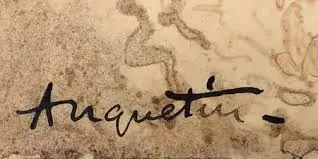
His signature
Not all of Louis Anquetin's works are signed.
Although there are variations, here is a first example of his signature:
Expertise your property
If you own a work by Louis Anquetin, don't hesitate to request a free appraisal by filling in our online form.
A member of our team of experts and certified auctioneers will contact you to provide an estimate of the market value of your Louis Anquetin work.
If you are considering selling your work, our specialists will also guide you through the various alternatives available to obtain the best possible price, taking into account market trends and the specific characteristics of each work.
Estimate in less than 24h
Discover in the same theme

Tableaux Alix Aymé - Value, quotation, artist
Alix Aymé is a 20th-century French artist. Her drawings and paintings are successful and highly prized at auction.
Learn more >

Rating and value of paintings by Paul Aïzpiri
Paul Aïzpiri is a painter of the Paris School who has produced paintings and works of considerable value at auction.
Learn more >

Rating and value of paintings by Jacques Blanchard
Jacques Blanchard is a twentieth-century still-life painter who has produced works that are highly valued at auction.
Learn more >
Works from the same period sold at auction

Estimated 4.000 - 6.000 €
EUGÈNE LEROY (1910-2000), Maison dans un sous bois, oil on canvas mounted on panel.

Estimated 3.000 - 5.000 €
Henri EPSTEIN (1892-1944), Place du sud de la France, Oil on canvas.

Estimated 8000 - 12000 €
Raymond THIBESART (1874-1968) Apple trees in blossom Oil on canvas.

Estimated 1.500 - 2.500
Odilon REDON (1840 - 1916) Ear cell. 1894 Lithograph on china paper applied to vellum

Secure site, anonymity preserved

Auctioneer approved by the State

Free and certified estimates
Frequently asked questions
-
Who is Louis Anquetin, and what is his role in art history?Louis Anquetin (1861–1932) was a leading Post-Impressionist artist who trained in the studios of Léon Bonnat and Fernand Cormon. He co-founded Cloisonnism with Émile Bernard, a style characterized by flat areas of vivid color outlined by bold contours, inspired by Japanese art and medieval stained glass. His works are featured in the world’s greatest museums, such as the Louvre, the National Gallery in London, and the Hermitage in Saint Petersburg.
-
What is the price range for Louis Anquetin's works, depending on the medium?The prices of Louis Anquetin’s works vary depending on the medium used: prints range from €65 to €6,000, drawings and watercolors from €50 to €1,077,300, and oil paintings on canvas from €100 to €1,300,060. Works from his Cloisonnisme period and his portraits of high society are particularly sought after by collectors and command the highest prices.
-
How do I have a work by Louis Anquetin authenticated and appraised?At Auctie's, you can request a free, no-obligation appraisal by filling out our online form. A state-certified expert or auctioneer will contact you to appraise your artwork and provide you with an accurate estimate of its market value within 48 hours.
-
Is this the right time to sell a work by Louis Anquetin?Yes, now is a good time to sell a work by Louis Anquetin. His works remain rare and highly valued in today’s market, with steady interest from collectors around the world. Demand for his cloisonniste compositions and his scenes of Parisian life, in particular, shows no sign of waning.
-
How does the sale of a work of art work at Auctie's?Auctie's guides you from appraisal to auction. After a free evaluation by our experts, we’ll help you choose the sales method best suited to achieving the highest possible price. Our licensed auctioneers manage the entire process, taking into account market trends and the unique characteristics of your artwork.
