



Rating and value of works, paintings, drawings by Vincent Van Gogh

Key takeaways
- Van Gogh's works sell for between €10 and €101.7 million, with the world record set in 2022 for "Orchard with Cypresses" (1888).
- Oil-on-canvas paintings are the most valuable segment (€150 to €101.7 million), while prints range from €10 to €315,000.
- Van Gogh (1853–1890) revolutionized painting through his technical innovation and distinctive use of color, particularly evident in his series of Sunflowers and seascapes.
If you own a work by or after the artist Vincent Van Gogh, and would like to know its value, our state-approved experts and auctioneers will offer you their appraisal services.
Our specialists will work to carry out a free appraisal of your work, and provide you with an accurate estimate of its value on the current market.
Then, if you wish to sell your work, we will direct you to the best possible arrangement to obtain the optimum price.
Rating and value of the artist Vincent Van Gogh
Considered one of the Netherlands' most famous artists, Van Gogh leaves behind an artistic identity of his own. This legacy consists mainly of drawings and paintings.
At present, prices for his works are exploding at auctioneers' gavels, his stock is on the rise.
His canvases and other works are particularly prized, especially by American and English buyers, and the price at which they sell on the art market ranges between €10 and €101,719,000, a considerable delta but one that speaks volumes about the value that can be attributed to Van Vogh's works.
In 2022, an oil on canvas entitled Verger with Cypress, and dating from 1888 sold for €101,719,000, a world record for the artist.
Order of value from a single work to the most prestigious
Technique used | Result |
|---|---|
Estamp | From €10 to €315,000 |
Drawing - watercolor | From €29,880 to €27,069,000 |
Oil on canvas | From €150 to €101,719,000 |
Estimate in less than 24h
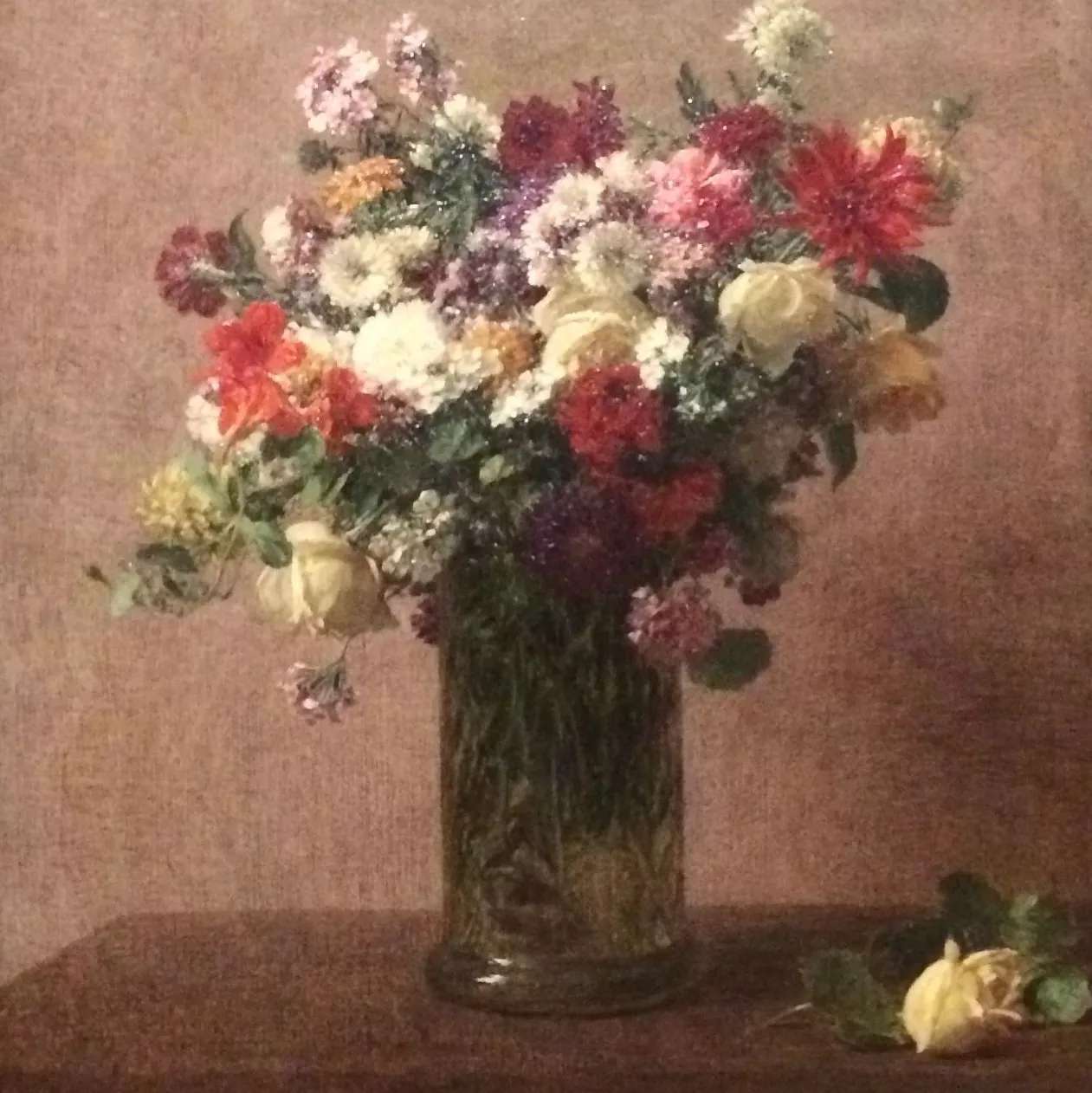
Style and technique of the artist Vincent Van Gogh
Vincent Van Gogh's work spans several movements, but remains predominantly imbued with naturalism.
Impressionist and Pointillist influences are naturally to be found, and characteristics of Fauvism can be discerned, in the use of color and treatment of form.
Vincent Van Gogh, genius between torture and incomprehension
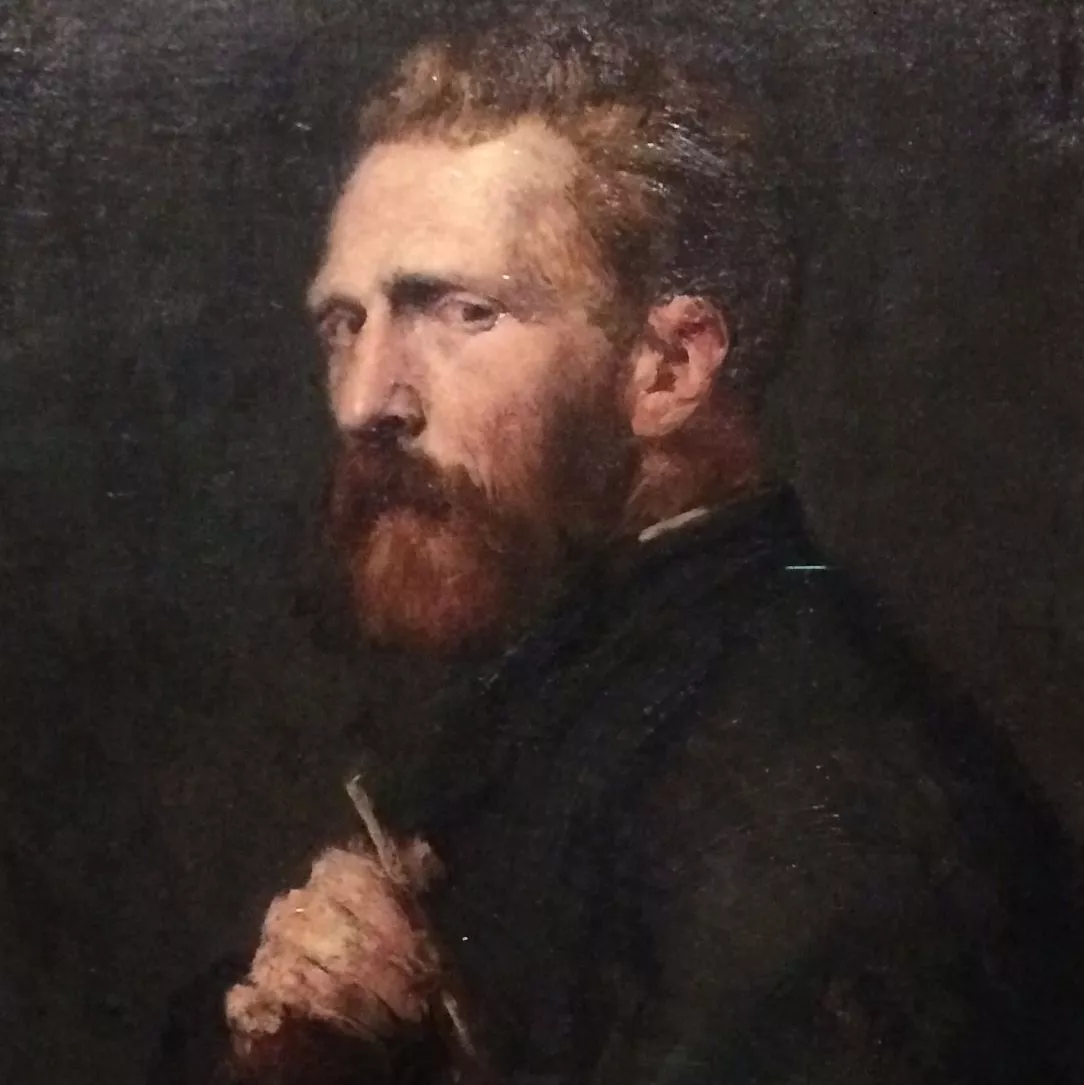
Vincent Van Gogh (1853-1840) was a Dutch painter who had a lasting impact on twentieth-century world art and influenced many artists after him.
His father was a pastor and raised him severely. Like Salvador Dali, he was named identically after his older brother, who was stillborn. He had a younger brother, Theo, who was to be of great importance in his life and work.
His uncle was founder of the Goupil art gallery, which gave him an early foothold in the art world. He works for his uncle in The Hague, Brussels and London.
At the time, he was already very sensitive, and took his failed love affairs very hard. He stopped working for his uncle and became a schoolteacher in London.
Both mystical and spiritual, he turned to religion, totally lost. In the end, painting was his final outlet.
He studied the work of Jean-François Millet extensively, finding in it new pictorial techniques from which he was to draw inspiration. He went on to study Dutch realism, and was inspired by Rubens.
He dislikes learning painting in a school, and quickly decides to join his brother in Paris. He frequents Pissarro, Gauguin, Signac, and the whole group of Parisian artists who will revolutionize painting.
He worked at the Atelier Cormon, where he met Toulouse-Lautrec and Émile Bernard.
He conducted research into color and form, studying Japanese prints. By the 1880s, his canvases were more colorful and softened. This artistic stability was short-lived: bored with Paris, he moved to Arles.
His view of nature and the light to be brought to the canvas in painting changes. Arles is the birthplace of his flower series. Once again, stability is short-lived, and he begs Gauguin to come and join him.
They quarrel violently and he cuts off his ear. He is admitted to an asylum, where he dies a few months later, poor, depressed and disturbed. He will never be conscious of his contribution to painting or of his success.
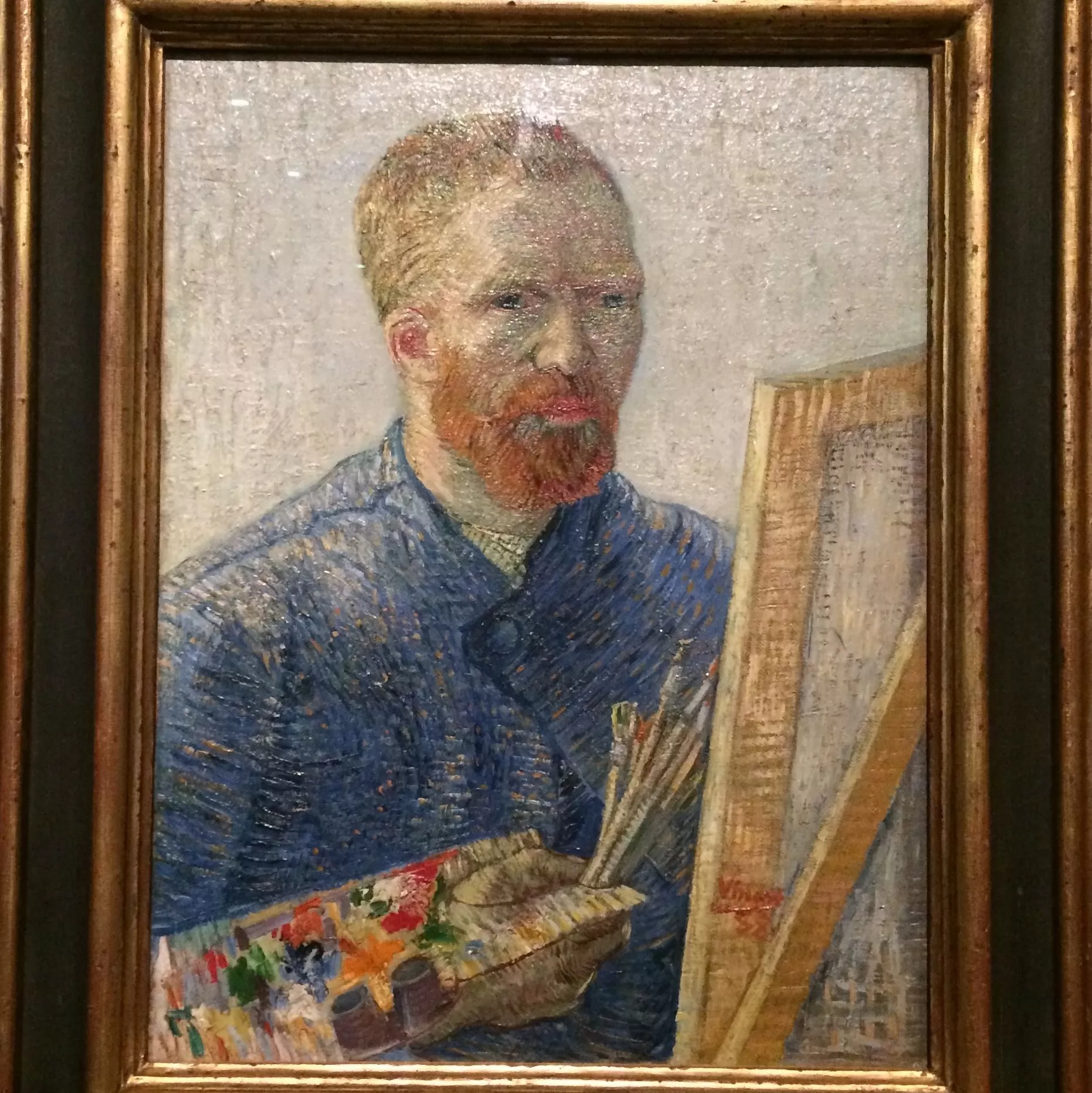
Focus on Van Gogh's marine painting on the cover
In this painting, Vincent van Gogh plunges us into the heart of a rough sea, with his tormented brushstrokes and inimitable sense of texture. The work, probably inspired by his sojourns on the Mediterranean coast, captures all the force and vivacity of the waves.
The thick strokes of blue and green, juxtaposed with bursts of creamy white, capture the incessant movement of the water, its swirls and luminosity, constantly changing under the tumultuous sky.
The small but sturdy sailboats seem almost lost in this liquid immensity, but the intensity of the boats' colors, with their white sails and red and green hulls, anchors them firmly in the composition.
The artist here plays on a strong contrast between the pitiless power of the sea and the tenacity of the fishermen, symbols of the daily struggle against natural forces.
Van Gogh, as usual, uses vibrant, expressive brushstrokes, lending raw emotion to the scene: the sea then becomes more than a landscape, it is a character in its own right, indomitable and fascinating.
The sky, meanwhile, is depicted with equal intensity, the shades of blue almost merging with those of the sea, creating a dynamic unity where the horizon dissolves.
Van Gogh expresses here not only the wild beauty of nature, but also the anxiety, energy and power that emanate from this marine world.
This painting reflects his deep respect for the power of the elements, while highlighting his genius for making visible what often escapes the eye: the emotion hidden in the movement of the waves and the light that glistens on the water.
Van Gogh's imprint on his era
Van Gogh marked his era with the innovation he brought to painting. On every level (pictorial treatment, form, color), he was constantly innovating, unaware of his genius or talent.
The world will remember the technical contribution he made to art. Van Gogh has his own museum in Amsterdam, and many of the world's capitals have already devoted exhibitions and retrospectives to him.
At auction, his works are all the rage every time they are shown, reaching unprecedented records until 2022, when the last world record was recorded for the artist.
Van Gogh's last canvas
Van Gogh's colorimetry
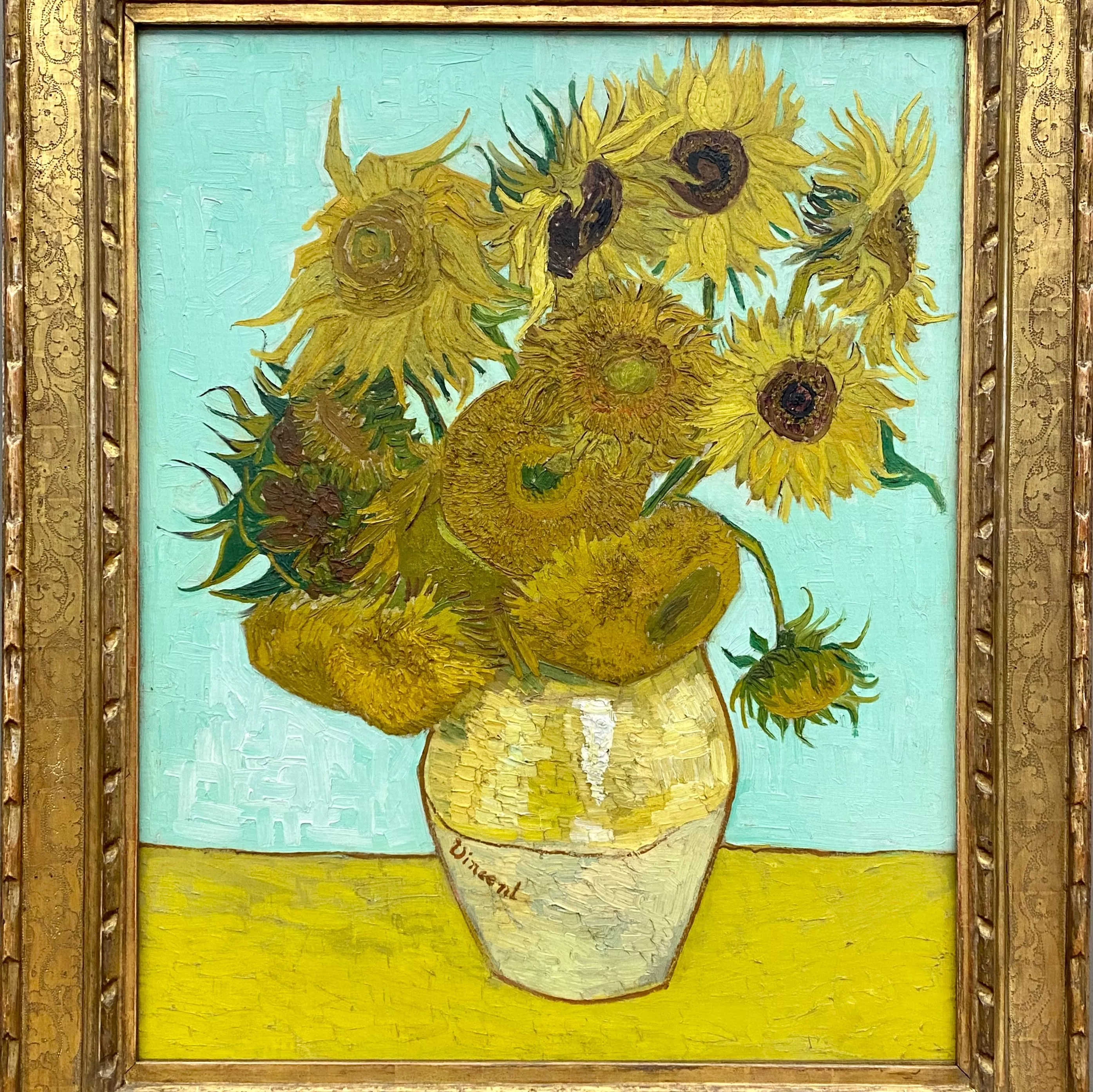
Vincent van Gogh's Sunflowers are undoubtedly among the artist's most emblematic works, where colorimetry plays a fundamental role in expressing emotion and vitality.
In this series of paintings, Van Gogh explores a restricted but intensely vibrant palette, dominated by bright yellows and golden ochres that flood the composition with an almost solar light.
This chromatic choice stems not only from a naturalistic desire to represent the flower, but also from a deeper quest to capture the very essence of life through color.
The omnipresent yellow seems to radiate from within the flowers, symbolizing both light, energy, and a certain sense of warmth.
Each petal and stem is traversed by subtle shades of yellow: from pale lemon yellows to earthier ochres, contrasted by touches of brown or olive green for the flower stems and hearts.
Van Gogh, with his vigorous brushwork, manages to give these colors an intensity that seems to overflow the canvas, creating an almost palpable sensation of summer heat.
The thick texture of the paint, laid down in generous layers, further accentuates the visual impact of this limited palette.
The backgrounds, often pale blue or soft green, serve as a soothing counterpoint to the bright yellow of the flowers.
This subtle contrast highlights the vitality of the sunflowers, while lending the whole a chromatic harmony in which yellow dominates, but never overwhelms the other hues.
Van Gogh has found in this series a way to make the colors sing, one against the other, to create a unique visual melody.
Through this monochromatic exploration, the Sunflowers become much more than floral representations: they embody light, life and the cyclical nature of existence.
Van Gogh's work with color in this work transcends mere observation to achieve an unparalleled emotional and symbolic depth.
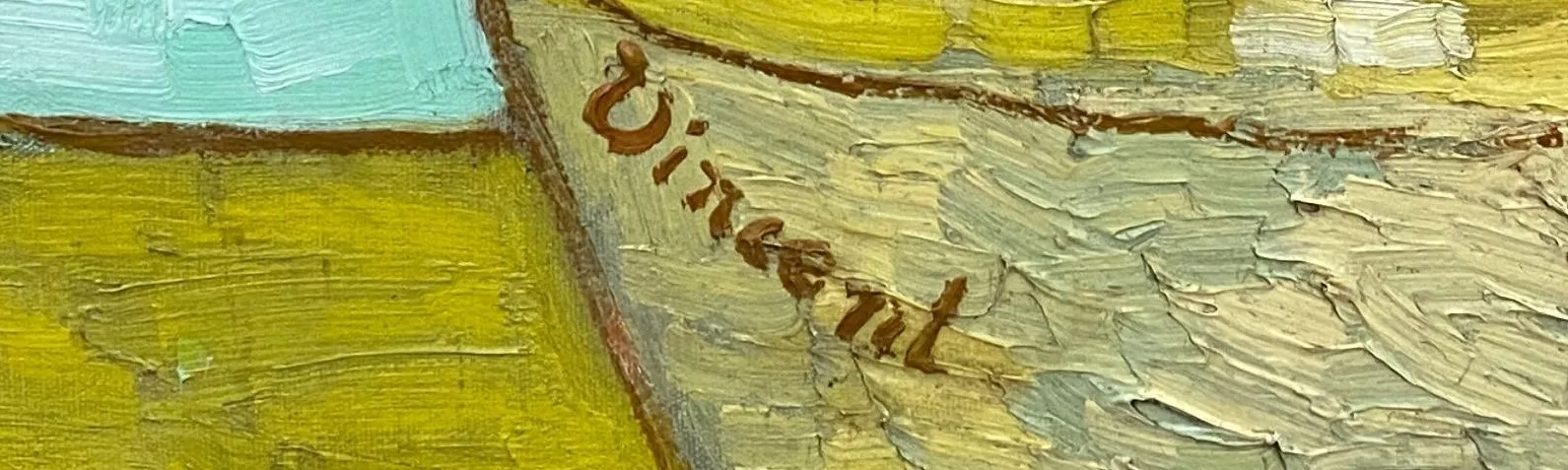
Recognizing the artist's signature
Van Gogh sometimes signs his works, mostly at the bottom of the painting, in a color that contrasts with the background. However, there are many copies, which is why expertise is paramount.
Knowing the value of a work
If you happen to own a work by or after Van Gogh, don't hesitate to request a free valuation using our form on our website.
A member of our team of experts and licensed auctioneers will contact you promptly to provide you with an estimate of the market value of your work, not forgetting to send you ad hoc information about it.
If you are considering selling your work, you will also be accompanied by our specialists in order to benefit from alternatives for selling it at the best possible price, taking into account the inclinations of the market.
Estimate in less than 24h
Works from the same period sold at auction

Estimated 2500 - 5000 €
Henri EPSTEIN (1892-1944), View of the village through the trees, Oil on canvas

Estimated 4.000 - 6.000 €
EUGÈNE LEROY (1910-2000), Maison dans un sous bois, oil on canvas mounted on panel.

Estimated 15.000 - 20.000 €
Jacques MAJORELLE (1886-1962) - Fishermen embarking, Abidjan, Ivory Coast - Oil on canvas.

Estimated 3.000 - 5.000 €
Henri EPSTEIN (1892-1944), Place du sud de la France, Oil on canvas.

Estimated 4.000 - 6.000 €
GASTON CHAISSAC (1910-1964) Composition 1947, Gouache and Indian ink on paper.
Discover in the same theme

Rating and value of paintings by Robert Pinchon
Robert Pinchon is a painter from the Rouen School who produced works that are highly valued at auction. Estimated in 24h.
Learn more >

Cote and value of paintings by Max Moreau
Max Moreau is a twentieth-century Orientalist painter whose paintings are highly valued on the auction market.
Learn more >

Market Value and Price of Etel Adnan's Paintings, Drawings,...
Etel Adnan is a twentieth-century Lebanese abstract artist who has produced many works that are highly regarded and valued.
Learn more >

Secure site, anonymity preserved

Auctioneer approved by the State

Free and certified estimates
Frequently asked questions
-
Who was Vincent van Gogh, and what impact did he have on modern art?Vincent van Gogh (1853–1890) was a Dutch painter who had a profound impact on 20th-century art. A self-taught artist and innovator in his approach to form, color, and painting technique, he influenced countless artists who came after him. Although little recognized during his lifetime, Van Gogh developed a unique style blending naturalism, Impressionism, and Pointillism, with an intensely vibrant palette and expressive brushstrokes that characterize his artistic genius.
-
What is the price range for Van Gogh's works at auction?The prices of Van Gogh's works vary considerably depending on the medium and rarity. Prints range from €10 to €315,000, drawings and watercolors from €29,880 to €27,069,000, and oil paintings on canvas from €150 to €101,719,000. The world record for the artist was set in 2022 with the sale of the painting “Orchard with Cypress Trees” (1888) for €101,719,000, demonstrating strong demand from American and British collectors.
-
How can a work attributed to Van Gogh be authenticated?Authenticating a Van Gogh work is essential, as there are many copies. We recommend taking advantage of our free appraisal service at Auctie’s: a state-certified expert or auctioneer will examine your artwork and provide you with an accurate and reliable estimate. You’ll receive a detailed response within 48 hours, with no obligation on your part.
-
Is this the right time to sell a Van Gogh painting?Yes, this is an excellent time to sell a Van Gogh painting. The artist’s market value is steadily rising; his paintings are all the rage at every auction and regularly set new records. Global demand—particularly from American and British buyers—remains very strong, ensuring an excellent return on your investment.
-
How does the appraisal process work at Auctie's?Appraisals at Auctie's are free and non-binding. Simply fill out our online form with information and photos of your artwork. A member of our team of experts and licensed auctioneers will contact you shortly to provide an estimate of your item’s market value, along with detailed information. If you decide to sell, we’ll guide you through the auction process to help you achieve the best possible price.
