



Rating and value of works, drawings, paintings by Emile Bernard

Key takeaways
- Works by Émile Bernard, a leading figure of Symbolism, sell for between 10€ and 2.7 million euros, depending on the medium and provenance.
- The Synthetist artist’s oil-on-canvas paintings command the highest prices, notably his painting *Bretonnerie*, which sold for over 2 million euros in 2022.
- Bernard developed Cloisonnisme alongside Louis Anquetin, a technique characterized by flat areas of color outlined with thick contours that inspired the Pont-Aven School.
If you own a work by or based on the artist Emile Bernard and would like to know its value, our state-approved experts and auctioneers will guide you.
Our specialists will carry out a free appraisal of your work, and provide you with a precise estimate of its value on the current market.
Then, if you wish to sell your work, we will direct you to the best possible arrangement to obtain the optimum price.
Artist's rating and value
Émile Bernard is an important artist of Symbolism, responsible for a considerable pictorial output. The market value of Émile Bernard's works on the art market is therefore extremely high, particularly for his Symbolist works.
The prices the works fetch on the auction market range from €10 to €2,705,600, a substantial range but one that says a lot about the value that can be attributed to Émile Bernard's work.
A work signed by him can fetch millions of euros at auction, as evidenced by his painting Bretonnerie,which fetched over €2 million in 2022.
Order of value from the most basic to the most prestigious
Technique used | Result |
|---|---|
Estamp | From €10 to €22,790 |
Drawing - watercolor | From €100 to €51,935 |
Oil on canvas | From €300 to €2,705,600 |
Estimate in less than 24h
The artist's style and technique
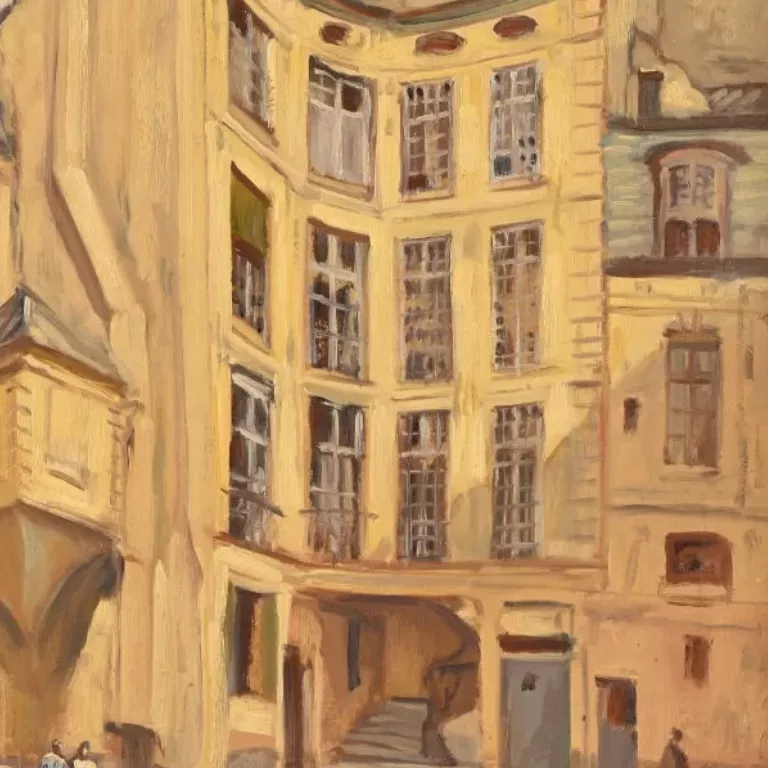
Influenced by synthetism and cloisonnism, Émile Bernard developed an aesthetic in which the simplification of forms and the flatness of colors became fundamental principles.
His works, evoking both the art of medieval stained glass and Japanese prints, are distinguished by a firm outline, which delineates forms by means of marked contours.
This approach, which rejects illusionism and traditional perspective, lends his compositions a singular graphic force, where each element seems inscribed in a space reduced to its strictest organization.
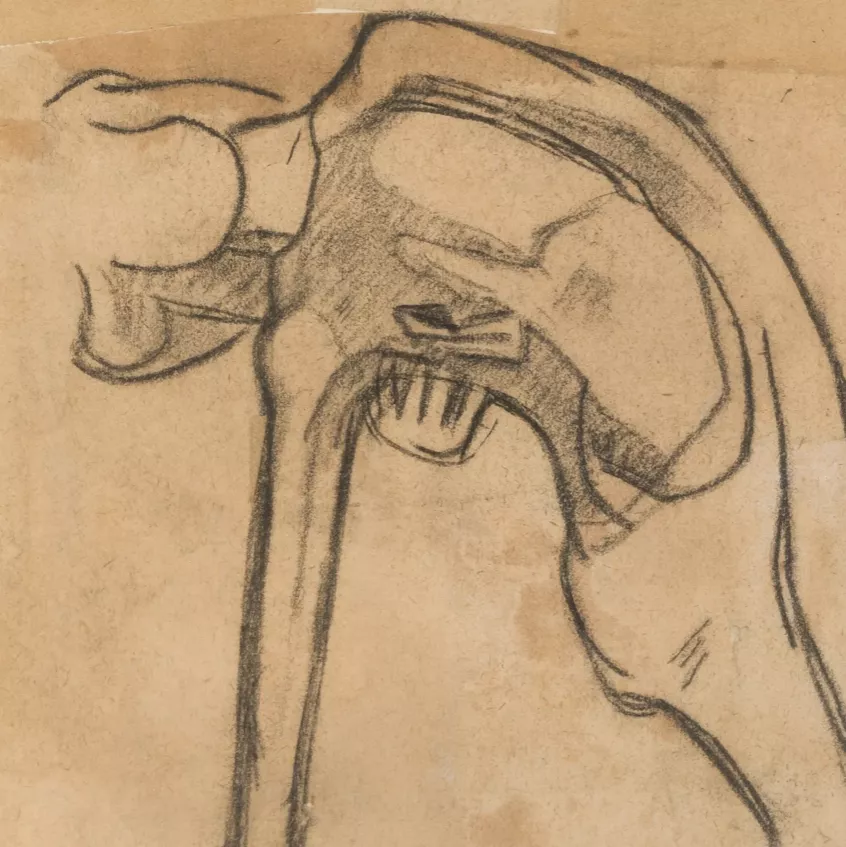
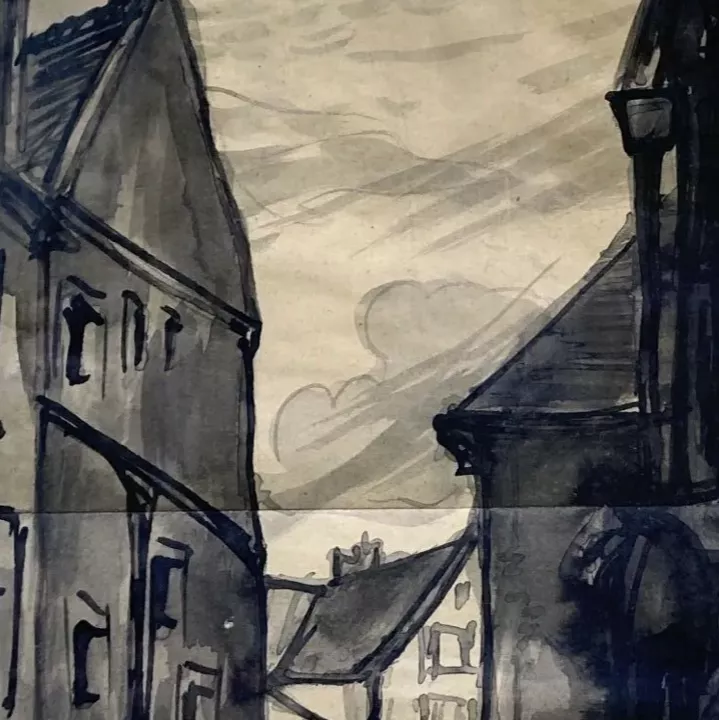
While watercolor on paper remains his technique of choice, Émile Bernard never ceases to experiment, alternating between ink, charcoal and wash, exploring the subtleties of line and contrast.
He seeks to go beyond mimetic rendering to achieve a more interior expression, where color and line suffice to evoke an emotion, an atmosphere.
His bold chromatic choices, in which pure tones are applied in solids, reflect a desire for formal synthesis, reinforced by an absence of modeling and illusionist perspective.
Alongside Paul Gauguin, Émile Bernard established himself as one of the leaders of synthesism. This movement, which broke with Impressionism, is based on an extreme stylization of motif: space is abolished, shapes are deliberately schematized, and color becomes a structuring element rather than a simple descriptive tool.
His palette, dominated by deep greens, is accompanied by vibrant yellows, powerful reds and dense blues, applied without gradation, according to a decorative logic.
In this quest for purity, he synthesized his compositions to the point of retaining only the essential, abandoning superfluous detail in favor of immediate legibility.
This radical approach endowed his work with a synthetic power that would have a lasting influence on the avant-gardes of the twentieth century.
Through his work on color and line, Bernard thus laid the foundations of a pictorial modernity that, far from being confined to post-impressionism, already heralded certain Fauvist and Expressionist research.
The life of Émile Bernard
Émile Bernard (1868-1941) began his studies at the École des Arts Décoratifs, before joining Fernand Cormon's studio at the age of sixteen, a key training ground for many avant-garde artists.
There he met Henri de Toulouse-Lautrec and Louis Anquetin, with whom he shares a fascination for pictorial experimentation. However, his rebellious temperament and refusal to conform to academic teachings earned him an expulsion after just two years.
This event marked a turning point: he left Paris and embarked on an initiatory journey on foot through Normandy and Brittany, stopping at Pont-Aven where he met Paul Gauguin.
This meeting, decisive for his artistic development, shortly preceded that of Vincent van Gogh, who influenced his transition to pointillism, a period in which he focused on the optical decomposition of light through small, juxtaposed strokes.
Rapidly, Bernard turned away from pointillism in favor of a more synthetic approach. Working alongside Louis Anquetin, he developed cloisonnisme, a style characterized by broad flat tints of color surrounded by thick outlines, reminiscent of medieval enamels and Japanese prints.
This new aesthetic, at odds with Impressionism, found a particular echo in Pont-Aven, where it had a profound influence on Paul Gauguin.
Together, they refined the principles of synthetism, which aimed to express a simplified, decorative vision of reality, emphasizing flatness, stylization and the subjectivity of color.
In 1891, Bernard abruptly broke with Gauguin, accusing him of appropriating the aesthetic discoveries they had jointly developed. This conflict marked the end of their collaboration and precipitated a turning point in his career.
In 1893, he left France to settle in Egypt, where he remained for a decade. Fascinated by the Orient, he devoted himself to orientalist painting, less studied today than his synthesist works, but which testifies to an in-depth research into light and composition.
This period, marked by a warmer palette and genre scenes imbued with a reinterpreted exoticism, is still little known to the general public.
Returning to France in 1904, Bernard sought to renew his pictorial language and drew closer to Paul Cézanne, whose influence encouraged him to adopt a more structured approach to form.
He gradually abandoned modernism in favor of a classicism inspired by the Italian primitives and the great Venetian masters of the Renaissance.
His taste for art history is also expressed in his passion for the Middle Ages, which led him to undertake the restoration of a medieval manor house in Brittany.
This fascination with medieval aesthetics is reflected in his work, notably through the use of frontal compositions, ornamental motifs and sharply contoured drawing, echoing the art of illumination and stained glass.
Between rupture and reinvention, Bernard crosses currents without ever becoming trapped in them, retaining an independence that makes him a singular figure of pictorial modernity.
Focus on Les bretonnes dans la prairie, Émile Bernard
Les Bretonnes dans la prairie perfectly illustrates Émile Bernard's innovative approach. Here, the artist applies the technique of cloisonnisme, which he developed with Louis Anquetin, and which is characterized by flat areas of color surrounded by dark outlines.
This process, inspired by medieval enamels and Japanese prints, marks a break with Impressionism by rejecting modeling and illusionist perspective.
On the canvas, young women in Breton headdresses sit in a meadow of bold hues, where the bright green of the grasses contrasts with a sky of softer shades. Bernard does not seek to capture the changing effects of light, but to structure his space through color and line.
Far from a realistic description, the scene is intended to be synthetic, almost decorative. The absence of superfluous detail and the stylization of the figures give the whole a graphic force that will profoundly influence the Pont-Aven School and emerging symbolism.
Through this work, Bernard asserts himself as one of the pioneers of a new painting, where the simplification of forms and the primacy of color redefine the codes of pictorial language.
Emile Bernard's imprint on his period
Émile Bernard established himself as a key figure in the avant-gardes of the late 19th century, at the crossroads of the currents that redefined modern painting.
His role in the emergence of cloisonnism and synthesism had a lasting influence on the development of post-impressionist art, notably through his association with Paul Gauguin and the Pont-Aven school.
By breaking with illusionist representation and imposing a more decorative, stylized approach, he paved the way for a redefinition of pictorial language that found an echo in Art Nouveau and, later, in certain Fauvist experiments.
While his theoretical and aesthetic contribution is sometimes overshadowed by that of Gauguin, he remains a precursor, whose simplification of forms and expressive power of color heralded the research of modern art.
His influence extends beyond the field of painting: his writings on art, his correspondence with Van Gogh and Cézanne, and his quest for a renewed classicism make him a bridge between tradition and modernity.
Today, his work remains an essential milestone for understanding the transition between the end of Symbolism and the emergence of the twentieth-century avant-gardes.
His signature
Although there are variations, here's a first example of his signature:

Expertise your property
If you happen to own a work by or after Émile Bernard, don't hesitate to request a free appraisal by filling in our form on our website.
A member of our team, made up of experts and certified auctioneers, will contact you promptly to provide you with an estimate of the value of your work, and will ensure that you receive ad hoc information about it.
If you are planning to sell your work, you will also be accompanied by our specialists in order to benefit from alternatives for selling it at the best possible price, taking into account the inclinations of the market and its specificities.
Estimate in less than 24h
Discover in the same theme

Rating and value of statues, bronzes and marbles by Pierre T...
Pierre Travers is a 20th-century sculptor who has produced works in marble and bronze that are sought-after and quoted on the auction market.
Learn more >

Rating and value of paintings by Joaquin Torres Garcia
Joaquin Torres Garcia is a cubist and surrealist artist from the École de Paris who produced works that are highly rated and have a high value at auct...
Learn more >

Rating and value of paintings by Carla Accardi
Learn more >
Works from the same period sold at auction

Estimated 4.000 - 6.000 €
EUGÈNE LEROY (1910-2000), Maison dans un sous bois, oil on canvas mounted on panel.

Estimated 10.000 - 15.000 €
Ebridge Ayer BURBANK(1858-1949), Young African-American boy, Oil on panel.

Estimated 3.000 - 5.000 €
Henri EPSTEIN (1892-1944), Place du sud de la France, Oil on canvas.

Estimated 3000-5000€
Alexandre Roubtzoff, Gammarth (small format)

Estimated 100-200€
Vassiliew Slavik, Oil on canvas

Estimated 1.000 - 2.000
Moïse KISLING (1891-1953) Portrait of a woman turning around Ink drawing

Secure site, anonymity preserved

Auctioneer approved by the State

Free and certified estimates
Frequently asked questions
-
Who was Émile Bernard, and what is his role in art history?Émile Bernard (1868–1941) was a leading Symbolist artist and, alongside Paul Gauguin, a co-founder of Cloisonnism and Synthetism. A key figure in the avant-garde movements of the late 19th century, he revolutionized painting by rejecting Impressionism in favor of simplified forms, flat colors, and a new form of expressiveness, exerting a lasting influence on Art Nouveau and the Fauvist movements.
-
What is the price range for Émile Bernard's works at auction?The market value of Émile Bernard’s works varies considerably depending on the medium and period: prints range from €10 to €22,790, drawings and watercolors from €100 to €51,935, and oil paintings on canvas from €300 to over €2.7 million, as evidenced by the sale of his painting *Bretonnerie* for over €2 million in 2022.
-
How can I have a work by Émile Bernard authenticated and find out its value?To authenticate and appraise a work by Émile Bernard, we invite you to request a free, no-obligation estimate using our online form. An expert or certified auctioneer from our team will contact you shortly to provide you with an accurate assessment of your item’s value in today’s market.
-
What are the main characteristics of Émile Bernard's style?Émile Bernard’s style is characterized by Cloisonnism and Synthetism: flat areas of pure color outlined by sharp contours, an absence of modeling and illusionistic perspective, and influences from medieval stained glass and Japanese prints. This radical approach prioritizes the simplification of forms, graphic structure, and emotional expression over realistic representation.
-
How do I sell a work by Émile Bernard through Auctie's?Auctie's guides you from the appraisal stage through to the auction to ensure your artwork sells for the best possible price. Following a free appraisal by our certified experts, we offer you the best options tailored to your item, taking into account the specific conditions of the current market and ensuring that you achieve the best possible sale price.
