



Rating and value of Raymond Duchamp-Villon's works and sculptures

Key takeaways
- Works by Raymond Duchamp-Villon, a French Cubist sculptor (1876–1918), sell for between €60 and €140,000, with some sculptures fetching as much as €1.42 million.
- His sculpture *Femme assise* (1914) exceeded its estimate of €130,000–175,000, selling for €1.42 million in 2002, illustrating its potential for appreciation.
- Duchamp-Villon revolutionized Cubist sculpture by emphasizing geometric abstraction and the dynamic expression of movement, particularly in *Le Cheval majeur* (1914).
If you own a work by Raymond Duchamp-Villon or after, and would like to know its value, our state-approved experts and auctioneers will offer you their appraisal services.
Our specialists will work to carry out a free appraisal of your work, and provide you with an accurate estimate of its value on the current market.
Then, should you wish to sell your work, we will direct you to the best possible arrangement to obtain the optimum price.
Raymond Duchamp-Villon's works rating and value
Raymond Duchamp-Villon is a French cubist sculptor. If you own a piece by the artist, it may be worth more than you think. On the art market, prices for these works can be very high at the auctioneer's hammer.
His paintings are particularly prized, and the price at which his works sell on the art market ranges from €60 to €140,000, a fairly substantial range, but one that says a lot about the value that can be attributed to Duchamp-Villon's works.
In 2002, his bronze sculpture entitled Sitting Woman, dating from 1914, sold for €1,420,000 while it was estimated at €130,000 to €175,000.
Order of value from a simple work to the most prestigious
Technique used | Result |
|---|---|
Estamp - multiple | From 20 to 200€ |
Painting | From 400 to 900€ |
Drawing - watercolor | From 800 to 13 300€ |
Sculpture- volume | From €650 to €1,420,250 |
Estimate in less than 24h
Style and technique of artist Raymond-Duchamp Villon
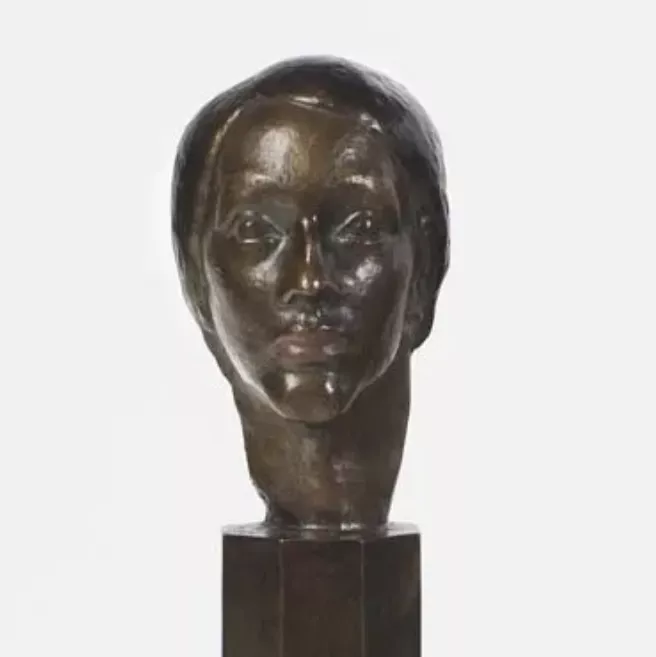
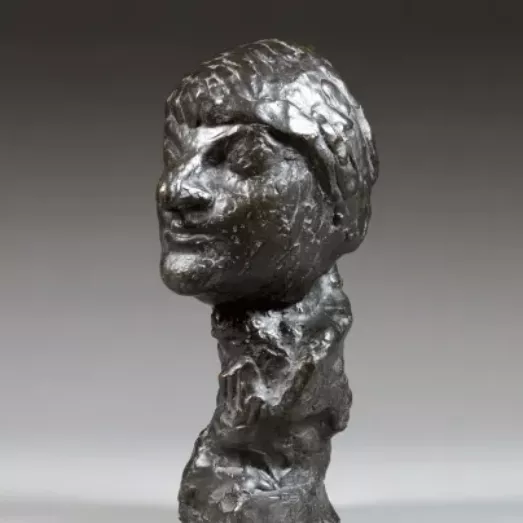
In Raymond Duchamp-Villon, style and technique proceed from a rigorous synthesis where classical statuary confronts the dynamics of cubism.
Trained as a sculptor in a spirit still imbued with naturalism, he gradually detached himself from it through contact with the plastic research carried out by his brother Jacques Villon and the artists of the Section d'Or.
From 1910, his volumes became purer, the form more geometric, and the influence of Rodin gave way to an architectonic construction close to Cézanne principles.
In Le Cheval majeur (1914, Musée national d'art moderne, Paris), the internal structure of movement takes precedence over anatomy: the figure, broken down into angular planes, translates less a physical representation than the energy contained in the mechanical momentum.
Direct carving and taut modeling give his works an almost industrial rigor, while the surface, stripped of all superfluous effects, emphasizes the articulation of masses in space.
Duchamp-Villon does not seek to freeze reality, but to extract a dynamic essence from it, where forms, reduced to relationships of force and tension, dialogue with abstraction without ever renouncing an organic reading of the subject.
Through this balance between geometric simplification and internal vitality, his work is part of the sculptural mutation of the early twentieth century, foreshadowing the later developments of Constructivism and Futurism through its analytical conception of volume.
The career of Raymond Duchamp-Villon
In Raymond Duchamp-Villon's case, the trajectory takes shape in the effervescence of the avant-gardes of the early XXᵉ century, between family roots and formal breaks.
Born in 1876 in Damville, he belongs to a sibling family devoted to plastic innovation: Jacques Villon explores the paths of Cubism, Marcel Duchamp challenges the conventions of art with his ready-mades.
Destined for medicine, he interrupts his studies due to illness and turns to sculpture, where he soon applies an analytical rigor close to Cézannean principles.
Settled in Puteaux, from 1911 he took part in meetings of the Section d'Or group, where a new conception of space and volume was forged.
While his early works still bear witness to a naturalism inherited from Rodin, he gradually refined a plastic syntax in which geometric decomposition became structural.
His involvement in the First World War, brutally interrupting this research, precipitated a premature end: suffering from typhoid fever, he died in 1918 at the age of 42.
His work, though brief, establishes itself as an essential link in the transition between classical sculpture and modernist forms, influencing both the developments of sculptural cubism and the constructivist experiments of the following decades.
Focus on Le Cheval majeur, Raymond Duchamp-Villon
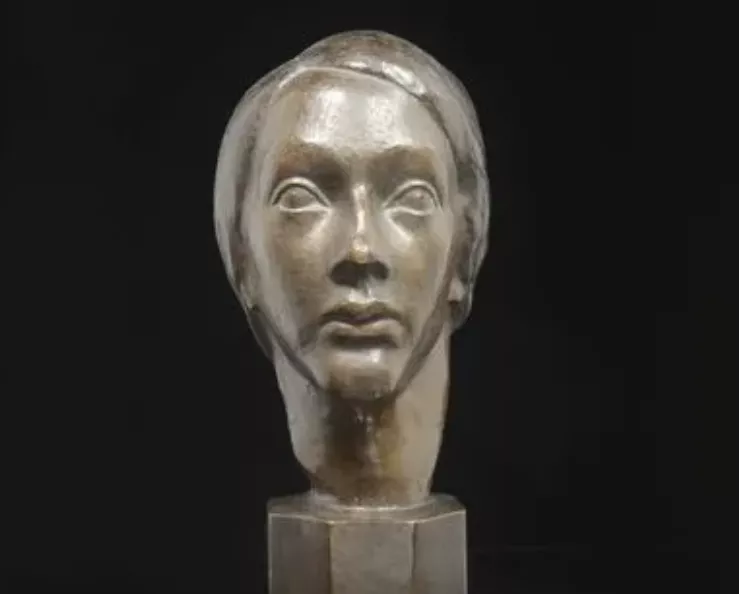
In Le Cheval majeur (1914, Musée national d'art moderne, Paris), Raymond Duchamp-Villon deploys a sculptural exploration in which the dynamics of movement become paramount, far beyond the simple anatomical representation of the horse.
Through an arrangement of rigid, angular planes, the work breaks down the horse's momentum not in its physical form, but in its internal structure, as if the animal's energy, ordinarily invisible, were materialized in the form of intertwined volumes.
The living model here gives way to a geometric abstraction, but far from a cold simplification, Duchamp-Villon seems to capture the essence of animality in an architecture of movement.
The tension between the different planes that make up the animal body echoes Cubist research, but also an almost mechanistic vision of nature, where anatomy is transcended in a plastic quest for pure energy.
The work thus bears witness to a major turning point in sculpture, where form becomes above all a vector of dynamic expression, a compromise between the rational analysis of matter and the raw instinct of movement.
In this way, Le Cheval majeur stands as a megaphone for Cubism in sculpture, while heralding the later preoccupations of Futurism, where time and space merge into a single vital pulse.
Raymond Duchamp-Villon's imprint on his period
Raymond Duchamp-Villon's imprint on his period emerges as a direct response to the artists' obsession with the deconstruction of form, typical of the early XXᵉ century avant-garde.
Through his radical sculptural approach, he helped redefine Cubist sculpture, often perceived until then as a form of painting transferred into three dimensions.
Freeing himself from the classical rules of representation, he applied to sculpture a methodology that favored geometrization and the analysis of movement, the latter being particularly evident in his major works such as Le Cheval majeur.
The tension between abstract forms and their evocation of animality or movement testifies to a refusal of academic immobilism, paving the way for a sculpture more oriented towards dynamic, energetic expression.
Duchamp-Villon thus forges a bridge between Cubism and Futurism, giving rise to an innovative sculptural language where volumes are no longer fixed but in perpetual transformation.
His legacy continues in the sculptural experiments of the interwar period, and his reflection on volume and movement exerts a marked influence on subsequent generations, most notably in the development of Constructivism and abstract sculpture.
In this way, Duchamp-Villon became one of the artisans of plastic modernity, embodying the idea that sculpture should not only represent reality, but explore its many invisible dimensions.
The stylistic influences of Raymond Duchamp-Villon
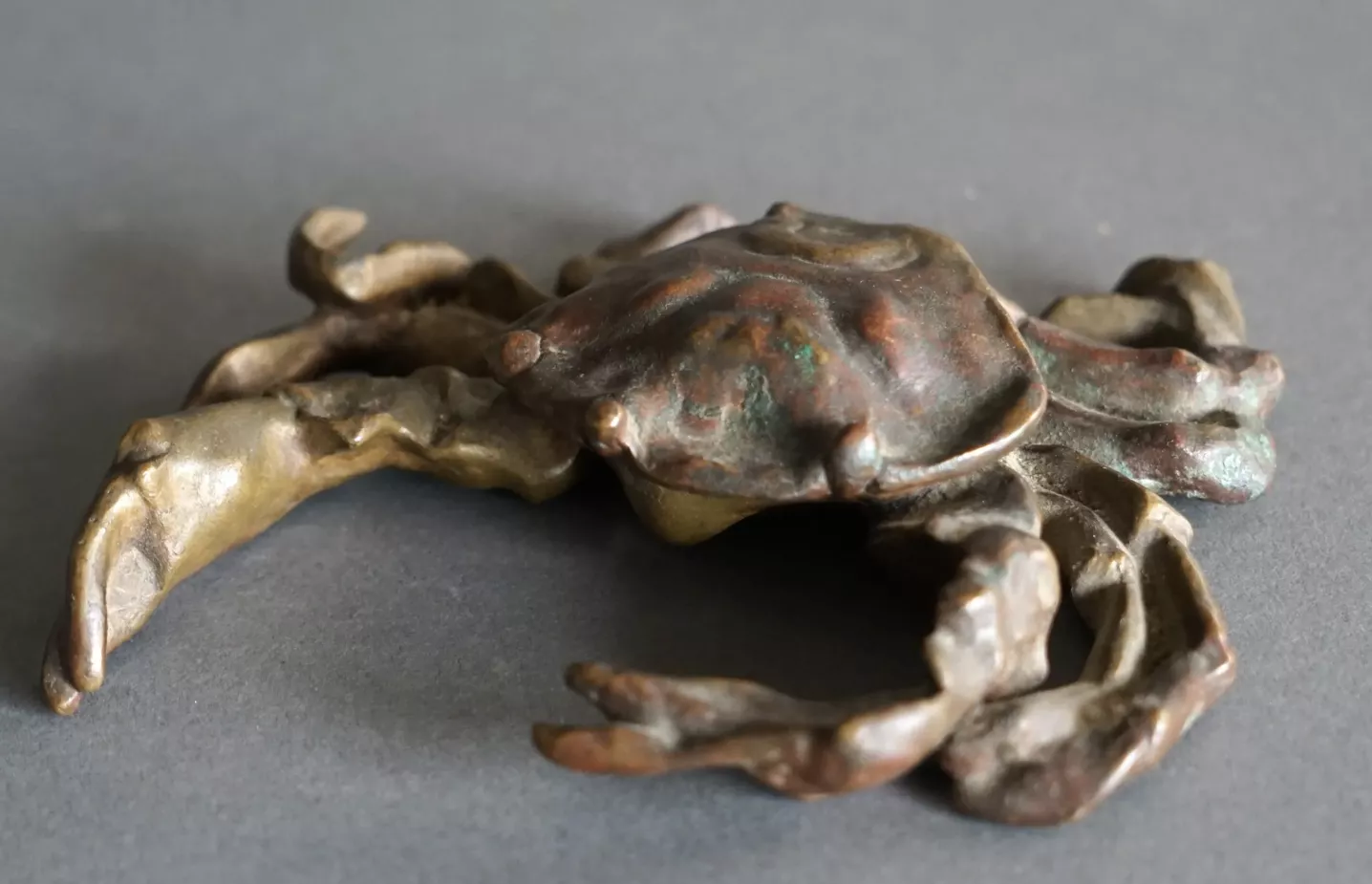
The stylistic influences of Raymond Duchamp-Villon on his period unfold in a subtle confrontation between classical traditions and the radical innovations of cubism.
His sculpture, marked by a search for geometric abstraction, bears witness to the impregnation of the plastic reflections of his brother, Jacques Villon, and the contributions of the Section d'Or, but gradually freed himself from the formal dictates of academic figuration.
Through works such as Le Cheval majeur, Duchamp-Villon integrates the Cubist principles of deconstruction of space and fragmentation of volumes, while accentuating their dynamic aspect, as if form were in perpetual evolution.
This dialogue with geometric forms and the abstraction of movement is enriched by the impact of Rodin and "art nouveau" in his quest for a synthesis between movement and structure.
Moreover, the Futurist period seems to have nurtured his desire to impart an energetic, vital dimension to his sculptures, a desire to translate the very essence of movement through matter.
His resolutely innovative sculptural practice also draws on the logic of machine and mechanics, characteristic of the early XXᵉ century, anticipating concepts that would feed constructivist research.
Through this tension between abstraction and figuration, and through his use of dynamic geometry and decomposed volumes, Duchamp-Villon pioneered a plastic revolution that would profoundly affect the sculptural currents of modernism.
Recognizing Raymond Duchamp-Villon's signature
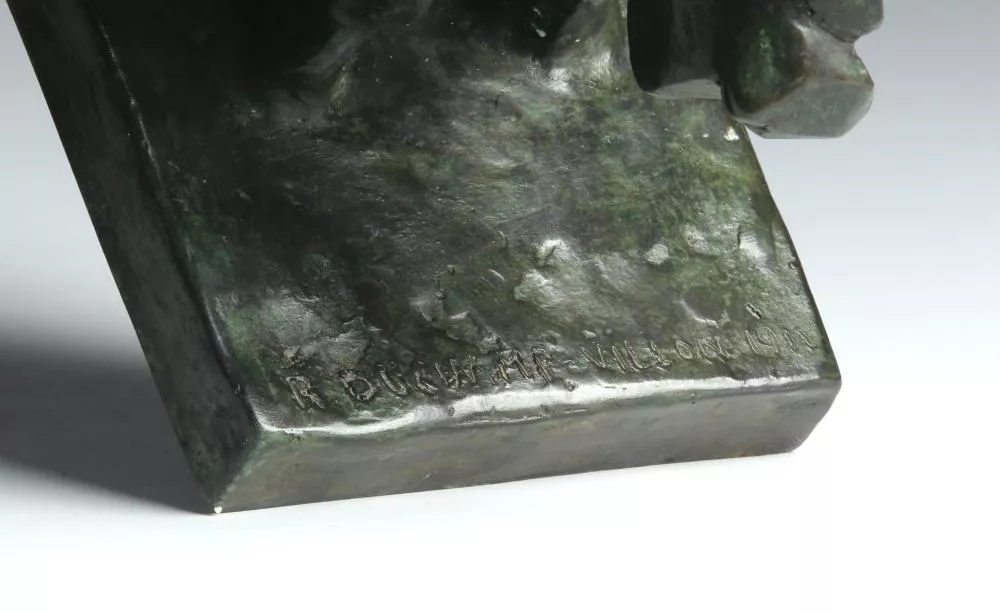
The artist signs his works in most cases. However, expertise is essential to ensure that your work is authentic. Here's an example of his signature :
Knowing the value of a work
If you happen to own a work by or after Raymond Duchamp-Villon, don't hesitate to request a free valuation using our form on our website.
A member of our team of experts and chartered auctioneers will contact you promptly to provide you with an estimate of the market value of your work, not forgetting to send you ad hoc information about it.
If you're thinking of selling your work, our specialists will also help you find alternatives to sell it at the best possible price, taking into account market trends.
Estimate in less than 24h
Discover in the same theme

Rating and value of Gio Ponti furniture, tables and armchair...
Gio Ponti is a modern Italian designer who has produced highly-rated works of art that are highly valued on the auction market.
Learn more >

Rating and value of paintings by Othon Coubine
Othon Coubine is a twentieth-century Fauvist painter who produced paintings that are highly valued at auction. 24-hour estimate!
Learn more >

Rating and value of paintings by Theo van Doesburg
Theo van Doesburg is an abstract painter of neoplasticism who produced works that are highly rated and valued at auction.
Learn more >
D'autres bronzes modernes vendus aux enchères

Estimated Between €2,000 and €4,000
Edouard Marcel SANDOZ (1881-1971) curly stingray, bronze print

Estimated Between €1,500 and €3,000
Renato CARVILLANI (1896-1986), seated woman, gilded bronze print

Estimated Between €1,500 and €3,000
César BALDACCINI dit CESAR (1921-1998), Poule Cartier, bronze print

Estimated Between €10,000 and €20,000
Baltasar LOBO (1910-1993), female nude in bronze

Estimated 5.000 - 8.000
Igor MITORAJ (1944-2014), Bust of Asclepius, Green patina bronze sculpture

Secure site, anonymity preserved

Auctioneer approved by the State

Free and certified estimates
Frequently asked questions
-
Who was Raymond Duchamp-Villon, and what is his role in the history of sculpture?Raymond Duchamp-Villon (1876–1918) was a French Cubist sculptor and a member of the Duchamp-Villon family, alongside Jacques Villon and Marcel Duchamp. He emerged as a key figure in the transition from classical sculpture to modernism, developing an innovative approach in which geometrization and the analysis of movement became structural elements. His brief but influential body of work laid the foundations for Cubism in sculpture and foreshadowed developments in Constructivism and Futurism.
-
What is the price range for works by Raymond Duchamp-Villon on the market?Prices for works by Duchamp-Villon vary considerably depending on the medium and provenance. Print multiples range from 20 to 200 €, paintings between €400 and €900, watercolor drawings between €800 and €13,300, and three-dimensional sculptures between €650 and €1,420,250. The remarkable example of the sculpture “Seated Woman” (1914), sold in 2002 for 1,420,000 €, illustrates the potential of the artist’s major works.
-
How do you authenticate a work by Raymond Duchamp-Villon?Authenticating a work by Duchamp-Villon requires professional expertise. Auctie's offers you a free, no-obligation appraisal by its state-certified auctioneers and experts, who will examine the work and provide you with a detailed evaluation within 48 hours. The artist signs most of his works, but only a qualified appraisal can confirm their authenticity and establish their provenance.
-
Is this the right time to sell a work by Duchamp-Villon?Yes, this is an excellent time to sell a work by Duchamp-Villon. The market for Cubist and early 20th-century avant-garde sculpture remains dynamic, with sustained demand for authenticated pieces with established provenance. The widespread interest in the pioneers of modern art ensures optimal visibility and potentially attractive auction results.
-
How does the process of selling a work of art at Auctie's work?Auctie's supports sellers from the free appraisal through to the auction. Once you submit your request, an expert will contact you within 48 hours to appraise your artwork and discuss the best options for selling it. Our specialists will then advise you on the strategy best suited to your sculpture or painting to ensure you get the best possible price at auction.
