



Rating and value of Jacques Villon's works

Key takeaways
- Jacques Villon (1875–1963), founder of the Section d'Or, has seen his market value skyrocket since the 2000s, establishing him as a safe bet on the international art market.
- His Cubist and abstract paintings are his most sought-after works, with prices ranging from €30 to €945,300 depending on technique and quality.
- *L'Acrobate* (1913) sold for €945,000 at Sotheby’s in 2004, far exceeding its estimate of €411,000 to €575,400.
Considered one of the most important theorists of his time, Jacques Villon (1875-1963) is the founder of the Section d'Or. His price fluctuates but remains high overall on the auction market, with his works attracting special interest from collectors.
If you own a work by or based on the artist Jacques Villon and would like to know its value, our state-approved experts and auctioneers will guide you.
Our specialists will carry out a free appraisal of your work, and provide you with a precise estimate of its value on the current market. Then, if you wish to sell your work, we'll guide you towards the best possible arrangement to obtain the best possible price.
Artist's rating and value
A versatile artist with a focus on synthetic cubism, Jacques Villon is a painter and printmaker who is highly regarded on the art market. Since the 2000s, his price has exploded, making him a sure thing on the international market, and he is highly prized by both French and American buyers.
Villon's most sought-after works are his cubist and abstract canvases.
His predominantly red Cubist composition L'Acrobate, dating from 1913, sold for €945,000 in 2004 at Sotheby's, while it was estimated at between €411,000 and €575,400.
Order of value from the most basic to the most prestigious
Technique used | Result |
|---|---|
Lithography | From €10 to €3,000 |
Drawing - watercolor | From €50 to €75,370 |
Estamp | From 5 to 175 110 € |
Painting | From 30 to 945 300 € |
Estimate in less than 24h
Style of Jacques Villon
Villon had a very complex start to his career. Introduced to engraving by his grandfather, he first worked as a newspaper illustrator, producing a few caricatures. In Montmartre, he rubbed shoulders with some of the Cubists, but soon moved away from this school to settle in Puteaux, because, as he himself said, he was not productive.
As he continued his work as an illustrator, he developed a unique style characterized by strong mathematical influences. Drawing on the theories of Leonardo and Fibonacci, as well as established scientific principles such as the Golden Number, he constructed his own system of logic.
Villon's style was now complete. The space of the painting becomes the color-space of shadow, but without dirt, always through transparencies, and always a central plane hinges, and when this central plane becomes shadow, everything changes, everything has to start again.
Thanks to his research, Villon manages to make a distinction between light-color and tube-color, testifying to his perfect mastery of the color wheel :
" Not only are tube-color different from light-color, but there's a difference at all in the way tube-color and light-color behave towards each other.
So, for example, once I've set the very first tone, which is taken from the local tone, I don't know what colors will follow. It's not up to me to choose them.
It's the color wheel that will tell me, because the color wheel on which the shades of light and their nuances are perfectly ordered, is calculated in such a way as to be able to indicate how these shades unite with each other.
So, when I've taken, with the color wheel, the two colors that go next to my first tone, I only have to repeat the same operation.
First I take one of these two colors, then the other, and each, according to its place on the color wheel, calls up two new colors on the canvas.
By proceeding in this way, all the colors come to be placed in the painting according to their interference in the light, and the surface covered by each of them depends on the arrangement of the planes in relation to the light source.
There are always different planes, aren't there, one plane that moves forward, another that follows it, a third that is further away.... On the canvas they overlap, but it's always their intersections that reveal them and assign each color a precise place. "
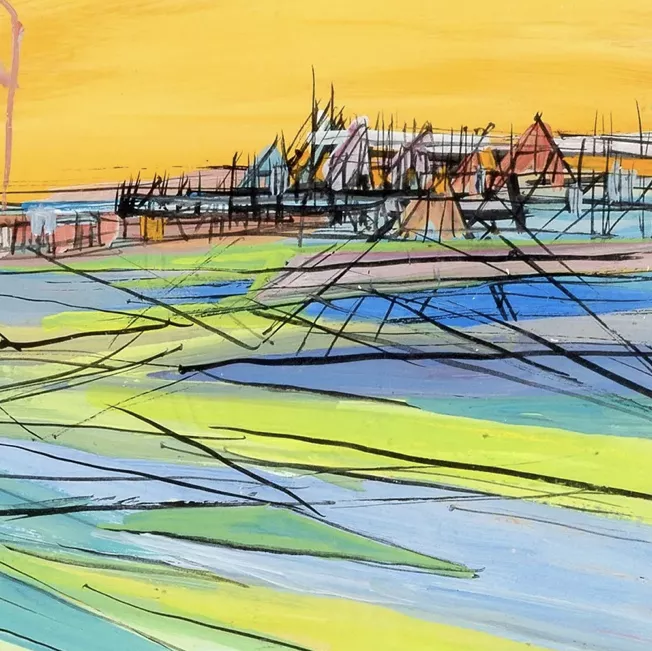
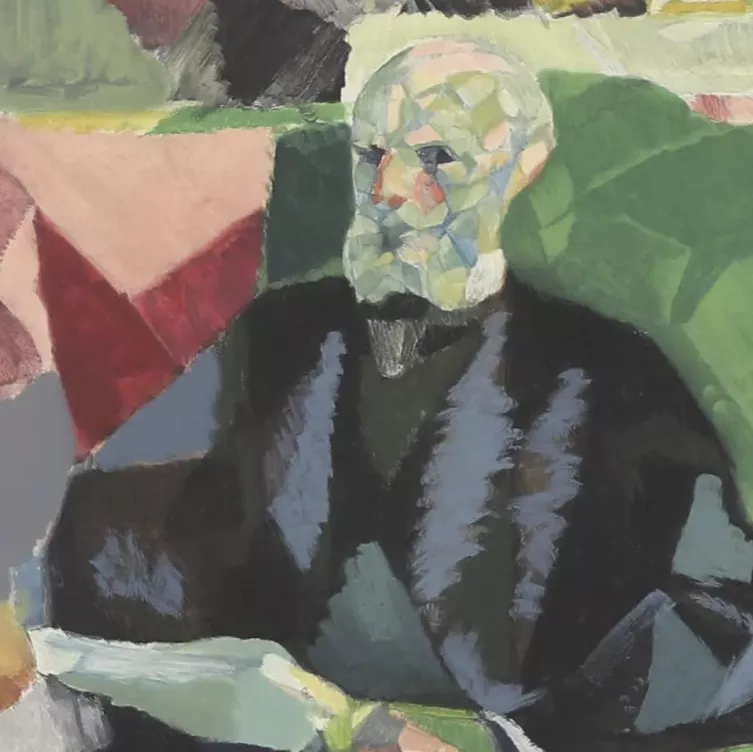
Jacques Villon's creative process
Starting with two intertwined geometric planes, Villon builds his canvas by adding a superimposition of triangular shapes - leading to a three-dimensional composition.
By first adding the first and second planes, adding his pyramidal vision and multiplying the whole by the infinity of lines of force, the artist obtains his three-dimensional composition.
Thus, by stretching the forms and superimposing the varied cut-outs, there is a clear move away from brilliant, descriptive semantics towards the description of a mechanical force, far superior to the spiritual force of internal organic tensions to be found in the Cubists of the time.
The use of this double semantics (that of etching and that of the avant-gardes) enables a particularly accurate and pertinent analysis of the artist's work, which stands in contrast to the almost expressionist reading of form that took place during the interwar period.
Then light, the key to understanding the artist's entire production, light that is no longer concrete but perfectly metaphysical poses numerous problems. It is no longer defined as an effect that might impose itself on the viewer, but as a structuring function of the work.
Villon starts with a single tone, and having never yielded to the temptation of monochromy, links color and light with the help of the chromatic circle.
Once he has set the first tone, he systematically uses the chromatic circle to find out which colors will follow. Villon would say " it's not up to me to choose them ". By understanding and analyzing this systematic recourse to this procedure, we come to the conclusion that color becomes an assigned weight.
For Villon, the painting is a recreation of the thing seen. His work is governed by a desire to return to order; chance has no place. The masses of color fragment into facets thanks to the regulating strokes, and the drawing becomes the conclusion of the painting.
The whole purely creative and gestural process enables the synthesis of movement to be expressed through a certain continuity, rather than obtaining a movement broken down into successive leaps.
Villon and etching
First trained in etching, then influenced by Henri de Toulouse-Lautrec in his early years and the making of press drawings, not by choice but by necessity, Villon really found himself from the 1900s onwards, experimenting with different ideas in etching and then painting.
Contrary to Picasso, who started from primitive art, or Braque, who questioned the distribution of space in the painting from the paintings of Cézanne, Villon entered Cubism from etching. The hatching specific to this medium led him to a concept that would structure the whole of his work : the mechanization of the stroke.
Villon thus joined the major issues that were being raised in philosophy across the Atlantic in the same years by art historians such as Goodman or Gombricht.
The latter, particularly in the context of the upheavals associated with the New York avant-garde, posed numerous problems concerning the viewer's visual reception and the status of the work of art.
Vallier explains how Jacques Villon used cubism as a research lever to solve problems that have always occupied the history of art: how to construct a canvas, how to attract the viewer's eye, and above all to understand what happens during the viewer's visual reception. Engraving will greatly help him in this process.
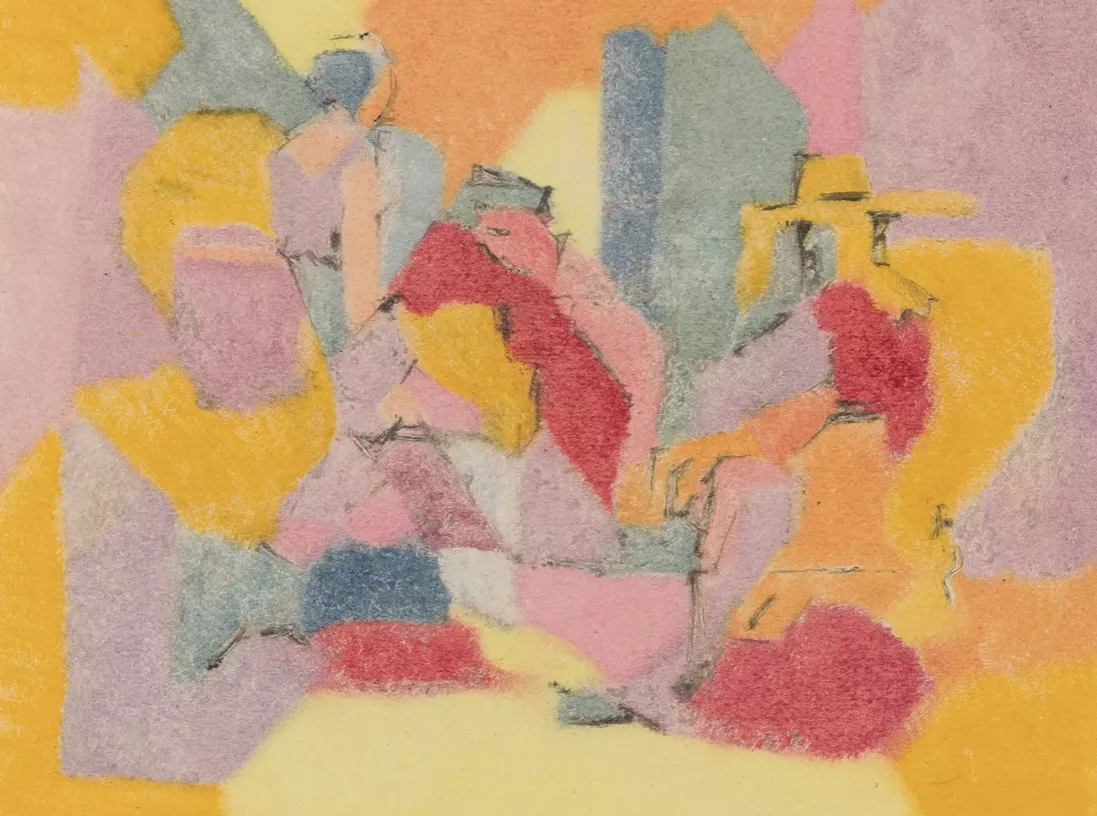
The historiography of Cubism in the twentieth century
The historiography of Cubism in the twentieth century turns out to be rather complex and peculiar, since from the outset it was a movement in the throes of change, constantly innovating, and whose leading artists did not necessarily agree on its principles.
In fact, beyond the oppositions between artists, two schools clashed : that of Montmartre, which included Pablo Picasso and Georges Braque, today the best-known works of French Cubism -
and that of Puteaux, which included artists such as Gleizes, Kupka, Metzinger, Picabia and Jacques Villon. Otherwise known as the Golden Section Group, under Villon's influence, in reference to the golden ratio.
The Puteaux school was fairly marginalized on the French and international scene, crushed by the glory of Picasso and the genius of Braque, which imposed itself on art historians - the latter thus setting himself up as a major precursor and theoretician of the cubist movement.
Some art historians, however, such as Jean Adhémar, Jean Révol (who went on to write a book revealing the similarities between Braque and Villon) and also Dora Vallier, were keen to study the context of Cubism by placing the two schools in tension.
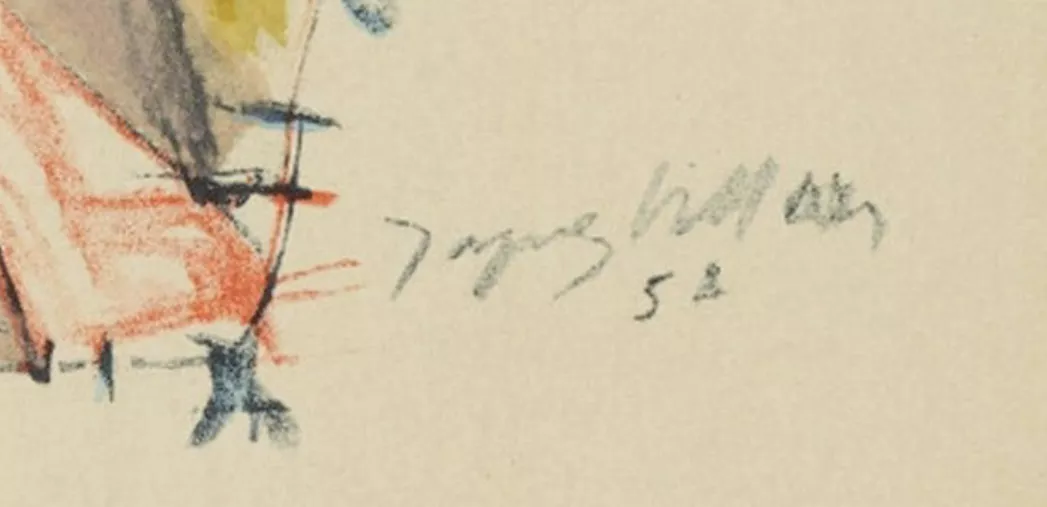
His signature
Not all of Jacques Villon's works are signed. Moreover, there are many copies : that's why expertise is important.
Expertise your property
If you own a work by Jacques Villon, don't hesitate to request a free appraisal by filling in our online form.
A member of our team of experts and certified auctioneers will contact you to provide an estimate of the market value of your work.
If you are considering selling your work, our specialists will also guide you through the various alternatives available to obtain the best possible price, taking into account market trends and the specific features of each work.
Estimate in less than 24h
Discover in the same theme

Estimate and auction your Camille Fauré vases and other Limo...
Pieces by Camille Fauré often fetch high prices at auction. The work of Emaux de Limoges justifies it!
Learn more >

Ratings and values of paintings by Alberto Savinio
Alberto Savinio is a twentieth-century Italian surrealist painter whose paintings are highly prized at auction.
Learn more >

Rating and value of paintings by Jacques Monory
Jacques Monory is a painter and sculptor of narrative figuration who has produced many works of great value.
Learn more >
D'autres tableaux abstraits vendus aux enchères

Estimated 2.000 - 4.000
Serge POLIAKOFF (1900-1969), Composition en rouge et bleu. 1965, Lithograph

Estimated Between €5,000 and €8,000
Jean MIOTTE (1926-2016), acrylic on canvas

Estimated 3.000 - 5.000
Roberto MATTA (1911-2002), Composition, Gouache on canvas

Secure site, anonymity preserved

Auctioneer approved by the State

Free and certified estimates
Frequently asked questions
-
Who is Jacques Villon, and what is his role in art history?Jacques Villon (1875–1963) was a French painter and printmaker considered one of the most important theorists of his time and the founder of the Section d'Or. A versatile artist of Synthetic Cubism, he distinguished himself through an innovative approach based on mathematical and scientific principles—notably the Golden Ratio and Fibonacci’s theories—which underpin his entire body of work.
-
What is the current market value of Jacques Villon's engravings and lithographs?Jacques Villon’s lithographs are priced between €10 and €3,000, while his prints range from €5 to €175,110. His works are particularly sought after by collectors, and his market value has skyrocketed since the 2000s, establishing him as a safe bet on the international market and making him highly prized by French and American buyers.
-
How can you authenticate a work by Jacques Villon and verify its authenticity?Since many of Villon’s works are unsigned and there are numerous copies, expert appraisal is essential. Auctie's offers a free, no-obligation appraisal: a certified expert or auctioneer will examine your artwork and provide you with an accurate estimate within 48 hours, guaranteeing the authentication and professional valuation of your item.
-
Is this the right time to sell a work by Jacques Villon?Yes, now is a good time to sell a work by Villon. Since the 2000s, his market value has been rising and remains generally high on the auction market, with sustained interest from French and international collectors. The market for his engravings and lithographs offers good prospects for appreciation.
-
How does the sale of a work of art work at Auctie's?Auctie's supports sellers from the appraisal stage through to the auction. After a free, no-obligation appraisal by our experts and certified auctioneers, we’ll guide you toward the most appropriate approach to achieve the best possible price. Our specialists will guide you, taking into account market trends and the unique characteristics of your artwork.
