



Rating and value of works, paintings, drawings by Paul Cézanne

Key takeaways
- Prices for Cézanne’s works vary considerably, ranging from €10 to €119.7 million, with values currently on the rise in the art market.
- Paintings command the highest estimates (€800 to €119.7 million), while prints are less expensive (€10 to €58,910).
- Cézanne (1839–1908) is recognized as a pioneer of Cubism and Post-Impressionism, having decisively influenced 20th-century art.
If you own a work by or after the artist Paul Cézanne, and would like to know its value, our state-approved experts and auctioneers will offer you their appraisal services.
Our specialists will carry out a free appraisal of your work, and provide you with a precise estimate of its value on the current market.
Then, if you wish to sell your work, we will direct you to the best possible arrangement to obtain the optimum price.
Rating and value of the artist Paul Cézanne
Considered one of the most versatile contemporary artists of the 20th century, Paul Cézanne leaves behind an artistic identity of his own. This legacy consists mainly of oils on canvas.
At present, prices for his works are rising at auctioneers' gavels, his stock is on the rise.
His canvases and other works are particularly prized, especially by French buyers, and the price at which they sell on the art market ranges between €10 and €119,669,400, a considerable delta but one that speaks volumes about the value that can be attributed to Paul Cézanne's works.
In 2022, a polychrome composition entitled La montagne Sainte Victoire, and dating from 1890 sold for €119,669,400.
Order of value from a simple work to the most prestigious
Technique used | Result |
|---|---|
Estamp | From €10 to €58,910 |
Drawing - watercolor | From 60 to 20,971,260€ |
Painting | From 800 to 119,669,400€ |
Estimate in less than 24h
Style and technique of the artist Paul Cézanne
Paul Cézanne is a member of the Impressionist movement, which gave impetus to Post-Impressionism as well as Cubism. In fact, the first phase of Cubism bears his name.
A pioneering and visionary artist, he leaves an absolutely considerable legacy throughout twentieth-century art, as he single-handedly represents theImpressionist break of 1910 that would allow new currents to blossom, including Cubism around the same years.
His role in the emergence of Cubism is quite colossal, since he was the first to understand the modern issues of the division of space and the plastic economy of the painting.
Paul Cézanne, his life, his work
Paul Cézanne (1839 - 1908) was a French painter from Aix en Provence. Originally from Aix-en-Provence, more precisely from Cesana, the genealogy established by art dealer Ambroise Vollard shows that he is of Aix origin for at least four generations.
The product of an illegitimate union, Cézanne grew up in a very modest environment and studied at the Collège Bourbon in Aix-en-Provence, where he met Émile Zola. At the same time, he took classes at the town's art school.
Cézanne then chose to study law, again in the same town. He had already won prizes for his paintings, and decided to stop his studies to move to Paris and continue painting. He failed the Beaux-Arts entrance exam.
After returning to Provence, he managed to work as a copyist at the Louvre and then at the Charles Suisse Academy, which really launched his career, as he met Camille Pissarro, Auguste Renoir, Alfred Sisley, and many others.
He met and married a model called Hortense, with whom he had a son. During his childhood, he had to go into hiding several times, being refractory to military service. They lived partly in Auvers-sur-Oise, and he painted many portraits of his wife.
The First Impressionist Exhibition took place in 1874, and Cézanne was already part of the group. He then moved to Pontoise, where he collaborated with Camille Pissarro. During this period, he worked on the motif and aerial perspective.
He juxtaposed colors and developed the chiaroscuro technique. He then had a studio built near Aix-en-Provence, and was admitted to the Salon at the same time. He creates a cycle of paintings on La Montagne Sainte Victoire, which becomes one of his most famous and prized.
In 1889, he takes part in the Exposition Universelle and the value of his paintings increases. In order to produce more, he painted in the favorite locations of his Impressionist colleagues, namely Barbizon and Giverny.
Bolstered by the experiments he was able to carry out in painting, he was the inspiration for an essay by Paul Signac entitled De Delacroix au néo-impressionnisme, in which he sheds light on the new techniques of divisionnism and pointillism, among others.
From 1903, he took the painter Charles Camoin under his wing, and a long correspondence was established between the two artists.
At the end of his career, an entire room was devoted to him at the Salon d'Automne. Suffering from severe migraines, he was forced to slow down his rate of production at the end of his life and career.
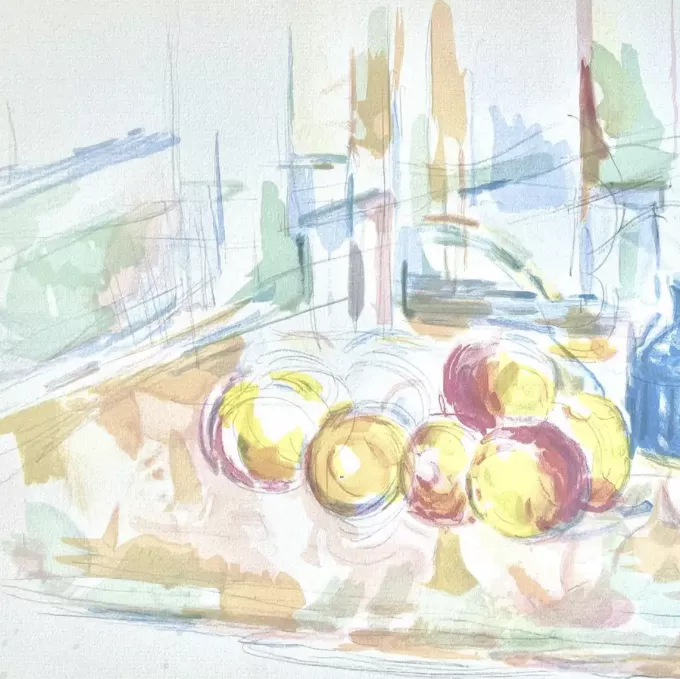
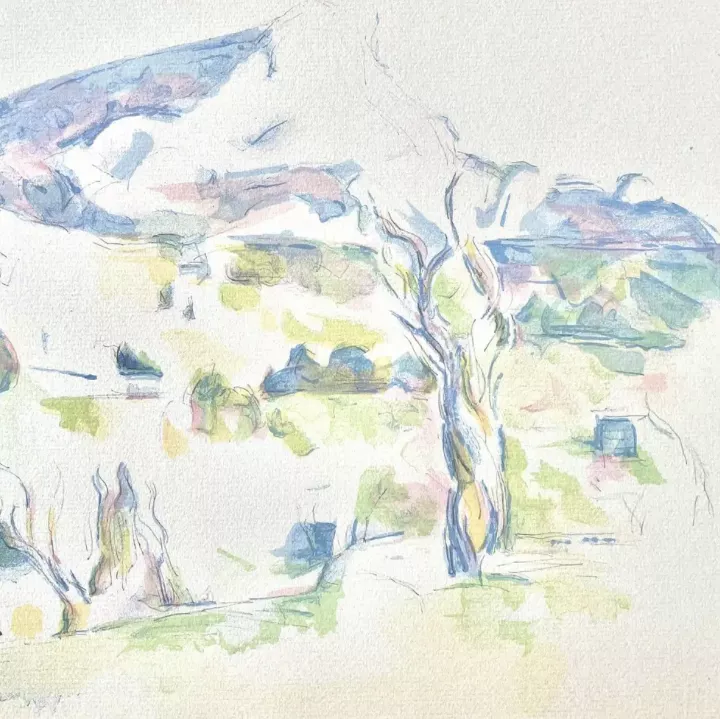
Understanding Cézanne's role in cubism
In the second half of the 19th century, a new artistic movement emerged in France, rapidly capturing the public's attention: impressionism.
This movement, of which Claude Monet became the emblematic figure, attracted many artists, but one name in particular stood out: Paul Cézanne.
Cézanne, while establishing himself as one of the masters of Impressionism with his numerous canvases, also emerged as a precursor of the artistic movements to come. He laid the foundations not only for Post-Impressionism, but also for Cubism, two currents closely linked by their conceptual evolution.
Post-Impressionism, which took off around 1910, encompasses a diversity of techniques and styles, ranging from Symbolism to Pointillism, via Synthetism and the Nabis group. This name was mainly intended to mark the transition from Impressionism, which critics and theorists were beginning to consider outdated.
However, long before 1910, Cézanne had already begun to question the artistic conventions of his time.
In Gardanne (1885), he moved away from the faithful representation of reality, introducing geometric forms and disrupting perspective. These innovations form the first foundations of cubism.
Cézanne continues this exploration in La montagne Sainte-Victoire vue de la carrière Bibemus (1897), where his reflections deepen: geometric shapes become more blurred, and perspectives are even more radically challenged.
The first phase of Cubism, known as Cézanne, took place between 1908 and 1910. Initiated by Picasso and Braque, it built on the foundations laid by Cézanne. Their aim was to free the canvas from the constraints of realism by treating volumes in unconventional ways, challenging the perceptual process.
This deconstruction culminated in Analytical Cubism (1910-1912), a phase of intense experimentation that pushed Braque and Picasso to verge on abstraction.
However, it was by reintegrating the different strata of reality and reinterpreting the relationship of being to the world that the third phase of Cubism, Synthetic Cubism, saw the light of day.
More aesthetically pleasing and accessible, this current attracted other artists such as Juan Gris, who went on to collaborate with Braque and Picasso.
Jacques Villon, although not the instigator, immersed himself in the study of these different phases. He focuses on one particular aspect of this artistic revolution: the stroke, its mechanization, and the softness he wishes to infuse into the facture of his works.
How Cézanne reinvented painting
Paul Cézanne's imprint on his period
Paul Cézanne leaves behind an artistic legacy that quite obviously transforms the landscape of modern art. He traversed his era, starting from Impressionism to become a precursor and visionary.
Cézanne was not content to follow the conventions of the day. He embarked on a deeper exploration, which led him to anticipate future movements, notably postimpressionism and cubism, two closely related currents.
Cézanne is often considered a pioneer of cubism, long before the term was formally used.
In works such as Gardanne (1885), he began to challenge the traditional representation of reality, introducing geometric shapes and disrupting perspective.
This questioning of classical representation is one of the foundations of Cubism.
His thinking continues in La montagne Sainte-Victoire vue de la carrière Bibemus (1897), where his ideas mature: forms become more fluid, planes more unstable. It was these innovations that would inspire artists like Picasso and Braque, who would take up the experimental elements given by Cézanne to give birth to cubism.
Today, Cézanne is widely recognized as one of the fathers of modern art. His influence endures, not only through the works he left behind, but also thanks to private collectors who play an essential role in preserving his work.
In addition, exhibitions are regularly organized on the artist's work or on those who were influenced by him. Many of his works are also permanently preserved in museums, making the public aware of his importance in the history of art.
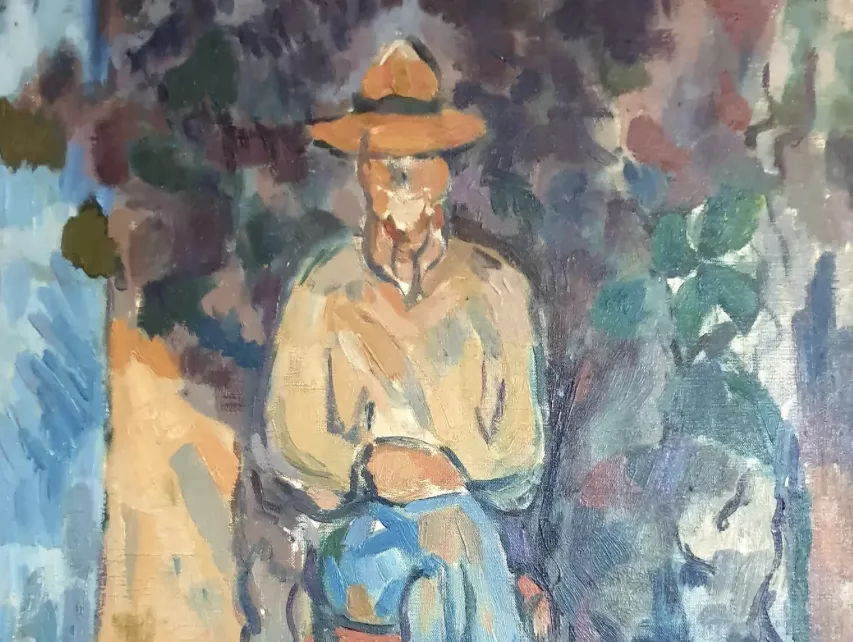
Recognizing the artist's signature
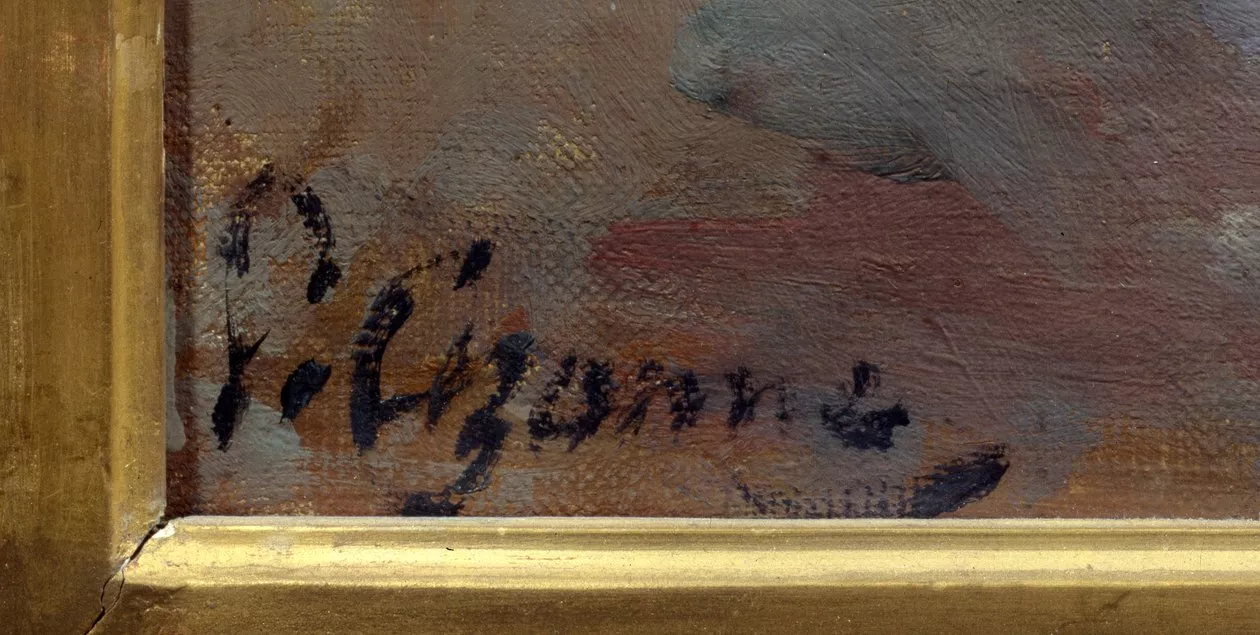
Cézanne very often signed his works, most often at the bottom of the painting, in a color that contrasts with the background. Here's an example.
Knowing the value of a work
If you happen to own a work by or after Paul Cézanne, don't hesitate to request a free appraisal using our form on our website.
A member of our team of experts and certified auctioneers will contact you promptly to provide you with an estimate of the market value of your work, not forgetting to send you ad hoc information about it.
If you are considering selling your work, you will also be accompanied by our specialists in order to benefit from alternatives for selling it at the best possible price, taking into account market inclinations.
Estimate in less than 24h
Works from the same period sold at auction

Estimated 2500 - 5000 €
Henri EPSTEIN (1892-1944), View of the village through the trees, Oil on canvas

Estimated 500 - 800 €
Louis BUISSERET (1888-1956) - Water carrier, Portugal, circa 1943, Oil on canvas

Estimated 15.000 - 20.000 €
Jacques MAJORELLE (1886-1962) - Fishermen embarking, Abidjan, Ivory Coast - Oil on canvas.

Estimated 3.000 - 5.000 €
Henri EPSTEIN (1892-1944), Place du sud de la France, Oil on canvas.

Estimated 8000 - 12000 €
Raymond THIBESART (1874-1968) Apple trees in blossom Oil on canvas.

Estimated 3000-5000€
Alexandre Roubtzoff, Gammarth (small format)
Discover in the same theme

Rating and value of works, drawings, paintings by Jean Royèr...
Jean Royère is a 20th-century decorator who produced furniture such as pedestal tables and sofas that are appreciated and quoted at auction.
Learn more >

Rating and value of paintings by Gustave Loiseau
Gustave Loiseau is a twentieth-century post-impressionist painter whose works are highly prized at auction.
Learn more >

Rating and value of drawings and paintings by Albert André
Albert André is a Post-Impressionist painter whose works command high prices at auction. 24-hour estimate.
Learn more >

Secure site, anonymity preserved

Auctioneer approved by the State

Free and certified estimates
Frequently asked questions
-
Who was Paul Cézanne, and what is his role in art history?Paul Cézanne (1839–1908) was a French painter from Aix-en-Provence, considered one of the most influential artists of the 19th century. A member of the Impressionist movement, he is best known as a pioneer of Post-Impressionism and Cubism. His revolutionary approach—which introduced geometric forms and challenged classical perspective—inspired the greatest masters of Cubism, such as Picasso and Braque.
-
What is the price range for Paul Cézanne's works?The prices of Cézanne's works vary considerably depending on the medium and rarity. Prints range from €10 to €58,910, drawings and watercolors from €60 to €20,971,260, and paintings from €800 to €119,669,400. The artist’s market value is steadily rising, particularly among French collectors.
-
How can you authenticate a work by Paul Cézanne and determine its value?To authenticate a work by Cézanne and obtain a reliable estimate of its value, we recommend that you request a free appraisal from Auctie's. Our auctioneers and certified experts will examine your work and provide you with an accurate estimate of its current market value, with no obligation on your part.
-
Is this the right time to sell a work by Paul Cézanne?Yes, now is a good time to sell a work by Cézanne. The artist’s market value is currently on the rise at auction, and his paintings are particularly sought after by collectors. The contemporary art market is showing sustained interest in the Impressionist masters and their precursors.
-
How does the appraisal and sales process work at Auctie's?The free appraisal begins with a request submitted via our online form. A certified expert or auctioneer will contact you promptly to examine your artwork and provide you with an accurate appraisal. If you’d like to sell, we’ll guide you through the process from the appraisal to the auction, helping you find the best options to achieve the highest price based on current market trends.
