



Surrealism: Appraisal and Auction

Key takeaways
- Surrealism is one of the strongest segments of modern art, with works by Dalí, Magritte, and Miró regularly selling for world-record prices.
- Price ranges vary considerably: from 2,000 to 40,000 euros for an engraving, to tens of millions for large-format works by major artists.
- The value of a work depends primarily on the artist’s identity, the period in which it was created (early versus late), and the technique used (dreamlike figuration, automatism, experimentation).
Dreams, objective chance, and impossible images: the value of Surrealist art varies greatly depending on the artist, the period, and the provenance of the work.
Below you’ll find all our valuation guides dedicated to Surrealism—Surrealist paintings, objects, collages, photographs, and drawings. Each guide details the price ranges observed at auction and the factors that determine a work’s value before it is entrusted to our state-certified auctioneers.
Guides on this art movement
See all guides >
Estimate and value of paintings, drawings by Hans Thoma
Discover the prices and values of works by Hans Thoma (1839–1924), a German Symbolist painter. Appraisals, art market trends, and expert advice.
Learn more >

Rating and value of drawings and paintings by Jan Toorop
Jan Toorop is a Dutch Symbolist painter whose Symbolist paintings command high prices at auction.
Learn more >

Rating and value of drawings and paintings by Arnold Böcklin
Arnold Böcklin was a 19th-century Symbolist painter who produced numerous paintings that are highly prized and valuable.
Learn more >

Rating and value of drawings and paintings by Georges d'Espa...
Georges d'Espagnat was a 20th-century Symbolist painter who produced numerous paintings that command high prices at auction.
Learn more >

Rating and value of Jacques Duval-Brasseur's furniture and s...
Jacques Duval-Brasseur is an iconic French designer of the 1970s. His works are highly valued at auction.
Learn more >

Rating and value of paintings by René Émile Ménard
René Émile Ménard is a twentieth-century Symbolist painter who produced numerous works of high value.
Learn more >

Rating and value of paintings by Tibor Csernus
Tibor Csernus is a Hungarian painter and pioneer of the over-naturalist style. His works are listed and have a high value at auction. 24h estimate
Learn more >

Rating and value of paintings, drawings and sculptures by Ya...
Yayoi Kusama is a Japanese artist known for the use of polka dots in her works, which are highly valued at auction.
Learn more >

Rating and value of paintings by Paul Klee
Paul Klee was an Expressionist painter who taught at the Bahaus, and was responsible for a considerable body of work of high value.
Learn more >

Rating and value of sculptures and bronzes by Irénée Duriez
Irénée Duriez is a French figurative sculptor who works on female representation through the medium of bronze. Estimated 24h.
Learn more >

Rating and value of paintings, drawings and sculptures by Lo...
Louise Bourgeois is a twentieth-century artist who worked mainly in sculpture, and whose value is exploding at auction today.
Learn more >

Rating and value of paintings by Pierre Alechinsky
Pierre Alechinsky is a founding member of the CoBra group. His works are highly valued. Estimated 24h.
Learn more >
Understanding the Value of a Surrealist Work
What Is Market Value in the Modern Art Market?
The market value of a Surrealist work refers to the benchmark value assigned to it by the secondary market at a given moment, based on the artist’s identity, the technique used, the period of creation, the condition of the work, the strength of the documentation, and current international demand.
Surrealism is today one of the most robust and sought-after segments of modern art: works by Salvador Dalí, René Magritte, Max Ernst, and Joan Miró regularly rank among the highest hammer prices at major auctions dedicated to 20th-century art.
Officially founded in 1924 by André Breton with the publication of the first Surrealist Manifesto, the movement sought to liberate the expression of the unconscious from the constraints of reason, morality, and inherited aesthetic conventions.
This ambition, combining an exploration of dreams, psychic automatism, and the most singular imagination, produced over the course of half a century a body of work of exceptional formal diversity, ranging from the quasi-photographic precision of Dalí and Magritte to the experimental techniques of Max Ernst, including the biomorphic abstraction of Miró and Tanguy.
This formal richness partly explains the considerable range of prices observed in this segment.

Why Surrealism Appeals to the Art Market
Surrealism enjoys an appeal that extends far beyond the traditional circle of modern art collectors. The immediate accessibility of its imagery—dreams, desire, strangeness, and dark humor—appeals to a much broader audience of collectors than that of other, more austere or theoretical contemporary movements.
This broad-based popularity, combined with the movement’s now undisputed institutional recognition in major museum collections worldwide, supports a structurally deep demand that has continued to grow for several decades.
The movement encompasses various techniques and approaches that shape market dynamics. Automatism, derived from the automatic writing theorized by Breton, emphasizes the spontaneity of the gesture and the absence of conscious control: André Masson and Joan Miró are its iconic representatives.
Dreamlike figuration, by contrast, employs extreme technical precision to depict impossible scenes with unsettling realism: Dalí and Magritte are its undisputed masters. Experimental techniques—such as frottage, scraping, and decalcomania—developed notably by Max Ernst, occupy a unique place, straddling the line between controlled chance and material exploration.
Technique / Movement | Period | Key Artists | Market Demand Level |
Precise dreamlike figuration | 1925–1970 | Salvador Dalí, René Magritte, Paul Delvaux | Exceptional, world-record auction prices |
Automatism and biomorphic abstraction | 1924–1960 | Joan Miró, André Masson, Yves Tanguy | Very strong, highly active international market |
Experimental techniques (frottage, scraping, collage) | 1925–1955 | Max Ernst, Hans Bellmer, Óscar Domínguez | Active, with specialized collectors |
Feminist Surrealism | 1930–1960 | Leonora Carrington, Remedios Varo, Dorothea Tanning | Very active, strong recent growth |
Surrealist Sculpture | 1930–1970 | Alberto Giacometti (Surrealist period), Jean Arp, Man Ray | Very high, a rare and sought-after segment |
Surrealist photography | 1925–1950 | Man Ray, Dora Maar, Brassaï | Strong, active market for vintage photography |
Estimate in less than 24h
The Criteria That Determine the Value of a Surrealist Work
The market value of a Surrealist work is determined first and foremost by the artist’s identity, which has a considerable impact in this segment: the gap between the market value of works by Dalí, Magritte, or Miró and that of an artist from their immediate circle—even one of high formal quality—often amounts to several orders of magnitude.
The period in which the work was created also plays a decisive role: for Dalí, works from his classical period—between the late 1920s and the mid-1940s—are valued incomparably higher than his later output, which is more abundant but of more uneven quality; for Magritte, the iconic compositions from the 1930s to the 1950s represent the peak of his market value.
The price ranges observed on the secondary market illustrate this considerable variation. A drawing or work on paper by a second-tier artist associated with the movement can range from 3,000 to 30,000 euros. A signed engraving or lithograph by a major artist, produced in a limited edition, ranges from 2,000 to 40,000 euros depending on the rarity and quality of the print.
A medium-sized canvas by a renowned artist such as Tanguy or Delvaux sells for between 200,000 and 3 million euros, depending on the period and quality. Large-format works by Dalí, Magritte, or Miró from their classical periods frequently exceed ten million euros and can reach tens of millions for their most iconic compositions.
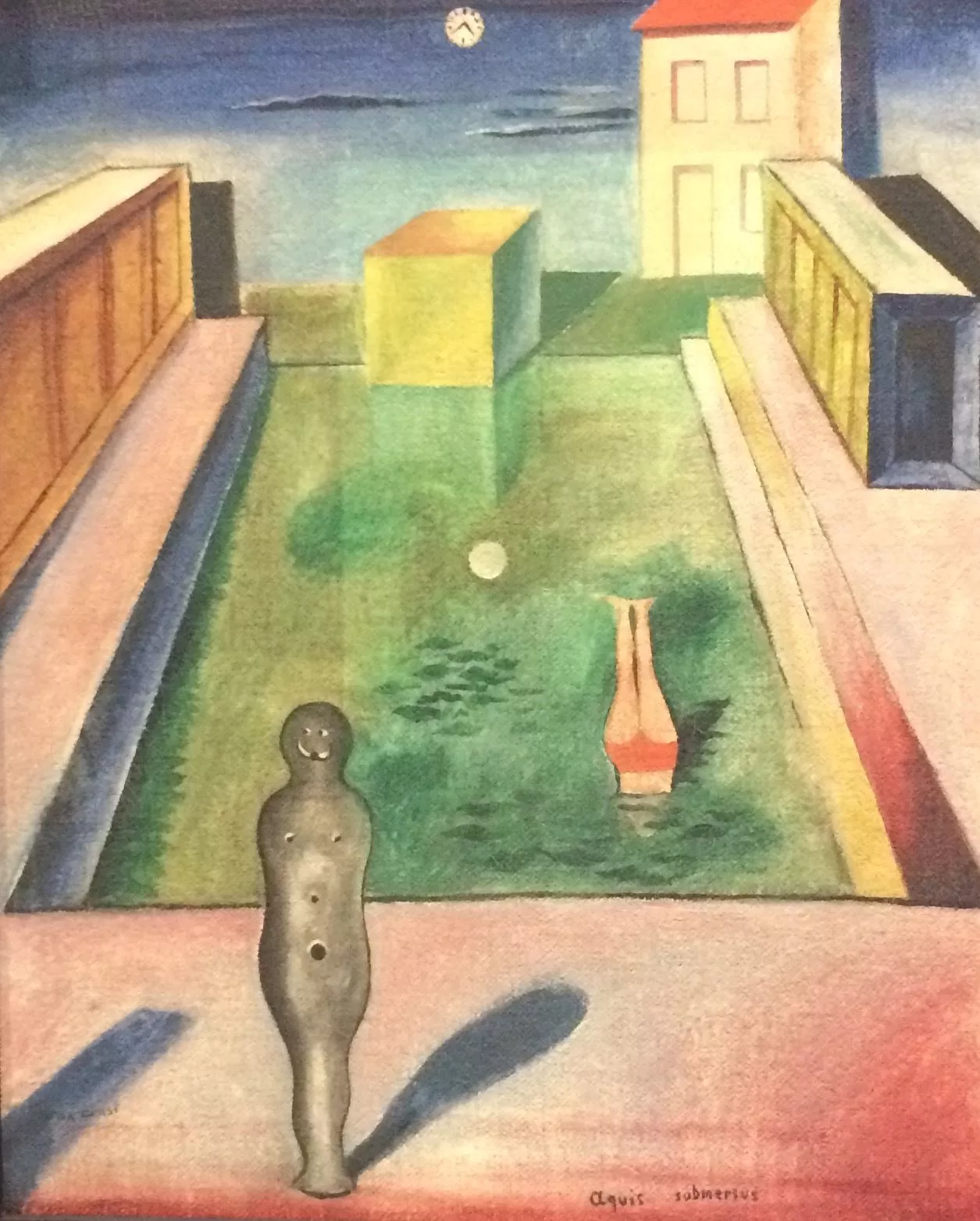
Paintings, Drawings, Sculptures: Surrealist Works Appraised
From automatism to dreams: contextualizing a Surrealist work
Precisely situating a Surrealist work within the movement’s diverse techniques and aesthetics is an essential step in any serious appraisal, as valuation criteria differ significantly depending on the technique used.
Paintings featuring dreamlike figuration—which require meticulous execution and often take a considerable amount of time to complete—are the most ambitious and sought-after works in the Surrealist canon: they form the core of the institutional market and major auctions.
Works created through automatic or experimental techniques—such as frottage, decalcomania, and collective “exquisite corpse”—occupy a distinct place, valued in particular for their historical significance and as a testament to the movement’s collective practices.
Drawings and works on paper, often created in a more intimate or exploratory setting, offer a unique insight into the artists’ creative process and represent a more financially accessible segment of the market.
Surrealist sculptures, though rarer in this movement—which was originally primarily pictorial and literary—nevertheless command considerable prices when signed by major figures such as Giacometti during his Surrealist period or Man Ray.
Finally, surrealist photography constitutes a separate yet related market, driven by figures such as Man Ray and Dora Maar, whose vintage prints are particularly sought after.
Technique / Category | Characteristics | Indicative Price Range | Market Demand |
Dreamlike figurative painting (major artist) | Extreme technical precision, lengthy production time, prestige | €1 million — tens of millions | Institutional, exceptional |
Medium-sized canvas (recognized artist, second tier) | Top-tier quality, gallery-sized | €200,000 — €3 million | Very popular |
Automatic or experimental work (frottage, decalcomania) | Historical record of collective practices | €30,000 — €500,000 | Active, specialized collectors |
Exquisite Corpse or documented collective work | One-of-a-kind piece with significant historical and anecdotal value | €10,000 — €150,000 | Specialized, high symbolic value |
Drawing or work on paper (major artist) | Insight into the creative process, small format | €5,000 — €200,000 | Contemporary, sought-after segment |
Signed engraving or lithograph (limited edition) | Numbered multiple, relatively affordable | €2,000 — €40,000 | Highly liquid, broad buyer base |
Surrealist sculpture (major artist) | Rare within the movement, high value per piece | €500,000 — several million € | Very high, specialists |
Vintage surrealist photograph (original print) | Rarity of the vintage print, artist’s signature | €10,000 — €300,000 | Strong, vintage photography market |
Collages, sculptures, and photographs: the most sought-after pieces
Collage plays a foundational role in the history of Surrealism, from Max Ernst’s experiments to the more narrative compositions developed by other members of the movement.
These works, which assemble fragments of pre-existing images to create unexpected and dreamlike juxtapositions, are particularly sought after when they are accurately documented and dated, as they directly reflect the technical experiments that defined the movement’s visual identity in its early days.
Max Ernst’s collages from his major collage novels—notably *A Week of Kindness*—rank among the most prized pieces in this segment.
Surrealist sculptures, although rare within the movement’s overall body of work, attract considerable interest from collectors and institutions when they appear on the market, precisely because of this inherent rarity.
Giacometti’s Surrealist period, preceding his postwar shift toward Existentialism, is now the subject of particularly strong demand.
Surrealist photography, long considered a minor genre compared to painting, has undergone a spectacular reevaluation since the 2000s: vintage prints by Man Ray, particularly his rayograms, now command prices that rival those of many painted works from the movement.
Estimate in less than 24h
Get a Free Appraisal of a Surrealist Artwork
A certified appraisal by a licensed auctioneer in less than 24 hours
Appraising a Surrealist work requires a comprehensive understanding of the history of this movement—with its complex international ramifications—the specific techniques each artist may have developed, and the current state of one of the most active and highly publicized markets in modern art.
The exceptional fame of the movement’s leading figures has given rise to an increasingly sophisticated market for forgeries, particularly in the case of Dalí, whose abundant production of multiples and late editions—sometimes of dubious provenance—significantly complicates the process of authentication.
As a state-certified auctioneer, Auctie’s possesses the training, experience, and networks necessary to conduct this appraisal with the rigor it demands. Its appraisal is backed by its professional liability and constitutes a legally binding document before any competent authority. It is offered free of charge, with a certified response within 24 hours.
What You Need to Provide for an Online Appraisal
For a surrealist painting, clear photographs of the front and back of the work are essential, as well as a close-up of the signature and any inscriptions on the back of the canvas or support, the precise dimensions of the composition, and any known provenance information: gallery label, purchase invoice, previous certificate of authenticity, or reference in an exhibition catalog or specialized publication.
For multiples, engravings, and lithographs, the edition number and any indication of a proof must be specified, as these directly influence the piece’s value.
For drawings, collages, and works on paper, the condition of the support is a key factor to document: pinholes, foxing, discoloration, and traces of previous mounting. For sculptures, photographs of the entire piece and of every significant detail—including the base and any foundry marks—are essential.
In cases of serious doubt regarding attribution—particularly for artists most vulnerable to the counterfeit market—a thorough physical examination will be recommended before any steps are taken to put the work up for sale.

Signature, Provenance, and Authenticity: The Pillars of Valuation
Signature, Attribution, and Authentication: Their Impact on Value
The authentication of a Surrealist work relies on a set of converging clues, the rigor of which must be proportional to the artist’s reputation.
The signature, when present, is a primary element, but it is far from sufficient for the most highly valued artists: caution is warranted, particularly in the case of Dalí, whose proliferation of signatures affixed to blank sheets of paper during his lifetime—and subsequently exploited to produce unauthorized multiples after his death—constitutes one of the most well-documented cases of art fraud in the 20th century.
For the movement’s major artists, authentication committees, foundations, or catalogs raisonné serve as the authoritative sources in the market. The Gala-Salvador Dalí Foundation strictly oversees the authentication of the artist’s works.
For Magritte, the catalog raisonné compiled by David Sylvester and Sarah Whitfield is the definitive reference. For Miró, the work of Jacques Dupin is authoritative, as is that of Werner Spies for Max Ernst.
A work listed in one of these collections or validated by the relevant committee enjoys the highest level of scholarly credibility, which is directly reflected in its market value.
Level of Documentation | Impact on Market Value |
Work listed in the catalogue raisonné or validated by the artist’s foundation | Maximum assurance; often an essential condition for sale |
Work published in specialized literature or exhibited in a major retrospective | Strong scientific backing; value highly sensitive |
Work with conclusive scientific analysis (pigments, supports, inks) | Guarantee of material authenticity; provides strong assurance to the buyer |
Work accompanied by a written expert opinion from a recognized specialist in the body of work | Good guarantee; facilitates the sale and reduces risk |
Work with documented provenance from the original gallery | Solid foundation; direct traceability to the artist or their circle |
Work without documentation; isolated signature without context | Maximum uncertainty; sale not recommended without prior in-depth appraisal |
Provenance and Condition: Their Impact on Valuation
The provenance of a Surrealist work is a key factor in building trust and determining its value. The major galleries that supported the movement—Galerie Pierre, the Galerie Surréaliste founded by André Breton, and later the Pierre Matisse Gallery in New York for artists who emigrated during the war—have built up archives that often make it possible to trace a work’s history from its creation.
A work with an unbroken chain of ownership from the artist’s studio to the current seller—or one whose inclusion in a historic Surrealist exhibition, such as the 1938 International Exhibition of Surrealism, is documented, enjoys near-absolute legitimacy on the market.
The condition of the work is a particular concern for this movement, as some artists experimented with materials and techniques whose long-term stability was not guaranteed. Max Ernst’s collages, composed of glued-together paper fragments, are sensitive to humidity and the gradual detachment of the assembled elements.
Dalí’s works from his classical period, painted with extreme technical precision, may exhibit cracking if the paint layers were not allowed sufficient drying time between successive glazes. Examination under raking light and ultraviolet light reveals these changes and allows for an assessment of their impact on the artwork’s value.
Sell a Surrealist Work at Auction with Auctie's
From the reserve price to the hammer price: how the price is determined
Auctions are the preferred method of sale for high-quality Surrealist works, particularly for major pieces whose international renown warrants exposure to the entire global market.
It yields a public price certified by a court-appointed auctioneer, resulting from the direct interplay of supply and demand at a given moment.
The reserve price, set in consultation with the seller, must be carefully calibrated: for major works, for which demand is driven by a growing number of collectors passionate about the surrealist imagination, a well-crafted sales strategy can spark a bidding war whose outcome far exceeds initial projections.
For second-tier artists or works on paper, the quality of the cataloging, the accuracy of the attribution, and the distribution of the catalog to the right specialized collectors remain the most decisive factors in achieving a good result.
The auctioneer plays an essential coordinating role in this process by curating a sale that creates the conditions for productive competition among bidders interested in each artist’s unique vision.
Hôtel Drouot and Online Auctions: Reaching the Right Bidders
Auctie’s holds its auctions at Hôtel Drouot, the leading auction venue in continental Europe, founded in 1852 and frequented by a dense network of dealers, collectors, and specialists in modern art.
For a Surrealist work, Drouot offers visibility among European enthusiasts of the movement, complemented by an online presence that significantly broadens the global reach of each auction, in a market where the most active buyers are often based in the United States, Asia, or the Middle East.
An American collector passionate about Dalí and Magritte, an Asian museum seeking an iconic work of the movement, or a collector from the Gulf region drawn to the dreamlike quality and unique imagination of Surrealism can bid in real time from their home countries.
For Surrealism, whose popularity extends far beyond the circle of fine art connoisseurs, this international dimension is almost always decisive in securing the highest hammer price.
Estimate in less than 24h
Estate Planning, Inheritance: Valuing an Inherited Surrealist Work
Inventory and Distribution of an Estate
Surrealist works are appearing with increasing frequency in the estates of collectors who acquired these pieces in the decades following their creation, at a time when these artists—though already recognized—were still accessible to collectors with substantial but not exceptional means.
A painting, drawing, or sculpture acquired in the 1960s or 1970s may now be worth considerably more than the heirs realize, making a preliminary appraisal all the more essential before any distribution of the estate.
Auctie’s regularly works alongside notaries to compile comprehensive estate inventories that include modern and surrealist artworks.
Each piece is appraised individually, with particular attention paid to issues of attribution and authenticity, which are, in this segment, absolutely decisive factors in determining value. The resulting report is an official document that is legally enforceable and can be included in the estate file without reservation.
Confidentiality of the process and preservation of anonymity
The circumstances leading to the appraisal of a surrealist work are often personal and sensitive: discovery as part of an inheritance, reorganization of a family collection built up over several decades, or a decision to sell after a long period of ownership.
Auctie’s handles each case with absolute discretion. The owner’s identity is never disclosed to third parties without their explicit consent, and the works may be offered for sale under complete anonymity if the owner so desires.
This confidentiality is a fundamental commitment of Auctie’s, applicable at every stage of the relationship, from the initial contact through to the receipt of the proceeds from the sale.
It is particularly valuable in this sector, where the potentially very high value of the works can attract unwanted attention if the sale process is made public prematurely.
Entrust the appraisal of your Surrealist artwork to Auctie’s
A Surrealist work deserves an appraisal that reflects the formal richness of the movement and the considerable stakes it may represent.
The diversity of techniques and processes, the sophistication of the counterfeit market for the most famous artists, and the extreme sensitivity of valuations to documentation and provenance: these are all reasons to entrust the appraisal of your piece to a state-certified auctioneer well-versed in the specifics of this demanding segment.
Auctie’s guides you from the initial appraisal through to the final auction, with the rigor of an expert trained in these matters and the discretion your financial decisions deserve. The appraisal is free, confidential, and non-binding, and you’ll receive a response within 24 hours.
Discover in the same theme
Rating and value of paintings by René Émile Ménard
René Émile Ménard is a twentieth-century Symbolist painter who produced numerous works of high value.
Learn more >
Rating and value of sculptures and bronzes by Irénée Duriez
Irénée Duriez is a French figurative sculptor who works on female representation through the medium of bronze. Estimated 24h.
Learn more >

Rating and value of paintings, drawings and photographs by P...
Pierre Molinier is a figurative and surrealist artist whose works have recently skyrocketed in value at auction.
Learn more >
Estimate in less than 24h
Frequently asked questions
-
What is the price range for a surrealist artwork?Prices vary considerably depending on the artist, the technique, and the period. A drawing by a second-tier artist ranges from 3,000 to 30,000 euros, while a medium-sized canvas by a well-known artist ranges from 200,000 to 3 million euros. Large paintings by Dalí, Magritte, or Miró from their classical periods regularly exceed ten million euros. The artist’s identity and the period in which the work was created are the key factors determining its value.
-
How do you have a surrealist work authenticated?Auctie's, a state-licensed auction house, offers a free, certified appraisal conducted by an auctioneer who is an expert in Surrealism. All you need to do is provide clear photographs of the front and back, a close-up of the signature, the exact dimensions, and any available provenance information. You will receive a certified response within 24 hours, backed by the expert’s professional liability.
-
Is this the right time to sell a surrealist work?Yes, Surrealism is today one of the most robust and sought-after segments of modern art, with a structurally deep demand that has been steadily growing for several decades. The immediate accessibility of its imagery appeals to a very broad audience of collectors, and the movement’s institutional recognition supports active and steady international demand.
-
What criteria determine the value of a surrealist work?Value depends first and foremost on the artist’s identity, which has a considerable impact: the gap between the market values of the masters (Dalí, Magritte, Miró) and those of second-tier artists spans several orders of magnitude. The period in which the work was created plays a decisive role: for Dalí, works from the late 1920s to the mid-1940s are valued much higher than his later works. Condition, rarity, documentation, and provenance also strongly influence the price.
-
How does the sale of a surrealist artwork work at Auctie's?Auctie's supports sellers from the free appraisal through to the auction sale. Following a certified, no-obligation appraisal by a licensed auctioneer, the artwork is cataloged, prepared for sale, and offered to a network of international buyers. Auctie's manages the entire sales process, from authentication to the completion of the transaction.
