



Rating and value of paintings by Pierre Alechinsky

Key takeaways
- Pierre Alechinsky’s works sell for between €10 and €1,150,000 at auction, with a record set by “Mur d’oiseaux” in 2018.
- Original paintings command high prices (averaging €100,000 to €300,000), while works on paper range from €750 to €4,000.
- A leading figure in Expressionism and Surrealism, his works are held by MoMA, the Tate, and other prestigious institutions, and his market value is steadily rising.
If you own a work by or after the artist Pierre Alechinsky and would like to know its value, our state-approved experts and auctioneers will guide you.
Our specialists will carry out a free appraisal of your work, and provide you with a precise estimate of its value on the current market.
Then, if you wish to sell your work, we will direct you to the best possible arrangement to obtain the optimum price.
Rating and value of the artist
An important figure in Expressionism and Surrealism, Pierre Alechinsky has established himself as an indisputable player in the art market.
Highly prized and sought-after in auction rooms, some of his works can fetch hundreds of thousands of euros - they are sold on the auction market for between €10 and €1,150,000, displaying a rising quotation, as evidenced by his oil on canvas Mur d'oiseaux, dating from 1958, sold for €1,150,000 in 2018, while it was estimated at between €350,000 and €500,000.
Order of value from the most basic to the most prestigious
Technique used | Result |
|---|---|
Sculpture - volume | From €300 to €20,000 |
Ceramics | From €420 to €25,470 |
Estamp - multiple | From €10 to €57,900 |
Drawing - watercolor | From €10 to €211,600 |
Painting | From €40 to €1,150,000 |
Estimate in less than 24h
The artist's style and technique
Pierre Alechinsky's work is inspired by Japanese calligraphy, accentuated by his travels to the Far East in 1955, and illustrated in his documentary film Calligraphie japonaise.
He adopts a fluid, spontaneous gesture with pen or brush, close to a written language freed from narrative constraint. He invents compositions with multiple reading levels, framing his central figure with illustrated margins (marginalia), thus creating a dynamic between center and periphery.
His works combine organic forms evoking animals, plants or natural forces, with lyrical, poetic abstraction. His plastic language oscillates between spontaneity and formal mastery, at the crossroads of surrealism and abstract expressionism.
He trained at Stanley Hayter's Atelier 17, and masters engraving, lithography, aquatint and etching, which he uses with inventiveness. The artist also uses maroufalge, a technique of gluing paper to canvas, preserving the liveliness of the ink while ensuring the durability of the support. This is a method he passed on to Keith Haring.
He gradually abandoned thick oils for more fluid, applied acrylics, favoring a light, expressive rendering from 1965 onwards. In some respects, his work parallels that of lyrical abstraction painters.
Pierre Alechinsky cultivates a rather dreamlike repertoire, often dominated by free gestural writing and lively compositions ; evoking the unconscious and visual narrative.
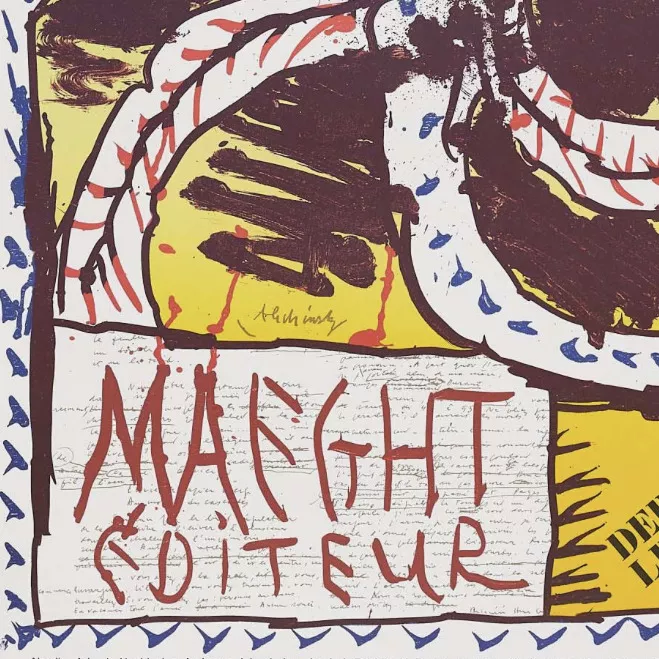
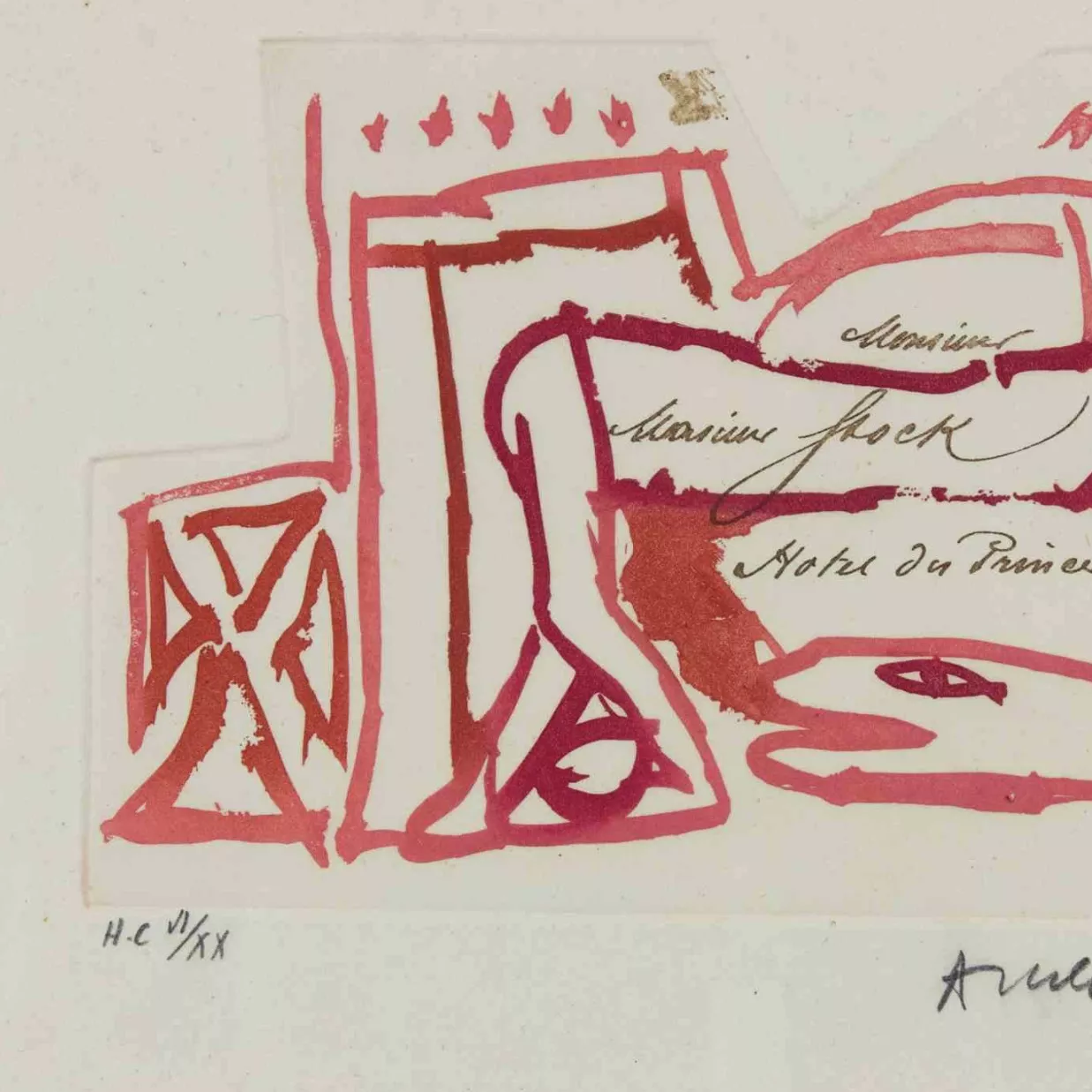
The life of Pierre Alechinsky
Pierre Alechinsky (1927 - ) was born in Schaerbeek (Brussels), to a father of Russian and Jewish origin. He became a naturalized Belgian citizen because his mother was Walloon. From 1944 to 1948, he studied illustration, typography, printing and photography at the École nationale supérieure d'Architecture et des Arts décoratifs de La Cambre, in Brussels.
In 1949, he joined the CoBra group, along with other artists such as Dotremont, Doucet, Appel, Constant and Corneille. With them, he takes part in exhibitions, the first of which is held in Amsterdam. He organizes the group's second international exhibition in Liège, is also an active contributor to the group's magazine.
His first solo exhibition took place in 1954 at Galerie Nina Dausset, followed by a major show at the Palais des Beaux-Arts in Brussels.
His work is also the result of Far Eastern influences and technical innovations. In 1955, he traveled to Japan, where he studied calligraphy and made a film on the subject. This research and the calligraphic tradition would have a heavy impact on his artistic practice.
From 1953, he settled in Bougival, where he perfected the techniques of marouflage (collage of paper on canvas), which blends calligraphy and inks with the pictorial medium. From the 1960s onwards, his works were exhibited in London, Bern, Venice (Biennale), Pittsburgh, New York and Amsterdam, contributing to his international reputation.
In 1983, he became professor of painting at the École nationale supérieure des Beaux-Arts in Paris. In 1994, he was awarded an honorary doctorate by the Université libre de Bruxelles, followed by the Légion d'honneur in 2006, and the Praerium Imperiale prize in 2018.
His career now spans more than seven decades. He produces paintings, prints, films and various artistic collaborations. His work can be found in prestigious institutions such as MoMA, the Tate, Belgium's Royal Museum of Fine Arts, Museum Ludwig in Cologne and the Walker Art Center in Mineapolis.
.
Market segmentation and artist's rating
The most expensive work auctioned for the artist is Wall of Birds, sold for 1,601,105 USD at Christie's Paris in 2018. The average estimated value over 12 months is around 66,700 USD for paintings, compared with around 11,000 USD for works on paper.
In recent results, Lanscape by Slice, estimated at between 150,000 and 200,000 GBP reached 277,250 GPB at Christie's France. At Lempertz Cologne, Copeaux d'ivoire reached €82,700, Le blanc-manger fetched €44,640, while Processionnaire fetched €42,500.
Some mediums are naturally valued, as is the case for many artists. Iconic paintings often fetch between €100,000 and €300,000, with the potential to exceed €1 million for key works.
Works on paper and watercolors typically range from €750 to €4,000, depending on print and technique. Objects and unconventional pieces (enamelled trays, collages) are often estimated at between €40,000 and €60,000.
Average prices thus indicate a strong valuation of original paintings, compared with printed prints. Some recent sales show a delay in outperformance compared with initial estimates, sometimes reaching 85% above the low estimate.
The market is therefore buoyant, with sales split between private amateurs, museum institutions and specialist collectors.
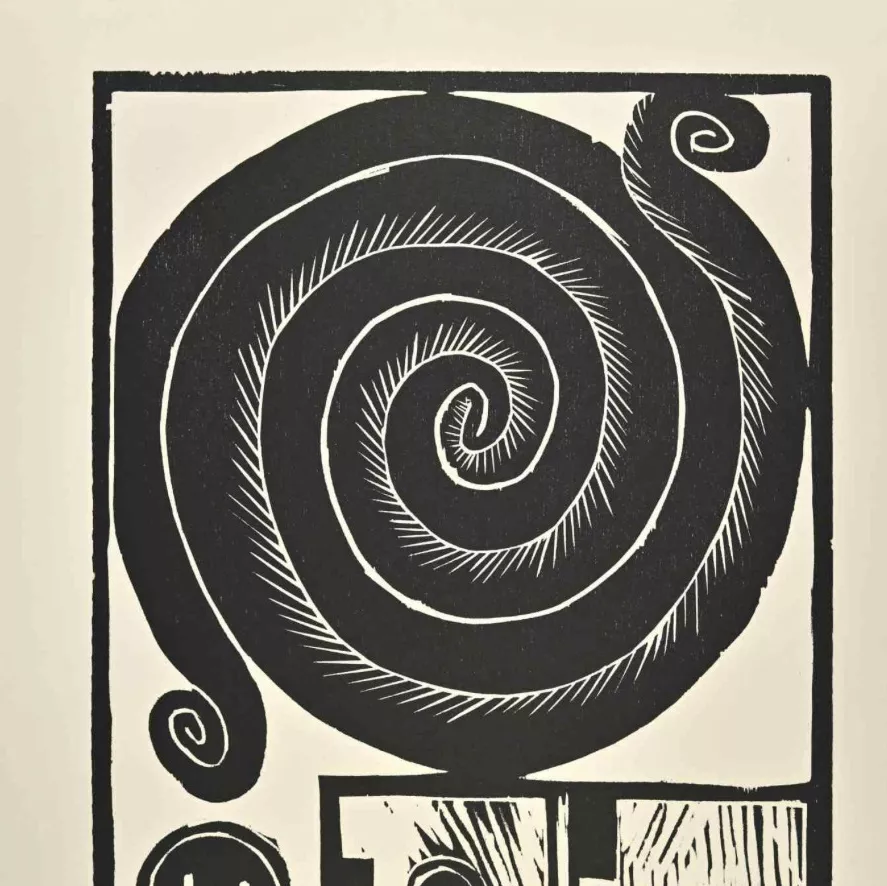
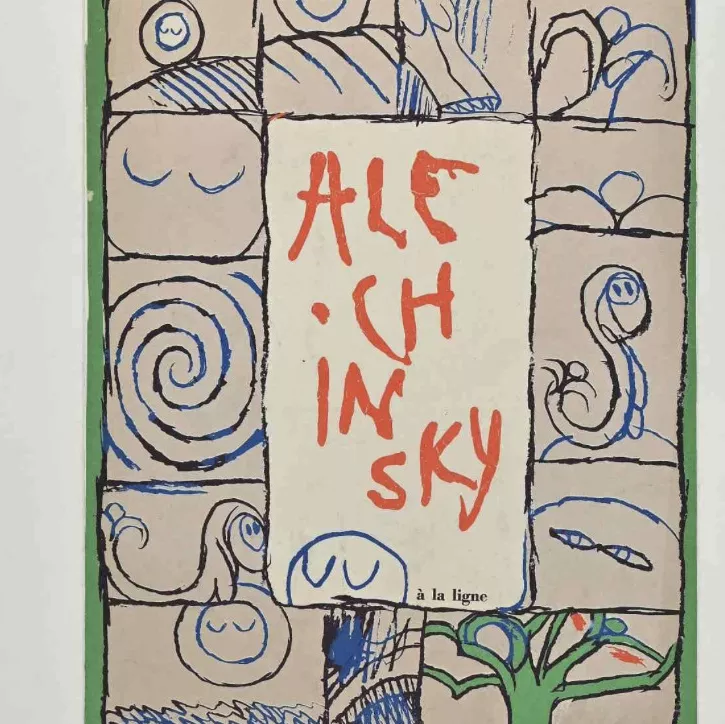
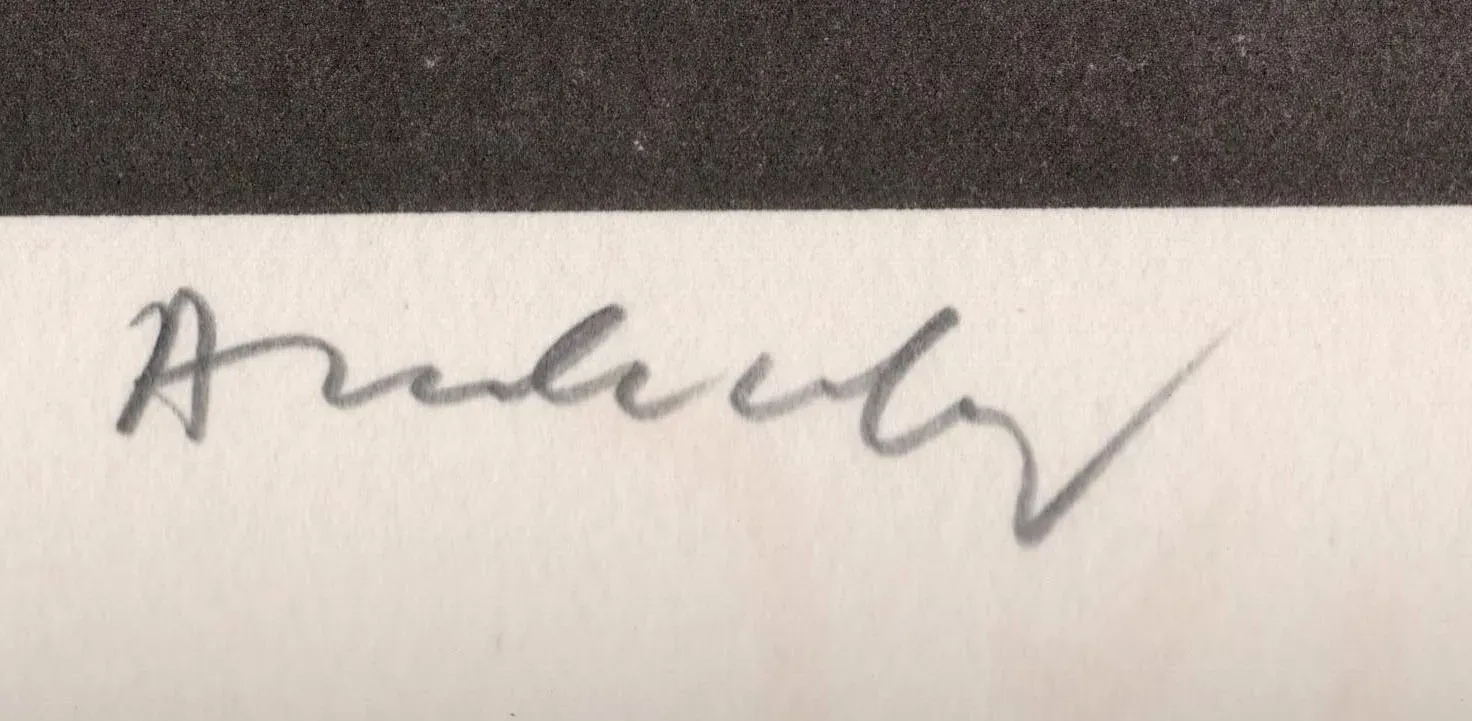
His signature
Not all of Pierre Alechinsky's works are signed.
Although there are variations, here is a first example of his signature:
Expertise your property
If you happen to own a work by Pierre Alechinsky, request a free appraisal without further delay via our form on our website.
A member of our team will contact you promptly to provide you with an estimate of the value of your work, as well as any relevant information about it.
If you are considering selling your work, our specialists will also be on hand to help you find alternative ways of selling it at the best possible price.
.Frequently asked questions
-
Who is Pierre Alechinsky, and what is his artistic background?Pierre Alechinsky (born in 1927) is a leading figure in Expressionism and Surrealism and a co-founder of the CoBra group in 1949. His work blends Japanese calligraphy (which he discovered during a trip to Japan in 1955) with lyrical abstraction, characterized by fluid and spontaneous brushwork. His works, which are part of the collections at MoMA, the Tate, and the Ludwig Museum, have earned him an international reputation and prestigious honors such as the Legion of Honor in 2006.
-
What is the price range for works by Pierre Alechinsky?Prices vary considerably depending on the medium: paintings range from €40 to €1,150,000, with iconic works typically selling for between €100,000 and €300,000. Works on paper and watercolors typically cost between €750 and €4,000, while prints range from €10 to €57,900. Prices are on the rise, as demonstrated by the 2018 sale of “Mur d’oiseaux” for €1,150,000, which far exceeded its initial estimate.
-
How do I have a work by Pierre Alechinsky authenticated and appraised?Auctie's offers a free, no-obligation appraisal conducted by state-certified auctioneers and experts. Simply submit a request using the form on the Auctie's website, and a member of the team will contact you promptly to provide an estimate for your artwork and relevant information within 48 hours.
-
Is this a good time to sell a work by Pierre Alechinsky?Yes, the market for Pierre Alechinsky is currently strong, with prices on the rise. Recent sales show that original paintings are commanding high prices, with some even exceeding their estimates by more than 85%. Museums and specialized collectors remain active, creating stable demand for his works.
-
How does the sale of a work of art work at Auctie's?Auctie's supports you from start to finish: a free appraisal by an expert, advice on the best sales approach to maximize the price, and then the organization of the auction. Our specialists will guide you toward the options best suited to your artwork to help you achieve the highest possible price.
