



Religious Art Appraisal: Valuation and Auction

Icons, sacred statuary, and liturgical metalwork: the value of religious art varies greatly depending on the period, material, and condition.
Below you’ll find all our valuation guides dedicated to religious art—icons, sculptures, metalwork, and devotional paintings. Each guide details the price ranges observed at auction and the factors that determine a work’s value before it is entrusted to our state-certified auctioneers.
Guides on this art movement
See all guides >
Rating and value of sculptures and bronzes by Jean-Jacques F...
Jean-Jacques Feuchère is a Symbolist and Romantic artist whose atypical output has met with great success at auction.
Learn more >

Rating and value of paintings by Jules Lefebvre
Jules Lefebvre is a French academic artist who produced many works that are highly valued at auction.
Learn more >

Rating and value of paintings by Fernand Cormon
Fernand Cormon was a realist painter of the 19th century. A teacher at the Beaux-Arts, he produced many highly-rated works.
Learn more >

Rating and value of paintings by Pierre Puvis de Chavannes
Pierre Puvis de Chavannes is a Symbolist artist who produced works that are highly valued at auction. Estimate in 24h.
Learn more >

Rating and value of paintings by Alexandre Séon
Alexandre Séon is a Symbolist painter who produced paintings that are highly valued at auction. 100% free estimate!
Learn more >

Rating and value of paintings by Georges Rouault
Georges Rouault is a twentieth-century Expressionist painter who produced many works that are highly valued at auction.
Learn more >

Rating and value of paintings by Antonio Tempesta
Antonio Tempesta is an Italian Mannerist painter who produced works that are listed and valued on the auction market.
Learn more >

Rating and value of works, drawings, paintings by Henry de G...
Henry de Groux was a twentieth-century painter from Brussels. A sickly, committed artist, he depicted scenes of torture and war that were highly rated...
Learn more >

Rating and value of drawings and paintings by Nicolas August...
Auguste Gallimard is a 20th-century painter of religious art and stained glass. He produced drawings and oils on canvas that were highly regarded at a...
Learn more >

Rating and value of works, drawings, paintings by Marc Chaga...
Marc Chagall is a twentieth-century artist who leaves behind a substantial body of work, including drawings and paintings that are highly prized at au...
Learn more >

Rating and value of works, paintings, drawings by Maurice De...
Maurice Denis is a painter belonging to the Nabis group. His drawings and paintings are highly appreciated and quoted on the art market.
Learn more >

Rating and value of works, paintings by Zoran Music
Zoran Music is a 20th-century painter who depicted the horror of the concentration camps. His works are valued and quoted at auction.
Learn more >
Understanding the Value of Religious Art
What Is Market Value in the Religious Art Market?
The market value of a religious artwork refers to the reference value assigned to it by the secondary market at a given moment, based on the object’s category— painting, sculpture, or liturgical metalwork, its artist (when identified), the period in which it was created, its condition, and the strength of the supporting documentation.
French religious art—which, given the country’s history, is primarily Christian and Catholic—encompasses a considerable body of work from the 17th to the 19th century, which accompanied the spiritual and liturgical life of parishes, chapels, and major religious institutions throughout the country.
This market, long undervalued compared to secular painting or secular decorative arts, has for several decades been the focus of renewed interest from collectors who appreciate both the artistic quality of these works and their spiritual and heritage value.
The gradual secularization of many religious buildings, as well as the dispersal of church furnishings during renovations or parish closures, has over time fueled an active market for antique paintings, statues, and liturgical objects.
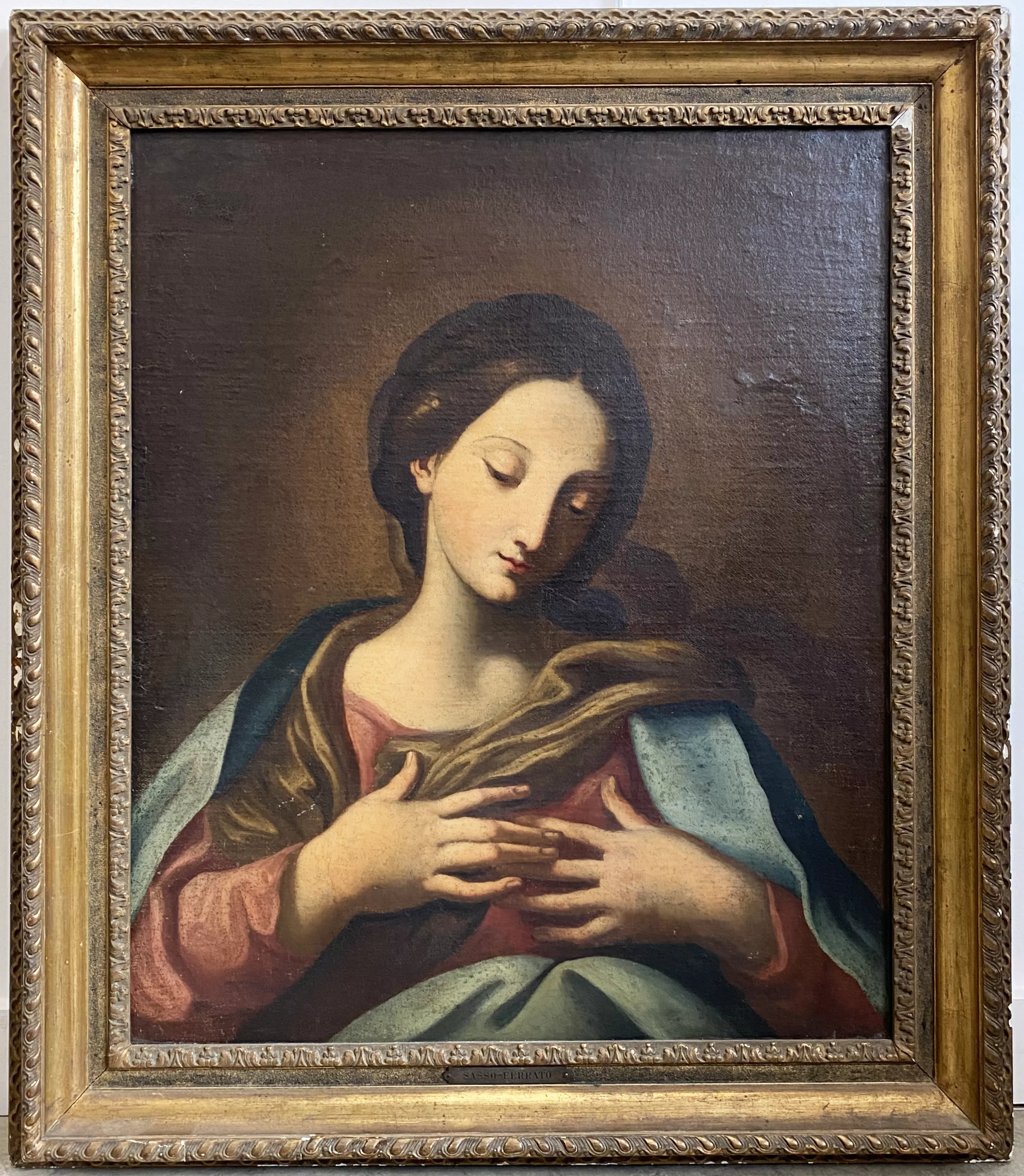
Why Sacred Art Remains in Demand on the Market
Sacred art continues to enjoy sustained demand in the antique art market for several interrelated reasons: the often high artistic quality of these works, which engaged some of the finest painters, sculptors, and goldsmiths of their time to decorate major religious institutions; the heritage and historical significance of these objects, which document the spiritual and material life of past centuries; and the intrinsic aesthetic appeal of certain compositions, particularly biblical scenes and depictions of the Virgin and Child, which have inspired some of the most admired masterpieces in the history of Western art.
The revival of sacred art in the 19th century—driven by a movement to restore and construct religious buildings amid a resurgence of Catholic fervor following the upheavals of the Revolution—spurred a new wave of artistic commissions, stained-glass windows, statues, and murals, which today constitute a distinct and active segment of the religious art market, alongside older works from the Grand Siècle and the 18th century.
Type of Object | Period | Material | Market Demand Level |
Religious painting (saint, Virgin Mary, biblical scene) | 17th–19th century | Oil on canvas or panel | Very strong, broad buyer base |
Statue of a saint or sculptural group | 17th–19th century | Polychrome wood, stone, plaster | Active market; sought-after decorative segment |
Chalice, ciborium, and liturgical silverware | 17th–19th centuries | Silver, vermeil, sometimes gemstones | Strong, specialized collectors |
Icon (Orthodox tradition) | 17th–19th centuries | Tempera on wood | Very active, international market |
Reliquary and devotional object | 17th–19th centuries | Precious metal, wood, glass | Moderate, niche market |
Estimate in less than 24h
The Criteria That Determine the Value of a Religious Artwork
The market value of a religious work of art is determined by a hierarchy of criteria that the auctioneer weighs according to the category in question.
For paintings, attribution to a documented artist, the quality of the composition, and the rarity of the specific subject depicted are decisive factors: a high-quality Virgin and Child—the most common subject in all of Western religious painting—must stand out for its remarkable execution to command a high price; the subject alone is not enough to elevate the value of a work of ordinary craftsmanship.
For gold and silverware, the hallmark, the quality of the metal, and the finesse of the silversmith’s work are essential.
The price ranges observed on the secondary market illustrate this wide variation. A religious painting of average quality, without a specific attribution, can range from 500 to 5,000 euros. A well-crafted 18th-century polychrome wooden statue of a saint ranges from 2,000 to 30,000 euros, depending on the quality of the carving and the condition of the original polychrome paint.
A hallmarked silver or vermeil chalice or ciborium sells for between 1,000 and 20,000 euros, depending on the silversmith and the piece’s age. Exceptional pieces—such as paintings attributed to a renowned master or documented examples of royal or episcopal silverware—can exceed several tens of thousands of euros, or even more for the rarest works.
Religious Paintings and Sculptures
Religious Paintings: Saints, the Virgin Mary, and Biblical Scenes
Religious paintings constitute the largest and most diverse segment of this market, covering an extremely varied range of iconography: portraits of saints identifiable by their specific attributes, the Virgin and Child in her many iconographic variations, scenes from the Passion or the Nativity, and episodes drawn from the Old Testament, from which classical religious painting drew much of its inspiration.
The quality of the composition, the balance of colors, and the mastery of chiaroscuro—particularly valued in 17th-century religious painting under the influence of Caravaggism—are essential criteria for evaluation.
Sculptures and Statues of Saints
Statues of saints—whether originally intended for liturgical use in churches or for private devotion in a domestic setting—are a category particularly sought after by contemporary collectors and interior designers, who appreciate both the spiritual and aesthetic dimensions of these pieces.
The original polychromy, when preserved without excessive repainting, is a major factor in determining value, as many antique statues have unfortunately undergone botched restorations that compromise their material authenticity and, consequently, their value.
Category | Characteristics | Estimated Price Range | Market Demand |
Attributed religious painting (documented artist) | High-quality composition, subject well rendered | 5,000 — 100,000 € | Strong demand, specialized collectors |
Religious painting of average quality (anonymous) | Solidly executed, classic subject matter | €500 — €5,000 | Active market, broad buyer base |
Polychrome wooden statue of a saint (18th century) | Original polychrome paint well preserved | €2,000–30,000 | Active, sought after by interior designers |
Sculptural group or fragmentary altarpiece | Narrative ensemble, quality of the sculpture | €5,000 — €80,000 | Well-preserved, heritage-quality piece |
Church decor (wood paneling, architectural element) | From an identified building | €1,000 — €50,000 | Moderate, specialized market |
Church decor and religious furnishings
Church decor and religious furnishings in the broad sense— choir stalls, confessionals, choir woodwork, and lecterns, constitute a category whose dispersal on the market most often results from building renovations or parish closures, during which these items were dismantled and sold separately.
The precise provenance from an identified religious building, when it can be established with certainty, considerably enhances the value of these pieces, conferring upon them a heritage and documentary significance that goes beyond their purely decorative quality.
Estimate in less than 24h
Liturgical Objects and Religious Metalwork
Chalices, ciboria, and reliquaries
Chalices and ciboria, central liturgical objects in the celebration of the Eucharist, are among the most sought-after pieces of religious gold and silverwork on the market; their craftsmanship in silver or vermeil has often involved renowned silversmiths, whose hallmarks allow for precise attribution and dating.
Reliquaries, intended to preserve the relics of saints and present them for the veneration of the faithful, constitute a rarer and often more richly ornamented category, with some examples featuring precious stones, rock crystal, or technically sophisticated enamels.
Icons, Crucifixes, and Devotional Objects
Icons, which stem from the Orthodox tradition but are widely available on the French market due to their significant historical circulation from Russia and Eastern Europe, constitute a distinct category of religious art, their creation according to precise iconographic canons and their unique spiritual value within the Orthodox tradition account for particularly strong international demand
Crucifixes and objects of private devotion, more modest in scale but highly diverse in their execution, round out this overview; their value depends largely on the quality of the material and the finesse of the craftsmanship.
Object | Material | Period | Approximate price range |
Hallmarked chalice or ciborium (silversmith identified) | Silver or vermeil | 17th–19th century | 1,500 — 25,000 € |
Ornate reliquary (gemstones, rock crystal) | Precious metal, glass, gemstones | 17th–18th century | €5,000 — €80,000 |
Russian or Greek icon (high quality, identified artist) | Tempera on wood, sometimes with a metal riza | 18th–19th century | €2,000–50,000 |
Altar or devotional crucifix (precious metal) | Bronze, silver, ivory | 17th–19th century | €800 — €15,000 |
Ex-voto or object of popular devotion | Wood, metal, naive painting | 18th–19th century | €200–3,000 |
Get a Free Appraisal of Your Religious Art
A certified appraisal by a licensed auctioneer in less than 24 hours
Appraising a work of religious art requires a thorough knowledge of Christian iconography, which allows for the accurate identification of the subject depicted and its place in the traditional hierarchy of religious themes, as well as an understanding of goldsmith’s hallmarks for liturgical objects made of precious metals.
The licensed auctioneer possesses this dual expertise, which is essential for a reliable appraisal of this particularly diverse collection.
Auctie’s offers this appraisal free of charge, with a certified response within 24 hours.
Whether you have inherited a religious painting, wish to have a statue of a saint or a piece of liturgical silverware appraised, or are considering compiling an inventory of your family’s heritage, the process is the same: submit your item to a trained expert capable of accurately assessing its value.
What you need to provide for an online appraisal
For a painting, clear photographs of the front and back of the work are essential, along with a close-up of any signature or inscription, the precise dimensions of the composition, and any known provenance information: a collection label, purchase invoice, or reference in an auction catalog or specialized publication.
For a statue, photographs of the entire piece and close-ups of the polychrome details are required. For a piece of silverware, a clear, close-up photograph of the hallmark—usually located on the base or rim of the object—is essential for identification.
Any information regarding the provenance of a specific religious building—such as a parish, chapel, or religious community—must be provided, as it can significantly enhance the appraisal. In cases of uncertainty regarding attribution, a physical examination will be offered before any steps are taken to list the item for sale.
Material, period, and provenance: the pillars of cataloging
Authentication and Dating of a Religious Artwork
The authentication of a religious work of art relies on a combined examination of style, execution technique, and—in the case of goldsmithing—official hallmarks, which allow for precise dating and attribution to a specific goldsmith or assay office.
For paintings, comparison with documented works by a presumed artist and analysis of the materials—canvas, panel, pigments—allow for establishing a date consistent with the proposed attribution.
For sculpture, an examination of the polychromy—when present—and its stratigraphy can reveal any repainting, which must be distinguished from the original paint layer.
Consulting diocesan inventories and parish archives—where they have been preserved—can, in some cases, provide precise documentation of a piece’s origin and the historical context of its creation or commission, thereby significantly enhancing its value and credibility among collectors.
Level of Documentation | Impact on the appraisal |
Work attributed to a documented and recognized artist or goldsmith | Maximum assurance; significant premium on value |
Established provenance from an identified historic religious building | Strong documentary evidence; significant increase in value |
Work accompanied by a written appraisal from a recognized specialist in religious art | Good guarantee; reassures the buyer and facilitates the sale |
Legible goldsmith’s hallmark, identifiable in reference directories | Solid foundation; reliable dating and attribution |
Anonymous work with a consistent style and iconography | Conservative estimate; based on the quality of execution |
Work without documentation or an identifiable hallmark | Increased uncertainty; estimate based solely on stylistic analysis |
Provenance, condition, and rarity
The provenance of a religious work of art is a key factor in building trust and determining value in this market.
A piece whose origin can be traced—whether acquired directly during the dispersal of a documented church collection or preserved for several generations within the same family—enjoys a legitimacy that collectors value highly.
Condition warrants special attention, as these works have often suffered the effects of humidity in old, poorly heated religious buildings, as well as any restorations carried out over the centuries with varying degrees of care.
Finally, rarity varies considerably by category: certain iconographic subjects, such as the Virgin and Child, are extremely common and do not, on their own, command a particular premium, whereas other rarer themes or liturgical objects that are exceptional in size or decorative richness benefit from an inherent rarity that supports a higher valuation.
From the 17th to the 19th Century: The Most Popular Periods
Classical Sacred Art: 17th and 18th Centuries
Seventeenth-century religious art, marked by the influence of Caravaggism and the Catholic Counter-Reformation—which spurred a profusion of artistic production intended to rekindle the devotion of the faithful—produced some of the most powerful works in the entire history of French religious painting.
The 18th century, while continuing this tradition, saw the development of a religious art that was at times more intimate and graceful, in keeping with the Rococo aesthetic dominant in the decorative arts of that period.
The Revival of Religious Art in the 19th Century
The 19th century witnessed a true revival of sacred art, driven by the reconstruction and restoration of numerous religious buildings that had been damaged or decommissioned during the Revolutionary period, as well as by a resurgence of Catholic fervor that resulted in a prolific body of artistic work, including stained-glass windows, mass-produced statues, and murals, the quality of which varied significantly depending on the workshops and commissions involved.
This segment, long undervalued compared to the religious art of previous centuries, is now undergoing a gradual reassessment by art historians and specialized collectors.
Selling a Religious Artwork at Auction with Auctie's
From the reserve price to the hammer price: how the price is determined
Auctions are a suitable method of sale for well-documented religious artworks in a market where the match between a high-quality piece and a specialized collector—or an enthusiast seeking a decorative piece with strong character—can generate targeted demand.
The reserve price, set in consultation with the seller, must be determined with particular attention to the specific category of the work, as a significant portion of its value in this diverse market depends on this classification.
For the best-documented pieces, particularly those attributed to a recognized artist or goldsmith, the dynamics of the auction may lead to results exceeding initial estimates.
The auctioneer plays a vital role in facilitating the process by engaging networks of collectors specializing in sacred art, as well as interior designers and art enthusiasts who appreciate the unique aesthetic of these pieces.
Hôtel Drouot and Auctions: Reaching the Right Bidders
Auctie’s holds its auctions at Hôtel Drouot, the leading auction house in continental Europe, founded in 1852, which regularly features sales dedicated to antique furniture and religious art.
For a work of religious art, Drouot offers visibility among specialized collectors and institutions, complemented by online promotion that extends the reach of each auction beyond metropolitan borders.
A collector passionate about French sacred art, a Russian or Greek connoisseur seeking a high-quality icon, or an interior designer looking for a statue of a saint for an original interior design project can bid from their own country.
For religious art, which has a large and diverse following, this aspect is often decisive in securing the best hammer price.
Estimate in less than 24h
Estate Planning, Inheritance: Valuing Inherited Religious Art
Inventory and Distribution of an Estate
Religious artworks frequently appear in the estates of French families—descendants of collectors who acquired these pieces during the dispersal of church furnishings or who simply inherited devotional objects passed down through several generations.
These pieces, which have sometimes been hung on walls or kept in family homes for a long time, can represent a significant portion of the estate’s assets, particularly when they are attributed to a recognized artist or goldsmith.
Auctie’s regularly works alongside notaries to compile comprehensive estate inventories that include religious artworks.
Each piece is appraised individually: precise description, identification of the subject and the artist (if possible), condition, and an estimate of market value as of the reference date. The resulting report is an official, legally binding document that can be included in the estate file without reservation.
Confidentiality of the process and preservation of anonymity
The circumstances leading to the appraisal of inherited religious art are often personal: probate, a family inheritance, or the decision to sell after a long period of ownership.
Auctie’s handles each case with absolute discretion. The owner’s identity is never disclosed to third parties without their explicit consent, and the works may be offered for sale under complete anonymity if the owner so desires.
This confidentiality is a core commitment of Auctie’s, valid at every stage of the relationship, from the initial contact through to the receipt of the proceeds from the sale.
Entrust the appraisal of your religious art to Auctie’s
A work of religious art deserves an appraisal commensurate with the iconographic and material richness of this body of work.
The precision required for identifying the subject and attribution, the decisive importance of hallmarks for liturgical gold and silverware, and the attention paid to provenance and condition: these are all factors that only a licensed auctioneer, well-versed in the specifics of this field, can assess with the rigor they require.
Auctie’s guides you from the initial appraisal through to the final auction, offering the expertise of a state-certified appraiser and the discretion your financial decisions deserve. The appraisal is free, confidential, and non-binding, and you’ll receive a response within 24 hours.
Discover in the same theme
Rating and value of paintings by Antonio Tempesta
Antonio Tempesta is an Italian Mannerist painter who produced works that are listed and valued on the auction market.
Learn more >
Rating and value of drawings and paintings by Nicolas August...
Auguste Gallimard is a 20th-century painter of religious art and stained glass. He produced drawings and oils on canvas that were highly regarded at a...
Learn more >
Rating and value of works, paintings by Zoran Music
Zoran Music is a 20th-century painter who depicted the horror of the concentration camps. His works are valued and quoted at auction.
Learn more >
Estimate in less than 24h
Frequently asked questions
-
Quels sont les facteurs qui déterminent la valeur d'une œuvre d'art religieux ?La valeur d'une œuvre religieuse dépend de plusieurs critères : l'attribution à un artiste documenté, la qualité de la composition et l'exécution, la rareté du sujet, l'état de conservation, et pour l'orfèvrerie, le poinçon et la qualité du métal. Pour les sculptures, la préservation de la polychromie d'origine est un facteur majeur de valorisation. La provenance précise d'un édifice religieux identifié enrichit considérablement la valeur patrimoniale de la pièce.
-
Comment faire estimer gratuitement une œuvre d'art religieux chez Auctie's ?Auctie's propose une estimation gratuite et sans engagement, certifiée par un commissaire-priseur agréé, avec une réponse en moins de 24 heures. Il suffit de soumettre des photographies nettes de votre œuvre (recto et verso pour un tableau, détails du poinçon pour l'orfèvrerie), les dimensions précises, et toute information de provenance connue. Un examen physique peut être proposé en cas de doute sur l'attribution.
-
Quelles sont les fourchettes de prix observées pour l'art religieux en vente ?Les prix varient fortement selon le type d'objet et sa qualité. Un tableau religieux anonyme de qualité courante se situe entre 500 et 5 000 euros, tandis qu'une statue de saint en bois polychrome du XVIIIe siècle oscille entre 2 000 et 30 000 euros. Une pièce d'orfèvrerie poinçonnée (calice, ciboire) se négocie entre 1 500 et 25 000 euros. Les pièces exceptionnelles attribuées à des maîtres reconnus peuvent dépasser plusieurs dizaines de milliers d'euros.
-
Est-ce le bon moment pour vendre une œuvre d'art religieux ?Oui, l'art religieux connaît depuis plusieurs décennies une attention renouvelée de la part des collectionneurs. Le marché conserve une demande soutenue pour les tableaux, sculptures et orfèvrerie liturgique, attirés tant par leur qualité artistique que par leur intérêt patrimonial et spirituel. La dispersion progressive de mobiliers d'église lors de rénovations ou fermetures de paroisses alimente un marché actif et durable.
-
Comment vendre une œuvre d'art religieux avec Auctie's ?Auctie's, maison de ventes aux enchères agréée, accompagne le vendeur de l'estimation initiale gratuite jusqu'à l'adjudication. Après l'évaluation de votre œuvre par un commissaire-priseur expert, vous êtes informé de sa valeur marchande. Auctie's gère ensuite l'intégralité du processus de vente aux enchères, en assurant la visibilité de votre pièce auprès des collectionneurs spécialisés et du large public.
