



Rating and value of works, drawings, paintings by Marc Chagall

Key takeaways
- Marc Chagall, a major artist of the 20th century, sees his works fetch between 10 and 21.4 million euros at auction, with an upward trend in the current market.
- The most highly valued mixed media works are paintings (up to 21.4 million euros), gouache drawings (up to 1.9 million euros), and prints (up to 1 million euros).
- His distinctive style blends dreamlike imagery, a vibrant palette of saturated colors (reds, intense blues), floating figures, and biblical or mythological scenes imbued with spirituality.
If you own a work by or based on the artist Marc Chagall and would like to know its value, our state-approved experts and auctioneers will guide you.
Our specialists will carry out a free appraisal of your work, and provide you with a precise estimate of its value on the current market.
Then, if you'd like to sell your work, we'll guide you towards the best possible arrangement to obtain the optimum price.
Artist's rating and value
A major artist of the 20th century, Marc Chagall was already enjoying great recognition during his lifetime. On today's art market, his works are highly valued and rising.
Highly prized, the themes most sought after by collectors are mythological and religious representations. The prices at which his works sell on the auction market range from €10 to €21,432,500, a considerable range but one that speaks volumes about the value that can be attributed to his works.
A work by Chagall can fetch tens of millions of euros at auction. His painting Les amoureux was adjudicated for over 21 million euros in 2017.
Order of value from a work "after" Marc Chagall to an "authentic" work by Marc Chagall
Technique used | Result |
|---|---|
Furniture | From €9,643 to €90,922 |
Sculpture - volume | From €200 to €320,000 |
Ceramics | From €150 to €321 062 € |
Estamp | From 10 to 1,042,751 € |
Drawing - gouache | From €60 to €1,919,409 |
Painting | From €80 to €21,432,500 |
Estimate in less than 24h
Marc Chagall's style and technique
Marc Chagall's work is particularly characterized by its dreaminess and poetry. He constructed a visual language all his own, where the real and the imaginary blend. He makes extensive use of floating figures, fantastical animals and scenes of village life, which he transforms into fairytale visions.
His vision of color is vibrant and expressive - he constructs an intense, highly saturated palette of reds, blues (the recent exhibition at the Albertina Museum in Vienna demonstrates this). His use of color is rather instinctive, not to represent reality but to convey emotion and atmosphere.
Chagall's influences are multiple: his style blends Jewish folk traditions, cubism, certain elements of surrealism and naive art. He quickly developed his own stylistic identity.
His perspective is fragmented and free Chagall deconstructs conventional space by juxtaposing scenes and clearly disrupting perspective. The figures he depicts seem to float, defying gravity and reinforcing the dreamlike quality of his compositions.
Chagall's line is fluid and expressive, and his precise yet spontaneous brushwork oscillates between the naivety of popular drawing and a mastery of contour. Chagall divides his energy between drawing and color, and consequently balances his compositions with subtlety.
The techniques he uses are mixed and varied apart from painting, he produces engravings, mosaics and also stained glass (as in Metz cathedral, for example, but also in Provence). He was much in demand for commissions in this medium in the 1960s.
He also worked in mosaics, but always adapted his style to the supports he had to work on, taking care to retain his immediately recognizable visual identity. His language is universal and loaded with symbols, which he inserts recurrently into his compositions.
Between intertwined fiancés, colorful roosters and celestial violinists, he translates a world that is both personal and visual, charged with spirituality and nostalgia.
.The life of Marc Chagall
Marc Chagall was born in Belarus in 1887. From an early age, the young Chagall developed a passion for drawing and began his apprenticeship in Russia.
In 1910, Chagall arrived in Paris and discovered the wealth of avant-garde artists. The young painter soon made friends with the leading artists of the day, such as Delaunay, de la Fresnaye, de Gleizes, or Metzinger. He is also influenced by Henri Rousseau.
Chagall drew his inspiration from the Fauvist movement for the colors, but he was also inspired by Cubism and Delaunay's luminist conception.
Chagall exhibited at the Salon des Indépendants in 1912 and 1913.
The war forced him to return to his homeland, where he became curator of Fine Arts in Vitebsk, but his artistic practices were misunderstood, prompting him to leave. He settled in Moscow in 1920, working for the Jewish Theatre. He created fantastic works inspired by Futurism and Cubism.
On his return to Europe, Chagall discovered engraving in Berlin. The artist received commissions for his work as soon as he returned to Paris in 1923. In 1937, Chagall was granted French nationality, but war forced him into exile in New York
There, Chagall created sets and costumes for "The Firebird" and achieved international renown after the war. This American period was marked by the anguish of war and the fate of the Jews.
From the 50s, Chagall returned to France. His art expanded into other fields. He produced ceramics, stained-glass windows, sculptures, ... and a fresco for the Opéra Garnier.
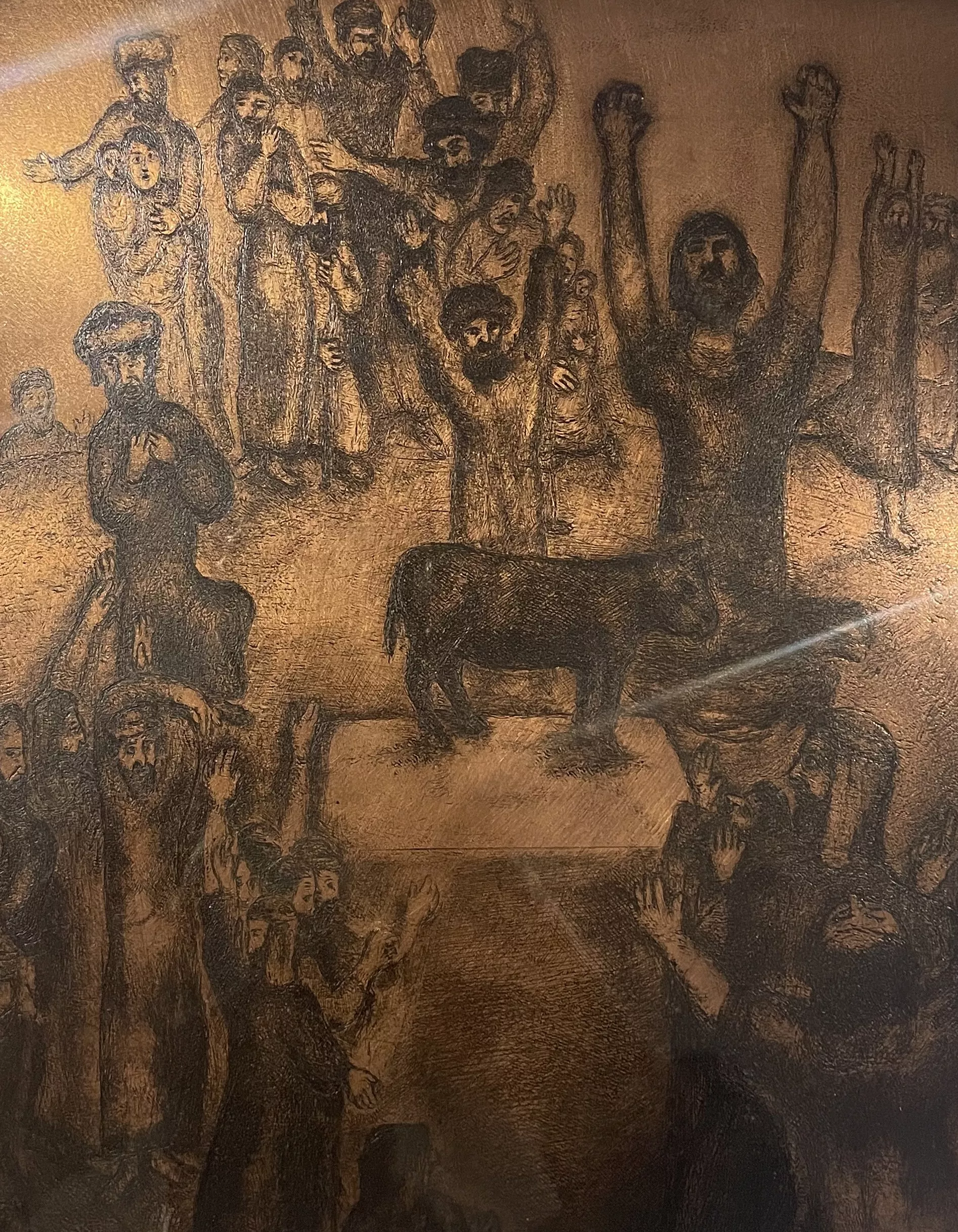
Focus on The Sacrifice of Isaac (Chagall and Caravaggio - putting it into perspective)
Throughout his production, and given that he received numerous commissions from the Church, Chagall was led to treat biblical subjects. This is the case with the Sacrifice of Isaac, explored by many giants of painting before him, including Caravaggio.
Caravaggio (1571 - 1610), produced his Sacrifice of Isaac between 1598 and 1603. In his vision, he adopts a certain naturalism, though the depiction is not devoid of the supernatural. The scene is tense, frozen in a critical moment when the angel stops Abraham's hand.
The expression is intended to be gripping and dramatic, especially that of Isaac's terror, depicted with his mouth half-open in a silent scream, which alone could contain all the dramatic intensity of the composition.
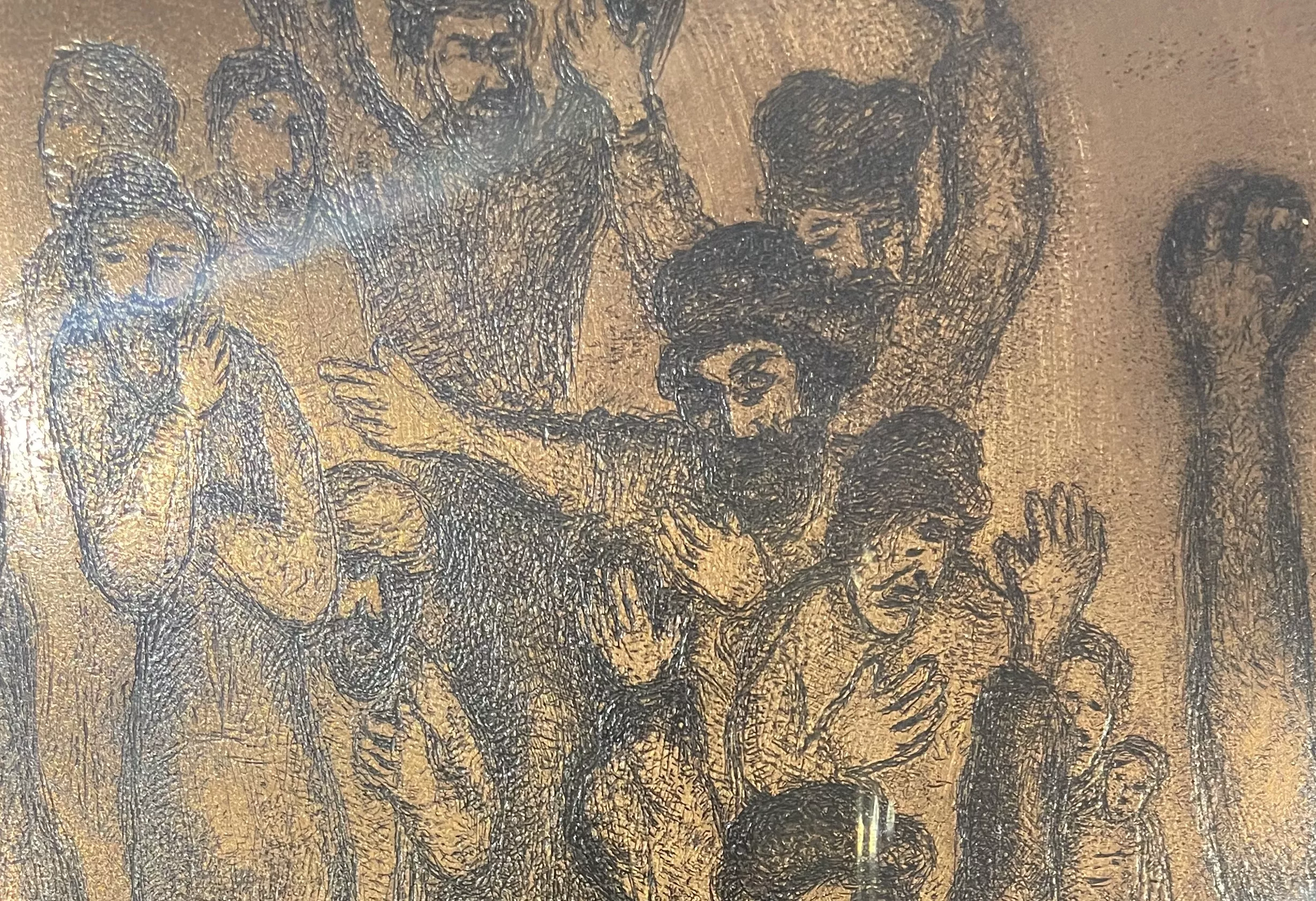
Chagall created his Sacrifice of Isaac in 1966, offering a symbolic and mystical interpretation of the scene. Far from Caravaggio's dramatic, " realistic " treatment, he chose to transform the biblical episode into a lyrical vision - one filled with vivid colors and violent figures.
Beyond the religious narrative, Chagall infuses it with a personal vision, which he also feeds with Jewish history and his own personal experience.
.
Caravaggio remains faithful to his use of chiaroscuro, immersing the scene in contrasting light, which strikes the faces and bodies to accentuate the dramatic tension.
The tones chosen are warm, especially earthy, close to the realists who would come later. These nuances serve to reinforce the impression of a tangible scene. Caravaggio pays attention to the smallest detail, from Abraham's beard to the prominent veins on Isaac's neck, making the rendering almost theatrical.
Chagall, on the other hand, prefers diffuse light and a fairly bright palette. His reds, as usual, are deliberately intense, the blues deep and the yellows naturally luminous, lending an obvious spiritual dimension to the scene.
His composition is not anchored in a physical reality, but in a dreamlike, timeless atmosphere, where Isaac's sacrifice serves to translate human suffering and the fate of the Jewish people.
In Caravaggio's painting, the bodies are sculpted by the light and are meant to be expressive to the extreme. Abraham, portrayed as is customary in the guise of a bearded old man, and holds his son violently, while Isaac struggles, his face marked by anguish.
The angel portrayed behind intervenes energetically, his wings visible - allowing us not to remove any supernatural element from the scene. He stops the action in a rather imperious and natural way.
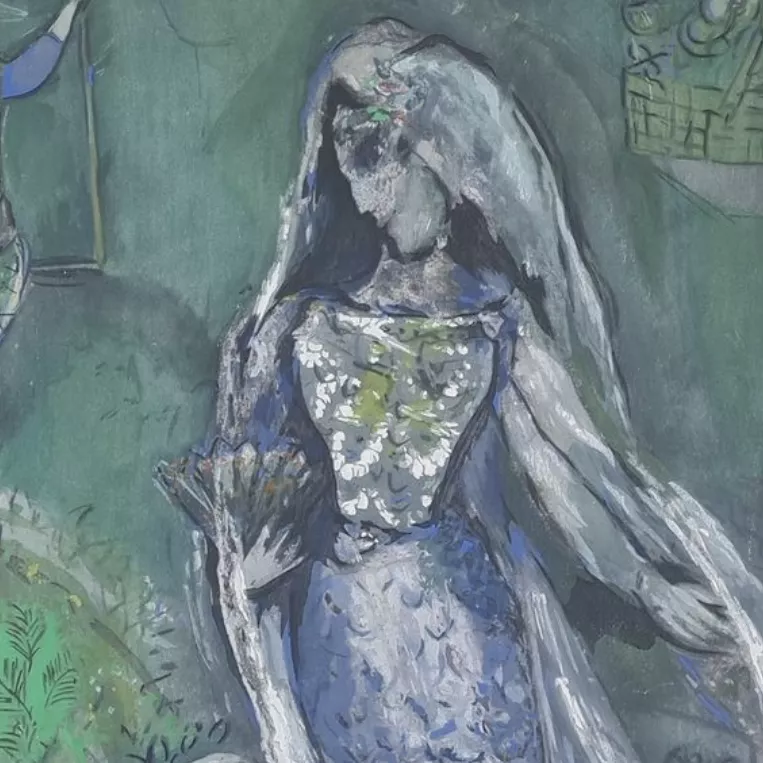
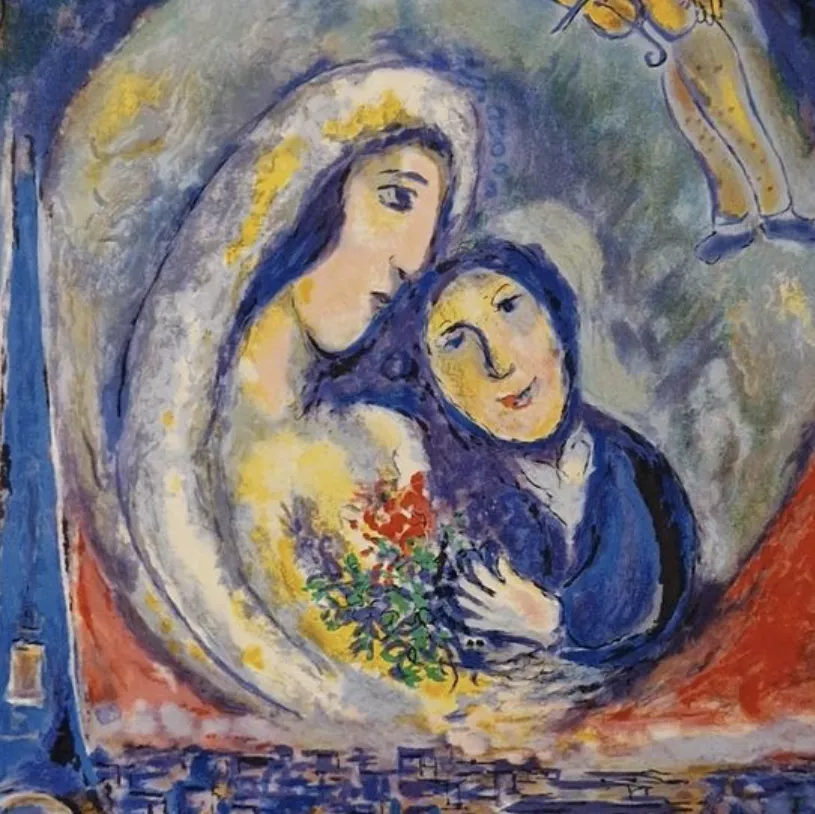
Chagall's figures are highly stylized - he uses an almost abstract treatment. Isaac and Abraham seem to float, and their expressiveness is more interiorized than physical. The angel is not limited to the role of intercessor, but becomes a protective figure who lends a sacred aura to the scene.
Caravaggio emphasizes sacrifice in all its violence, both physical and psychological. The story is told as a test of faith, where man is put to the test of God. The presence of the ram, symbolizing substitution, anchors the theoretical message of salvation and redemption.
Chagall's version, on the other hand, goes beyond the simple biblical narrative. His sacrifice of Isaac becomes a metaphor for historical uprooting and suffering - and puts emotion above literal narrative.
In this way, the two works offer a deferred and different vision of the same biblical episode. While Caravaggio's treatment is fairly realistic and emphasizes the drama, Chagall has a more personal treatment. One seeks a physical and psychological representation, the other a spiritual and historical one. Two aesthetics, two sensibilities.
His signature
Not all Marc Chagall's works are signed.
Although there are variations, here's a first example of his signature:
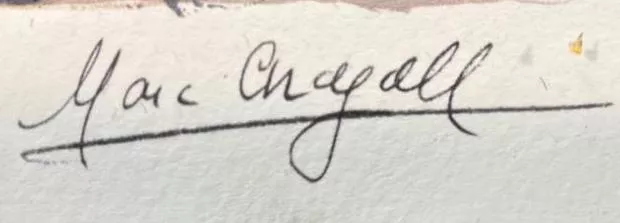
Our team remains at your disposal to identify your works.
Expertise your property
If you own a work by Marc Chagall, don't hesitate to request a free appraisal by filling in our online form.
A member of our team, made up of experts and certified auctioneers, will contact you to provide an estimate of the market value of your work signed by Marc Chagall.
If you are considering selling your work, our specialists will also guide you through the various alternatives available to obtain the best possible price, taking into account market trends and the specificities of each object.
Estimate in less than 24h
Discover in the same theme

Rating and value of Sonia Delaunay's works, drawings and pai...
Sonia Delaunay, a renowned painter and artist, has produced a wide range of works that are sought after and appreciated at auction. Their value is hig...
Learn more >

Rating and value of paintings by Constantin Terechkovitch
Terechkovitch is a Russian Expressionist painter who has produced works that are quoted and valued on the auction market.
Learn more >

Rating and value of paintings by Lin Fengmian
Lin Fengmian is an avant-garde Chinese painter who has produced numerous paintings that are highly valued on the art market.
Learn more >
Works from the same period sold at auction

Estimated 15.000 - 20.000 €
Alfred Auguste Janniot (1889-1968) attributed to : Very large bas-relief

Estimated 15 000 - 20 000 €
Jean HENNINGER (1916-1994) Hunting scene.

Estimated 30 € - 50 €
In the spirit of Keith HARING (1958-1990), Pregnant woman and "radiant baby".

Secure site, anonymity preserved

Auctioneer approved by the State

Free and certified estimates
Frequently asked questions
-
Who was Marc Chagall, and what was his artistic context?Marc Chagall (1887–1985) was a major 20th-century artist born in Belarus. His unique style blends Jewish folk traditions, Cubism, Surrealism, and Naïve art. Known for his dreamlike quality, poetry, and floating figures, Chagall developed an unmistakable stylistic identity using a vibrant palette of intense colors. He also created works in ceramics, stained glass, and mosaics, notably for Metz Cathedral and the Opéra Garnier.
-
What is the price range for Marc Chagall's works at auction?The prices of Marc Chagall’s works vary considerably depending on the medium and authenticity. Paintings range from €80 to €21,432,500 (such as the painting “Les amoureux,” which was sold at auction in 2017). Prints range from €10 to €1,042,751, gouache drawings from €60 to €1,919,409, and sculptures from €200 to €320,000. This wide range reflects the diversity of the works and their levels of rarity.
-
How do you authenticate a work by Marc Chagall?To authenticate a work by Marc Chagall, it is recommended that you seek professional expertise. Auctie's offers a free, no-obligation appraisal request, conducted by its experts and state-certified auctioneers. Our team will contact you to analyze your artwork and provide you with an accurate estimate of its market value within 48 hours.
-
Is this the right time to sell a work by Marc Chagall?Yes, now is a good time to sell a work by Marc Chagall. His works are currently commanding high prices on the art market, and those prices are on the rise. Mythological and religious themes are particularly sought after by collectors, which supports steady demand and prices that are favorable to sellers.
-
How does the sales process work at Auctie's?The process begins with a free, no-obligation appraisal: you fill out an online form, and an expert will contact you within 48 hours with an estimate. If you wish to sell, our specialists will guide you toward the best solution to achieve the optimal price, taking into account market trends and the specific characteristics of your artwork. Auctie's supports you from the initial appraisal through to the auction.
