



Rating and value of paintings by Pierre Puvis de Chavannes

Key takeaways
- Prices for works by Puvis de Chavannes range from €20 (prints) to €770,000 (oil on canvas), reflecting a wide range of market values.
- A leading figure of Symbolism in the 19th century, the artist is prized for his refined style, serene compositions, and timeless pastel colors.
- His drawing “The Childhood of Saint Geneviève” sold for €770,000 in 2024, exceeding its initial estimate of €540,000 to €720,000.
If you own a work by artist Pierre Puvis de Chavannes or based on his work and would like to know its value, our state-approved experts and auctioneers will guide you.
Our specialists will carry out a free appraisal of your work, and provide you with an accurate estimate of its value on the current market.
Then, should you wish to sell your work, we will direct you to the best possible arrangement to obtain the optimum price.
Artist's rating and value
With his elegant, sensitively imbued paintings, Pierre Puvis de Chavannes became a major exponent of Decadantism and Symbolism. Works by Puvis de Chavannes are quite present and appreciated on today's art market.
The prices at which they currently sell range from €20 to €770,000, a considerable delta but one that says a lot about the value that can be attributed to your paintings, prints, drawings and pictures.
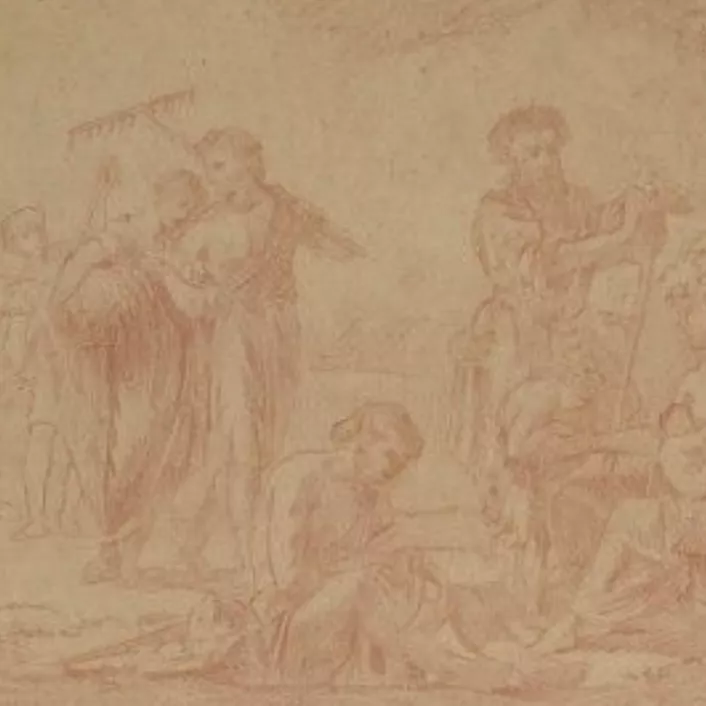
Prized by collectors, some of his exceptional works can fetch hundreds of thousands of euros, as evidenced by his drawing L'enfance de Sainte Geneviève, sold for €770,000, whereas it was estimated at between €540,000 and €720,000.
Order of value from the most basic to the most prestigious
Technique used | Result |
|---|---|
Estamp - multiple | From €20 to €1,800 |
Drawing - watercolor | From €40 to €54,000 |
Oil on canvas | From €140 to €770,000 |
Estimate in less than 24h
The artist's style and technique
The works of Pierre Puvis de Chavannes are distinguished by their serene, poetic approach, where the simplicity of the lines and the softness of the colors establish an atmosphere of eternity and contemplation.
Puvis, in search of a classical ideal, adopts a style that marries harmony and simplicity, freeing himself from superfluous details to better sublimate the human figure and the landscape.
His palette, delicate and often powdered with pastel tones, lends his frescoes a timeless, almost out-of-this-world appearance, where each scene seems bathed in a soft, diffused light.
The artist skilfully plays on the contrasts between light and shadow, not to dramatize, but to accentuate a serene, almost mystical peace, which invites contemplation. His figures, frozen in measured gesture, embody allegories of rest, harmony and the bond between man and nature.
With classical rigor, Puvis de Chavannes constructs his compositions in successive wide planes, creating a spatial depth that gently guides the viewer's gaze through landscapes imbued with quietude.
In his work, eroticism is barely hinted at, evoked with delicate restraint, far removed from the provocation of his contemporaries. Puvis is above all interested in idealized beauty, where the human figure blends into nature as an organic element of the scene, evoking a vision of universal purity.
The result is a style that contrasts with the artistic movements of his time, favoring an interiority and a silent lyricism.
He influenced other Symbolist artists, including Alphonse Osbert, Odilon Redon or Alexandre Séon.
The life of Pierre Puvis de Chavannes
Pierre Puvis de Chavannes (1824-1898), born into a wealthy Lyonnais family, showed from an early age an attraction for art that clashed with the expectations of his milieu.
He began his training at the École des Beaux-Arts in Lyon, but soon felt cramped by the academic straitjacket, aspiring to a more personal and profound artistic expression.
In 1847, he moved to Paris, where he frequented the studios of Thomas Couture and Eugène Delacroix, soaking up a variety of influences while seeking to define his own pictorial language.
In parallel, he established links with artists and writers of the time, forming a network of friendships that enabled him to immerse himself in the artistic effervescence of the capital.
Gradually, Puvis moved towards a pared-down style, in opposition to the narrative overload of academic works, and favored the fresco as the medium for his compositions.
It was at the Paris Salon that Puvis de Chavannes achieved his first successes, affirming his reputation as an innovative artist.
His mural works, which adorn the walls of numerous public buildings, such as the Pantheon and the Hôtel de Ville in Paris, embody his ideal of a grand, timeless painting, where the harmony of lines and the softness of hues create an atmosphere of serenity.
On the bangs of fashions and dominant movements, Puvis was often criticized for the stripped-down nature of his compositions, but he eventually established himself as a major figure, admired for his boldness and originality.
Introspective by nature, Puvis shunned worldly life and devoted himself fully to his art. His austere lifestyle and commitment to a pure artistic vision contrasted with the glitz and glamour of Parisian life.
Although discreet, he gained recognition during his lifetime, notably thanks to the founding of the Société Nationale des Beaux-Arts, which enshrined his work. Elected to the Académie des Beaux-Arts, he was respected as much for his talent as for his sincere quest for an aesthetic of spiritual elevation.
In the last years of his life, a weakened Puvis de Chavannes withdrew somewhat from the hustle and bustle of Paris, nevertheless continuing to paint with undiminished fervor until his final days.
His art, imbued with melancholy and dreaminess, left a lasting imprint on French painting, heralding Symbolism and inspiring subsequent generations.
Les dessous du visible - Puvis de Chavannes
Focus on Le Rêve, Puvis de Chavannes
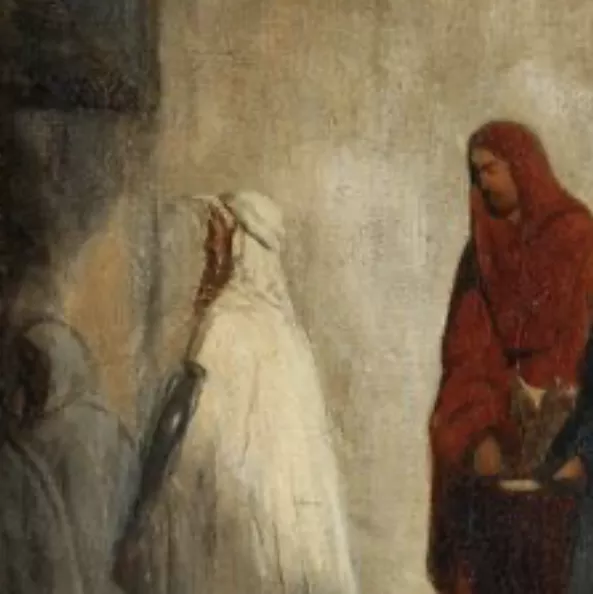
In Le Rêve, Pierre Puvis de Chavannes plunges us into a scene imbued with mysticism, where ethereal figures float above a sleeping young man, symbolizing the fragility of human aspirations and limited access to a divine or spiritual ideal.
Puvis de Chavannes, as a forerunner of Symbolism, focuses here on evoking the invisible, the immaterial. His choice of soft colors, the palette dominated by soothing blues and earthy tones, lends the work a dreamlike calm.
In the context of symbolism in the 20th century, artists often used such symbols to question religious dogma, criticizing a restrictive vision of spirituality.
The three gracefully floating female figures can be interpreted as allegories of faith, hope and charity, but their distant approach to the young man could also reflect the inaccessibility of the religious ideal, a theme dear to the symbolists.
By hijacking traditional codes, Puvis de Chavannes opens the way to an introspective reading: the flowers falling delicately towards the sleeper recall an ideal that we brush against but never grasp.
This is less an affirmation of faith than a personal, intimate spiritual quest, where institutional religion gives way to a free exploration of the mysteries of the human soul.
This type of poetic symbolism is part of a movement that will be pushed further by twentieth-century artists, often with a more virulent critique of the influence of the Church and a quest for spiritual emancipation.
Puvis de Chavannes and Symbolism in the 19th century
Pierre Puvis de Chavannes is often recognized as one of the pioneers of Symbolism, although his work predates the movement's official advent. Through his paintings, he blazed a new trail, where art no longer sought merely to imitate reality, but to evoke ideas, emotions and inner truths.$
His works, marked by serene compositions and allegorical figures, establish an atmosphere of contemplation that invites the viewer to ponder the mysteries of human existence.
Contrary to the naturalists, Puvis de Chavannes does not focus on realistic details, preferring a purification of shapes and colors.
This visual simplification, characteristic of his style, allows a sense of purity and sacredness to emerge, where each element seems to carry a symbolic meaning.
A pioneer in his approach to the invisible, Puvis de Chavannes presents idealized landscapes, scenes suspended in an indefinite space-time, inviting the viewer on an introspective journey.
By moving away from traditional religious themes, he develops a more universal and personal vision of spirituality. His figures, often in a state of contemplation or reverie, embody a quest for the ideal that echoes the concerns of later symbolists.
Through his work, Puvis de Chavannes laid the foundations for an art that transcends appearances, preferring to suggest the invisible forces and deep emotions that inhabit man.
This approach set an example for many Symbolist artists, who found in it a model of detachment from the material world to explore the mysterious dimensions of the human spirit.
In this respect, Puvis de Chavannes stands out as an essential precursor of Symbolism, paving the way for a more introspective art, imbued with silence and poetry, where each image becomes the mirror of an inner reflection.
His works, at once refined and charged with meaning, mark a break with realism and herald a new era in art, that of the search for the absolute.
His signature
Not all of Pierre Puvis de Chavannes' works are signed.
Although there are variations, here is a first example of his signature:
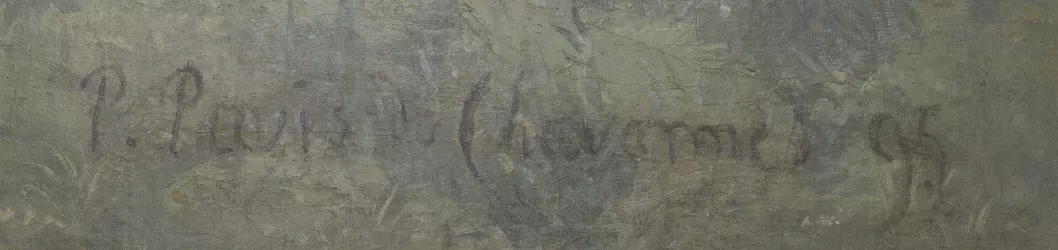
Our team remains at your disposal to identify your works.
Expertise your property
If you happen to own a work by or after Pierre Puvis de Chavannes, don't hesitate to request a free appraisal by filling in our form on our website.
A member of our team of experts and chartered auctioneers will contact you promptly to give you an estimate of the value of your work, and will ensure that you receive ad hoc information about it.
If you are planning to sell your work of art, our specialists will also help you to find alternatives for selling it at the best possible price, taking into account the inclinations of the market and its specificities.
.Estimate in less than 24h
Discover in the same theme

Rating and value of sculptures, bronzes and marbles by Alber...
Carrier-Belleuse was a 19th-century painter and sculptor who produced bronzes and marbles that are valued at auction.
Learn more >

Agathon Léonard porcelain biscuit rating and value
Agathon Léonard was an Art Nouveau sculptor who created porcelain biscuit for the Manufacture de Sèvres, which are listed at auction.
Learn more >

Rating and value of paintings by Conrad Wise Chapman
Conrad Wise Chapman was a 19th-century American landscape and military painter who produced works of high value.
Learn more >
Works from the same period sold at auction

Estimated 1.500 - 3.000
Pascal DAGNAN-BOUVERET (Paris 1852-1929 Quincey) Portrait of a young Breton woman in traditional headdress, Oil on canvas

Estimated 200 - 400
Philippe SWYNCOP (1878-1949) Portait de Madeleine Lejour, Oil on canvas

Estimated 3.000 - 5.000
Henri Adrien TANOUX (1865-1923) The Slave Trader, oil on canvas

Secure site, anonymity preserved

Auctioneer approved by the State

Free and certified estimates
Frequently asked questions
-
Who is Pierre Puvis de Chavannes, and what is his artistic style?Pierre Puvis de Chavannes (1824–1898) was a leading French painter of the Symbolist and Decadent movements, known for his refined and poetic compositions. His style is characterized by simple lines, soft pastel tones, and an atmosphere of timeless serenity. He was a pioneer of Symbolism, which prioritized the evocation of the invisible and inner emotions over realistic imitation, thereby influencing many Symbolist artists such as Odilon Redon and Alphonse Osbert.
-
What are the prices and values of Puvis de Chavannes's works?Prices for works by Puvis de Chavannes range from €20 to €770,000, depending on the medium and rarity. Prints sell for between €20 and €1,800, drawings and watercolors for €40 to €54,000, and oil paintings on canvas for €140 to €770,000. His exceptional works, such as the drawing *The Childhood of Saint Geneviève*, which sold for €770,000, are highly sought after by collectors in today’s market.
-
How can you authenticate a work by Puvis de Chavannes?To authenticate a work by Puvis de Chavannes, we recommend submitting your item for a free appraisal at Auctie's. Our team of experts and state-certified auctioneers will examine your artwork and provide you with an accurate assessment of its current market value, with no obligation on your part.
-
How does the appraisal process work at Auctie's?Appraisals at Auctie's are free and non-binding. Simply fill out a form on our website with information about your item and photos of it. A member of our team of experts and auctioneers will contact you shortly to provide you with an accurate estimate of your item's value, usually within 48 hours.
-
How do you sell a work by Puvis de Chavannes?If you’d like to sell a work by Puvis de Chavannes, Auctie’s will guide you through the process from appraisal to auction. After a free appraisal, our specialists will guide you toward the best sales strategy and advise you on options for selling your artwork at the best possible price, taking current market trends into account.
