



Rating and value of paintings by Stanislas Lépine

Key takeaways
- Works by Stanislas Lépine, a 19th-century landscape painter, fetch a range of prices: prints €20–30, watercolors €60–5,260, and oil paintings up to €205,800.
- His naturalistic paintings of the Seine and Parisian landscapes are particularly sought after at auction for their subtle treatment of light and atmosphere.
- A low-key painter influenced by Corot (1835–1892), Lépine favored balanced compositions, a soft color palette, and an airy perspective, steering clear of the dramatic effects of the Impressionists.
If you own a work by artist Stanislas Lépine or based on his work and would like to know its value, our state-approved experts and auctioneers will guide you.
Our specialists will carry out a free appraisal of your work, and provide you with an accurate estimate of its value on the current market.
Then, should you wish to sell your work, we will direct you to the best possible arrangement to obtain the optimum price.
Artist's rating and value
Stanislas Lépine produced a variety of works, including paintings, watercolors and prints. He mainly depicted landscapes of the countryside.
His naturalistic landscapes are particularly sought-after at auction, and can fetch several hundred million euros in bids.
As witness his oil on canvas La Seine au pont de Sèvres,which fetched €205,800, whereas it was estimated at between €40,000 and €55,000.
Order of value from the most basic to the most prestigious
Technique used | Result |
|---|---|
Estamp - multiple | From €20 to €30 |
Drawing - watercolor | From 60 to 5,260€ |
Painting | From 20 to 205,800€ |
Estimate in less than 24h
Style and technique of Stanislas Lépine
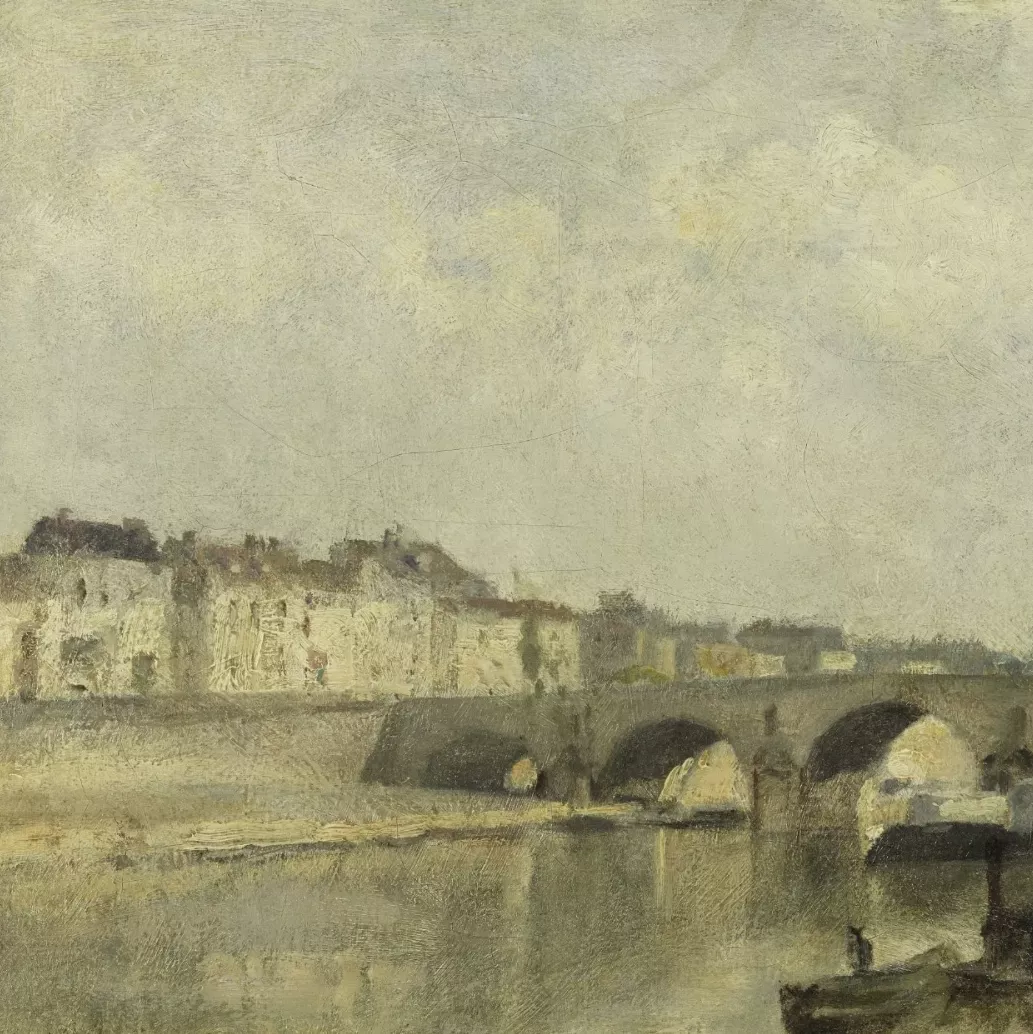
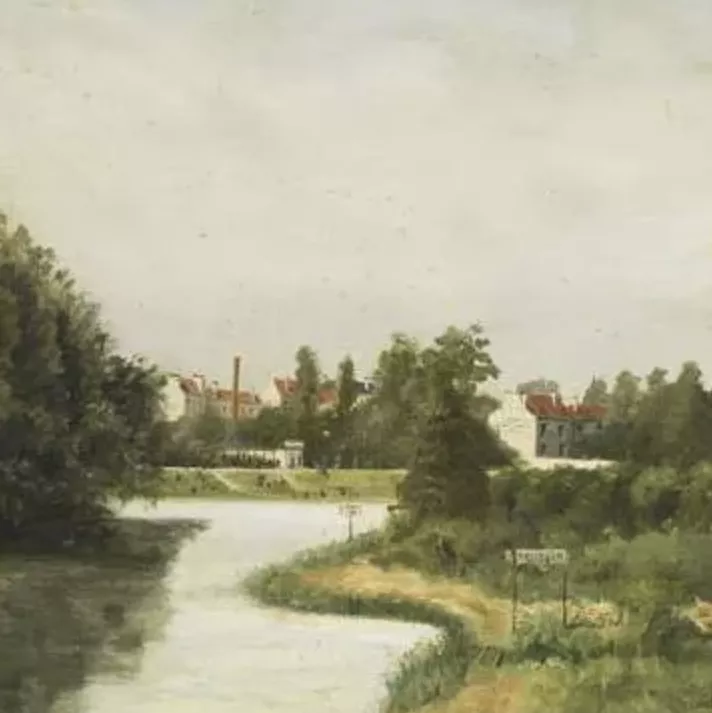
Stanislas Lépine is best known as a landscape painter, following in the footsteps of 19th-century painters of this pictorial genre. He favors tranquil, uncluttered scenes, far removed from grandiose representations.
He is strongly influenced by Jean-Baptiste Corot, especially in his attention to subtle atmospheres and variations in light.
He uses a light, harmonious palette, adopting fairly soft hues and playing on gradations of grays, blues, ochres to give an impression of calm and naturalness. His touch is fluid and delicate, his brushstrokes light, reflecting a search for simplicity and spontaneity.
He thus stays far away from the overemphasized effects of certain Impressionists. His compositions are balanced, and he structures his landscapes with great rigor, favoring horizontal lines and open perspectives - which naturally guide the viewer's gaze.
He depicts many quays and rivers, particularly the Seine and the area around the Paris river, which he depicts with an almost melancholy sensitivity. His work establishes a link between tradition and modernity. He was never strictly speaking an Impressionist, but shares with them a fascination for natural light.
His technique asserts itself without emphasis, his approach based on a rather soothed painting style, which avoids violent contrasts or dramatic effects, thus lending his work a rather timeless elegance.
The life of Stanislas Lépine
Stanislas Victor Lépine was born in Caen, Normandy, in 1835. He soon became interested in painting and decided to leave his region to study in Paris, in the studio of Jean-Baptiste Corot. Corot had a profound influence on his approach to landscape.
Lépine was a discreet and solitary painter, leading a quiet career, preferring to devote himself to painting and producing pictures without seeking official recognition. He nurtured a particular attachment to urban landscapes, developing a predilection for views of Paris and the Seine - painting quays, bridges and alleyways.
He devoted particular attention to the play of light and atmosphere. Nevertheless, he took part in numerous exhibitions, exhibiting regularly at the Salon from 1859 onwards. In 1874, he was exhibited at the first Impressionist exhibition, although he was not entirely one of them.
Lépine was an appreciated but little-known painter. Although some collectors and enthusiasts appreciated his work, he was not commercially successful during his lifetime and was completely unaware of the value his paintings would have in the future. He lived in modest conditions.
His influence was discreet but real, as his work inspired artists attached to the poetic representation of urban landscapes, among them certain Impressionists who shared his fascination for natural light.
Despite some financial difficulties, he continued to paint until the end of his life. He died in Paris in 1892.
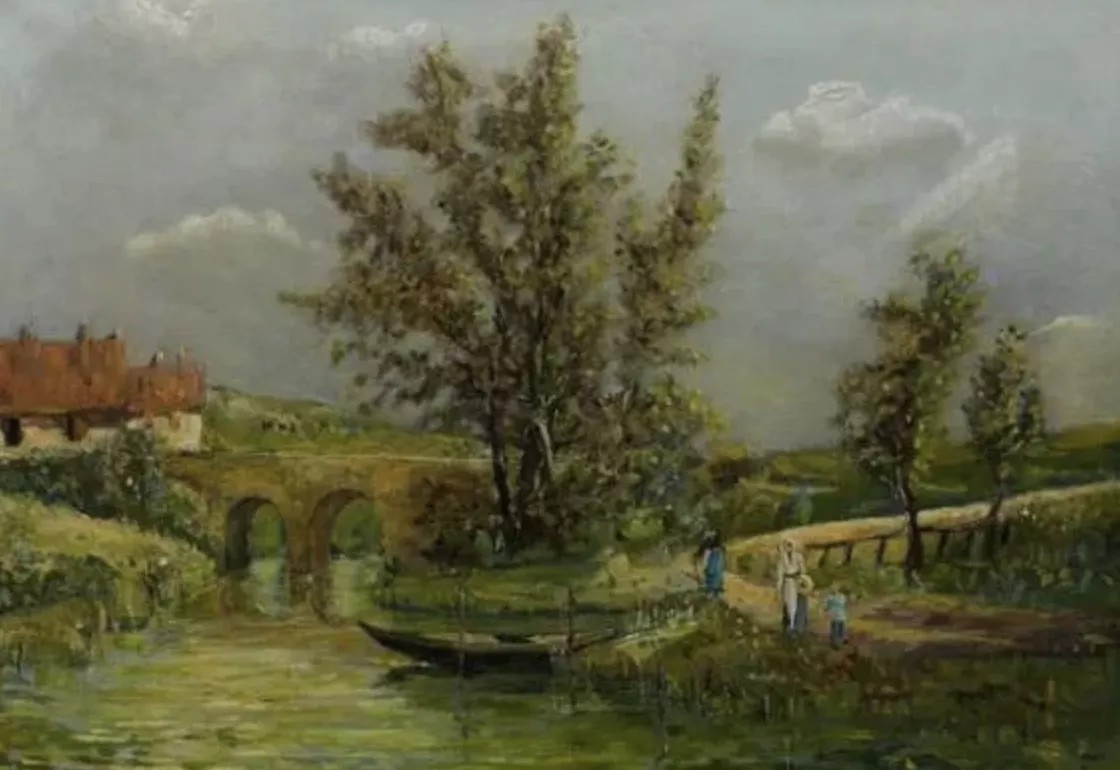
Focus on Le Canal à Saint-Denis, Stanislas Lépine
A painting by Lépine is never static; it soaks up the atmosphere. Le Canal à Saint-Denis is a rigorous demonstration of this.
The diffuse lighting modulates the entire composition, establishing a subtle interplay of values and nuances. The sky, treated in light glazes, is reflected in the water, where silvery and bluish tones intertwine in a moiré surface.
The spatial structure is organized according to a controlled horizontal dynamic. The boats, barely defined, emerge from the pictorial flow without a marked break, while the background dissolves into an atmospheric mist.
The aerial perspective, achieved through tonal modulations and a gradual reduction in contrast, unifies the whole. Lépine doesn't describe, he synthesizes. He doesn't dwell on the anecdote, but on the optical perception of a transitory scene.
The work illustrates a plastic research that runs through the whole of his production. At the end of the 19th century, he purified his pictorial language, favoring chromatic modulation and the erasure of structural lines in favor of visual homogeneity.
Here, pictorial matter is integrated into the support with great economy of means, the brushstroke becomes fluid, contours dissolve.
Analyzing this canvas is to apprehend a work on light and the spatialization of forms, to perceive the interaction between colored masses and the subtlety of tonal transitions.
This is a work which is not limited to the representation of a site, but which questions visual perception and the treatment of pictorial space. This is Lépine's singularity: he doesn't simply paint a landscape, he theorizes its presence.
Stanislas Lépine's imprint on his period
Stanislas Lépine's imprint on his period is not simply a question of landscape, it's a question of light, atmosphere, emotion. Lépine doesn't paint landscapes, he enlivens them. He captures light, shapes it, magnifies it.
He plays with shadow, mist, water, transforming nature into living matter. He doesn't seek to render a simple scene, he seeks to reveal a sensation, a suspended moment.
Each canvas is an invitation to enter into an atmosphere, a vision. Lépine doesn't try to freeze reality, he seeks to turn it into an emotion, a vibration.
He explores the city as he explores nature, with the same gentle, accurate élan. His views of Paris don't describe, they evoke. Quays, bridges and the Seine are not static elements; they breathe, blending into a changing atmosphere, a fragile balance between light and matter.
He's not looking for grandeur, he's looking for the intimate, the subtle, the silent. His Paris is not one of tumult, it's one of misty mornings, of silvery reflections, of skies hesitating between shadow and brilliance.
Far from pomp and pageantry and grand historical scenes, he prefers the furtive moment, the light gliding across a facade, the softness of a milky sky. He's part of tradition, but doesn't confine himself to it. His brush captures what the eye barely perceives, a quiver in the air, a clarity that diffuses.
His art doesn't freeze time, it suspends it, stretches it in a light that unfolds, that evolves with each glance. His work continues to live, to vibrate, and this is perhaps his greatest legacy.
The place of landscape painting on the art market
On the art market, landscape painting can sometimes go unnoticed. Seen and reviewed, discreet and lost among other genres, we often forget the interest of these works. Yet some 19th-century artists, such as Corot, Lazare Bruandet or Jules Breton have a significant rating.
Today, it exists in a balance between heritage and modernity. It crosses eras without disappearing, adapting to new sensibilities and expectations. It does not belong to the past, but dialogues with the present.
On the art market, it retains its place, discreet but essential. It escapes the effects of fashion, following its own rhythm. It doesn't seek the limelight, it seeks the obvious.
In the face of major signatures and contemporary trends, it remains a refuge, a timeless obviousness. It attracts collectors in search of serenity and contemplation.
Its success is not flashy, but constant and profound. It doesn't impose itself, it insinuates itself, finding its place in the eyes of those who know how to see. And this is perhaps its real asset.
His signature
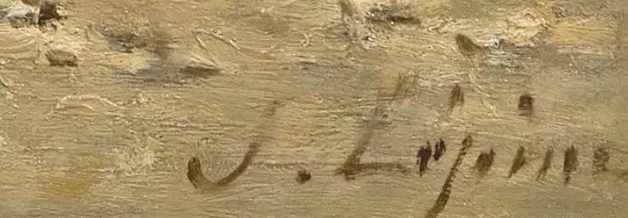
Not all of Stanislas Lépine's works are signed.
Although there are variations, here's a first example of his signature:
Expertise your property
If you own a work by Stanislas Lépine, don't hesitate to request a free appraisal by filling in our online form.
A member of our team of experts and certified auctioneers will contact you to provide an estimate of the market value of your work.
If you are considering selling your work, our specialists will also guide you through the various alternatives available to obtain the best possible price, taking into account market trends and the specific features of each work.
Estimate in less than 24h
Discover in the same theme

Rating and value of sculptures, bronzes and marbles by Henri...
Henri Honoré Plé was a sculptor who made the transition from 19th to 20th century sculpture. His works are highly regarded.
Learn more >

Rating and value of marines paintings by Hendrik Willem Mesd...
Hendrik Willem Mesdag was a marine painter associated with the Hague School, who produced numerous paintings that fetch high prices at auction.
Learn more >

Rating and value of drawings and paintings by Horace Vernet
Horace Vernet was a French Romantic and Orientalist painter who produced numerous paintings that are highly valued and command high prices.
Learn more >
Other similar works sold at auction

Estimated 2.000 - 4.000
Maximilien LUCE (1858-1941), Moulineux, l'entrée du village, circa 1903, Oil on canvas

Estimated 2.000 - 4.000
Ramiro ARRUE (1892-1971,) Landscape in front of the Rhune, Oil on panel

Estimated 800 - 1.500
DAUBIGNY Charles François (1817-1878) Les carrières de Clamart Oil on panel

Estimated 3.000 - 5.000
Georges LAPCHINE (1885-1951) The port of St Tropez Oil on canvas

Estimated 800 - 1.500
Jean Roger SOURGEN (1883-1978) Trees and dunes Oil on panel

Estimated 2.000 - 3.000
Wladimir de TERLIKOWSKI (Poraj, 1873 - Paris, 1951) L'entrée du village Oil on canvas, signed lower left in red.

Secure site, anonymity preserved

Auctioneer approved by the State

Free and certified estimates
Frequently asked questions
-
Who was Stanislas Lépine, and what was his artistic background?Stanislas Lépine (1835–1892) was a 19th-century French landscape painter who trained in the studio of Jean-Baptiste Corot, from whom he inherited a subtle approach to light and atmosphere. Although his work was included in the first Impressionist exhibition in 1874, he was not a full-fledged member of the movement, preferring a more serene and structured approach. He is best known for his paintings of urban and river landscapes, particularly views of Paris and the Seine, which blend tradition and modernity.
-
What are the price ranges for Stanislas Lépine's works?Prices vary considerably depending on the technique and the quality of the work. Prints range from €20 to €30, drawings and watercolors from €60 to €5,260, while paintings (oil on canvas) fetch prices ranging from €20 to €205,800. For example, his painting “The Seine at the Pont de Sèvres” exceeded its initial estimates (€40,000–55,000) and sold for €205,800.
-
How can I authenticate a work by Stanislas Lépine and get an estimate?To authenticate and appraise a work by Stanislas Lépine, we recommend that you contact Auctie's via our free online appraisal form. A state-certified expert or auctioneer will examine your artwork and provide you with an accurate estimate of its market value, with no obligation on your part, within 48 hours.
-
Is this the right time to sell a work by Stanislas Lépine?Yes, now is a good time to sell a work by Stanislas Lépine. Nineteenth-century landscape painting enjoys steady and consistent interest among collectors seeking serenity and contemplation, while the works of this long-overlooked artist are gaining increasing recognition in the art market. Auction results, such as that for “The Seine at the Sèvres Bridge,” demonstrate the strength of demand.
-
How does the sale of a work by Stanislas Lépine take place at Auctie's?At Auctie's, our service begins with a free, no-obligation appraisal conducted by our experts and licensed auctioneers. Once the appraisal is complete and if you decide to proceed, we’ll guide you toward the best sales option for your artwork to maximize its value, and then we’ll manage the entire process through to the auction.
