



Rating and value of works, drawings, paintings by Henry de Groux

Key takeaways
- A Belgian Symbolist painter (1866–1930), Henry de Groux was a member of the group “Les XX” and a leading figure in 19th-century art who was critical of social injustices.
- De Groux’s works sell for between €10 and €37,000 at auction, with his watercolor drawings and oil-on-canvas paintings among the most sought-after by collectors.
- Rooted in Romanticism and influenced by Delacroix, the artist is known for his dramatic compositions that explore historical, mythological, and Byzantine themes with visionary emotional intensity.
A 19th-century Belgian painter, Henry de Groux (1866-1930) is associated with the Symbolist movement.
A member of the artistic group "Les XX", the painter criticized the society of his time and the social injustices it suffered. As such, Henry de Groux is a major figure in 19th-century art.
If you own a work by or based on the artist Henry de Groux and would like to know its value, our state-approved experts and auctioneers will guide you.
Our specialists will carry out a free appraisal of your work, and provide you with a precise estimate of its value on the current market.
Then, should you wish to sell your work, we will direct you to the best possible arrangement to obtain the optimum price.
Artist's rating and value
By virtue of their unusual themes, Henry de Groux's works are quite popular on the art market. His representations, qualified as historical, are the most prized by collectors and can fetch tens of thousands of euros at auction.
The prices at which his works sell range from €10 to €37,000, a considerable delta but one that speaks volumes about the value that can be attributed to the artist's works.
As witnessed by drawingThe Exceptional Bernard De Leye Collection,which went for €37,000 at German auction house Lempertz in 2021.
Order of value from the most basic to the most prestigious
Technique used | Result |
|---|---|
Estamp - multiple | From €10 to €5,000 |
Sculpture - volume | From €150 to €13,000 |
Oil on canvas | From €90 to €35,000 |
Drawing - watercolor | From €25 to €37,000 |
Estimate in less than 24h
Style and technique of the artist Heny de Groux
Opposed to the avant-gardes of his time and emerging movements such as Cubism, Dadaism or Futurism, Henry de Groux is distinguished by a deep attachment to Romanticism.
A fervent admirer of Delacroix and Géricault, he draws on their heritage for an aesthetic imbued with idealism and grandeur.
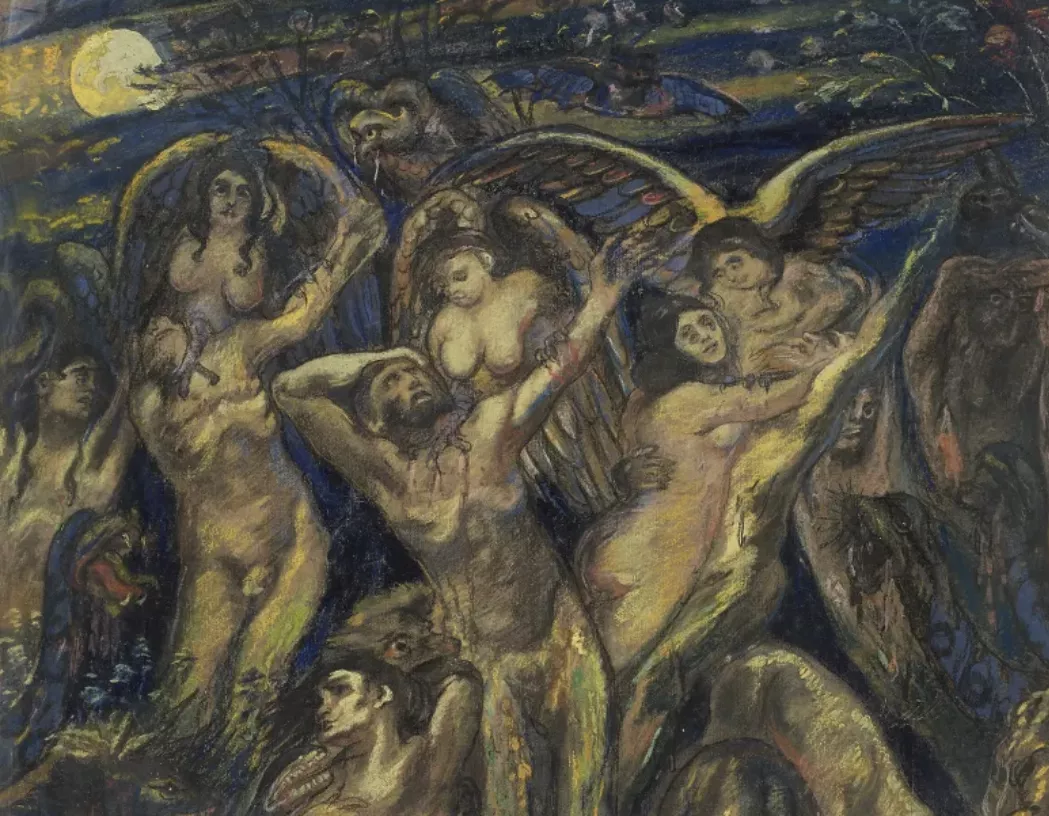
His pictorial compositions, often dramatic and expressive, testify to a taste for heroic themes and apocalyptic visions, where intense emotions dominate.
Parallel to painting, De Groux also distinguished himself in sculpture, where he expressed a similar sensibility. Strongly influenced by Symbolist literature, he created imaginary portraits of mythical and literary figures he deeply admired, such as Baudelaire, Dante and Napoleon.
These works embody an idealized, introspective vision, fusing personal homage with ambitious aesthetic research.
The artist also explores historical and mystical themes, notably through striking depictions of Byzantine history, which he reinterprets with an almost visionary intensity.
His scenes, often populated by tormented crowds and individuals with tortured faces, are bathed in an atmosphere of chaos, where collective hysteria meets almost transcendental violence.
The torments he depicts, both physical and spiritual, reflect a fascination with the limits of the human soul in the face of hardship, while also reflecting his own existential anxieties.
Henry de Groux thus embodies an artistic vision where the exaltation of the Romantic sublime and narrative power intertwine, making him a figure apart, resolutely turned towards an idealized past in a changing world.
The life of Henry de Groux
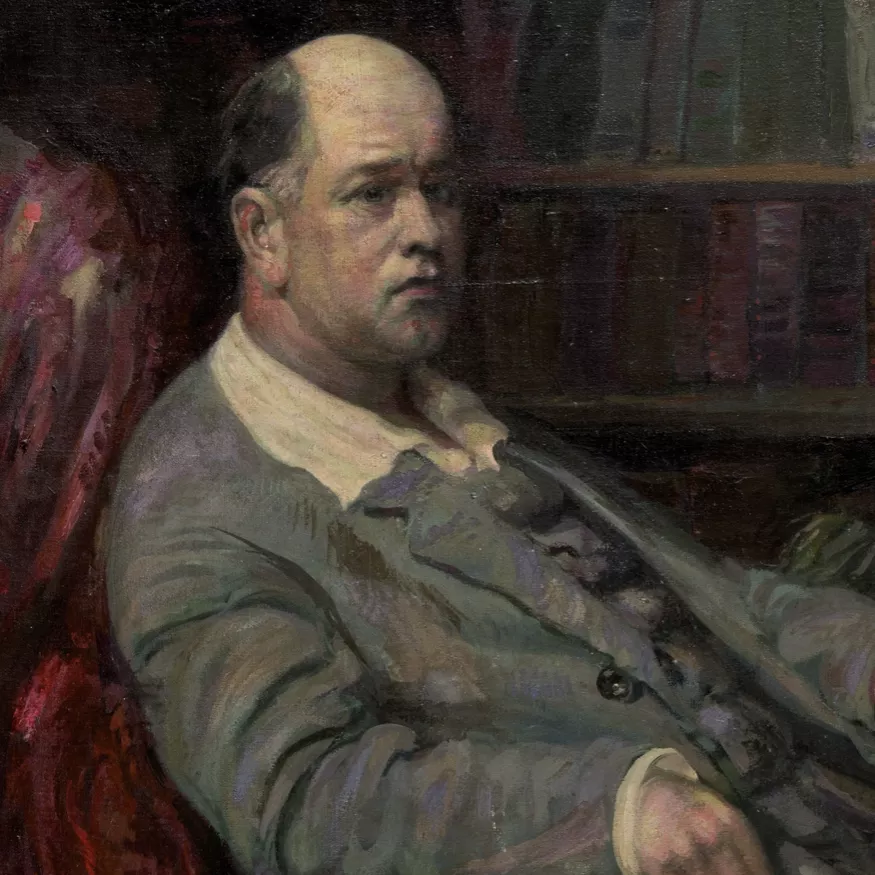
Henry de Groux, born in Brussels in 1866, was the son of Symbolist painter Charles de Groux, from whom he inherited his attraction to expressive, emotionally-charged subjects.
From an early age, he showed a precocious talent for drawing and painting, which led him to enter the Royal Academy of Fine Arts in Brussels.
Rapidly, he distinguished himself by a flamboyant, rebellious personality, often at odds with his contemporaries.
Refusing to bend to academic norms and emerging avant-garde currents, he adheres to a Romantic and Symbolist tradition, where the exaltation of emotions and the quest for the ideal predominate.
During the course of his career, he moved to Paris, where he rubbed shoulders with the intellectual and artistic circles of the late XIXᵉ century.
Prolific, he regularly exhibited his works in prestigious salons, but his clear-cut positions and fiery temperament won him as many admirers as detractors.
Henry de Groux established himself as a committed artist, marked by a fascination for great historical and literary figures, as well as an exacerbated sensitivity to the upheavals of his time.
His personal life, marked by periods of instability and crisis, shines through in his works, in which he expresses his inner torments with unparalleled intensity.
Until his death in 1930, he remained faithful to his romantic aesthetic and fierce independence, leaving behind a prolific body of work deeply rooted in a tragic and sublime vision of humanity.
Focus on Le Christ aux outrages, Henri de Groux
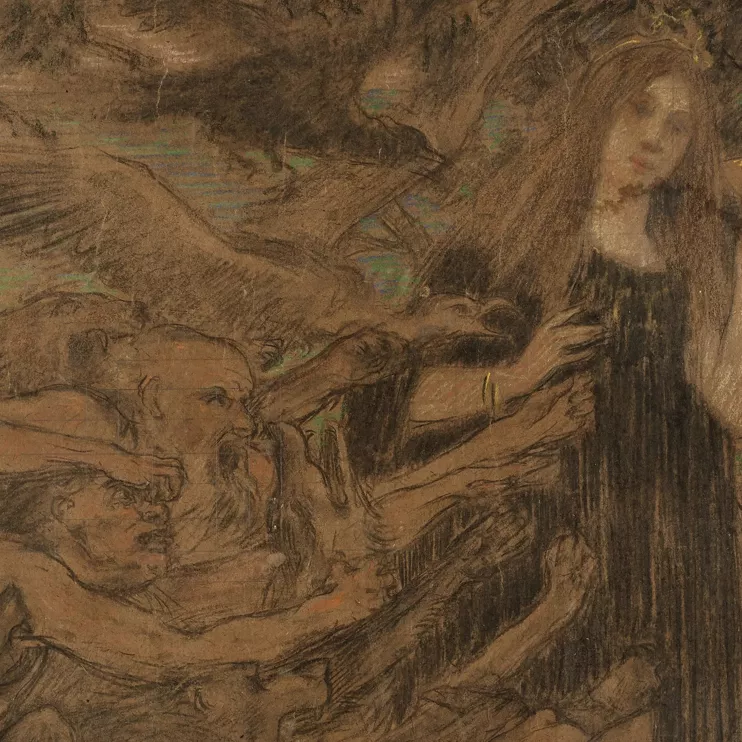
The work "Le Christ aux outrages" by Henry de Groux masterfully illustrates the tragic, intense vision that characterizes his art.
This painting, created in 1891, is part of a Symbolist tradition in which the power of the image transcends the simple biblical narrative to reach a universal and timeless dimension.
At the center of the composition, Christ, dressed in a simple red cloak, seems almost crushed by a threatening crowd. The treatment of the surrounding figures, with their convulsed faces and chaotic postures, reflects a tormented humanity, caught up in blind collective violence.
De Groux adopts a dark palette, dominated by deep blacks and bright reds, lending the scene a dramatic intensity.
The nervous, sometimes cross-hatched brushstrokes bear witness to an inhabited, almost frenetic pictorial gesture, amplifying the emotion conveyed by the work.
Light, for its part, plays a fundamental role: it illuminates Christ in an almost unreal way, creating a striking contrast with the oppressive shadow enveloping the crowd.
This chiaroscuro, inspired by Baroque masters such as Caravaggio, reinforces the impression of a struggle between the divine and the profane, between spirituality and barbarism.
More than just a religious scene, "Le Christ aux outrages" reflects the artist's obsession with existential and moral questions.
By highlighting individual suffering in the face of collective cruelty, Henry de Groux interrogates the human condition in all its complexity.
This painting, both moving and captivating, remains one of the most eloquent testimonies to his artistic and spiritual quest.
The legacy of Henry de Groux
The legacy of Henry de Groux lies in his ability to crystallize, in his works, the tumults and anxieties of an era undergoing profound change.
A marginal figure, often in opposition to mainstream currents such as cubism or futurism, he embodies a late romanticism tinged with symbolism.
His painting, marked by scenes imbued with chaos and exaltation, reveals a rare sensitivity to the human condition and its torments.
Rejecting the conventions of his time, De Groux bequeathed a work of striking intensity, where the pictorial gesture translates an emotional urgency.
Beyond painting, his sculptures and drawings also bear witness to his fascination with heroic figures and mystical themes.
An admirer of Delacroix and Géricault, he took on the Romantic legacy while infusing it with a visionary force that would inspire certain Symbolist and Expressionist artists.
Today, De Groux's work is recognized as a powerful testimony to the fin de siècle, a mirror of the social and spiritual tensions that ran through his era.
While his name remains less famous than that of his contemporaries, his production still influences those who seek to express, through art, the unfathomable depths of human experience.
Through his tormented visions and aesthetic explorations, Henry de Groux leaves a singular imprint, that of an artist in perpetual search of truth and emotion.
Henry de Groux's quote on the auction market
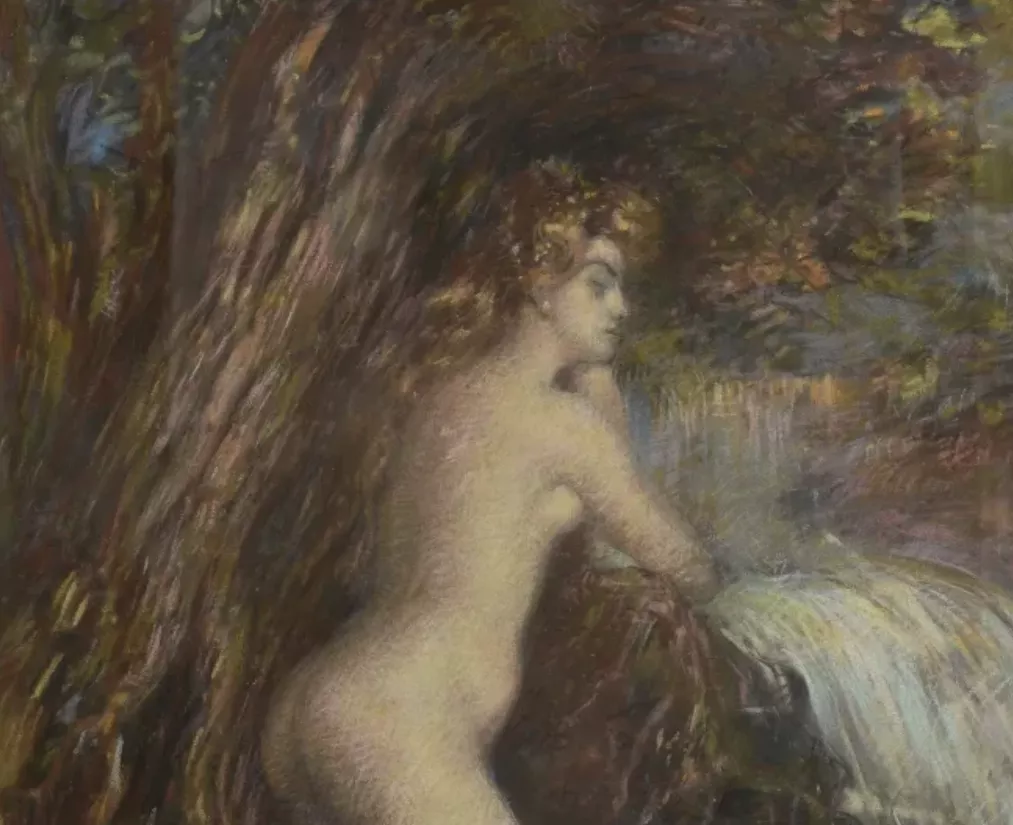
Henry de Groux's quote on the auction market reflects the growing interest in this atypical artist, often seen as a link between late Romanticism and Symbolism, like Gustave Moreau or Odilon Redon. Long overshadowed by the major figures of his time, his works today appeal to collectors drawn by their emotional intensity and narrative richness.
His great pictorial compositions, such as La Guerre or Le Christ aux outrages, fetch notable prices when they appear on the market, sometimes rivalling those of Félicien Rops for their provocative force or Jean Delville for their mystical, transcendent dimension.
De Groux's drawings, imbued with nervousness and density, evoke the studies of Théophile Steinlen or the tormented sketches of James Ensor.
These pieces, privileged witnesses to his creative process, find a loyal audience among lovers of turn-of-the-century symbolism and graphic art.
These sculptures, though rare, are in the tradition of the expressiveness of Carriès or the heroic figures of Rodin, which reinforces their appeal on the market.
While his monumental paintings can fetch several tens of thousands of euros, more modest pieces, such as small studies or lithographs, remain accessible, attracting a wider audience, in the image of works by Alphonse Osbert or Eugène Carrière.
Institutions' increased interest in his work, combined with retrospective exhibitions, consolidated his gradual recognition.
Thus, Henry de Groux, once marginalized, gradually established himself alongside his contemporaries as a key figure for lovers of visionary Romanticism and tormented Symbolism.
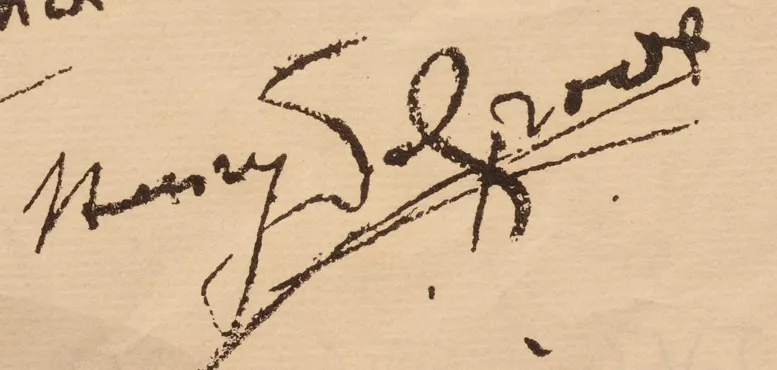
His signature
Not all of Henry de Groux 's works are signed.
Although there are variations, here is a first example of his signature:
Expertise your property
If you own a work by Henry de Groux, please feel free to request a free appraisal by filling out our online form.
A member of our team of experts and chartered auctioneers will contact you to provide an estimate of your work's market value.
If you are considering selling your work, our specialists will also guide you through the various alternatives available to obtain the best possible price, taking into account market trends and the specific features of each work.
Estimate in less than 24h
Discover in the same theme

Rating and value of paintings by Georges Lapchine
Georges Lapchine is a 20th-century Russian painter who produced Russian Impressionist canvases that were highly successful at auction.
Learn more >

Market Value and Price of André Cottavoz's Paintings, Drawin...
André Cottavoz is a twentieth-century Sanzist artist who produced works that are highly rated and valued at auction.
Learn more >

Rating and value of paintings by Paul-Charles Chocarne Morea...
Paul Charles Chocarne Moreau is a 19th-century painter who mainly painted children's scenes, which are highly valued.
Learn more >
Works from the same period sold at auction

Estimated 10.000 - 15.000 €
Ebridge Ayer BURBANK(1858-1949), Young African-American boy, Oil on panel.

Estimated 4.000 - 6.000 €
GASTON CHAISSAC (1910-1964) Composition 1947, Gouache and Indian ink on paper.

Estimated 500 - 800€
Pierre Adrien Dalpayrat (1844-1910), ceramic mask

Estimated 4.000 - 6.000
Ary Scheffer (Dordrecht 1795-1858 Argenteuil) One of the three holy women (meditating on Christ's resurrection after the vision in the tomb?) Oil on canvas

Secure site, anonymity preserved

Auctioneer approved by the State

Free and certified estimates
Frequently asked questions
-
Who is Henry de Groux, and what is his historical context?Henry de Groux (1866–1930) was a 19th-century Belgian painter and the son of the Symbolist painter Charles de Groux. A member of the artistic group “Les XX,” he was a leading figure of late Symbolism, characterized by a deep attachment to Romanticism and a critique of social injustices. Opposed to emerging avant-garde movements such as Cubism and Futurism, he developed a visionary aesthetic marked by emotional intensity and dramatic grandeur.
-
What is the price range for Henry de Groux's works?Prices for works by Henry de Groux range from €10 to €37,000, depending on the medium and the piece’s prestige. Prints range from €10 to €5,000, sculptures between €150 and €13,000, while oil-on-canvas paintings and watercolor drawings—which are more highly prized by collectors—can fetch between €35,000 and €37,000 at auction. His historical and dramatic depictions are the most sought-after on the market.
-
How can you authenticate a work by Henry de Groux?To authenticate a work by Henry de Groux, we recommend that you request a free appraisal from our state-certified auctioneers and experts. Fill out our online form, and a member of our team will contact you to evaluate your work and provide you with an accurate, no-obligation estimate of its market value.
-
Is this the right time to sell a work by Henry de Groux?Yes, this is an excellent time to sell a work by Henry de Groux. The growing interest among collectors and institutions in this once-marginalized artist, combined with a gradual recognition of late Symbolism, is supporting stable and rising market values. His dramatic paintings and emotionally intense drawings appeal to a loyal audience drawn to heroic and mystical themes.
-
How does the process of selling a work of art at Auctie's work?The process begins with a free, no-obligation appraisal: fill out our online form, and our experts will contact you within 48 hours. If you’d like to sell your artwork, our team of licensed auctioneers will guide you through the entire process—from appraisal to the auction—taking into account market trends and the unique characteristics of your piece to help you achieve the best possible price.
