



Ceramic Appraisal: Valuation and Auction

Key takeaways
- The value of a ceramic piece depends mainly on where it was made (Sèvres and Meissen can increase the price by a factor of 10 to 50), the quality of the decoration, and its condition.
- Price ranges vary considerably: regional earthenware 30–300 euros, Moustiers 500–8,000 euros, Sèvres 2,000–100,000 euros, Picasso 3,000–80,000 euros.
- The expertise of a certified auctioneer is essential to distinguish an exceptional piece from a reproduction, with a free, certified appraisal provided in less than 24 hours.
Stoneware, earthenware, and glazed ceramics from major workshops: the value of ceramics varies greatly depending on the workshop, the signature, and the quality of the glaze.
Below you’ll find all our valuation guides dedicated to ceramics—stoneware, earthenware, artist-made ceramics, and workshop pieces. Each guide details the price ranges observed at auction and the factors that determine a piece’s value before it is entrusted to our state-certified auctioneers.
Guides on this type of item
See all guides >
Rating and value of works, prints, paintings by Pierre Alech...
Pierre Alechinksy is a twentieth-century expressionist and surrealist painter who produced many works that are highly regarded on the auction market.
Learn more >

Rating and value of works, drawings, paintings by Kees Van D...
Kees Van Dongen is a 20th-century Fauvist and Expressionist painter whose paintings and drawings are highly prized at auction. Estimated in 24h.
Learn more >

Rating and value of Jean Cocteau's works, paintings and draw...
Jean Cocteau is a twentieth-century artist whose drawings, ceramics and paintings are sought-after at auction.
Learn more >

Rating and value of works, drawings, paintings by Marc Chaga...
Marc Chagall is a twentieth-century artist who leaves behind a substantial body of work, including drawings and paintings that are highly prized at au...
Learn more >

Rating and value of works, tapestries and hinges by Jean Pic...
Jean Picart le Doux was a famous 19th-century painter and upholsterer. His works are very popular on the auction market.
Learn more >

Rating and value of works, tapestries, paintings, drawings b...
Jean Lurçat is a major 20th-century artist, particularly famous for his tapestries. His works are highly prized at auction.
Learn more >

Rating and value of works, drawings, paintings, sculptures b...
Honoré Daumier was a 19th-century painter and cartoonist. He produced many works of great value.
Learn more >

Rating and value of works, sculptures by Amalric Walter
Almaric Walter is a 20th-century sculptor who collaborated with Daum. His works are valued at auction. Estimate in 24h
Learn more >

Rating and value of works, ceramics by Pol Chambost
Pol Chambost is a highly successful 20th-century ceramist. Today, his works are highly prized and quoted at auction.
Learn more >

Rating and value of Dalpayrat ceramics
Dalpayrat, a 19th-century ceramics manufacturer, has produced some of the most unique works on the auction market. Estimates in less than 24h.
Learn more >

Value and rating of Édouard Cazaux's ceramics
Édouard Cazaux, a 20th-century ceramist, produced a significant body of ceramics. His works are highly valued and appreciated.
Learn more >

Value and quotation of works, ceramics by Roger Capron
Post-war designer Roger Capron leaves behind a singular body of work that is still very valuable. Estimate in less than 24h.
Learn more >
Understanding the Value of a Ceramic Piece
What Is Market Value in the Ceramics Market?
A ceramic’s market value refers to the reference value assigned to it by the market at a given time, resulting from a combination of factors including its geographic and cultural origin, the period of production, the manufacturer or artist who created the piece, the manufacturing and decoration techniques, its condition, and the strength of the supporting documentation.
Ceramics, defined as any object shaped from clay or mineral materials and hardened by firing, represent one of the oldest expressions of human creativity and one of the most diverse collectibles markets in existence.
This market has a remarkable characteristic: prices range from a few dozen euros for a common regional pottery piece to several million euros for an extremely rare Chinese imperial piece, and it is not always easy, for a layperson to discern at first glance what justifies such a disparity.
It is precisely for this reason that the expertise of a specialized auctioneer is essential before any purchase or sale in this market: an untrained eye may just as easily underestimate an exceptional piece as overvalue a common object.
Earthenware, stoneware, porcelain, bisque: techniques on the market
Each ceramic technique produces distinct visual and tactile effects that give it its own aesthetic and specific criteria for appraisal.
Earthenware, a ceramic with an opaque tin-glaze in a creamy white hue onto which designs are painted before firing, gave rise in France to the great traditions of Rouen, Moustiers, Strasbourg, and Marseille, whose 18th-century pieces are among the most sought-after on the market.
Stoneware, a ceramic fired at very high temperatures whose vitrified body is naturally impermeable, is found in both European artisanal traditions—such as Beauvais stoneware—and major Asian traditions, including Korean celadon and Japanese stoneware.
Hard-paste porcelain, which requires firing at over 1,300 degrees Celsius and the use of high-purity kaolin, has represented the technical pinnacle of Western ceramics since its development in Meissen in 1708: translucent, resonant, and of immaculate whiteness, it has been adopted by all the prestigious European manufacturers—Sèvres, Meissen, Vienna, and Berlin—and today represents the most highly valued segment of antique European ceramics.
Biscuit porcelain—unglazed porcelain with a matte white finish used to imitate marble in the production of statuettes and decorative groups—completes this remarkably rich technical panorama.
Technique | Characteristics | Origins and Manufacturers | Market Demand Level |
European hard-paste porcelain (Sèvres, Meissen) | Translucency, hardness, high-quality painted decorations | Sèvres, Meissen, Vienna, Berlin | Very strong, institutional |
French earthenware (Rouen, Moustiers, Strasbourg) | Tin-glazed, polychrome decorations, fragility | Rouen, Moustiers, Marseille, Strasbourg | Very active, regional and national collectors |
European and Asian stoneware | Hardness, impermeability, variable glaze | Beauvais ware, Korean and Japanese stoneware | Active, specialized market |
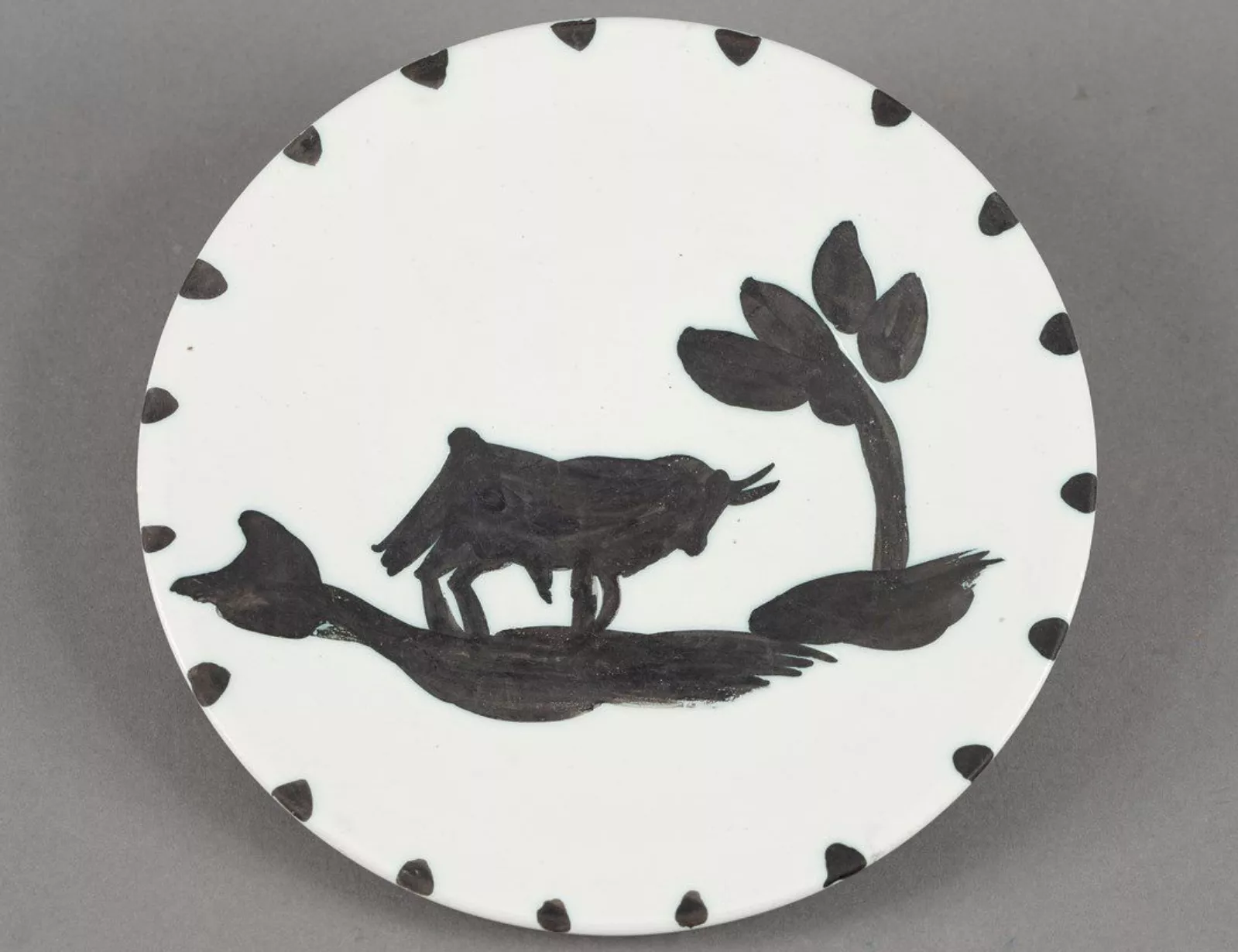
Artist ceramics (20th century) | Artistic expression, one-of-a-kind pieces | Picasso (Vallauris), contemporary potters | Active, growing demand |
Folk and rustic earthenware | Regional artisanal production, naive designs | Regional French pottery | Affordable, active mass market |
The criteria that determine the value of a ceramic piece
The market value of a ceramic piece depends on a hierarchy of criteria, with the manufacturer or artist being the primary determining factor. A Sèvres plate with a royal blue background decorated with scenes painted by the manufactory’s official painter will always be worth significantly more than a piece from the same period produced by a less prestigious manufactory.
The quality of the decoration—whether hand-painted by an identified decorator or applied mechanically—is the second fundamental criterion: the rarest and most refined decorations, painted by artists identified in the manufactory’s records, command a considerable premium.
Price ranges vary widely. A common piece of regional earthenware can cost between 30 and 300 euros. A fine set of 18th-century Moustiers earthenware ranges from 500 to 8,000 euros, depending on quality and condition.
A high-quality piece of Sèvres porcelain sells for between 2,000 and 100,000 euros. A properly authenticated ceramic piece by Picasso made in Vallauris ranges from 3,000 to 80,000 euros. High-quality Chinese imperial porcelain can exceed several hundred thousand euros.
Estimate in less than 24h
Get a Free Appraisal of a Ceramic Piece
A certified appraisal by a licensed auctioneer in less than 24 hours
Identifying the manufacturer of a porcelain piece, deciphering marks and signatures on earthenware, distinguishing an antique stoneware piece from a period-style reproduction, recognizing a decorator’s hand in the records of a major manufacturer: these are all specialized areas of expertise that require in-depth training—and Auctie’s appraiser offers this expertise to you free of charge, with a certified response in less than 24 hours.
What you need to provide for an online appraisal
Clear photographs of the entire piece, its base with any markings, and any significant decoration are essential. Please provide the precise dimensions, the estimated material, the condition, and any documentation of provenance or references in specialized publications.
Manufacturing, Decoration, and Condition: The Pillars of Valuation
Manufacturer’s Marks and Identification: Their Impact on Value
Criterion | Impact on Value |
Manufacturing (Sèvres, Meissen vs. mass-produced items) | Primary factor; can increase value by a factor of 10 to 50 |
Decoration (identified painter vs. ordinary decoration) | Significant premium for high-quality paintings by identified artisans |
Condition (no chips or restoration) | An intact piece is often worth several times as much as a restored one |
Rarity of the model (ceremonial piece vs. mass-produced item) | Ceremonial pieces and rare forms significantly increase value |
Documentation (manufacturer’s inventory or provenance) | Excellent assurance; facilitates appraisal and provides security for the buyer |
Provenance and condition
The provenance of an antique ceramic is an important factor in building trust. A piece whose origin in a major historical collection can be documented enjoys a legitimacy that collectors directly value.
Condition is absolutely critical: earthenware or porcelain without even the slightest chip, crack, or restoration is a highly prized rarity.
Sell Ceramics at Auction with Auctie's
From the reserve price to the final bid
Auctions are the best way to sell high-quality ceramics. Auctie's holds its auctions at the Hôtel Drouot and online, reaching collectors from around the world who are passionate about ceramic art.
Estate Settlement: Appraising Inherited Ceramics
Auctie's works alongside notaries to compile detailed inventories. Each case is handled with the utmost discretion.
Glossary of the Ceramics Market
Term | Definition |
Grade | Estimated market value of a ceramic piece, based on auction results and demand. |
Earthenware | A ceramic with an opaque tin-glaze, decorated with motifs painted before or after firing. |
Hard-paste porcelain | A translucent ceramic made from kaolin clay and fired at high temperatures, invented in China. |
Stoneware | A dense, impermeable ceramic fired at high temperatures, with a naturally vitrified body. |
Biscuit | Unglazed porcelain fired once, with a matte white finish resembling marble. |
Glazed | A glazed layer applied to ceramic to make it waterproof and decorate it. |
Mark | A mark affixed to the underside of the base to identify the manufacturer, artisan, or period. |
Underglaze decoration | Decor painted before the glaze is applied, protected and set by firing. |
Glaze | A colored glassy material used to decorate ceramics or metals. |
Provenance | The history of ownership of a ceramic piece. |
Auction | The awarding of a lot to the highest bidder at the conclusion of an auction. |
Estimate in less than 24h
Let Auctie's appraise your ceramics
Ceramics is humanity’s first art form—one that has accompanied the rise of all civilizations by translating their daily needs and highest aesthetic aspirations into fired clay.
Appraising a ceramic object means interpreting the story behind a gesture, a firing process, a legacy of craftsmanship, and a living aesthetic tradition. Auctie’s offers this expertise to you, free of charge and in complete confidence.
The appraisal is free, with no obligation, and you’ll receive a response within 24 hours.
Discover in the same theme

Rating and value of lithographs and paintings by Hervé di Ro...
Hervé di Rosa is a French painter of the figuration libre movement who has produced numerous works of high value.
Learn more >

The price of paintings and ceramics by Guidette Carbonell
Guidette Carbonell, the power of color in contemporary painting and ceramics
Learn more >

Rating and value of works, drawings, paintings by Chu Teh Ch...
Grand master of Chinese art, millionaire auctioneer, major figure of Asian abstract art: Focus on Chu Teh-Chun.
Learn more >

Secure site, anonymity preserved

Auctioneer approved by the State

Free and certified estimates
Frequently asked questions
-
What factors determine the value of a ceramic piece?The value of a ceramic piece depends primarily on the manufacturer or artist (the primary determining factor), the quality of the decoration and its creator, the condition of the piece—free of chips or restorations—the rarity of the model, and its documented provenance. A piece from Sèvres will therefore be worth significantly more than a mass-produced item from the same period, and an intact piece is often worth several times as much as a restored one.
-
How do I have a piece of pottery authenticated and appraised?Auctie's offers a free, no-obligation appraisal by state-certified auctioneers who specialize in ceramics. To request an appraisal, please submit clear photographs of the entire piece, its base (including any markings), its exact dimensions, its condition, and any documentation regarding its provenance. You will receive a certified response within 24 hours.
-
What are the price ranges for ceramics based on their type?Common regional earthenware typically ranges from 30 to 300 euros. An 18th-century set of Moustiers earthenware ranges from 500 to 8,000 euros. High-quality Sèvres porcelain sells for between 2,000 and 100,000 euros. An authenticated Picasso ceramic ranges from 3,000 to 80,000 euros. High-quality Chinese imperial porcelain can exceed several hundred thousand euros.
-
How do I sell ceramics at auction with Auctie's?Auctie's supports sellers from the initial free appraisal through to the final auction. The auction house holds its sales at the Hôtel Drouot and online, reaching collectors worldwide who are passionate about ceramic art. For estates, Auctie's works alongside notaries to compile detailed inventories with absolute discretion.
-
Why should you hire an expert to appraise a piece of ceramics?Identifying the manufacturer of a piece of porcelain, reading marks and signatures, distinguishing an antique stoneware piece from a reproduction, or recognizing the hand of a decorator requires in-depth training. An untrained eye may just as easily underestimate an exceptional piece as it might overvalue a common object. The specialized expertise of an auctioneer is therefore essential before any purchase or sale.
