



Ratings and values of paintings by Luong Xuan Nhi

Key takeaways
- The works of Luong Xuan Nhi, a Franco-Chinese artist, sell for between €200 and €96,240, with a world record of €590,000 set in 2021 for "Le tricot."
- His drawings and watercolors fetch prices ranging from €1,100 to €590,000, while his paintings range from €250 to €240,000 depending on technique and quality.
- A student at the École des Beaux-Arts de l’Indochine, founded in 1925, this artist, born in 1914, combines European techniques with Vietnamese traditions through his modernized silk paintings.
If you own a work by Luong Xuan Nhi or one based on the artist, and would like to know its value, our state-approved experts and auctioneers will offer you their appraisal services.
Our specialists will carry out a free appraisal of your work, and provide you with a precise estimate of its value on the current market.
Then, should you wish to sell your work, we will direct you to the best possible arrangement to obtain the optimum price.
Rating and value of the artist Luong Xuan Nhi
The artist Luong Xuan Nhi leaves behind a distinctive body of work, composed mainly of drawings and paintings. He is Franco-Chinese. Now, the prices of his works are rising under the auctioneers' hammer.
The price at which they sell on the art market ranges from €200 to €96,240, a significant gapbut one that speaks volumes about the value that can be attributed to Luong Xuan Nhi's works. He is especially prized by buyers from Hong Kong, China and France.
In 2021, an ink on silk on canvas entitled The Knitting, dating from 1941, sold for €590,000, a world record to date for the artist, while it was estimated at between €160,000 and €200,000. His value has exploded in recent years.
Order of value from a simple work to the most prestigious
Technique used | Result |
|---|---|
Painting | From €250 to €240,000 |
Drawing - watercolor | From €1,100 to €590,000 |
Estimate in less than 24h
Style and technique by artist Luong Xuan Nhi
In Luong Xuan Nhi's painting, the surface retains this function of balance, clarity, ordered stability.
But it no longer relies on the rigor of line or the solidity of volume: it is articulated around a controlled fluidity, a measured suppleness, a constructed transparency. The light, discontinuous brushstroke deposits color without fixing it, without saturating it.
The drawing, discreet, sometimes effaced, does not delimit: it accompanies the form, letting it emerge. Color, treated in washes or matte solids, organizes the composition by zones, by breaths, without ever breaking the continuity of the pictorial field.
In portraits of young women, market scenes or urban views, the motif does not impose itself on the eye: it settles, at a distance, in a calm frontality. The diffused light evens out the planes, absorbs the contrasts, and unites the figures with their setting.
This construction by fusion rather than opposition is found in Jeune femme au foulard violet (fig. 1), where the face, treated without shadow or relief, seems suspended between two flat tints of color, one for the background, the other for the garment.
The gaze, fixed, peaceful, does not seek to question, but to stand. The drapery, reduced to a few supple lines, does not describe the fabric: it restores its lightness.
The space, with no depth, no marked perspective, is conceived as a continuous field, where each form finds its place without tension. The slow, stable rhythm is based on the repetition of curves, on the balance of colored masses, on the restraint of gesture.
So, removed from both narrative and expression, Long Xuan Nhi's painting asserts a logic of silent construction, where the figure, far from being central, becomes part of a whole, integrated, soothed, held.
Luong Xuan Nhi's life
In Luong Xuan Nhi's career, academic training retains this function of rigorous line, mastery of form, clarity of vision.
Pupil of the first graduating class of the École des Beaux-Arts de l'Indochine, founded in Hanoi in 1925 by Victor Tardieu, he received instruction based on observation, construction and the discipline of drawing, alongside other artists such as Alix Aymé or Thoung Lan Nguyen.
Born in 1914, he was one of a generation of Vietnamese artists who sought to combine European techniques with local traditions. Very early on, he adopted silk painting, which he adapted to a modern aesthetic, based not on rupture but on simplification, stability and fluidity of composition.
From the 1930s onwards, he exhibited at salons organized by the School, then abroad, where his work was quickly identified by its restraint, economy of means and attention to motif.
In the decades that followed, he in turn taught, directed the École supérieure des beaux-arts du Viêt Nam, and took part in his country's artistic life without ever inflecting his style.
Thus, unaffected by school effects or variations in fashion, Luong Xuan Nhi's career is part of an assumed continuity, based on discretion, precision and poise - an art without emphasis, without rupture, but of constant coherence.
Focus on Young Girl with Lotus, Luong Xuan Nhi
In Young Woman with Lotus (fig. 1), the composition retains this function of calm, stability, measured frontality.
But it doesn't rely on a posture effect or the staging of the subject: it is organized around a silent balance between figure, object and space.
The face, oval, smooth, with no marked expression, barely stands out from the background, in a gentle continuity between skin, clothing and background.
The flower, held in both hands, is neither accentuated nor stylized: it extends the line of the arms, responding to the curve of the body. The color, applied in transparent washes, settles in without contrast, in a restricted range of beiges, browns and pale pinks. The plain, depthless background doesn't frame: it envelops.
No element breaks this unified surface. The light is diffuse, even, without direction or intensity: it illuminates without shaping. The gaze, calm, does not catch, but lets itself be gazed at. The motif tells nothing, suggests nothing: it stands.
Then, removed from effect, narrative, immediate expression, Luong Xuan Nhi's image imposes a form of quiet obviousness, a restrained construction, where the figure is not a center but an element among others, attuned to the lines, hues, silence of the whole.
Luong Xuan Nhi's imprint
In Luong Xuan Nhi's work, silk painting retains this function of continuity, transmission, visual balance.
But she is no longer content to apply an inherited model: she reorganizes the surface, simplifies forms, imposes a new logic of construction, based on restraint, frontality, clarity.
At a time when modernity often expresses itself through rupture or tension, her work asserts a measured stability, a constant discretion, a silent rigor.
The figures, centered, held, isolated in calm flat tints, impose a presence without narration, without pathos, without effect. The image doesn't tell the story: it holds its ground. This restraint becomes a position.
In teaching, in exhibitions, in the institution, this position asserts itself with the same constancy. Luong Xuan Nhi's style, identifiable without being rigid, had a lasting influence on Vietnamese painting in the decades that followed, notably in his way of combining precision of drawing, mastery of emptiness and absence of insistence.
Thus, removed from any demonstration, Luong Xuan Nhi's imprint is inscribed in a sober, regular line, without apparent brilliance, but of a held coherence, whose correctness continues to act, without noise.
Luong Xuan Nhi's place in Vietnamese painting
In Vietnamese painting of the XXᵉ century, Luong Xuan Nhi's work retains this function of discreet landmark, mastered continuity, formal coherence.
But it is not part of a logic of avant-garde or rupture: it occupies a median, stable position, between heritage and adaptation.
Trained at the École des Beaux-Arts de l'Indochine, active in the early institutions of the Republic, he embodies a generation that seeks less to overturn frameworks than to reformulate them, simplify them, make them compatible with a modernity without violence.
His painting on silk, rigorous, appeased, became a model of graphic clarity and pictorial holding.
In a history marked by political tensions, aesthetic shifts, changes of reference, his work maintains a line. No slogan, no militant image, no imposed style: a balanced surface, a posed motif, a held gesture.
Then, removed from the most visible manifestations, Luong Xuan Nhi's place is established differently - not in rupture, but in continuity, in slow construction, in the lasting accord between form, support and gaze.
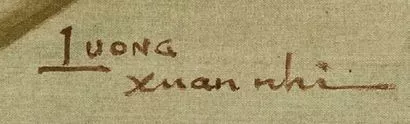
Recognizing the artist's signature
Luong Xuan Nhi his works most of the time, in French and Chinese, and marks his watercolors with a seal. However, it is essential to have your work appraised to be sure of its originality. What's more ; there are of course many copies.
Knowing the value of a work
If you happen to own a work by Luong Xuan Nhi or after the artist, don't hesitate to request a free appraisal using our form on our website.
A member of our team of experts and certified auctioneers will contact you promptly to provide you with an estimate of the market value of your work, as well as ad hoc information about it.
If you wish to sell your work, you will also be accompanied by our specialists in order to benefit from alternatives for selling it at the best possible price, taking into account market inclinations.
.Estimate in less than 24h
Discover in the same theme

Rating and value of works, drawings, paintings by Fernand Ve...
Fernand Verhaegen is a twentieth-century Belgian painter who produced drawings and oils on canvas that are highly regarded on the auction market.
Learn more >

Rating and value of paintings by Louis Rollet
Louis Rollet is a twentieth-century Orientalist painter who has produced works that are highly regarded and valuable at auction. Estimated in 24h.
Learn more >

Rating and value of paintings by Vladimir Velickovic
Vladimir Velickovic is a painter of narrative figuration who has produced works that are highly rated and valued on the art market.
Learn more >
More Asian art at auction

Estimated 1000 - 2000 €
NGUYEN TUONG LAN (1906-1947) - Ink and gouache painting on silk depicting a temple.

Estimated 1.000 - 2.000
TRAN DUY (1920-2014). École des beaux-arts de l'Indochine, preparatory class 1945, ink and color painting on silk

Estimated 15.000 - 20.000
ZAO WOU-KI (1921-2013) Composition, 1972, Brush and Indian ink on Asian paper.

Estimated 2.000 - 4.000
VIETNAM, 20th century. Lacquer on panel, fishermen and sampans on a river. Signed Thanh and dated 55

Estimated 12.000 - 15.000
Nguyễn Tường Lân (1906-1946), (Workshop of) Tuong Lan NGUYEN "Hiện vẻ hoa - Showing the flowers" Ink and colors on silk, mounted on paper.

Estimated 1.000 - 1.200
Nguyen Tri Minh (1924-2010) "Lotus and Bamboo" Oil on isorel

Secure site, anonymity preserved

Auctioneer approved by the State

Free and certified estimates
Frequently asked questions
-
Who is Luong Xuan Nhi, and what is her artistic background?Luong Xuan Nhi (1914–) is a Franco-Chinese artist who trained at the Indochina School of Fine Arts in Hanoi in 1925. He belongs to the first generation of Vietnamese artists to have combined European techniques with local traditions, notably through silk painting adapted to a modern aesthetic. He later served as director of the Vietnam National Academy of Fine Arts, and his work had a lasting influence on 20th-century Vietnamese painting through its precision, subtlety, and formal balance.
-
What is the price range for Luong Xuan Nhi's works on the market?The prices of Luong Xuan Nhi's works range from €200 to €96,240, depending on the type and technique. Paintings range from €250 to €240,000, while drawings and watercolors can fetch between €1,100 and €590,000. Her world record remains an ink-on-silk piece titled “Le tricot” (1941), which sold for €590,000 in 2021—well above its initial estimate—reflecting a skyrocketing market value in recent years.
-
How can you authenticate a work by Luong Xuan Nhi?Authentication of a work by Luong Xuan Nhi requires a professional appraisal by Auctie's. Our state-certified experts and auctioneers will examine your artwork free of charge and with no obligation to confirm its authenticity. This step is essential because many copies exist, even though the artist generally signed his works in French and Chinese and stamped his watercolors with a seal.
-
Is this a good time to sell a work by Luong Xuan Nhi?Yes, now is a good time to sell a work by Luong Xuan Nhi. His market value has been skyrocketing for several years, and prices have been rising steadily at auctions, particularly among buyers from Hong Kong, China, and France. This positive market momentum offers a favorable opportunity to get a better price for your work.
-
How does the appraisal process work at Auctie's?Appraisals at Auctie's are free and non-binding. Simply fill out a form on our website to request an appraisal. A member of our team of experts and licensed auctioneers will contact you promptly to provide an estimate of your artwork’s market value and share relevant information with you; we typically respond within 48 hours.
