



Rating and value of works, drawings and paintings by Victor Vasarely

Key takeaways
- Victor Vasarely (1906–1997), the undisputed master of Op Art, dominates the market with works priced between €5 and €535,240.
- His paintings are the most highly valued segment, while prints (€5 to €60,000) and tapestries (€700 to €59,000) offer more affordable entry points.
- The “Zèbre” and “Vega” periods (beginning in 1968) are in the highest demand among collectors, particularly in France and the United States.
Heir to the Bauhaus and proponent of total art, Victor Vasarely (1906-1997) is the most famous exponent of Op art. Very popular in Paris in the 1980s, his artistic posters represent his psychedelic, illusionist and abstract style, and can be seen all over the city.
If you own a work by or based on the artist Victor Vasarely and would like to know its value, our state-approved experts and auctioneers will guide you.
Our specialists will carry out a free appraisal of your work, and provide you with a precise estimate of its value on the current market.
Then, if you wish to sell your work, we will direct you to the best possible arrangement to obtain the optimum price.
Rating of the artist Victor Vasarely
Victor Vasarely enjoyed great success during his lifetime thanks to his participation in some of the major events of his time. He quickly established himself as a major player on the art market.
Today, his works are successful in auction houses and attract a large number of collectors. His pieces are traded mainly in France and the United States.
The price at which his works sell on the auction market ranges from €5 to €535,240, a substantial delta but one that speaks volumes about the value that can be attributed to the artist's works.
As witness his oil on canvas Atlai III, dating from 1955, sold for €535,240 in 2010, while it was estimated at between €113,880 and €170,820.
Order of value from the most basic to the most prestigious
Technique used | Result |
|---|---|
Estamp - multiple | From €5 to €60,000 |
Furniture | From €138 to €7,000 |
Ceramics | From €250 to €8,000 |
Upholstery | From €700 to €59,000 | Drawing - watercolor | From €160 to €69,195 |
Sculpture - volume | From €200 to €130,480 |
Painting | From €686 to €535,240 |
Estimate in less than 24h
Victor Vasarely's style and technique
In Victor Vasarely's painting, geometry retains this property of structuring space, of distributing forms according to a rigorous logic.
But this is at the price of a shift: it no longer simply organizes the pictorial field, it becomes its unstable motor, the site of a perception in constant reconfiguration.
The figure disappears, but the optical structures attached to it remain, i.e. frames, networks, contrasts.
In Vega-Nor (fig. 1), the grid no longer rests on a fixed system: it bulges, expands, contracts, as if subjected to an internal force. The surface, though flat, seems to be sucked into a moving depth.
The color, reduced to a play of clean values, no longer models volumes but reverses their reading, according to an optical logic that reverses the hierarchies of form.
The motif is no longer a decorative element: it becomes a dynamic field, a wave that runs through the composition.
Thus, stripped of its classical function of harmonization, geometry now devotes itself to producing visual tensions, generating an unstable, autonomous space that escapes the very gaze it solicits.

The life of Victor Vasarely
Victor Vasarely was born in 1906 in Hungary. After studying medicine, Vasarely turned to art in 1925. Attracted by the Bauhaus movement, a few years later he joined the Muhëly in Budapest, a school based on the Bauhaus model. The young artist would benefit from the teachings of the famous Walter Gropius, Wassily Kandinsky and Paul Klee.
At the same time, Victor Vasarely discovered abstract art and constructivism. These movements would have a significant impact on his entire career.
In 1930, Victor Vasarely moved to Paris, where he worked as a graphic designer and draftsman in various advertising agencies.
From 1930 to 1947, Vasarely conducted graphic experiments focusing on light, perspective and lines. From 1935 onwards, his paintings reveal Cubist and Surrealist influences. His art gradually became abstract. His artistic research focused on pure forms and colors.
In the 1950s, Victor Vasarely created contrasting compositions by juxtaposing colors and geometric shapes. From 1958 onwards, he turned to kineticism then to pop-art. His canvases became increasingly vivid.
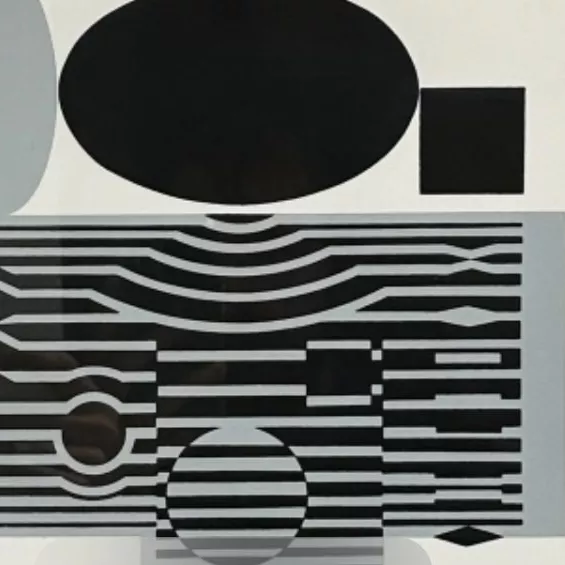
The Vega period, explored from 1968 onwards, is Victor Vasarely's most famous. His works are characterized by distorted geometric volume shapes, inspired by planets and cells.
Focus on Vega 200, Victor Vasarely
In Vega 200 (fig. 1), an acrylic on canvas by Victor Vasarely, the orthogonal grid retains this ability to organize space, to distribute units according to a pre-established order. But it does so at the cost of a certain slippage: the regularity of the module becomes the medium of a distortion, the matrix of a movement that alters the stability of the visual field.
The circle at the center is not drawn: it emerges from the progressive dilation of the squares, like an internal thrust that inflects the grid. The illusion of volume is no longer achieved by modeling, but by the deformation of the system itself, by the repeated gap between the shape and its frame.
The color, treated in clean gradations, does not indicate light, but accentuates the fictitious curvature of the surface. The space thus produced is never given all at once: it pulses, contracts and relaxes to the rhythm of optical tensions.
Then, freed from any mimetic function, the image no longer shows a form, it generates it, it makes it happen through the variations of a closed system, where each element, however minute, participates in the general instability of perception.

The characteristics of Op Art
In Op Art, perception retains this ability to organize the image, to stabilize forms in a coherent visual field. It has also been developed by artists such as André Cadere or Alexandra Exter.
However, this comes at the price of a certain change: it no longer relies on the representation of an object, but on the activation of a system, on the setting in motion of a network of lines, contrasts or modules.
The figure disappears, but the optical effects traditionally associated with it remain: sparkles, vibrations, pulsations, illusions of depth.
In the works of Bridget Riley or Victor Vasarely, the pictorial surface ceases to be a space for projection, becoming an active plane, a dynamic structure that produces its own variations.
The line no longer delimits, it undulates; the motif no longer frames the form, it contradicts it, submerges it, tilts it.
The illusion, far from being an artifice, becomes the very heart of the device, the condition of the visual experience.
This subversion of perceptual reference points is accentuated by the systematic use of geometry, value contrasts and play on scale.
Color, often reduced to binary combinations or rigorous gradations, no longer serves to shape form, but to disrupt its reading. Black and white, complementary colors and gradual transitions are all used to generate optical conflicts, instability and floating phenomena.
Then, stripped of its descriptive function, painting becomes a field of operations, a space with no real depth, but saturated with effects. The gaze finds no resting point: it is caught in a loop, solicited, manhandled, projected from one point to another.
Op Art does not seek to represent reality, but to make vision itself an object of experimentation. Through this internal logic, it returns the image to its primary elements - line, contrast, surface - the better to divert them, to proliferate them in a space where the eye, in attempting to see, reveals its own limits.

Victor Vasarely's imprint on his time
In his lifetime, Victor Vasarely enjoyed great renown. In addition to his artistic experiments, he produced commissioned works, both public and private, which were integrated into Parisian public spaces.
Leaving behind a large artistic output, Vasarely was very present on the art market.
His works from his "Zebra" and "Vega" periods are highly sought-after by collectors, and can fetch hundreds of thousands of euros at auction.
In addition to his pictorial works, Vasarely produced a number of volumes, furniture, tapestries and ceramics. Less common on the art market, these works are sold for thousands of euros, with the exception of his tapestries, which can fetch tens of thousands of euros.
His signature
Victor Vasarely's works are not all signed.
Although there are variations, here is a first example of his signature:

Expertise your property
If you own a work by Victor Vasarely, don't hesitate to request a free appraisal by filling in our online form.
A member of our team of experts and certified auctioneers will contact you to provide an estimate of the market value of your Victor Vasarely work.
If you are considering selling your work, our specialists will also guide you through the various alternatives available to obtain the best possible price, taking into account market trends and the specificities of each work.
Estimate in less than 24h
Discover in the same theme

Rating and value of works, drawings, paintings by Gustave Ca...
Gustave Cariot was a twentieth-century pointillist painter who produced drawings and oil paintings that were appreciated and quoted at auction.
Learn more >

Rating and value of sculptures, bronzes and drawings by Remb...
Rembrandt Bugatti is a twentieth-century animal sculptor whose works are highly prized at auction.
Learn more >

Rating and value of Isabelle Waldberg's sculptures
Isabelle Waldberg is a twentieth-century abstract sculptor who has produced works that are highly rated and valued at auction.
Learn more >
Works from the same period sold at auction


Secure site, anonymity preserved

Auctioneer approved by the State

Free and certified estimates
Frequently asked questions
-
Who is Victor Vasarely, and what is his artistic movement?Victor Vasarely (1906–1997) is the most famous representative of Op Art, a movement that treats vision itself as an object of experimentation. As a successor to the Bauhaus, he developed an abstract, illusionist, and geometric style characterized by optical effects (vibrations, flickering, illusions of depth) and the rigorous use of pure forms and colors. His “Zebra” and “Vega” periods are particularly sought after by collectors.
-
What are the price ranges for Victor Vasarely's works based on the techniques used?The prices of Vasarely’s works vary considerably depending on the technique used. Multiple prints range from €5 to €60,000, watercolor drawings from €160 to €69,195, sculptures between €200 and €130,480, and paintings between €686 and €535,240 (a record set by “Atlaï III,” which sold for €535,240 in 2010). Tapestries can fetch up to 59,000 €, while furniture and ceramics range from a few hundred to 8,000 €.
-
How do I have a work by Victor Vasarely appraised?Auctie's offers a free, no-obligation appraisal of your artwork. Simply fill out the online form on our website: a certified expert or auctioneer will contact you to appraise your piece and provide you with an accurate estimate of its market value within 48 hours. This appraisal is an essential prerequisite before any sale, especially since some of Vasarely’s works are unsigned.
-
Is this the right time to sell a work by Victor Vasarely?Yes, this is an excellent time. Vasarely’s works are enjoying great success at auction and attracting many collectors, particularly in France and the United States. The market remains strong and dynamic, particularly for paintings and works from the “Zèbre” and “Vega” periods. An Auctie’s expert can advise you on the best sales strategy based on current market trends.
-
How does the sale of a work of art work at Auctie's?Auctie's guides you from the free appraisal to the auction. After our certified auctioneers have appraised your artwork, we’ll help you choose the best sales approach to achieve the highest possible price, taking into account the unique characteristics of your item and current market trends. Our specialized team guides you through every step of the sales process.
