



Rating and value of Jean Dufy's watercolors and paintings

Key takeaways
- Jean Dufy’s works sell for between €10 and €420,400, with an oil on canvas selling for €274,000 in 2023.
- This 20th-century artist blends Fauvism, Cubism, and Impressionism into a distinctive style characterized by vibrant colors and fluid lines.
- His watercolors, drawings, and oil-on-canvas paintings form the core of his body of work and are particularly prized for their ethereal depiction of light and urban movement.
If you own a work by or after the artist Jean Dufy, and would like to know its value, our state-approved experts and auctioneers will offer you their appraisal services.
Our specialists will carry out a free appraisal of your work, and provide you with an accurate estimate of its value on the current market.
Then, if you'd like to sell your work, we'll point you in the right direction to get the best possible price for it.
Rating and value of the artist Jean Dufy
A midway between cubism, impressionism, modernism and fauvism, Jean Dufy quickly established himself in the art of the 20th century. This legacy is made up of various creations : paintings, drawings, but above all watercolors.
At present, the prices of his works are rising enormously under the auctioneers' hammer.
His creations are particularly prized, and the price at which they sell on the art market ranges from €10 to €420,400, a considerable gap but one that speaks volumes about the value that can be attributed to Jean Dufy's works.
In 2023, an oil on canvas entitled Voiliers dans le port du Havre, dating from 1907, sold for €274,000 while it was estimated at between €200,000 and €400,000.
Order of value from a simple work to the most prestigious
Technique used | Result |
|---|---|
Estamp - multiple | From €10 to €2,800 |
Drawing - watercolor | From €40 to €94,500 |
Oil on canvas | From 45 to 420 400€ |
Estimate in less than 24h
Style and technique of artist Jean Dufy
Jean Dufy develops an immediately recognizable style, marked by an explosion of color and a lightness of line that lend his works an almost musical vitality.
While he inherited Fauvist and Post-Impressionist influences, his approach remained above all personal, favoring an intense palette dominated by deep blues, punctuated by vibrant touches of red, yellow or green.
The fluidity of his drawing, often sketched in supple, dynamic lines, contributes to this impression of constant movement, as if each scene captured the energy of the moment.
His work on light, rather suggested than rigorously described, brings an airy dimension to his compositions, reinforcing this feeling of lightness that runs through his cityscapes as much as his circus scenes or regattas.
In contrast to his brother Raoul, whose art is based on a more graphic stylization and deconstruction of forms, Jean retains a certain lyricism in his approach, while multiplying the play of superimposition and transparency.
Gouache and watercolor occupy an essential place in his practice, enabling him to work in vivid, spontaneous flat tints, where the material almost seems to vibrate under the effect of the color.
His Paris is not a static setting, but a city in celebration, bathed in a joyful light and an effervescence that at times recalls the musical universe to which he remains attached.
Through this colorful harmony and airy drawing, Jean Dufy imposes a poetic vision of the world, where the moment and the impression take precedence over strict formal exactitude.
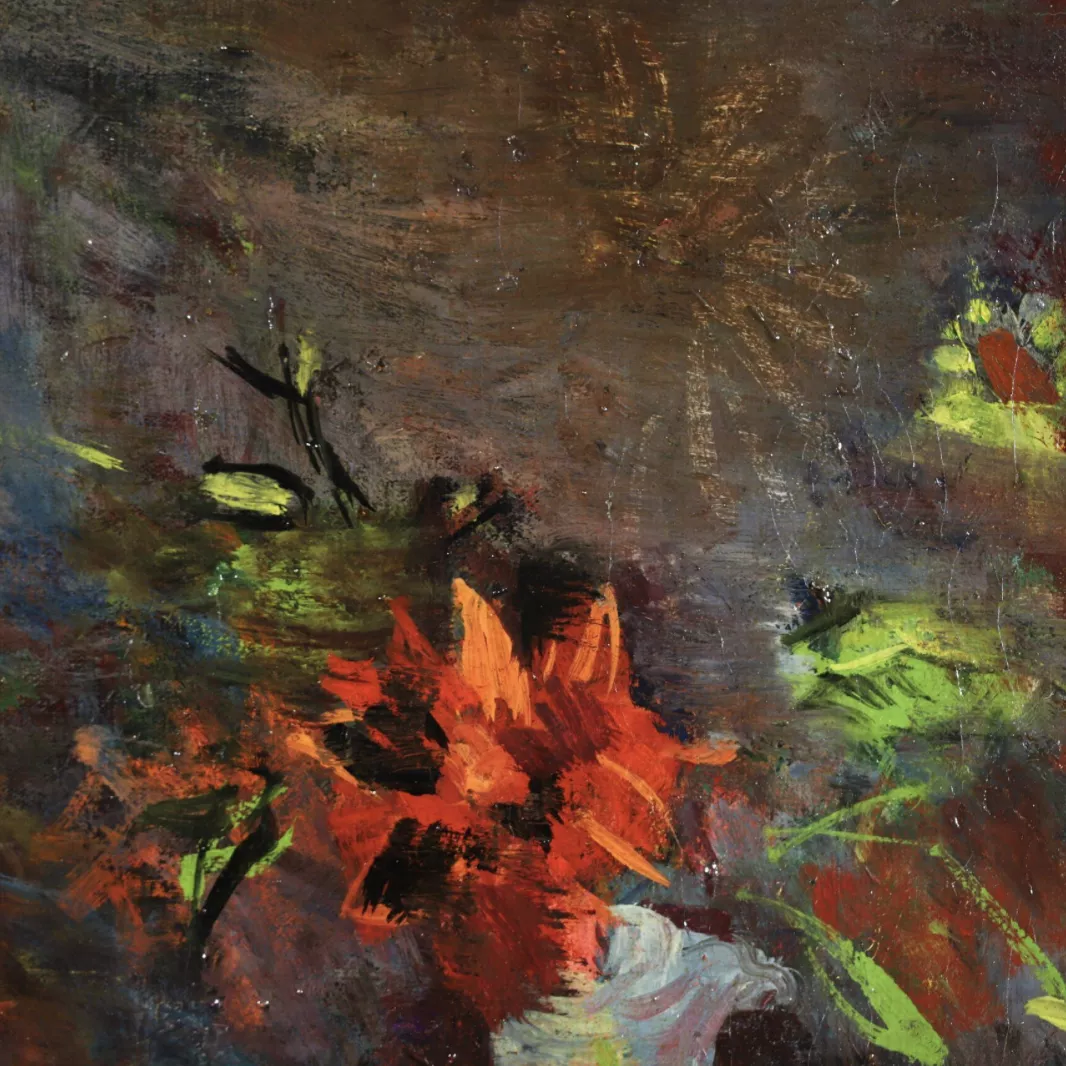
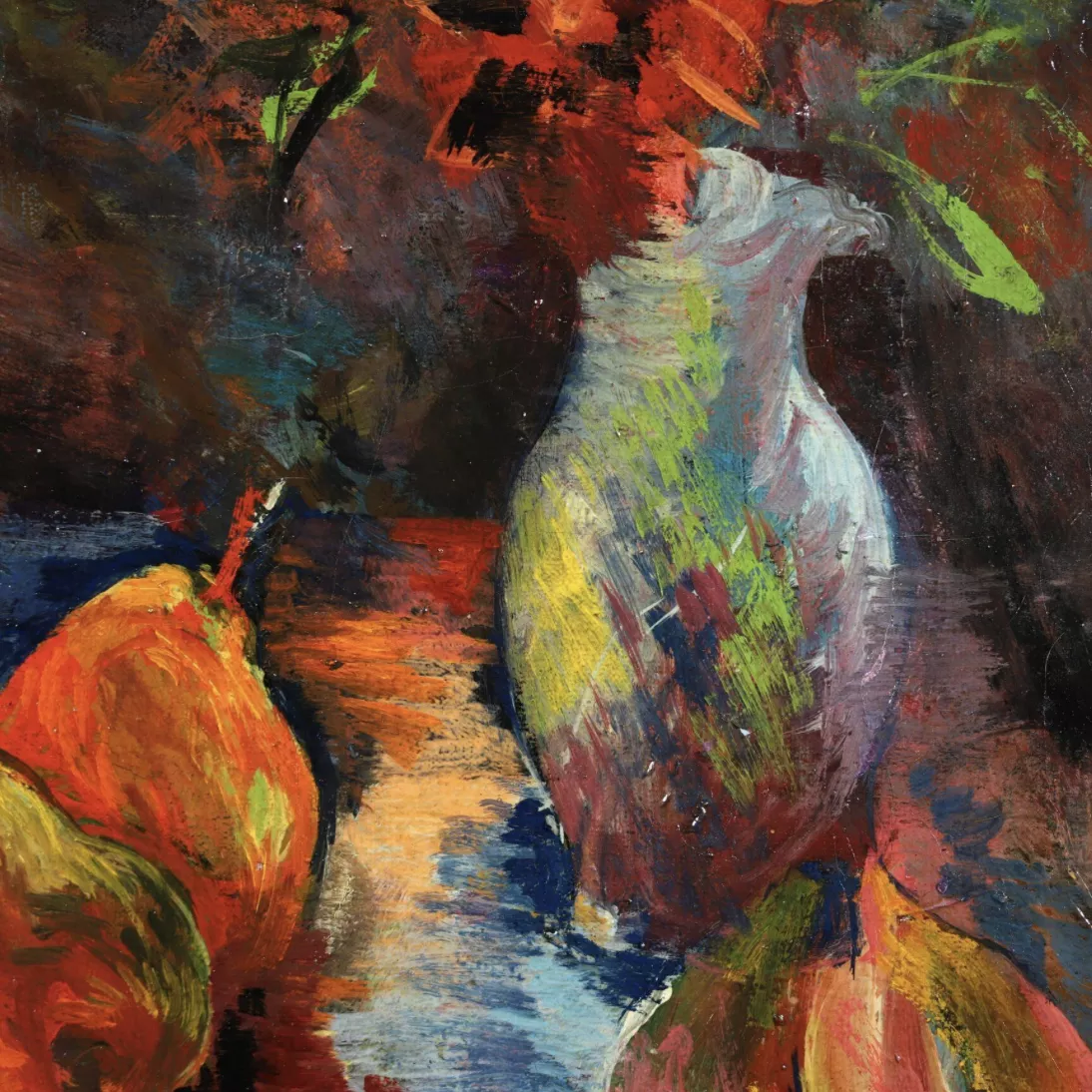
Jean Dufy, his life, his work
Jean Dufy (1888-1964) belongs to the line of colorist painters of the 20th century, developing a singular approach to light and movement.
Trained at the Beaux-Arts in Le Havre, he distinguished himself through a personal synthesis of Fauvism and Cubism, assimilating the lessons of his brother Raoul while emancipating himself through a more fluid and spontaneous style.
From the 1920s, he established himself as a painter of urban modernity, multiplying views of Paris where architecture breaks down into chromatic flat tints and sinuous lines.
His treatment of landscape, which he also applied to port scenes and depictions of social life, was based on a simplification of forms and a fragmentation of space, amplified by the use of a palette with sustained contrasts.
At the same time, he worked for the Manufacture de Sèvres and designed textile decors, refining his taste for rhythmic compositions and colorful harmonies.
His pictorial language, dominated by deep blues, bears witness to a quest for clarity and balance, where the dynamics of the line lend his works a particular musicality.
Less studied than Raoul Dufy, his work is nonetheless part of the same research into the visual transcription of movement and light, revealing a synthetic approach where graphic elegance vies with controlled expressiveness.
Focus on Paris, the Eiffel Tower, Jean Dufy
Jean Dufy unfurls in Paris, the Eiffel Tower a vibrant, lyrical vision of the capital, where color and rhythm prevail over rigorous description of reality.
The famous tower, treated with an airy lightness, dominates a composition where shapes dissolve in a harmony of bright tones.
The palette, dominated by deep blues, is enlivened by touches of red, yellow and green, creating a play of contrasts that energizes the whole.
Using fluid, segmented strokes, Dufy superimposes hues in fine transparencies, lending the scene a moving, almost impalpable depth.
Far from being rendered with exactitude, the architecture becomes a living motif, bathed in reflections and chromatic echoes.
Following in the footsteps of Fauvism while incorporating Cubist influences, Dufy favors an atmospheric perception where forms marry and respond to each other in a subtle balance.
His work on light, which he fragments into colorful splinters, gives the composition a vibration akin to that of a musical score.
The city is no longer a set in stone, but a stage in perpetual motion, where each element seems to participate in a visual choreography.
The streets, facades and trees are integrated into a network of supple lines, as if sketched in the course of a masterful improvisation. Far from a documentary approach, Dufy captures the very essence of Paris, a city animated by its brilliance and modernity.
In this work, it's not a matter of faithfully retranscribing a landscape, but of expressing its energy, light and rhythm in a resolutely poetic and sensory interpretation.
Jean Dufy's treatment of the pictorial surface
At Jean Dufy, the pictorial surface becomes a space of freedom where color and light combine in a dynamic interplay of intertwining.
He abandons any illusionist temptation in favor of a synthetic vision where forms, simplified and vibrant, are arranged in a subtle chromatic balance.
With a fragmented, almost musical touch, he modulates hues by juxtaposing fluid flat tints and luminous highlights that enliven the composition.
His approach, close to that of the Fauvists in its bright palette, also incorporates a Cubist influence in the way volumes unfold in light facets, without concern for rigorous perspective.
Far from a smooth, uniform rendering, Dufy exploits variations in texture to infuse the canvas with its own rhythm, alternating dense areas with more airy ones where color seems to float in transparency.
This fragmentation of the motif, sometimes enhanced by lines sketched in brush or ink, gives the scene a character that is both spontaneous and masterful, where the eye wanders without ever being stopped by an overly precise detail.
The result is a pictorial surface in perpetual vibration, where the light does not come from a single point but emanates from the color itself, multiplied in splinters and reflections.
Through this approach, Dufy does not seek to reproduce a frozen world, but to transcribe a sensation, a movement, an atmosphere in perpetual mutation.
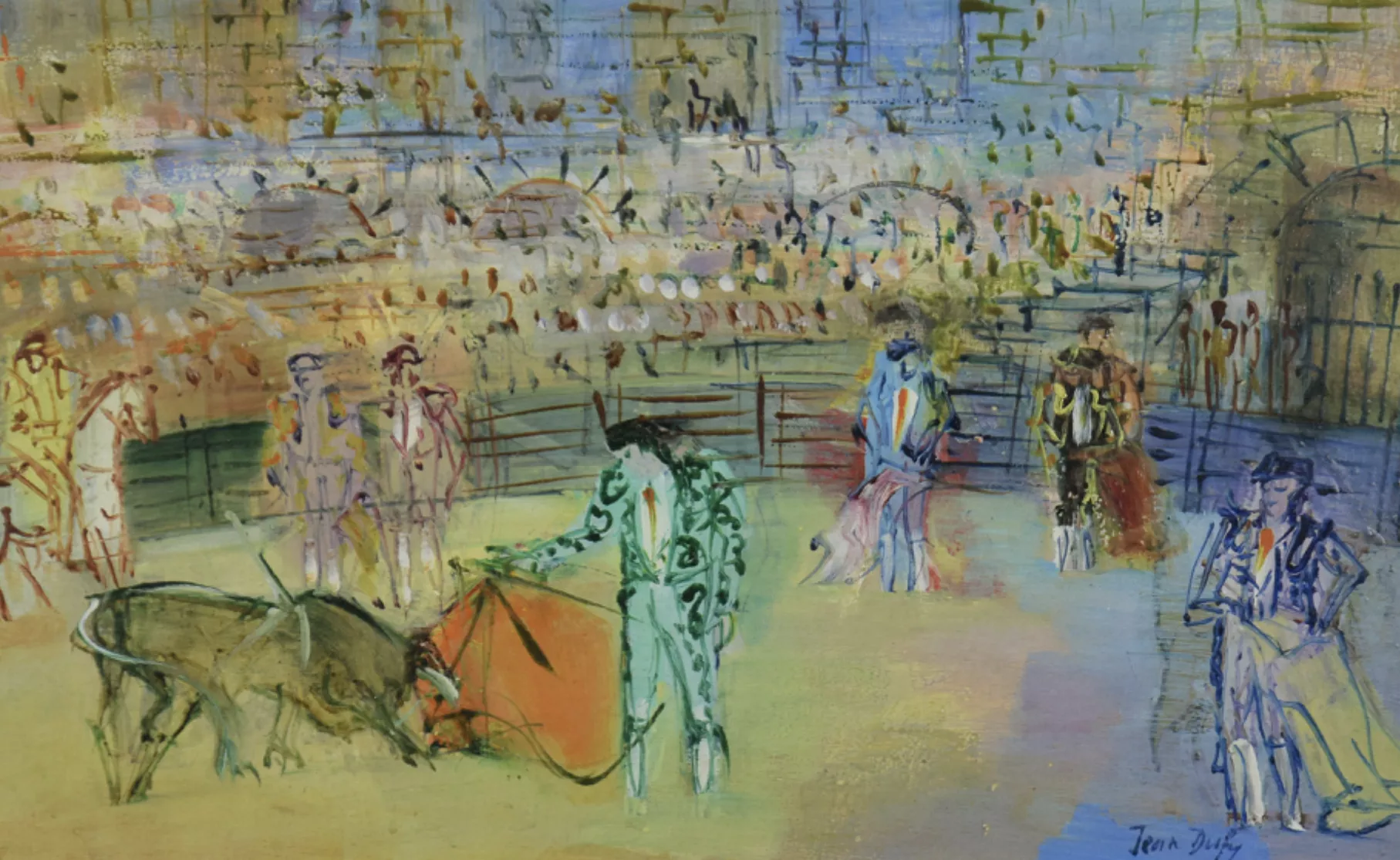
The stylistic influences of Jean Dufy
Jean Dufy is part of a pictorial heritage where several currents intersect, assimilated and reinterpreted in a language all his own.
The influence of his brother Raoul is obvious, particularly in his use of a luminous palette and his propensity for translating the liveliness of the world through flat tints of color and softly sketched contours.
But Jean Dufy does not limit himself to this lineage. His eye turns to the Fauves, whose chromatic freedom he adopts, and to the Post-Impressionists, whose search for luminous vibration he retains.
Cubism, in its most lyrical version, also permeates his work, not through a rigorous deconstruction of forms, but through a way of arranging pictorial space in light facets, abolishing traditional perspectives in favor of a more musical composition.
The influence of Matisse and Vlaminck can be seen in his decorative treatment of surfaces, where motifs and colors respond to each other in subtle harmony.
His taste for urban scenes and modern motifs also brings him close to Robert and Sonia Delaunay, whose interest in colorful contrasts and visual rhythms he shares.
Sensitive to the applied arts and the supple lines of Art Deco, Jean Dufy developed an aesthetic in which form is simplified, stylized, but always imbued with a refined pictorial sensibility.
Drawing from these diverse influences, he succeeded in creating a personal universe, where color and movement transcend the subject to render a vision of the world imbued with lightness and musicality.
Recognizing the artist's signature
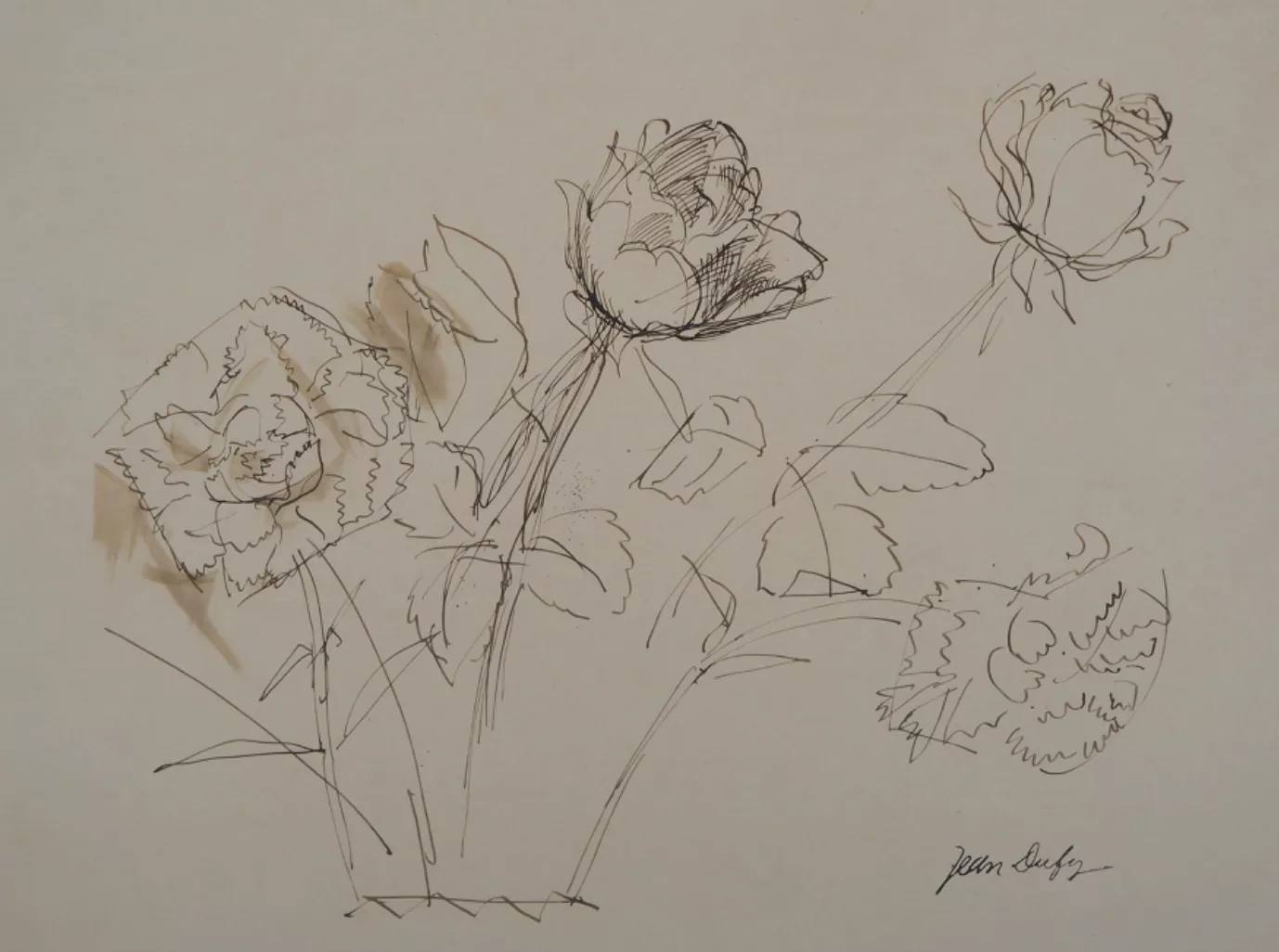
Not all of Jean Dufy's works are signed, and copies may exist. Here's an example of his signature.

Knowing the value of a work
If you happen to own a work by or after Jean Dufy, don't hesitate to request a free valuation using our form on our website.
A member of our team of experts and certified auctioneers will contact you promptly to provide you with an estimate of the market value of your work, as well as any relevant information about it.
If you are considering selling your work, our specialists will also help you to find alternatives for selling it at the best possible price, taking into account market inclinations.
Estimate in less than 24h
Discover in the same theme

Rating and value of paintings, drawings and watercolors by Z...
Zao Wou Ki is a Franco-Chinese painter of the École de Paris and lyrical abstraction whose value has exploded at auction in recent years.
Learn more >

Rating and value of Paul Milet's ceramics, vases, stoneware
Paul Milet is an Art Nouveau ceramist. His works are highly valued on the auction market. Estimate in 24h.
Learn more >

Rating and value of paintings by Bernard Lorjou
Bernard Lorjou is a twentieth-century expressionist painter whose paintings, drawings and drawings are highly valued.
Learn more >
Other similar works sold at auction

Estimated 2.000 - 4.000
Jean DUFY (1888-1964) Vase of anemones, Watercolor

Estimated 2.000 - 4.000
Jean DUFY (1888-1964) Vase of anemones, Watercolor

Estimated 3.000 - 5.000
Alphonse OSBERT (1857-1939) "Le soir" Oil on canvas

Estimated 1.500 - 3.000
Jean VANDEN EECKHOUDT (1875-1946), Basket of persimmons, Oil on canvas

Estimated 2.000 - 4.000
Jean-Gaston MANTEL (1914 -1995), Paysannes orientales à la moisson, Oil on canvas mounted on isorel

Estimated 18.000 - 30.000
Charles CAMOIN (1879-1965) "Le Port de Marseille, 1928" Oil on canvas.

Secure site, anonymity preserved

Auctioneer approved by the State

Free and certified estimates
Frequently asked questions
-
Who is Jean Dufy, and what is his artistic background?Jean Dufy (1888–1964) was a 20th-century French painter whose work bridged Fauvism, Cubism, Impressionism, and Modernism. Trained at the Beaux-Arts in Le Havre and influenced by his brother Raoul, he established himself in the 1920s as a painter of urban modernity, particularly renowned for his watercolors, drawings, and oil paintings on canvas, characterized by their vibrant colors and musical composition.
-
What is the price range for Jean Dufy's works?The prices of Jean Dufy’s works vary considerably depending on the medium and quality: prints sell for between €10 and €2,800, watercolor drawings between €40 and €94,500, and oil paintings on canvas between €45 and €420,400. For example, an oil on canvas titled “Sailboats in the Port of Le Havre” (1907) sold for €274,000 in 2023.
-
How can you authenticate and appraise a work by Jean Dufy?To authenticate a work by Jean Dufy and determine its value, we recommend that you request a free appraisal from Auctie's using our online form. Our team of experts and licensed auctioneers will contact you promptly to provide an accurate and reliable appraisal of your artwork, with no obligation on your part.
-
Is this the right time to sell a work by Jean Dufy?Yes, now is a good time to sell a work by Jean Dufy. His works are particularly sought after at the moment, and prices are rising significantly in the art market. The favorable market conditions make this an opportune time to maximize the value of your acquisition.
-
How does the sale of a work of art work with Auctie's?Auctie's supports you every step of the way: a free, no-obligation appraisal; a valuation report provided by our experts within 48 hours; and guidance on the best options for selling your artwork at the best price. Throughout the process, our specialists advise you based on current market trends.
