



Rating and value of paintings by Pierre Hodé

Key takeaways
- Pierre Hodé’s works sell for between €150 and €91,500, with his paintings fetching tens of thousands of euros, unlike his watercolor drawings.
- A French artist (1889–1942) with a distinctive style blending Cubism, Fauvism, and lyrical abstraction, featuring a vibrant color palette and masterful geometric compositions.
- Free appraisals and estimates are available for any work signed by or attributed to Pierre Hodé prior to an auction.
If you own a work by artist Pierre Hodé or based on his work and would like to know its value, our state-approved experts and auctioneers will guide you.
Our specialists will carry out a free appraisal of your work, and provide you with an accurate estimate of its value on the current market.
Then, should you wish to sell your work, we will direct you to the best possible arrangement to obtain the optimum price.
Artist's rating and value
Pierre Hodé has created a multitude of works with a variety of colors and media. The value of each piece depends on the medium used. On today's market, his paintings fetch tens of thousands of euros at auction. His drawings are less popular.
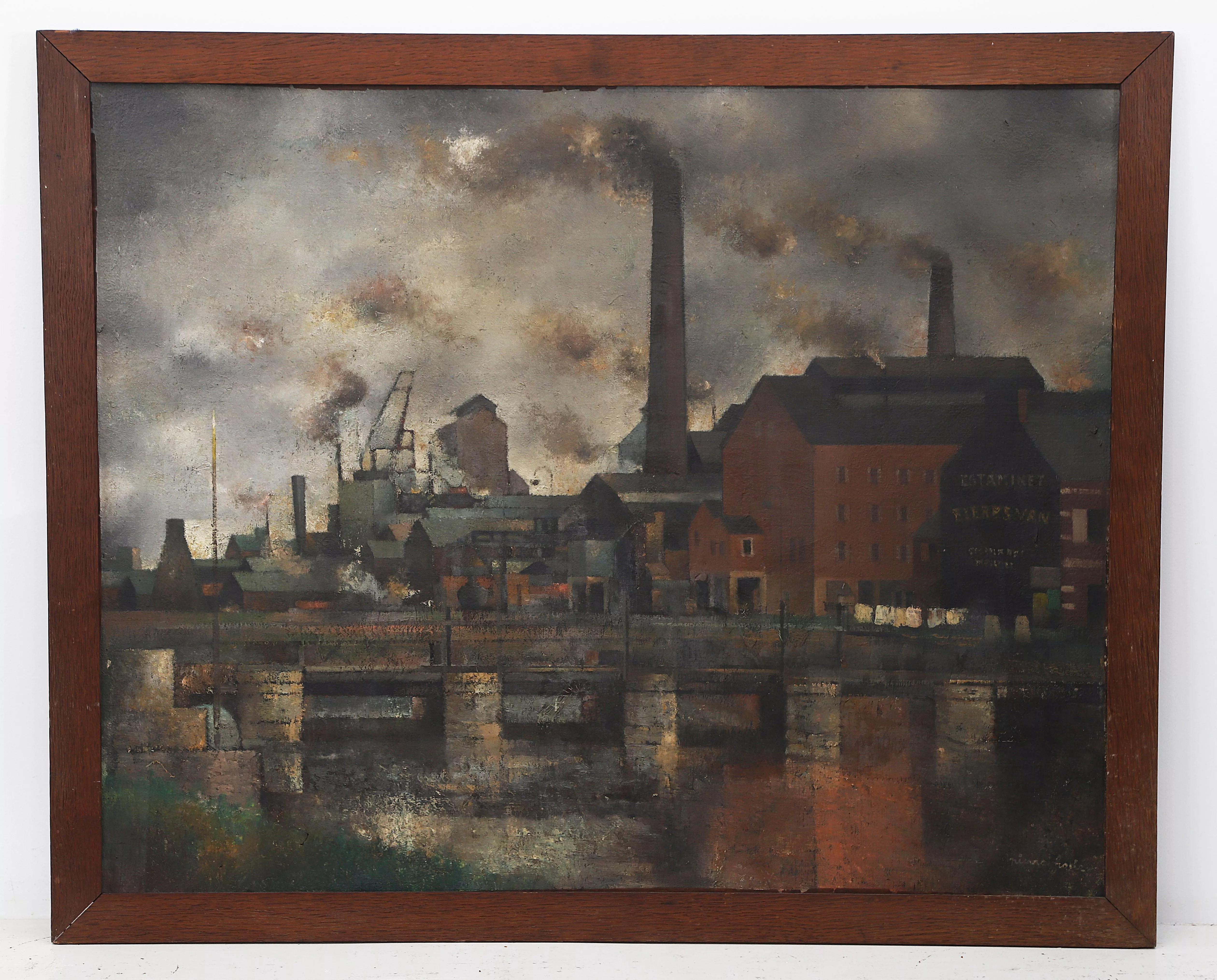
The price at which his works sell ranges from €150 to €91,500. Thus, a work signed Pierre Hodé can sell for tens of thousands of euros at auction, as evidenced by his painting Le port de Rouen, adjudicated at €51,000 in 2015.
Order of value from the most basic to the most prestigious
Technique used | Result |
|---|---|
Drawing - watercolor | From €150 to €15,000 |
Painting | From €210 to €91,500 |
Estimate in less than 24h
The works and style of Pierre Hodé
Pierre Hodé's style and technique are distinguished by a bold approach to color and composition, where the influence of Cubism and Fauvism is interwoven with a deeply personal sensibility.
Her work demonstrates a rare ability to deconstruct forms without ever losing their essence, creating works where every element seems reinvented yet remains recognizable.
Light plays a central role in his canvases: it doesn't simply illuminate, but seems to filter through the geometric volumes, giving the whole a vibrant depth and intensity.
Hodé's palette, often composed of flat tints of sharp, vivid colors, is never aggressive, but on the contrary controlled, each hue finding its place in a striking visual harmony. His compositions, while dynamic and in perpetual motion, retain a certain restraint that evokes a form of contemplation.
Hodé doesn't simply follow the major artistic currents of his time; he interprets them, reinvents them, and finds a balance between abstraction and realism.
His work, at once modern and imbued with a discreet classicism, is the fruit of a constant search for new ways of expressing reality through pared-down forms and restrained expressiveness.
This quest for formal balance, blending geometric rigor and vibrant color, makes Pierre Hodé a unique figure on the artistic landscape, where innovation and tradition coexist with a rare fluidity.
Pierre Hodé, in his quest for singular artistic expression, is part of a line of artists who, like him, have married color, geometry and abstraction with finesse.
As such, he shares affinities with Albert Gleizes and André Lhote, whose Cubist approach, though different, is characterized by a shared desire to break down forms to reveal a new visual harmony.
With Hodé, this research takes on a more fluid, less angular character than with Gleizes, but just as rigorous in the construction of volumes.
Hodé can also be likened to Raoul Dufy, notably in their use of vibrant colors and their ability to infuse carefully crafted compositions with an apparent lightness.
Hodé's vibrant, luminous palette finds a subtle echo in Dufy's, with the same chromatic freedom that brings scenes to life while retaining an underlying rigor.
However, where Fernand Léger moves towards an almost mechanical monumentality in his cubist compositions, Hodé favors softer forms, more intimately linked to nature and movement, which brings him closer to a Robert Delaunay.
Like the latter, Hodé explores light with particular delicacy, playing it through his geometric volumes to create a depth that transcends mere representation.
In short, Pierre Hodé is distinguished by his ability to integrate these influences while retaining his own identity, balancing tradition and innovation in an approach that combines great formal freedom with a luminous, organic sensibility.
The life of Pierre Hodé
Pierre Hodé (1889-1942) was a French painter who marked the early 20th century with his singular approach to cubism and abstraction. Born in Le Havre, he first trained at the École des Beaux-Arts in his native town before moving to Paris, where he frequented avant-garde artistic circles.
It was in the 1910s that he began exhibiting his first works, influenced by Impressionism and Fauvism, before moving towards a more personal style, marked by the geometrization of forms.
In 1923, Hodé joined the group of artists gathered around the Berthe Weill gallery, where he came to prominence for his bold use of color and resolutely modern compositions.
Hodé's work quickly evolved into an original synthesis between cubism and lyrical abstraction, where geometric forms are articulated in subtle harmony.
Inspired by his travels in North Africa, he incorporated elements of light and movement into his work, while maintaining a rigorous construction.
Pierre Hodé enjoyed growing success, exhibiting both in Paris and abroad, notably in Brussels and New York. His balanced compositions, in which color plays a central role, earned him praise from influential critics, who hailed the technical mastery and sensitivity of his art.
While Hodé's work is sometimes compared to that of contemporaries such as Albert Gleizes or André Lhote, he stands out for a more intuitive approach, allowing emotional depth to shine through behind formal rigor.
Dying prematurely in 1942, Pierre Hodé left behind a rich and complex body of work, which continues to inspire and fascinate with its quest for an aesthetic that is both modern and timeless.
Gris, for example, would focus more on technique and compositional work.
He died in Boulogne Billancourt in 1927.
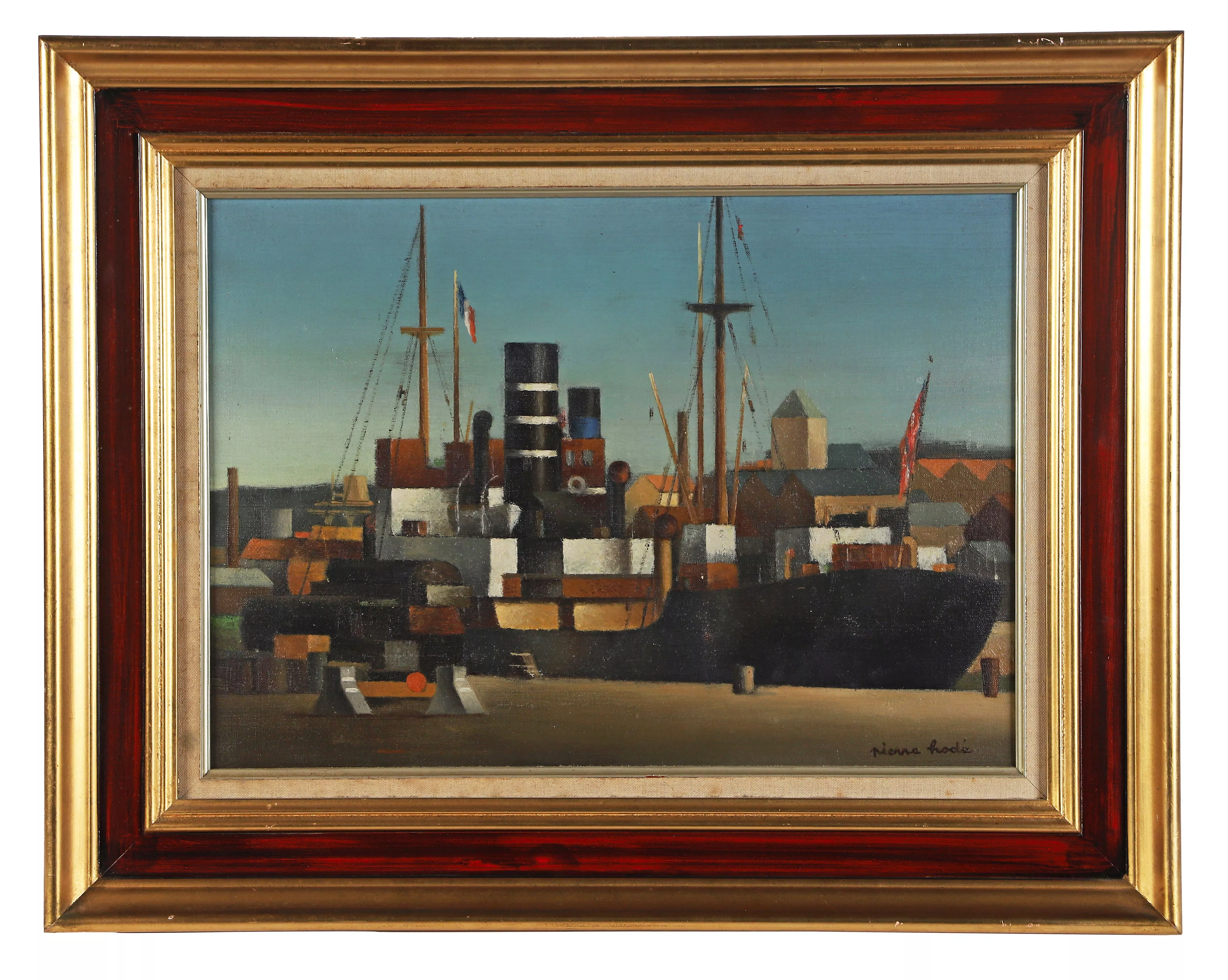
Focus on Pierre Hodé's cubist boat
This work by Pierre Hodé, with its cubic shapes and carefully chosen hues, plunges us into a harbor landscape where harmony reigns supreme.
The silhouettes of the ships, adorned with black and white smokestacks, stand out precisely against a pale sky, creating an atmosphere where modern industry blends with the tranquility of a moment frozen in time.
The earthy, metallic colors favored by the artist reinforce the impression of robustness and solidity. Shades of brown, gray and black intertwine, emphasizing the utilitarian aspect of the boats and buildings, while each element seems to fit into a perfectly orchestrated architectural composition.
The Cubist influence can be felt in the way Hodé breaks down the forms, playing with the vertical lines of the masts against the horizontal lines of the docks.
This confrontation creates a play of visual tensions that energizes the work, while lending it a certain monumentality.
Through this canvas, Hodé doesn't simply reproduce a seascape; he invites us to a profound contemplation of the industrial city in its geometric essence.
The coldness of steel and coal invites itself into the viewer's gaze, while the rigor of the forms evokes the quiet power of modernity.
In short, Pierre Hodé, with his pared-down style and mastered technique, succeeds in transforming a simple port into a space for reflection, where the austere beauty of industry blossoms before our eyes, inviting us to feel and appreciate the multiple dimensions of his art.
Pierre Hodé's mark on his time
Pierre Hodé leaves a discreet but decisive mark on the art of his time. His painting, marked by an attachment to geometric forms and colorful harmonies, reflects an artist in search of a balance between tradition and modernity.
Although he never sought to provoke or violently upset convention, his work is distinguished by an elegant sobriety that brings him close to painters such as Roger de La Fresnaye or Albert Gleizes.
Far from the excesses and radicalisms of certain avant-garde movements, Hodé favors a thoughtful, measured approach, where every composition seems weighed, every color carefully considered.
His art, imbued with a certain restraint, bears witness to an era when experimentation remained fundamental, but when some, like him, chose to move forward with subtlety rather than rupture. He thus remains an important figure of his time, leaving behind a body of work that is as discreet as it is inescapable.
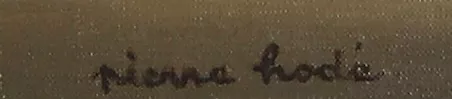
His signature
Not all of Pierre Hodé's works are signed. They are often signed at the bottom of the drawing or painting.
Expertise your property
If you happen to own a work by or after Pierre Hodé, don't hesitate to request a free valuation by filling in our form on our website.
A member of our team of experts and chartered auctioneers will contact you promptly to provide you with an estimate of the value of your work, and will ensure that you receive ad hoc information about it.
If you're thinking of selling your work, our specialists will also help you find alternatives to sell it at the best possible price, taking into account the inclinations of the market and its specific features.
Estimate in less than 24h
Discover in the same theme

Rating and value of works, drawings, paintings by Paul Sérus...
Paul Sérusier is a 20th-century painter from the Nabis group. His works are highly valued and highly prized.
Learn more >

Rating and value of works, drawings, paintings by Jacob Hend...
Jacob Hendrik Pierneef is a South African Impressionist painter whose drawings and oil paintings are sought-after at auction.
Learn more >

Rating and value of paintings, drawings and engravings by Ar...
Arthur-Luiz Piza is a Brazilian abstract artist who has excelled in the medium of printmaking but has also produced other highly-regarded works.
Learn more >
Similar works sold at auction

Estimated Between €1,200 and €1,600
Camille HILAIRE (1916-2004), The apple tree in blossom, oil on canvas

Estimated Between €5,000 and €8,000
Jean MIOTTE (1926-2016), acrylic on canvas

Estimated 800 - 1.500
André DEVAMBEZ (1867-1943) Little Red Riding Hood, Gouache and watercolor on paper

Estimated 5.000 - 8.000
Robert PINCHON (1886-1943) View of a port on the banks of the Seine, Oil on canvas

Estimated 2.500 - 5.000
Alfred RETH (1884-1966) Composition, 1959, Oil and sandblasting

Estimated 20.000 - 30.000
Chaffic ABBOUD (1926-2004) "La visite", Oil on canvas

Secure site, anonymity preserved

Auctioneer approved by the State

Free and certified estimates
Frequently asked questions
-
Who is Pierre Hodé, and what is his artistic style?Pierre Hodé (1889–1942) was a French painter who left his mark on the early 20th century with his original synthesis of Cubism and lyrical abstraction. Trained at the École des Beaux-Arts in Le Havre before moving to Paris, he distinguished himself through his intuitive approach to the geometrization of forms, combined with a vibrant color palette and a subtle mastery of light. His work balances formal rigor with emotional sensitivity, influenced by his travels in North Africa.
-
What is the price range for Pierre Hodé's works at auction?The prices of Pierre Hodé’s works vary considerably depending on the technique used. His drawings and watercolors range from €150 to €15,000, while his paintings range from €210 to €91,500. For example, his painting “Le Port de Rouen” sold for €51,000 in 2015. The value of each piece depends on the medium, its condition, and its provenance.
-
How can you authenticate a work by Pierre Hodé?To authenticate a work by Pierre Hodé, we recommend that you request a free appraisal from our state-certified experts and auctioneers. By filling out our online form, you will be contacted within 48 hours for an accurate and confidential appraisal of your work, with no obligation on your part.
-
Is this the right time to sell a work by Pierre Hodé?Yes, now is a good time to sell a work by Pierre Hodé. His paintings are flooding the current market and fetching significant prices at auction, reflecting a growing interest in early 20th-century painters and artists who explored the synthesis between Cubism and lyrical abstraction. Our specialists will determine the best strategy to maximize the sale price.
-
How does the sale of a work of art work at Auctie's?At Auctie's, the process is simple and transparent: you request a free estimate via our online form, our experts will contact you within 48 hours with an accurate appraisal, and then we’ll guide you through the process from the estimate to the auction. Our team of licensed auctioneers will guide you based on market trends to secure the best possible price, taking into account the condition and provenance of your artwork.
