



Rating and value of works, drawings, paintings by Fernand Léger

Key takeaways
- Fernand Léger, a leading master of 20th-century Cubism, has seen his works fetch millions of euros, notably *Contraste de formes*, which sold for 53.2 million in 2017.
- Estimates vary considerably depending on the medium: prints range from 10 to 30,000 €, sculptures from 80 to 790,500 €, and oil-on-canvas paintings up to 53 million €.
- The artist (1881–1955) is known for his theory of contrasts in form and color, his post-World War I mechanical style, and his exploration of a new realism after 1930.
If you own a work by or based on the work of the artist Fernand Léger and would like to know its value, our state-approved experts and auctioneers will guide you. Our specialists will carry out a free appraisal of your work, and provide you with a precise estimate of its value on the current market. Thereafter, if you wish to sell your work, we will guide you towards the best possible arrangement to obtain the optimum price.
Artist's rating and value
Great master of Cubism, Fernand Léger made his mark on the art market at the beginning of the 20th century. As a result, a work signed by Fernand Léger can fetch tens of millions of euros from auctioneers' hammers, as demonstrated by his oil on canvas Contraste de formes, sold for over 53 million euros in 2017.
Order of value from a work "after" Fernand Léger to an "authentic" work by Fernand Léger
Technique used | Result |
|---|---|
Estamp - lithography | From €10 to €30,000 |
Sculpture - volume | From €80 to €790,500 |
Drawing - gouache | From €300 to €2,899,680 |
Oil on canvas | From €6,000 to €53,152,600 |
Estimate in less than 24h
The artist's style and technique
Fernand Léger was a compulsive draftsman who produced a large number of works, including paintings, drawings and prints.
Very few of Fernand Léger's pre-1910 paintings survive. Indeed, most were lost or destroyed by the artist himself.
Although his style is often associated with cubism, the artist is distinguished by his search for contrasts of form. Most of his works reflect the theme of the inter-war period, particularly urban agitation, not unlike the theory of the Italian Surrealists following Marinetti's manifesto, but also the machine, a strange lobotomizing and alienating creature. At the end of the 1920s, female figures made their appearance under his brushstrokes, and after 1930, the artist explored a "new realism" that reflected the images conveyed by the media of the time.
.
The life of Fernand Léger
Originally from Normandy, Fernand Léger (1881-1955) was not a very studious student, but showed great mastery of drawing. He started out as an apprentice architect in Caen.
In 1900, Fernand Léger arrived in Paris and took free classes at the École des Beaux-Arts taught by painter Jean-Léon Gérôme. He decided to move to the "Ruche" in 1907, where he befriended Robert Delaunay, Blaise Cendrars and Marc Chagall.
In contact with his counterparts, Léger develops his own style. Although he began his career in the Impressionist tradition, he was inspired by the Cubist research of Pablo Picasso and Georges Braque and thus changed his trajectory, veering towards Cubism.
In 1913, Fernand Léger signed an exclusive agreement with the famous art dealer Daniel-Henry Kahnweiler. Thanks to this contract, the artist established himself as a sure bet on the art market, with a stable valuation.
Léger was one of the "conscripts" and had to serve in the French army during the Great War, an experience that had a profound impact on his art. From then on, his style became more simplified and mechanical, nurturing a reflection on the brutality of combat, at the root of the mechanization that plagued post-First World War society. This period is often referred to as his "mechanical" period, and is marked by images of machines and stylized human figures.
At the end of the war, he focused on two themes: the city and the machine. Fascinated by modern life, Léger advocated a "new realism" that emphasized the aesthetics of industrial civilization. He incorporates urban signals and mechanical motifs into his compositions, while the human figure is standardized, taking on the appearance of geometric shapes.
In the 1920s, several collaborations lead Fernand Léger to open up to other creative fields. In particular, he directed a film in 1924, Ballet Mécanique, considered the first film without a script.
After the announcement of the Second World War, Léger fled France for the United States. During this intense and stimulating period, he invented the principle of "color outside", enabling him to surround shapes and emphasize their contrast with the background.
At the end of his life, Léger was driven by an ideal of " art for all ". He embarked on monumental projects, both public and religious.
Fernand Léger's imprint on his time
Fernand Léger succeeded in creating a unique painting that reflected the energy of his time and made unrestrained use of contrasts of form and color, the keystone of his artistic style.
Fernand Léger then became a major player in the avant-garde, and the ensemble enabled him to develop his theory of contrasts, opposing straight and curved lines, flat and modeled surfaces.
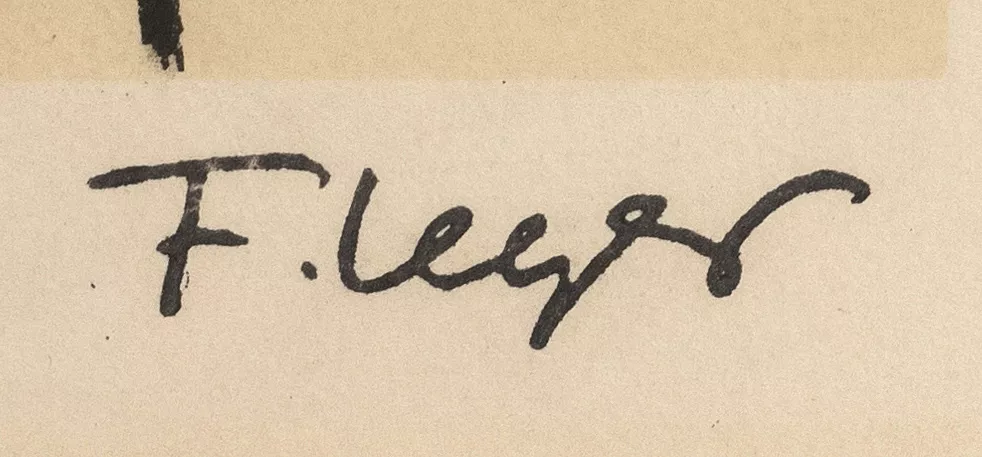
His signature
Although there are variations, here's a first example of his signature:
Expertise your property
If you happen to own a work by or after Fernand Léger, don't hesitate to request a free appraisal by filling in our form on our website. A member of our team of experts and certified auctioneers will contact you promptly with an estimate of the value of your work, and will provide you with all the relevant information. If you are planning to sell your work, you will also be accompanied by our specialists in order to benefit from alternatives for selling it at the best possible price, taking into account the inclinations of the market and its specificities.
Estimate in less than 24h
Discover in the same theme

Rating and value of works, drawings, paintings by André Dera...
André Derain is a twentieth-century Fauvist painter who produced a number of works that are highly prized at auction.
Learn more >

Rating and value of paintings by Jean Puy
Jean Puy is a twentieth-century Fauvist painter who produced works with significant upside potential in terms of price and value.
Learn more >

Rating and value of sculptures and drawings by Emile Gilioli
Emile Gilioli was a 20th-century abstract sculptor who created numerous works that command high prices at auction.
Learn more >
Works from the same period sold at auction


Secure site, anonymity preserved

Auctioneer approved by the State

Free and certified estimates
Frequently asked questions
-
Who is Fernand Léger, and what is his artistic context?Fernand Léger (1881–1955) was a leading master of Cubism who made a name for himself in the art world as early as the beginning of the 20th century. Originally from Normandy, he moved to Paris in 1900 and developed his own style through his interactions with Robert Delaunay, Blaise Cendrars, and Marc Chagall at La Ruche. His work is characterized by an exploration of contrasts in form and evolved from Cubism toward a “new realism” that reflected urban bustle and a fascination with machinery.
-
What is the price range for Fernand Léger's works, depending on the medium?The value of Fernand Léger’s works varies considerably depending on the medium: lithographs range from €10,000 to €30,000, gouache drawings from €300 to €2,899,680, sculptures between €80 and €790,500, and oil paintings on canvas between €6,000 and €53,152,600. Authentic works and major paintings can fetch tens of millions of euros, as evidenced by the sale of *Contraste de formes* for over 53 million euros in 2017.
-
How do I have a work by Fernand Léger authenticated and appraised?To authenticate and appraise a work by Fernand Léger, simply request a free, no-obligation appraisal from Auctie's by filling out the form available on our website. A state-certified expert or auctioneer will contact you shortly to analyze the work and provide you with an accurate estimate of its current market value.
-
Is this the right time to sell a work by Fernand Léger?Yes, now is a good time to sell a work by Fernand Léger. As a master of Cubism recognized since the early 20th century, his works enjoy stable values and strong demand in the art market. Auctie’s experts will advise you on the best approach to achieve the highest possible price, taking into account current market conditions.
-
How does the sale of a work of art work at Auctie's?The sales process at Auctie's begins with a free appraisal of your artwork by our experts and licensed auctioneers. Once you have received the appraisal, if you wish to sell, our specialists will guide you through the process and offer you the best options for selling your artwork at the most favorable price, taking into account market trends and specific market conditions.
