



Rating and value of Luc Lanel's services, dishes and silverware

Key takeaways
- Luc Lanel's works sell for between €40 and €5,900 at auction, with some pieces fetching prices that exceed initial estimates.
- Silverware and ceramics dominate his body of work, with price ranges of €120 to €2,050 and €180 to €2,200, respectively.
- A leading figure in Art Deco design (1893–1965), Lanel revolutionized French silverwork for Christofle with his clean, functional geometric forms.
If you own a piece of furniture or creation by Luc Lanel and would like to know its value, our state-approved experts and auctioneers will guide you.
Our specialists will carry out a free appraisal of your object, and provide you with an accurate estimate of its value on the current market.
Then, should you wish to sell your object, we will direct you to the best possible arrangement to obtain the optimum price.
The market value of Luc Lanel's works
Thanks to their refined design, manufacturing quality, comfort, historical value and aesthetics, Luc Lanel's creations are in great demand among furniture enthusiasts and are highly prized on the market. Their value varies according to their years of production and state of preservation.
Their price can soar at auction, particularly for his silverware items, which are adaptable to many interiors.
The price at which they sell on the auction market ranges from €40 to €5,900. In 2020, a pair of " Écaille " vases, dating from 1925, sold for €5,100 while they were estimated at between €600 and €800.
Order of value from the most basic to the most prestigious
Technique used | Result |
|---|---|
Silver | From €120 to €2,050 |
Ceramics | From €180 to €2,200 |
Dinanderie | 50 to 5,100€ |
Silver metal | 40 to 5,900€ |
Estimate in less than 24h
Luc Lanel's style and technique
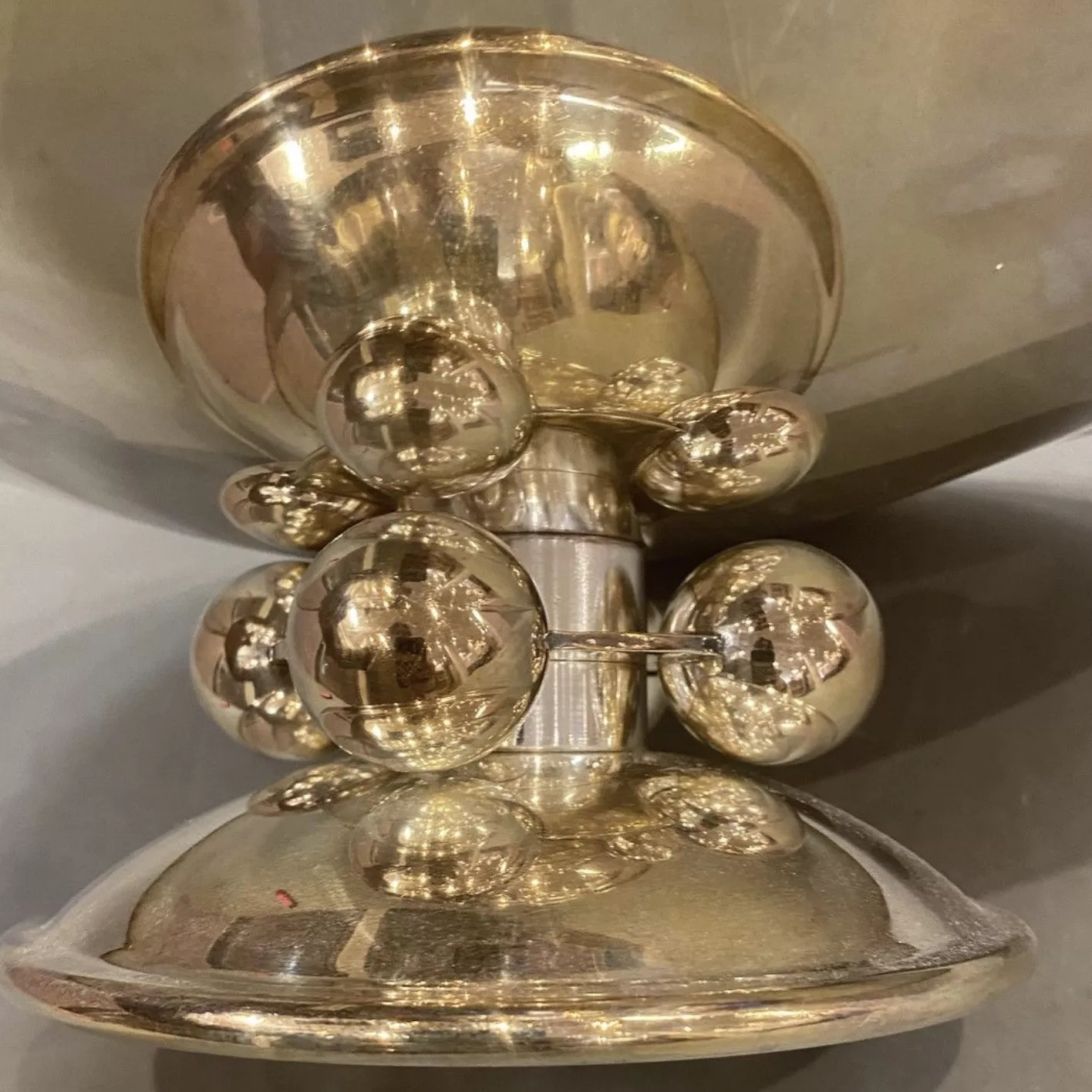
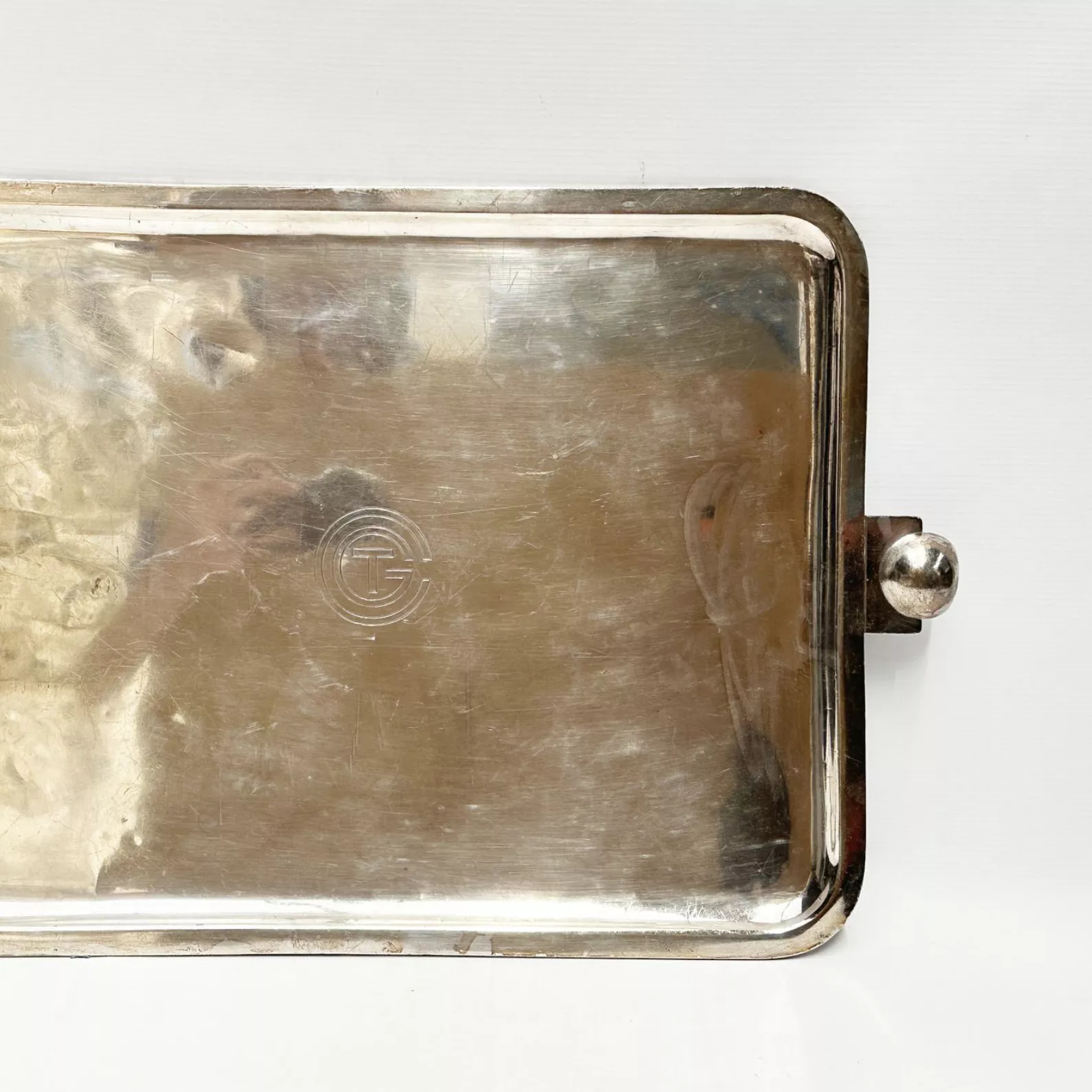
Luc Lanel (1893 - 1965) was an artist who developed a rationalist, functional aesthetic. His work is in line with the modernism of the 1930s, combining geometric rigor and restrained elegance.
Originally trained as an ornamentalist, he developed a pared-down style, stripped of all decorative superfluity, in keeping with the spirit of late Art Deco and international style.
He mastered metal and industrial design. Specializing in silversmithing and tableware, notably for Christofle, he works mainly in silver-plated metal and chrome, but also in steel, in pure, clean lines that are sometimes inspired by machinismo or modern architecture.
The forms he mobilizes are simple, often cylindrical or elliptical. Lanel favors elementary structures: tubes, cones, spheres and linear segments. His objects (teapots, cutlery, vases and lighting fixtures) are based on harmonious proportions and meticulous treatment of surfaces.
His work is a constant dialogue between art and industry he conceives objects as reproducible forms, designed for mass production, while maintaining a high formal standard. This positioning (between craft and industrial design) anticipates the principles of modern design.
He collaborates with major institutions, creating decorative ensembles for French liners such as the Normandie and the Pasteur, where he applies his metal forms to monumental spaces - notably through his sconces, railings and balustrades of great stylistic coherence.
He is above all influenced by abstraction and constructivism. His creations share a logic of geometric composition that is directly inherited from constructivism, where function guides form and visual harmony derives from structural logic.
Luc Lanel is therefore developing a body of work at the crossroads of design, goldsmithing and decorative architecture. His style is characterized by formal sobriety, technical excellence and a profoundly modern conception of the object, designed for use and for the eye.
Luc Lanel's life and career
Luc Lanel was born in Paris in 1893. Trained at the École des Arts Décoratifs, he quickly specialized in object design and industrial arts. This rigorous training in the applied arts soon shaped his taste for precision, geometry and sobriety of form.
He made his debut in the goldsmith's and silversmith's industry in the 1920s, and began working for Christofle, where he gradually imposed a modernist aesthetic. He gradually broke away from the floral ornamentation and neo-styles of the 19th century, becoming one of the firm's leading designers between the wars.
He was an important figure in Art Deco and then modernist design. At the 1925 Exposition Internationale des Arts Décoratifs, he presented pieces that marked a shift towards a more refined style. In the '30s, he collaborated on several major interior design projects, notably for French transatlantic liners (such as the Normandie and Pasteur). He designed lighting fixtures, railings and decorative objects in metal.
Luc Lanel played a central role in the evolution of industrial taste at a time when industry was seeking to reconcile beauty and mass production, Luc Lanel embodied the ideal of a modern designer. He designed utilitarian objects (cutlery, vases, etc.) with great formal rigor, aiming for functional elegance.
He was a discreet but influential designer. Although he received little media coverage during his lifetime, he nevertheless left a coherent body of work that contributed to the evolution of French silversmithing towards more modern, timeless forms. He died in 1965, leaving behind a body of work that has become emblematic of design from the 1930s-50s.
Luc Lanel therefore embodies a rare alliance between artistic craftsmanship and industrial logic. His career illustrates the transformation of French decorative arts in the 20th century, towards a modern, rational and sustainable aesthetic, which was to have a profound influence on post-war design.
Focus on the silver-plated tea service for Christofle, Luc Lanel, circa 1935
The silver-plated tea service for Christofle is an emblematic example of Art Deco functionalism. Designed for Christofle, it illustrates the perfect synthesis between functional demands and decorative refinement.
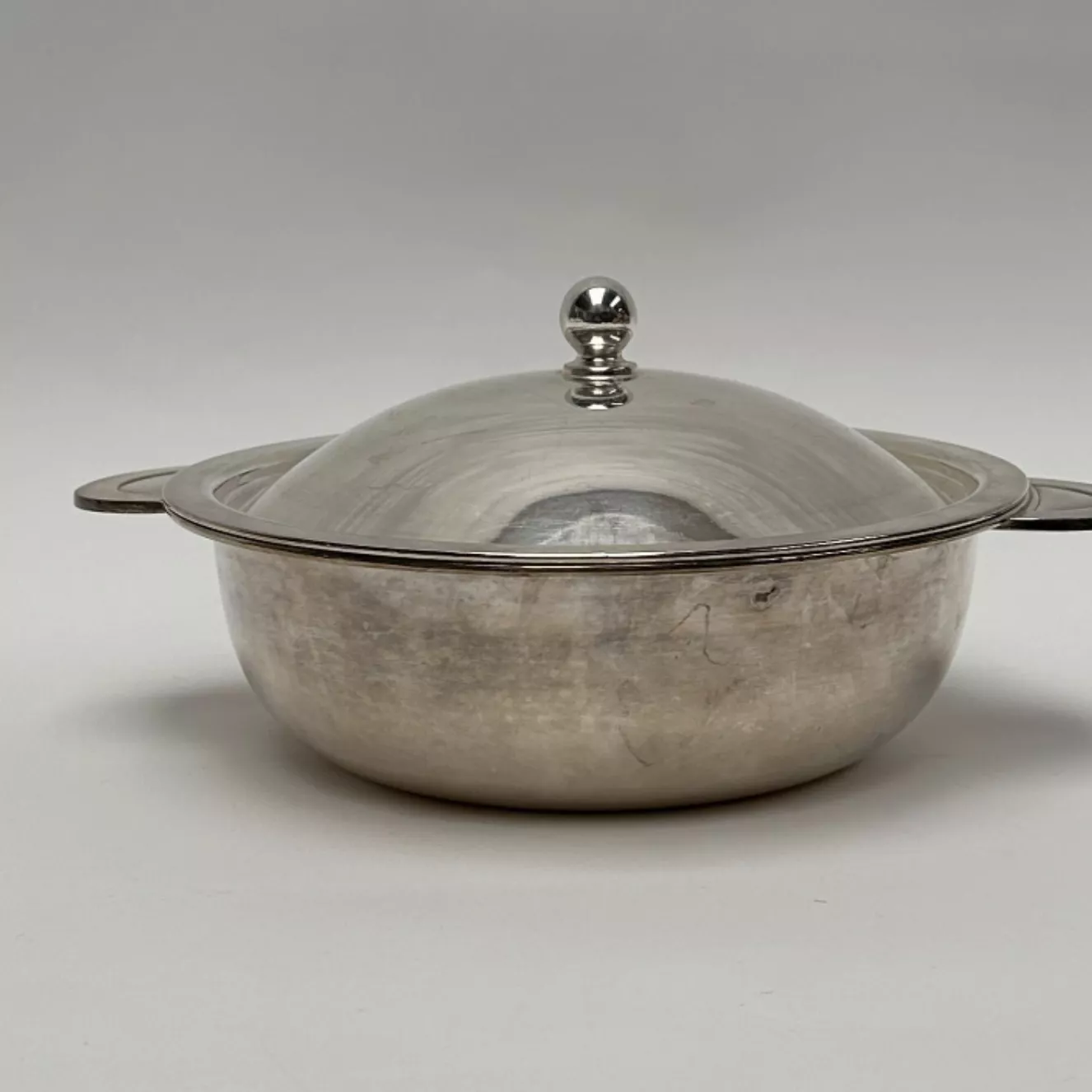
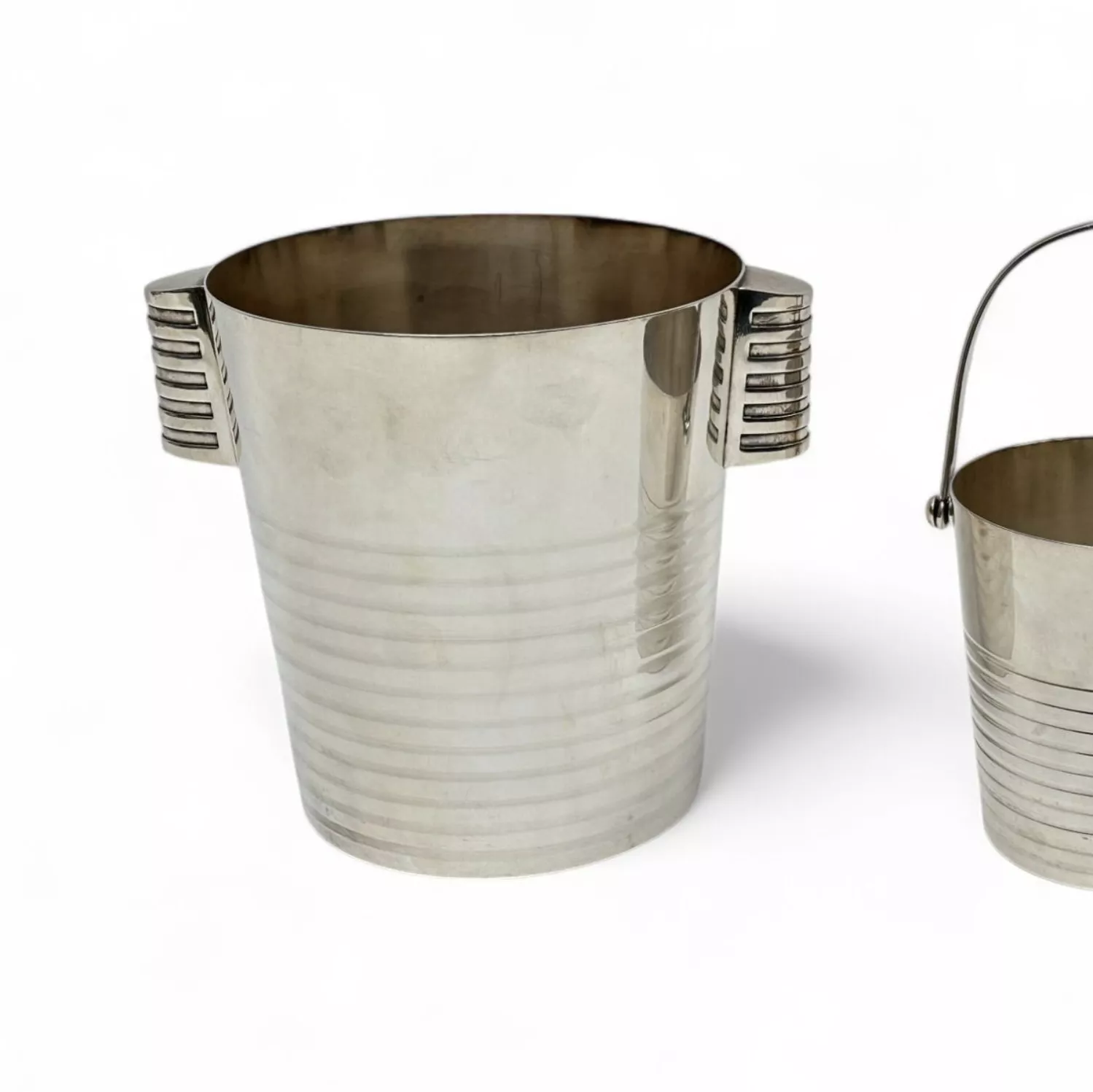
It consists of a teapot, sugar bowl, milk jug and tray, the whole displaying a keen sense of proportion and sobriety. The geometric shapes used are pure and balanced, each element resting on a slightly stretched cylindrical base, and topped by a hemispherical lid.
The handles are reduced to angular or semi-circular shapes, joining here constructivist influences. The harmony of the volumes creates a visual unity that is both simple and rigorous.
The surface is smooth and reflective. The silver metal service also plays on the brightness and clarity of the material. The walls are polished and unadorned, emphasizing the purity of the lines and the silent elegance of the object. The light reflects off them, accentuating the sharpness of the contours.
The ergonomics of the object are thought through to the smallest detail. Proportions are calculated for use. The pouring spout is discreet yet functional, while the handles keep the hand free from heat and the lids fit precisely. Aesthetics therefore never compromise the object's practicality.
This service is a model of French industrial design. Luc Lanel has created a work that is both utilitarian and sculptural, in which geometric rigor is placed at the service of everyday life. He affirms his vision of modern, uncluttered art, fully in tune with the times.
Luc Lanel's imprint on his period
Luc Lanel established himself in his time as a key player in the modernization of the decorative arts. In decades marked by the transition between the ornaments inherited from the 19th century and the emergence of a more functional design ; Lanel plays a key role in the adoption of a refined formal language, which he adapts to the demands of industrial production and modern aesthetics.
He is a designer at the heart of the reform of taste. Thanks to his creations for Cristofle, he imposed simple, legible and geometric forms in the field of silversmithing and tableware. In this way, he helped redefine French luxury around central notions such as sobriety, clean lines and polished metal.
He became a decorator of architectural stature, as his work on the great French liners of the 1930s, such as the Normandie, testifies to his ability to think the object in space, and to create coherent decorative ensembles that are both functional and aesthetically innovative, while remaining in tune with the spirit of architectural modernity.
During his career, he exerted a certain influence on French design. With his concern for elegant standardization, Luc Lanel anticipated the principles of post-war design, including the combination of formal efficiency, material quality and mass production. In this way, he paved the way for developments in utilitarian furniture in the second half of the twentieth century, following in the footsteps of other artists such as Jean Desprès.
Luc Lanel's imprint was thus part of the profound change in French decorative taste between 1925 and 1950. This discreet but decisive artist helped to tip the applied arts towards a modern aesthetic, which was also intended to be rational and sustainable, reconciling traditional craftsmanship with the demands of modernity.
Recognizing the artist's signature
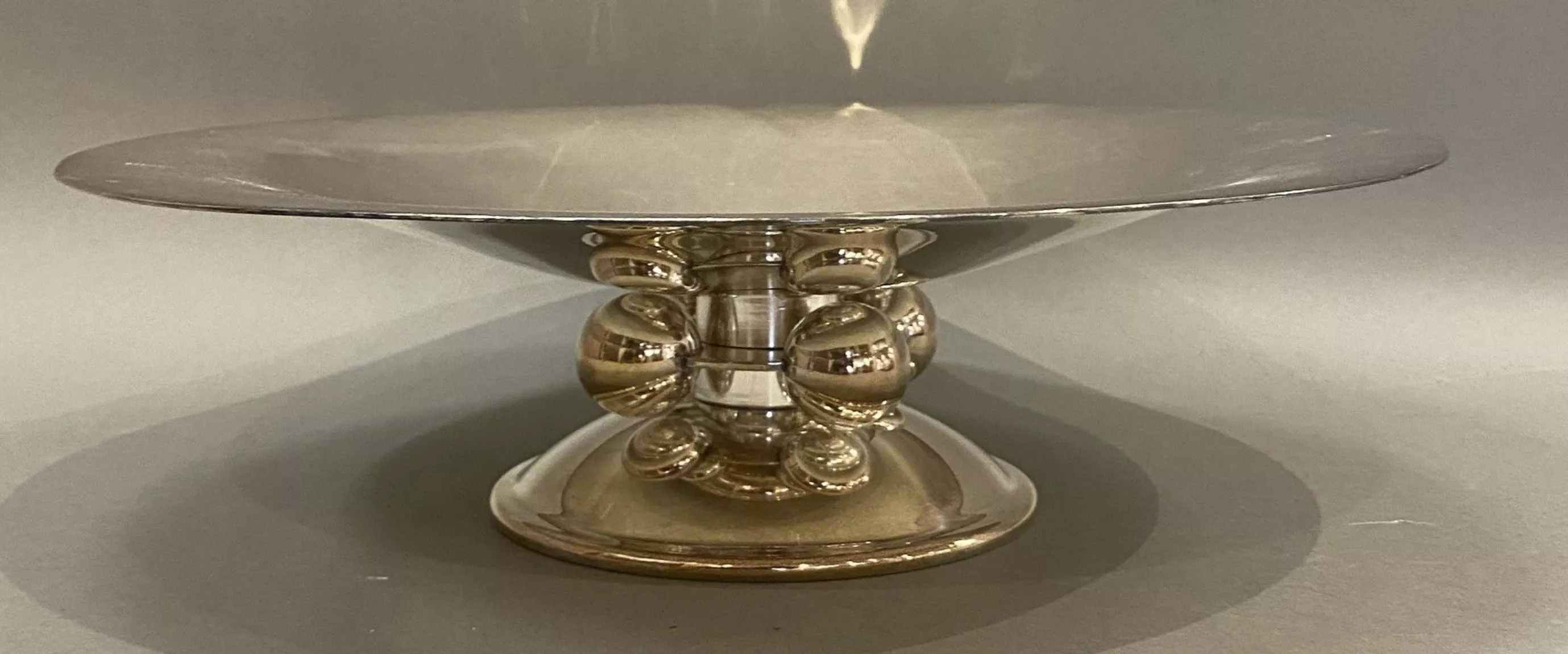
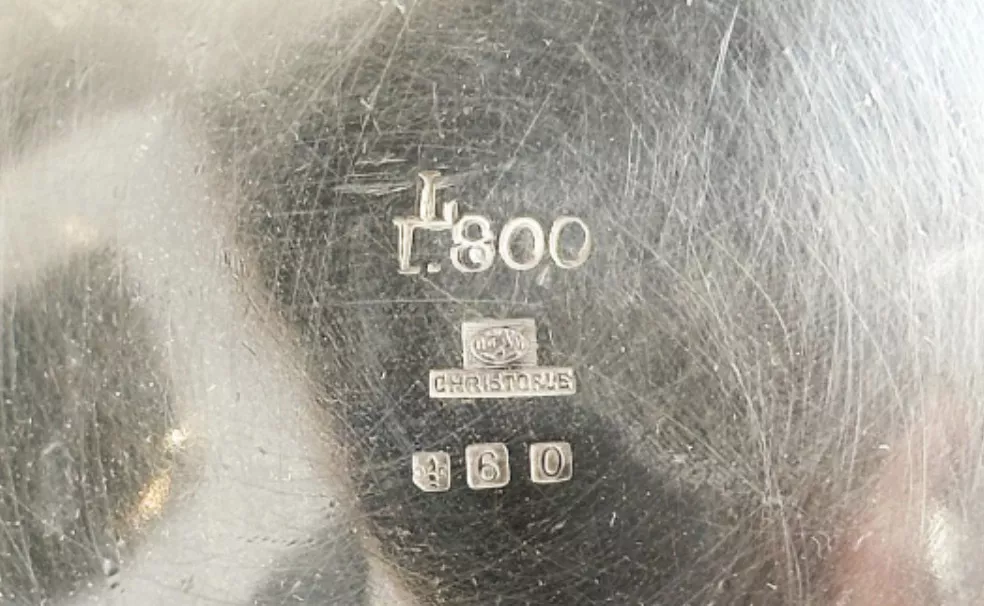
Despite a recognizable design, the artist's works are not always signed - which reinforces the need for expertise since there are so many copies. The hallmark remains a very important indication.
Expertise your property
If you own a creation by Ueli Berger, don't hesitate to request a free appraisal by filling out our online form.
A member of our team of experts and licensed auctioneers will contact you to provide an estimate of the market value of your Baumann chair.
If you're thinking of selling your work, our specialists will also guide you through the various alternatives available to obtain the best possible price, taking into account market trends and the specific features of each work.
Estimate in less than 24h
Discover in the same theme

Rating and value of paintings, drawings and sculptures by Co...
In polychrome resin, our reader's sculpture represents a yellow bird on a kind of rock in shades of Klein blue and red. It is signed C
Learn more >

Rating and value of sculptures, bronzes by Auguste Rubin
Auguste Rubin is a sculptor of the Art Nouveau period who produced works that are highly rated and valued at auction.
Learn more >

Rating and value of Russian Orientalist paintings by Alexand...
Alexander Iacovleff was a Russian Orientalist painter who produced numerous paintings that are highly valued at auction.
Learn more >
Similar items sold at auction

Estimated 500 - 1.000
CHRISTOFLE, part of a silver-plated household set

Estimated 800 - 1.500
QUEILLE silversmith for ODIOT Silver household set (925)

Estimated 200 - 400
LUC LANEL (1893-1965) and CHRISTOFLE, Silver-plated tray, "Transat" model

Estimated 400 - 600
CHRISTOFLE Large Louis XV style silver-plated 231-piece menagère set in a wooden cabinet with four drawers.

Estimated 350 - 500
Lot of 3 pieces in Turkish silver (900) including two goblets on foot with openwork decoration of angels

Estimated 1.000 - 1.500
Quadrangular silver tray (min.800) with incised decoration of flower branches

Secure site, anonymity preserved

Auctioneer approved by the State

Free and certified estimates
Frequently asked questions
-
Who was Luc Lanel, and what was his artistic background?Luc Lanel (1893–1965) was a leading French designer of the Art Deco movement and 1930s modernism. Trained at the École des Arts Décoratifs, he developed a rationalist aesthetic combining geometric precision with understated elegance, working notably for Christofle in the fields of silverware and tableware. He is also known for his decorative designs on great French ocean liners such as the Normandie, embodying the rare fusion of fine craftsmanship and industrial design.
-
What is the price range for Luc Lanel's works at auction?Luc Lanel’s works sell for between €40 and €5,900, depending on the technique and the period. Silverware and copperware pieces are the most sought-after, with prices ranging from €50 to €5,100 for copperware and from €40 to €5,900 for silver-plated pieces. For example, a pair of “Écaille” vases from 1925 sold for €5,100 in 2020, far exceeding its initial estimate of €600–800.
-
How can you authenticate a work by Luc Lanel and avoid counterfeits?Although Luc Lanel’s design is recognizable, his works are not always signed, which makes expert appraisal essential given the large number of existing copies. The hallmark remains a very important detail to check. We recommend having your piece appraised by requesting a free estimate from our state-certified experts and auctioneers, who will be able to confirm the authenticity of your item.
-
Is this the right time to sell a piece by Luc Lanel?Yes, this is an excellent time to sell. Luc Lanel’s designs are in high demand among enthusiasts of Art Deco and modernist furniture and design, particularly his silverware pieces, which blend seamlessly into a wide variety of interiors. Their historical significance, craftsmanship, and timeless aesthetic make them highly sought-after items on today’s market.
-
How does the free appraisal at Auctie's work, and how does the sale of a piece take place?The appraisal is simple and non-binding: fill out our online form, and an expert or certified auctioneer will contact you to evaluate your item and provide you with an accurate estimate of its market value. If you decide to sell, our specialists will guide you through the best available options to get the highest possible price, taking into account market trends and the unique characteristics of your creation.
