



Rating and value of paintings by Paul-Charles Chocarne Moreau

Key takeaways
- Chocarne Moreau’s oil-on-canvas paintings—his preferred medium—sell for between €80 and €69,020, with significant variations depending on quality and provenance.
- A French painter (1855–1931) who specialized in humorous genre scenes featuring children; he was trained by Bouguereau at the École des Beaux-Arts in Paris.
- In 2014, the painting “Young Child in a Park” sold for €50,000, far exceeding its initial estimate of €5,000 to €7,000.
If you own a work by or after the artist Chocarne Moreau, and would like to know its value, our state-approved experts and auctioneers will offer you their appraisal services.
Our specialists will carry out a free appraisal of your work, and provide you with a precise estimate of its value on the current market.
Then, if you wish to sell your work, we will direct you to the best possible arrangement to obtain the optimum price.
Rating and value of the artist Chocarne Moreau
Paul Chocarne Moreau was a French painter and draughtsman, recognized in this case under the Second Empire and the Third Republic.
His most prized works are his oils on canvas, and the price at which they sell on the market ranges from €80 to €69,020, a substantial range but one that speaks volumes about the value that can be attributed to Chocarne Moreau's works.
In 2014, an oil on canvas entitled Jeune enfant dans un parc, l'un tenant une écrevisse, l'autre une statue, sold for €50,000, whereas it was estimated at between €5,000 and €7,000.
Order of value from a simple work to the most prestigious
Technique used | Result |
|---|---|
Estamp - multiple | From €200 to €1,635 |
Drawing - watercolor | From €110 to €3,700 |
Painting | From €80 to €69,020 |
Estimate in less than 24h
Artist's style and technique
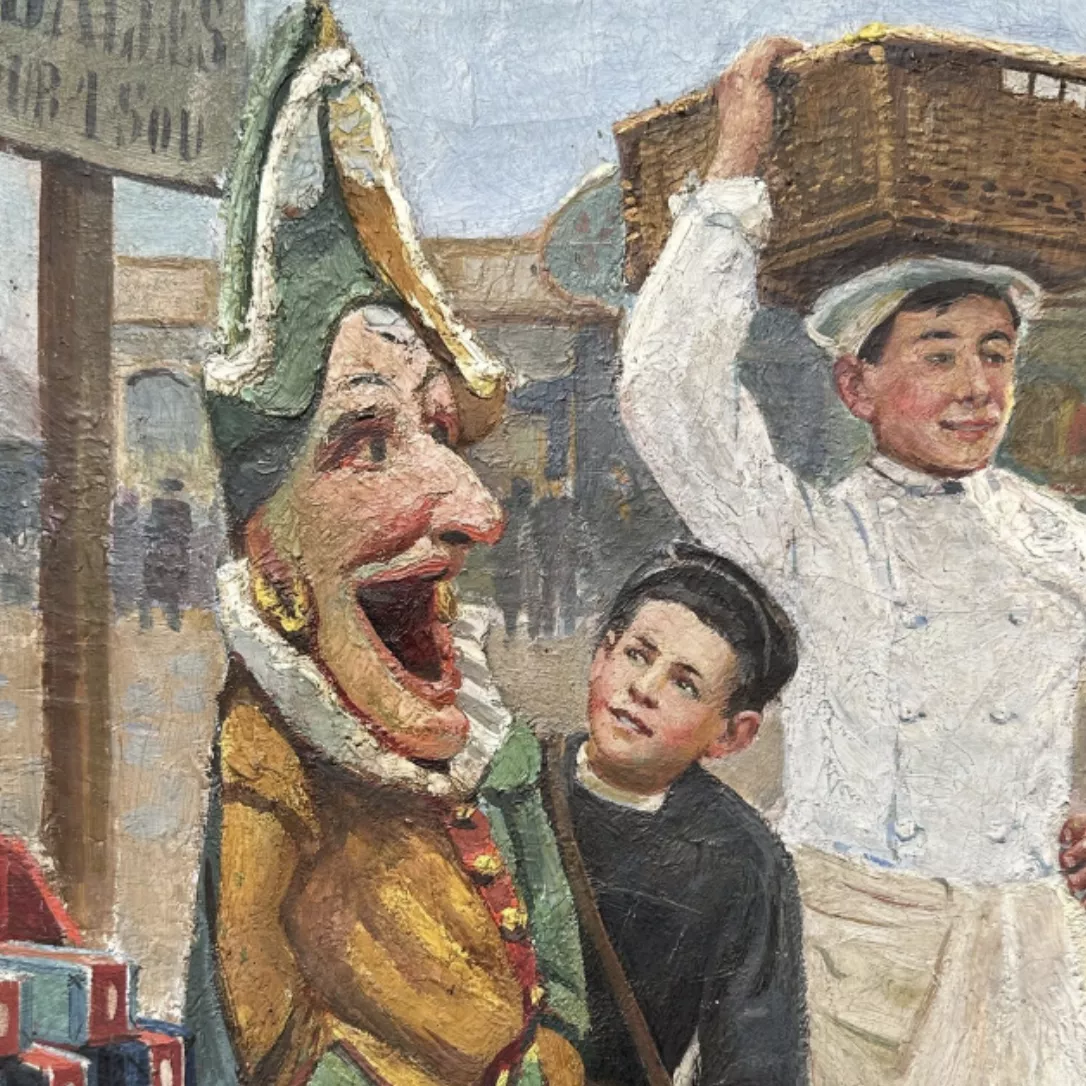
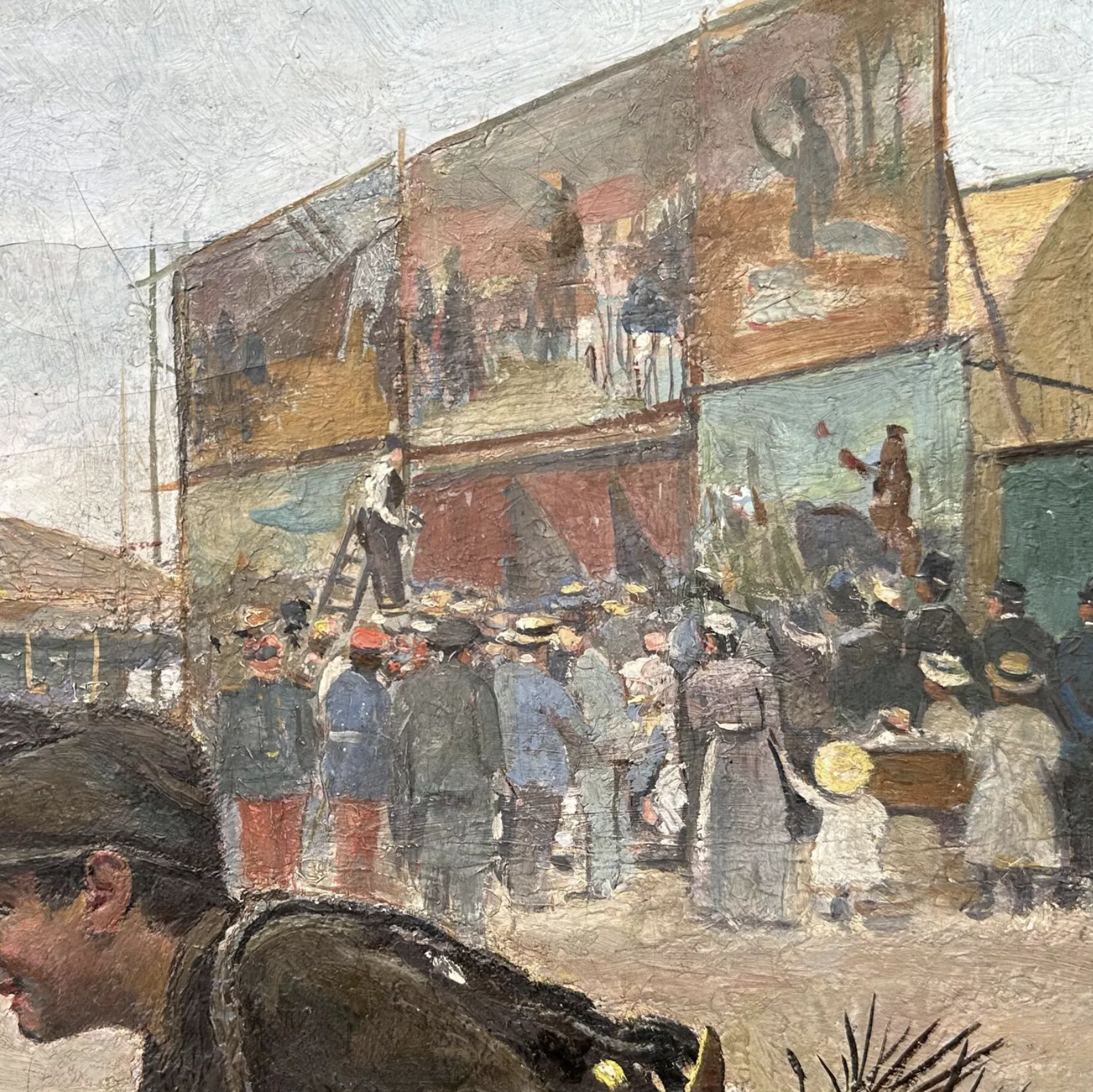
Paul-Charles Chocarne Moreau (1855 - 1931), was a French painter known for his genre scenes. He worked mainly in oil on canvas, with a fairly smooth rendering and no visible impasto.
His work testifies to a great mastery of academic drawing, with precise contours and rigorous proportions. His palette is luminous, dominated by warm, natural tones (ochres, browns, reds, enhanced by touches of white).
He applies color often in thin layers, with subtle plays of light to shape volumes. His style is narrative and anecdotal, inherited from academic painting and bourgeois realism.
He depicts objects in extreme detail, with an eye for the picturesque, and works with theatrical staging, each canvas seeming to tell a story often in a single act, with a visual or narrative climax.
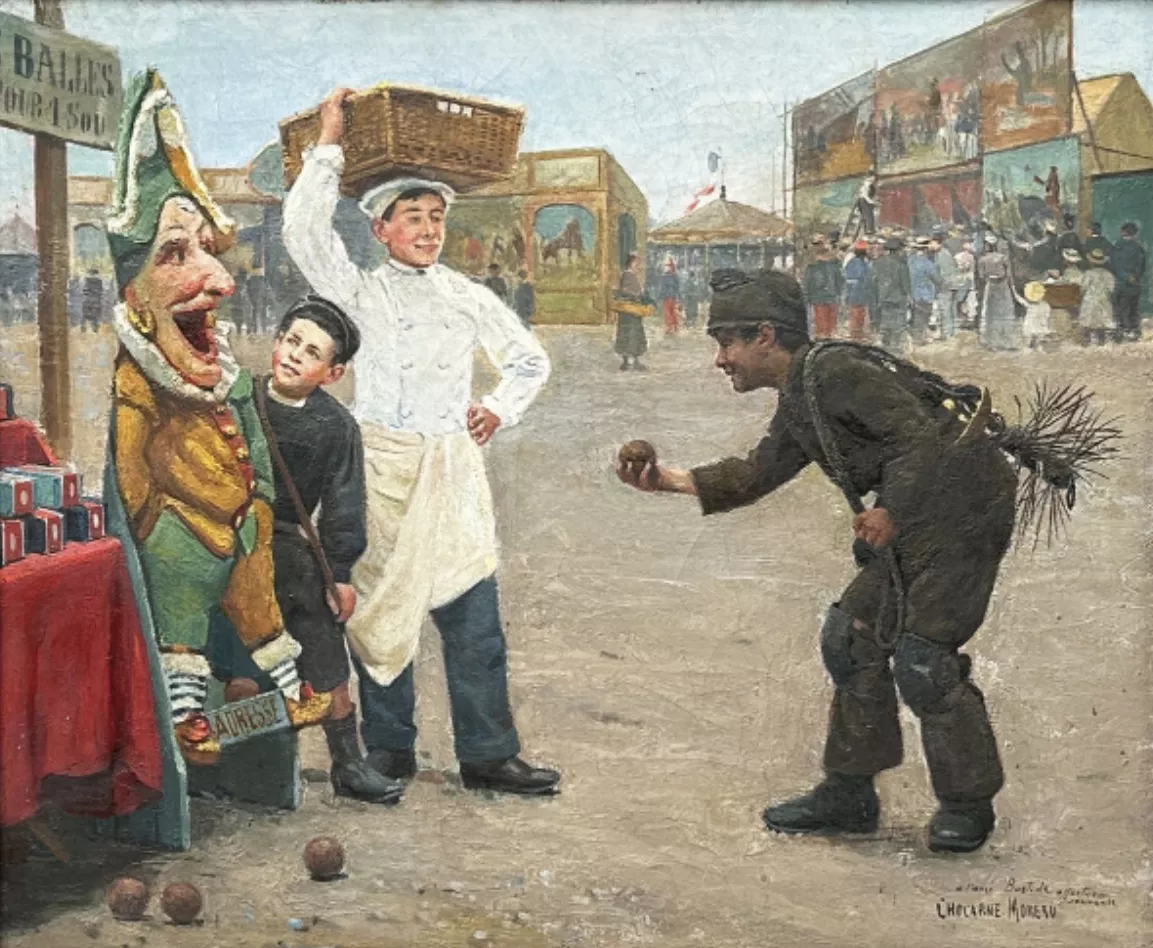
Characters' facial expressions and gestures are treated with vivacity and light exaggeration, verging on caricature. He is a specialist in humorous genre scenes, often revolving around youth, mischief and childish mischief.
He depicts street children, small merchants, apprentices or schoolchildren, and refuses gravity : his style is light, ironic, tender, and sometimes moral without ever being heavy-handed. Chocarne Moreau turns art into an amused social mirror, observing everyday life with finesse.
Trained at the École des Beaux-Arts in Paris, he was a pupil of Bouguereau and Tony Robert-Fleury. He inherits the French academic tradition of the 19th century, but diverts it towards more popular, lighter subjects.
His style combines the heritage of genre realism (Meissonier, Traviès) with a humorous touch of his own. His works are designed to please, with a clear composition, a readable subject and an immediate message, and aimed at a bourgeois or family audience, sensitive to both technical virtuosity and eye appeal.
The life of Paul Chocarne Moreau
Paul Chocarne Moreau was born into a middle-class family in Dijon in 1855. He moved to Paris to study at the Beaux-Arts, where he received rigorous academic training from Bouguereau and Tony Robert-Fleury, two pillars of 19th-century academic education.
He distinguished himself early on through his facility with drawing and showed a pronounced taste for pictorial narrative, debuting at the Salon des artistes français in the late 1870s.
He built his reputation by moving away from large-scale mythological or historical subjects in favor of scenes of everyday life, and specialized in small-format paintings, often featuring mischievous children or street scenes.
Chocarne Moreau met with notable commercial success, his works appealing to bourgeois clientele for their freshness and virtuosity. He exhibited regularly until the beginning of the twentieth century.
His production remained constant (interior scenes, small trades, children), always treated with humor and realism. Some of his works were reproduced as engravings or distributed as postcards, a testament to his popularity.
He remained on the bangs of the major modernist movements, and embodied a traditional, accessible and narrative style of painting.
Paul Chocarne Moreau died in Neuilly-sur-Seine, in relative obscurity. After his death, his work fell into oblivion for some time, although it was still prized by lovers of genre scenes.
He was rediscovered by collectors and auction houses for his technical virtuosity and his ability to capture the emotions of childhood.
Today, he is considered a valuable witness to popular Parisian life at the turn of the 20th century, between social observation and pictorial entertainment.
Focus on Le voleur de confitures, Paul Chocarne Moreau
With Le voleur de confitures, a medium-format oil on canvas often reproduced in prints, the artist depicts a child, caught eating, with his hands full of jam.
The child, at the center of the composition, has reddened hands, stained cheeks and a look that's both sheepish and mischievous. Behind him, we can make out a half-open sideboard, an overturned pot and an adult silhouette out of frame.
The bodily attitude, with the hands frozen and the gaze raised, conveys a theatrical moment, caught on the spot, just before the reprimand. The décor is modest but highly detailed (kitchen utensils, bourgeois furniture, soft light and cast shadows).
The composition is centered, with the child catching the eye, isolated in the moment of offense, in a soft but focused light. The drawing is precise, the strokes firm and the contours sharp, with a classic treatment of volume through light.
The colors are warm and natural, with a predominance of browns, ochres and reds, and highlights of white on the shirt or porcelain. Jam is treated as both a pictorial and narrative element.
The work plays on a popular iconography: that of the greedy, fault-finding child, both blameworthy and endearing. It is a parody of the religious scene (guilt, temptation, punishment), but transposed into a light, humorous bourgeois universe.
The child is not demonized, but presented as a comic hero, reflecting a society tenderized by youthful indiscretions. The work also questions the notion of authority, transgression and forgiveness in the family unit.
This painting is widely reproduced, often offered as a moral but benevolent image, in school or domestic settings. It expresses everyday joy and educational tenderness, and perfectly embodies the Chocarne-Moreau spirit.
Recognizing the artist's signature
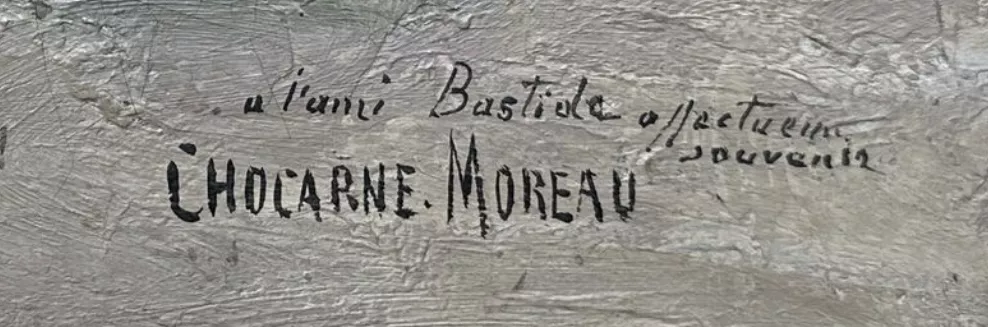
Paul Chocarne Moreau doesn't necessarily sign his works. If they are, here's an example of his signature :
Knowing the value of a work
If you happen to own a work by Paul Chocarne Moreau, request a free appraisal without further delay via our form on our website.
A member of our team will contact you promptly with the estimation of the value of your work, not forgetting to provide you with ad hoc information about it.
If you are considering selling your work, you will also be accompanied by our specialists in order to benefit from alternatives for selling it at the best possible price.
Estimate in less than 24h
Discover in the same theme

Value and quotation of works, paintings by Alexandre Roubtzo...
Alexandre Roubtzoff is a 20th-century Orientalist painter. His paintings are highly valued. Estimate in less than 24h.
Learn more >

Rating and value of works, prints and paintings by Jacques V...
Jacques Villon is a Cubist artist of the 20th century who produced prints and paintings quoted on the auction market. Estimated in 24h.
Learn more >

Rating and value of paintings by Huguette Caland
Huguette Caland is a Lebanese artist who has produced abstract works in various media, working with the body and eroticism.
Learn more >
D'autres tableaux modernes figuratifs vendus aux enchères

Estimated 800 - 1.500
Jean Roger SOURGEN (1883-1978) Trees and dunes Oil on panel

Estimated 3.000 - 5.000
Georges LAPCHINE (1885-1951) The port of St Tropez Oil on canvas

Estimated 18.000 - 30.000
Charles CAMOIN (1879-1965) "Le Port de Marseille, 1928" Oil on canvas.

Estimated 1.500 - 3.000
Jean VANDEN EECKHOUDT (1875-1946), Basket of persimmons, Oil on canvas

Estimated 2.000 - 4.000
Charles LACOSTE (1870-1959) Starry night, Oil on paper mounted on canvas

Secure site, anonymity preserved

Auctioneer approved by the State

Free and certified estimates
Frequently asked questions
-
Who was Paul Chocarne Moreau, and what was his artistic style?Paul Chocarne Moreau (1855–1931) was a French painter who trained at the École des Beaux-Arts in Paris under Bouguereau and Tony Robert-Fleury. A specialist in humorous genre scenes, he primarily depicted mischievous children and everyday life among the common people in a virtuosic academic style, characterized by a luminous palette, precise draftsmanship, and a lighthearted, ironic narrative.
-
What is the price range for Paul Chocarne Moreau's paintings?Oil-on-canvas paintings, the artist’s preferred medium, sell for between €80 and €69,020. Drawings and watercolors range from €110 to €3,700, while prints and multiples range from €200 to €1,635. These price variations depend on the work’s size, subject matter, condition, and provenance.
-
How can you authenticate a work by Paul Chocarne Moreau?To authenticate a work by Chocarne Moreau, we recommend that you request a free appraisal from our state-certified experts and auctioneers. They will analyze the technique, signature, provenance, and condition of the work to provide you with an accurate estimate within 48 hours, with no obligation on your part.
-
Is this the right time to sell a work by Paul Chocarne Moreau?Yes, because this artist is currently experiencing a resurgence in popularity among collectors. Long relatively forgotten after his death, Chocarne Moreau is now recognized as a valuable chronicler of working-class Parisian life at the turn of the 20th century. His technical virtuosity and his ability to capture the emotions of childhood are attracting a growing clientele.
-
How does the appraisal and sale of a work of art take place at Auctie's?The appraisal is free, non-binding, and conducted by our experts. Once we receive your request, a specialist will contact you promptly to provide you with the appraisal. If you decide to sell, our auctioneers will then guide you through the entire process to ensure you receive the best terms of sale and achieve the highest possible price.
