



Rating and value of paintings by Georges Vantongerloo

Key takeaways
- Vantongerloo, a Belgian abstract painter of European renown, has seen his works sell for between €80 and €1,136,500 at auction, with prices that are stable and strong.
- His 1930 oil on canvas "Composition Derived from the Equation y=-ax²+bx+18," from 1930, fetched €1,136,500 in 2018, exceeding its initial estimate of €910,000 to €1,360,000.
- Estimates vary depending on the medium: sculptures from €230 to €2,500, prints from €80 to €2,600, watercolor drawings from €800 to €251,900, and paintings from €80 to €1,136,500.
If you own a work by or based on the artist Georges Vantongerloo and would like to know its value, our state-approved experts and auctioneers will guide you.
Our specialists will carry out a free appraisal of your work, and provide you with a precise estimate of its value on the current market.
Then, if you wish to sell your work, we will direct you to the best possible arrangement to obtain the optimum price.
Rating and value of the artist
A Belgian abstract painter who is fairly well known in Europe, Georges Vantongerloo became very famous during his lifetime. Today, his works are highly prized on the market, particularly by collectors of his school.
The artist therefore maintains a stable and lively quotation, with his creations being sold for between €80 and €1,136,500 on the auction market.
A work by Vantongerloo can sell for over €1 million, as evidenced by his oil on canvas Composition emanating from the equation y=-ax2+bx+18 with chord of orange, green, violet, dating from 1930, sold for €1,136,500 in 2018, while it was estimated at between €910,000 and €1,360,000.
Order of value from the most basic to the most prestigious
Technique used | Result |
|---|---|
Sculpture - volume | From €230 to €2,500 |
Estamp - multiple | From €80 to €2,600 |
Drawing - watercolor | From €800 to €251,900 |
Painting | From €80 to €1,136,500 |
Estimate in less than 24h
The artist's works and style
In 1917, in his pared-down compositions in which geometric forms are articulated with an almost scientific rigor (Musée National d'Art Moderne, Paris), in his use of mathematical proportions as a structuring principle, Vantongerloo had chosen extreme simplification and calculated color modulation to organize pictorial space : direct influences of the neoplastic research he had just integrated, to which was added his own interest in algebraic theories applied to art.
Mondrian, at the same time, reduced plastic expression to verticals and horizontals alone, banishing all curves and obliques : a radicality that Vantongerloo, more flexible in his approach, deflects by introducing dynamic relationships between surfaces and lines, as evidenced by Composition émanante de l'ellipse (1920, private collection) and Construction dans l'espace (Musée d'Art Moderne de la Ville de Paris).
In both cases, painting is definitively detached from reality to become a purely visual transcription of the universal laws of equilibrium and movement, which must - one imagines - have seemed highly speculative to their contemporaries, still influenced by the vestiges of expressionism or analytical cubism.
With their precise intersections and measured chromatic flats, Vantongerloo's works anticipate an evolution in which formal rigor is accompanied by reflection on perception and spatiality.
But the very structure of his compositions was evolving: in 1930, when he produced Composition basée sur la relation du cercle et du carré (Kunstmuseum, Basel), he no longer referred solely to the principles of De Stijl but attempted, he wrote in his theoretical notes, to "visualize the hidden harmony of natural phenomena". For him, the line is no longer a simple outline delimiting forms, but a vector of energy, an active element in the pictorial field.
On a theoretical level, this approach reflects a desire to transpose mathematical laws into art, in a quest where beauty lies in the balance of forces and the clarity of plastic relationships.
Here again, his attitude dovetails with that of the geometric abstractionists: for both, painting and sculpture no longer aim to imitate nature, but to express immutable principles, governed by rational, timeless structures.
The life of Georges Vantongerloo
Georges Vantongerloo (1886 - 1985) was a Belgian abstract painter and member of the De Stijl group, who worked in Paris.
Born in Antwerp, he began his artistic training at the Académie royale des Beaux-Arts in Brussels, but also in Antwerp, from 1900.
His early work, from 1910 to 1917, is characterized by a fairly figurative style, which evolves towards academicism and then postimpressionism.
During the First World War, he was drafted into the Belgian army, but was soon wounded and hospitalized in Holland. He remained in Holland for the rest of the war as a refugee near The Hague. His first exhibition took place in 1917, at the Cercle Hollando-Belge.
It was also there that he made the acquaintance of Jules Schmalzigaug, who, according to some sources, introduced him to modern art. He then met Theo Van Doesburg, Bart van der Leck and Mondrian, members of the De Stijl group and magazine, of which he became a full member in 1917.
He was one of the co-authors of the group's manifesto in 1918, which marked a turning point in his painting. Like many abstract artists, he had a close connection with science and especially mathematics, which he believed would enable him to represent the great mystery of the universe in measurable forms.
He also studied geometry, physics and cosmology extensively, wishing for an art that conformed to pure mathematical relations. Based on this observation, the works he produces are part of pure geometric abstraction (cf François Morellet)
The lattice-like compositions he produces seem arbitrary, yet nothing is left to chance by the artist. The arrangement of lines is systematically determined by formulas.
As for color, it is determined by the size of the chromatic volume. He doesn't paint only with primary colors like Mondrian, nor does he use only lines : some works have a dominant of angles and straight lines, while others have a dominant of circles and ovals.
Because of these choices, he left the De Stijl group four years after joining, in 1921 only, having introduced a lot of exact science, consisting in finding the laws of color by linking together harmonies of sound and color.
He had, however, moved geographically away from the group earlier, as he moved to Menton, France, in 1919 with his wife. At this time, he also began producing bronzes, in order to support himself - as he was unable to sell many works at the time.
In France, he met Max Bill, who organized several of his exhibitions. In 1931, together with other artists including Theo Van Doesburg (who had also left De Stijl following a dispute with Mondrian), he founded the Abstraction-Création group in Paris.
In the 20s and 30s, he continued his research into spatial and volumetric proportions - which he applied in his Spherical Constructions and Interrelations of Masses. Moreover, he was the first to use the aesthetic principles of neoplasticism in sculpture.
In 1936, he became better known and recognized, and took part in the exhibition Cubism and Abstract Art held at the Museum of Modern Art in New York. Eight years later, he produced his first monograph in 1943, at the Galerie de Berri (Paris).
During the 1940s, Vantongerloo worked with more intuitive organic forms in Plexiglas, to explore concepts of infinity, movement and space.
.
Focus on Composition émanante de l'ellipse, Georges Vantongerloo
In Composition émanante de l'ellipse (collection Peggy Guggenheim Foundation, Venice), Vantongerloo applies a mathematical logic to geometric forms, where the line frees itself from the strict constraints of neoplastic orthogonality to open up to the curve.
If, in his early research, the artist was attached to the principles of number and proportion, this 1944 work testifies to a desire for gradual emancipation from De Stijl dogma: here, the ellipse, a rare figure in geometric abstraction, introduces a dynamic that breaks with the strict order of the square and rectangle.
As in his theoretical writings, Vantongerloo seeks to overcome statism by inserting into the composition a principle of growth that suggests internal movement. Color, reduced to clear flat tints, plays a modulating role, nuancing the rigor of the line and introducing a vibratory effect.
In this balance between construction and fluidity, Composition émanante de l'ellipse illustrates this search for an abstraction subject to the laws of an internal logic, where geometry ceases to be a mere framework to become a field of open experimentation.
As a result, Geroges Vantongerllo's works are very successful on the auction market today. While some of his works are exhibited in museums around the world, it is private collectors who play the greatest role in preserving his work.
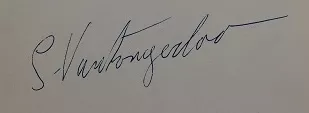
His signature
Not all of Georges Vantongerloo's works are signed.
Although there are variants, here's a first example of his signature:
Expertise your property
If you own a work by Georges Vantongerloo, don't hesitate to request a free appraisal by filling in our online form.
A member of our team of experts and certified auctioneers will contact you to provide an estimate of the market value of your work.
If you are considering selling your work, our specialists will also guide you through the various alternatives available to obtain the best possible price, taking into account market trends and the specific features of each work.
Estimate in less than 24h
Discover in the same theme

Value and quotation of works, paintings by Yves Brayer
Yves Brayer, a painter of 20th-century figurative art, is a figure forgotten by the general public but sought-after at auction. Estimated in 24h.
Learn more >

Rating and value of paintings by Pierre Dmitrienko
Pierre Dmitrienko is an abstract painter who has produced works that are highly rated and valued at auction. 100% free estimate!
Learn more >

Rating and value of paintings by Vilmos Huszar
Vilmos Huzsàr was a Hungarian painter and member of the De Stijl movement, who produced numerous works of great value.
Learn more >
D'autres tableaux abstraits vendus aux enchères

Estimated 2.000 - 4.000
Serge POLIAKOFF (1900-1969), Composition en rouge et bleu. 1965, Lithograph

Estimated Between €5,000 and €8,000
Jean MIOTTE (1926-2016), acrylic on canvas

Estimated 3.000 - 5.000
Roberto MATTA (1911-2002), Composition, Gouache on canvas

Secure site, anonymity preserved

Auctioneer approved by the State

Free and certified estimates
Frequently asked questions
-
Who was Georges Vantongerloo, and what was his artistic background?Georges Vantongerloo (1886–1985) was a Belgian abstract painter and a founding member of the De Stijl group in 1917. Based in Paris from 1919 onward, he distinguished himself through his unique approach to geometric abstraction, incorporating mathematical and scientific principles into his compositions. Unlike Mondrian, who used only primary colors and orthogonal lines, Vantongerloo introduced curved shapes, circles, and ovals, before founding the Abstraction-Création group in 1931.
-
What is the price range for Georges Vantongerloo's works at auction?Works by Georges Vantongerloo sell for between €80 and €1,136,500, depending on the medium and rarity. Paintings command the highest prices (up to €1,136,500), while drawings and watercolors range from 800 to 251,900 €, prints from 80 to 2,600 €, and sculptures from 230 to 2,500 €. His market value remains stable and strong, particularly among collectors specializing in geometric abstraction.
-
How can you authenticate and appraise a work by Georges Vantongerloo?To authenticate and appraise a work by Georges Vantongerloo, we recommend that you submit a request for a free appraisal to Auctie's. A state-certified expert or auctioneer will examine your artwork and provide you with an accurate estimate of its market value. This appraisal is non-binding, and you will receive a response within 48 hours.
-
Is this the right time to sell a work by Georges Vantongerloo?Yes, now is a good time to sell a work by Georges Vantongerloo. The artist enjoys stable and strong market value, with growing interest among collectors in geometric abstraction and Constructivist art. His works regularly fetch high prices at auction, and recognition by major museums (such as the Musée National d’Art Moderne in Paris and the Guggenheim) is driving demand.
-
How does the sale of a work of art work at Auctie's?At Auctie's, we support sellers every step of the way, from appraisal to auction. After a free, no-obligation appraisal, our specialists will guide you through the various sales options to help you achieve the best possible price. We take into account market trends and the unique characteristics of each artwork to maximize the results of your sale.
