



Rating and value of paintings by Theo van Doesburg

Key takeaways
- Van Doesburg's paintings sell for between €1,370 and €2,519,500, while his watercolor drawings range from €830 to €596,000.
- Works from the 1920s are the most sought-after by collectors and have maintained a stable international market value since his lifetime.
- As the founder of De Stijl in 1917, van Doesburg distinguished himself from Mondrian by introducing the diagonal into his geometric compositions, influencing the Bauhaus and the modernist avant-garde.
If you own a work by or based on the artist Theo van Doesburg and would like to know its value, our state-approved experts and auctioneers will guide you.
Our specialists will carry out a free appraisal of your work, and provide you with an accurate estimate of its value on the current market.
Then, should you wish to sell your work, we will direct you to the best possible arrangement to obtain the optimum price.
Artist's rating and value
In his lifetime, Theo van Doesburg enjoyed great success and a high international rating that has not diminished today. His paintings and drawings produced in the 1920s are the most highly prized and attract a great deal of interest from collectors.
The price at which they sell on the art market ranges from €10 to €2,519,500, a consequent delta but one that speaks volumes about the value that can be attributed to the artist's works.
A work by van der Leck can fetch hundreds of thousands of euros, as demonstrated by his painting Composition, dating from 1918, which sold for €2,519,500 in 2001, whereas it was estimated at between €1,323,000 and €1,837,500.
Order of value from the most basic to the most prestigious
Technique used | Result |
|---|---|
Estamp - multiple | From €10 to €8,530 |
Drawing - watercolor | From €830 to €596,000 |
Painting | From €1,370 to €2,519,500 |
Estimate in less than 24h
The artist's style and technique
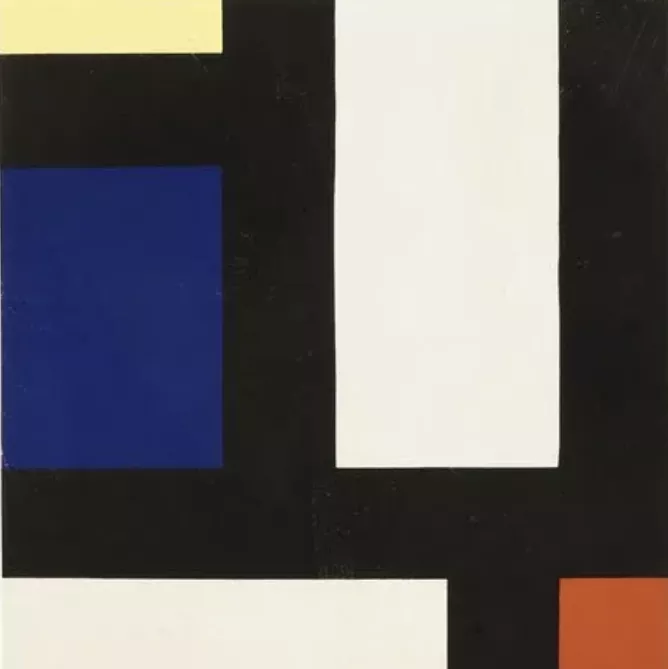
Theo van Doesburg explored a style of painting in which order and harmony took precedence over all forms of naturalism. Founder of the De Stijl movement alongside Mondrian, he developed a plastic language based on geometric rigor and the simplification of forms, seeking to eliminate all subjectivism.
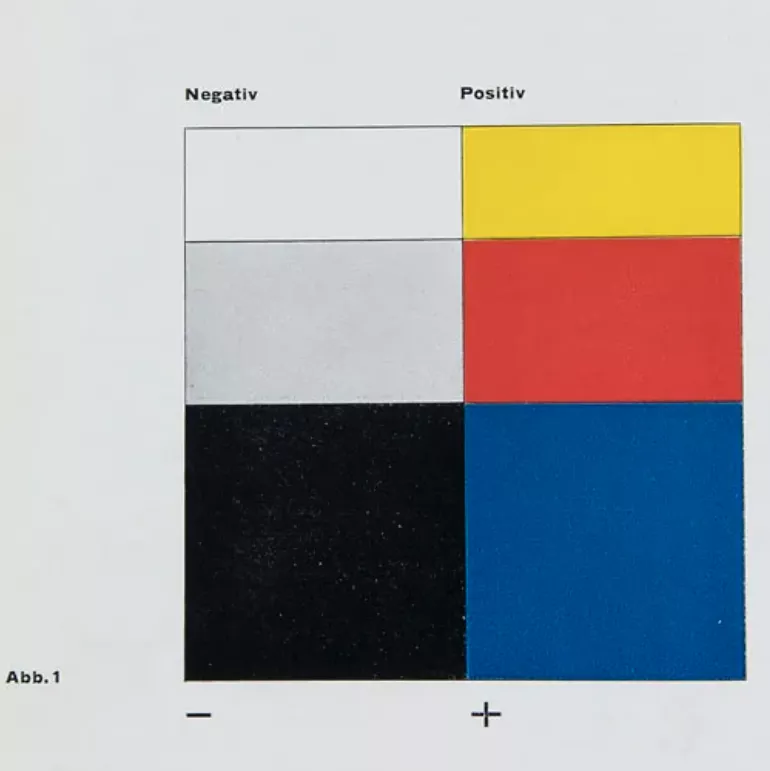
His palette is reduced to primary colors, combined with black, white and gray, in a quest for absolute balance where each element finds its rightful place.
His methodically constructed compositions reflect a desire to go beyond the individual to reach the universal, reflecting a vision where art and architecture merge into a coherent whole.
However, far from a strict application of the principles of neoplasticism, van Doesburg stands out for his ability to experiment. Where Mondrian imposed a strict orthogonal grid, he introduced the diagonal, energizing his compositions and opening up new perspectives on movement.
Painter, architect, typographer and theorist, he conceived art as an inseparable whole in which each discipline dialogues with the other. His work, in constant evolution, pushes the boundaries of modernism, influencing both the Bauhaus and the international avant-garde.
Through his works, he seeks to structure space and rhythm with an almost mathematical precision, while infusing an energy specific to his singular approach to neoplasticism.
The life of Theo van Doesburg
Christian Emil Marie Küpper, known as Theo van Doesburg (1883 - 1931), was an abstract artist of the early 20th century. A painter as well as an art theorist and architect, Van Doesburg is fairly well known in the Netherlands, but less so in France.
Born in Utrecht, he was the son of a photographer. Close to his stepfather, he took the latter's name, adding a particle to form his artist's name.
He began his training by taking drama lessons in 1902. He began by trying his hand at writing without studying the subject, but eventually turned to painting, again as a self-taught artist. His signature became Theo van Doesburg.
He began exhibiting a few years later, officially holding his first show in 1908, in The Hague. At this point in his career, he painted in a rather naturalistic style.
In 1915, he did his military service and at the same time became acquainted with the work of Piet Mondrian, who was conducting extensive research into abstraction - using primary colors combined with black and white, himself influenced by Bart van der Leck.
The same year, he published an article in the magazine Eenheid, commenting on and explaining Mondrian's work. After founding De Anderen with other artists, he founded De Stijl with the creator of neoplasticism in 1917. Throughout his life, he devoted a great deal of time and energy to the group and the magazine.
After a spell in Paris, Van Doesburg moved to Weimar, where he met a number of Russian Constructivists. With them, he steered the aesthetics of Constructivism towards iconographies emphasizing mass production, machinismo and craftsmanship.
In this, he drew stylistically closer to artists such as Gustav Klucis. After this experience, he joined the Dada group in 1921, resuming his publications of writings, since he mainly wrote poems in his Dada period.
He then moved closer to the Bahaus school, where he gave a whole series of lectures. In 1922, he organized the International Congress of Progressive Artists in Düsseldorf. After severing ties with Mondrian, he had the opportunity to collaborate with Hans Arp and Sophie Tauber-Arp.
His research took a turning point when he published the Elementarist manifesto. He continued to produce until the end of his life, dying in 1931 of a heart attack.
Focus on Counter-Composition XVI, Theo van Doesburg
With Contre-composition XVI, Theo van Doesburg breaks with the strict orthogonality of neoplasticism to introduce a new dynamic into abstraction.
The composition, built on a play of obliques, seems in motion, contrasting with the rigidity of Mondrian's grids.
Yet, balance remains, governed by an almost mathematical precision where each element finds its rightful place.
The primary colors - red, blue, yellow - dialogue with black, white and gray in a masterful arrangement. Rather than juxtaposing static forms, van Doesburg tilts the planes, creating a visual tension that energizes the whole.
Space seems to tilt, animated by these oblique lines that oppose and respond to each other. This approach marks a break with the dogma of neoplasticism, affirming the artist's desire to explore new avenues within abstraction.
With this work, van Doesburg affirms his conception of a total art, where painting, architecture and design intertwine. It's no longer a question of simply organizing colored surfaces, but of infusing the composition with a rhythm and energy of its own.
By integrating movement into abstraction, he opens the way to experiments that will have a lasting influence on the avant-garde of the 20th century.
.
Theo van Doesburg's imprint on his period
Theo van Doesburg's imprint goes far beyond painting and is part of a global overhaul of the visual arts.
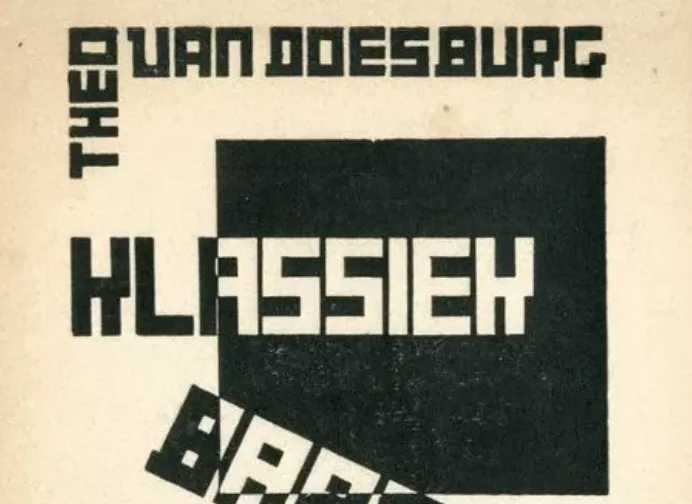
Founder and theorist of the De Stijl movement, he redefined the principles of abstraction by integrating a vision where art, architecture, design and even typography come together in total harmony.
His introduction of the diagonal into composition marks a decisive break with the strict orthogonality of neoplasticism, injecting a new dynamic into a plastic language hitherto founded on absolute stability.
His influence extends to the Bauhaus, where he disseminates his ideas and directly influences designers such as Walter Gropius and Ludwig Mies van der Rohe.
His impact also reaches major avant-garde figures, from Russian Constructivism to Minimalism, modern architecture and the graphic arts.
His commitment to structured, rational and universal art shaped twentieth-century aesthetic thought, profoundly influencing contemporary design and the plastic experiments that would follow.
Today, his work still resonates in geometric abstraction and the relationship between form, space and color, testifying to his central role in the evolution of modernism.
Theo van Doesburg's stylistic influences
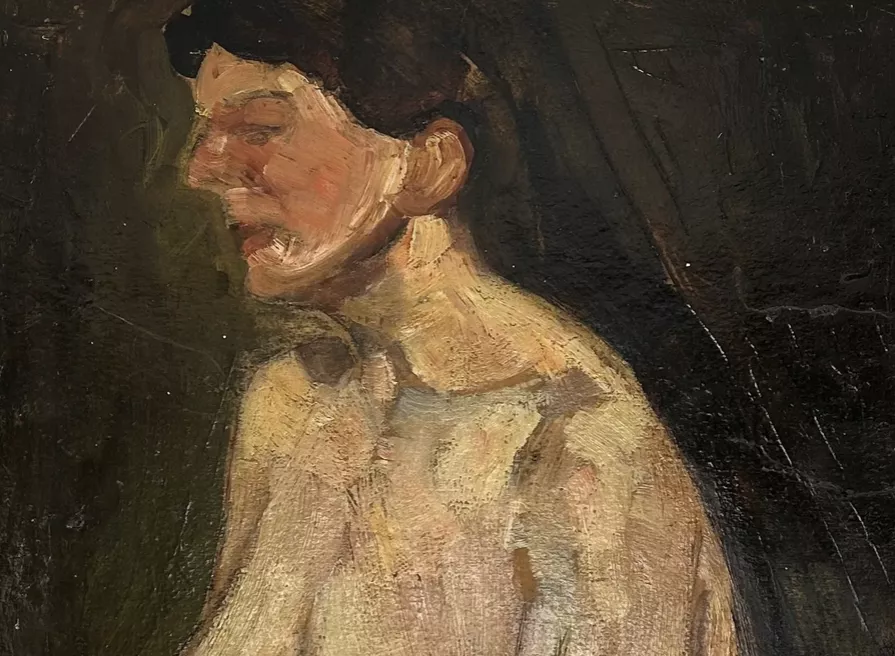
Theo van Doesburg drew his influences from several avant-garde currents of the early 20th century. Influenced by Expressionism and Cubism, he soon moved away from them to develop a more radical approach to abstraction.
Discovering the work of Piet Mondrian and Bart van der Leck led him to theorize an art based on the geometrization of forms and the use of pure colors, principles that would give birth to the De Stijl movement.
However, where Mondrian imposed strict orthogonality, van Doesburg introduced the diagonal, influenced by the research of Russian Constructivism and his interest in the dynamism of forms.
His work was also inspired by the principles of the Bauhaus, where he briefly taught and disseminated his ideas on the unity between art and architecture.
His theoretical and plastic commitment makes him a transitional figure between neoplasticism and the modernist experiments that would leave a lasting mark on the 20th century.
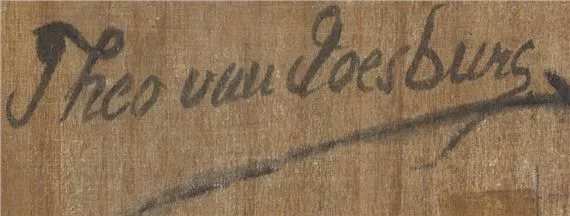
His signature
Although there are variations, here's a first example of his signature :
Expertise your property
If you happen to own a work by Theo van Doesburg, request a free appraisal without further delay via our form on our website.
A member of our team will contact you promptly to provide you with an estimate of the value of your work, as well as ad hoc information about it.
If you are considering selling your work, you will also be accompanied by our specialists in order to benefit from alternatives for selling it at the best possible price.
.Estimate in less than 24h
Discover in the same theme

Rating and value of paintings by Chaïm Soutine
Chaïm Soutine is a twentieth-century Russian Expressionist painter whose paintings are highly prized at auction.
Learn more >

Rating and value of paintings by Vladimir Terlikowski
Vladimir Terlikowski is a twentieth-century Polish painter whose works are highly valued at auction.
Learn more >

Rating and value of sculptures, bronzes and drawings by Char...
Charles Malfray is a twentieth-century sculptor who produced works that are highly regarded and valued at auction. Free estimate.
Learn more >
D'autres tableaux abstraits vendus aux enchères

Estimated 2.000 - 4.000
Serge POLIAKOFF (1900-1969), Composition en rouge et bleu. 1965, Lithograph

Estimated Between €5,000 and €8,000
Jean MIOTTE (1926-2016), acrylic on canvas

Estimated 3.000 - 5.000
Roberto MATTA (1911-2002), Composition, Gouache on canvas

Secure site, anonymity preserved

Auctioneer approved by the State

Free and certified estimates
Frequently asked questions
-
Who is Theo van Doesburg, and what is his role in art history?Theo van Doesburg (1883–1931) was a Dutch painter, architect, typographer, and theorist who co-founded the De Stijl movement with Piet Mondrian. He revolutionized geometric abstraction by introducing the diagonal into his compositions and by merging painting, architecture, and design. His influence extended to the Bauhaus and the international avant-garde of the 20th century.
-
What is the price range for Theo van Doesburg's paintings?The value of Theo van Doesburg’s works varies considerably depending on the medium and the period. Paintings range from €1,370 to €2,519,500, drawings and watercolors from €830 to €596,000, while prints and multiples range from €10 to €8,530. His works from the 1920s are the most sought-after by collectors.
-
How can you authenticate a work by Theo van Doesburg and determine its exact value?You can request a free, no-obligation appraisal from Auctie's by filling out a form on our website. A state-certified auctioneer or appraiser will examine your artwork and provide you with an accurate estimate of its current value within 48 hours, along with relevant information.
-
Is this the right time to sell a work by Theo van Doesburg?Yes, now is a good time to sell a work by Theo van Doesburg. His international market value remains high, and collectors are showing sustained interest, particularly in his paintings and drawings from the 1920s. The market for geometric abstraction and Neoplasticism remains dynamic.
-
How does the sales process work at Auctie's?Auctie's supports you every step of the way: a free, no-obligation appraisal, followed by assistance in determining the best sales strategy. Our specialists will guide you toward the best options for getting the highest possible price for your artwork, from the appraisal through to the auction.
