



Rating and value of François-Xavier Lalanne luminaires, lamps and candleholders

Key takeaways
- François-Xavier Lalanne’s light fixtures sell for between €3,800 and €1,700,000, with prices rising remarkably since 2021.
- The “Lampe Singe” in patinated bronze (2005) exceeded estimates by fetching €1,700,000 at auction, compared to a projected range of €150,000–200,000.
- Gilded bronze lamps range from €21,550 to €637,000, while candelabra sell for between €4,500 and €52,000.
If you own a work by or after the artist François-Xavier Lalanne, and would like to know its value, our state-approved experts and auctioneers will offer you their appraisal services.
Our specialists will work to carry out a free appraisal of your work, and will provide you with an accurate estimate of its value on the current market.
Then, should you wish to sell your work, we will direct you to the best possible arrangement to obtain the optimum price.
Rating and value of artist François-Xavier Lalanne
Specializing in sculpture of all kinds, François-Xavier Lalanne is a renowned French artist. He is particularly famous for his luminaries, which sell at a premium, especially those depicting animals.
His works sell on the market for between €3,800 and €1,700,000.
In 2021, one of his patinated bronze lamps, Lampe Singe Allumé, dating from 2005, sold for €1,700,000 while it was estimated at between €150,000 and €200,000. Its value is exploding.
Order of value from a simple work to the most prestigious
Type of lamp | Result |
|---|---|
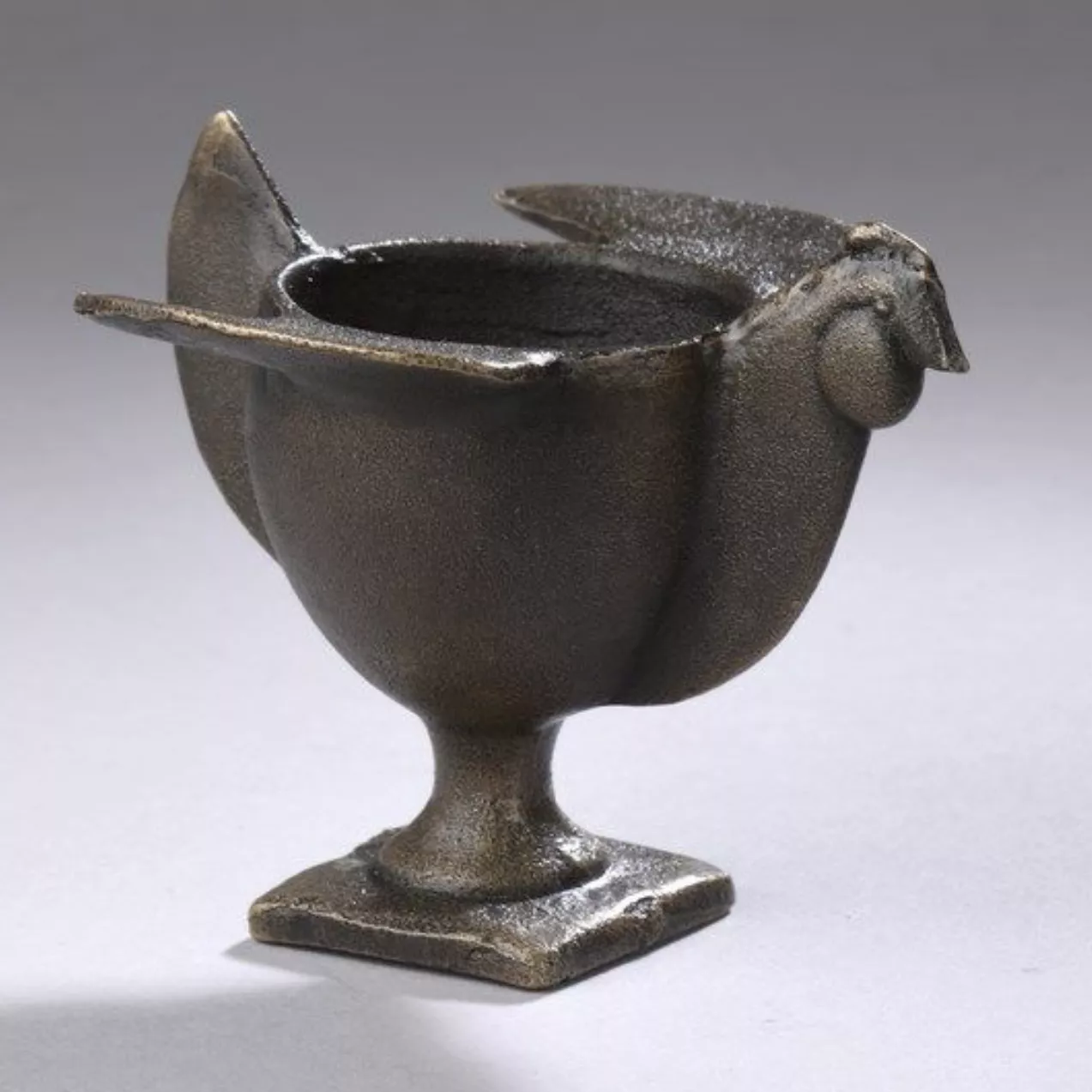
Black - candelabra | From €4,500 to €52 000€ |
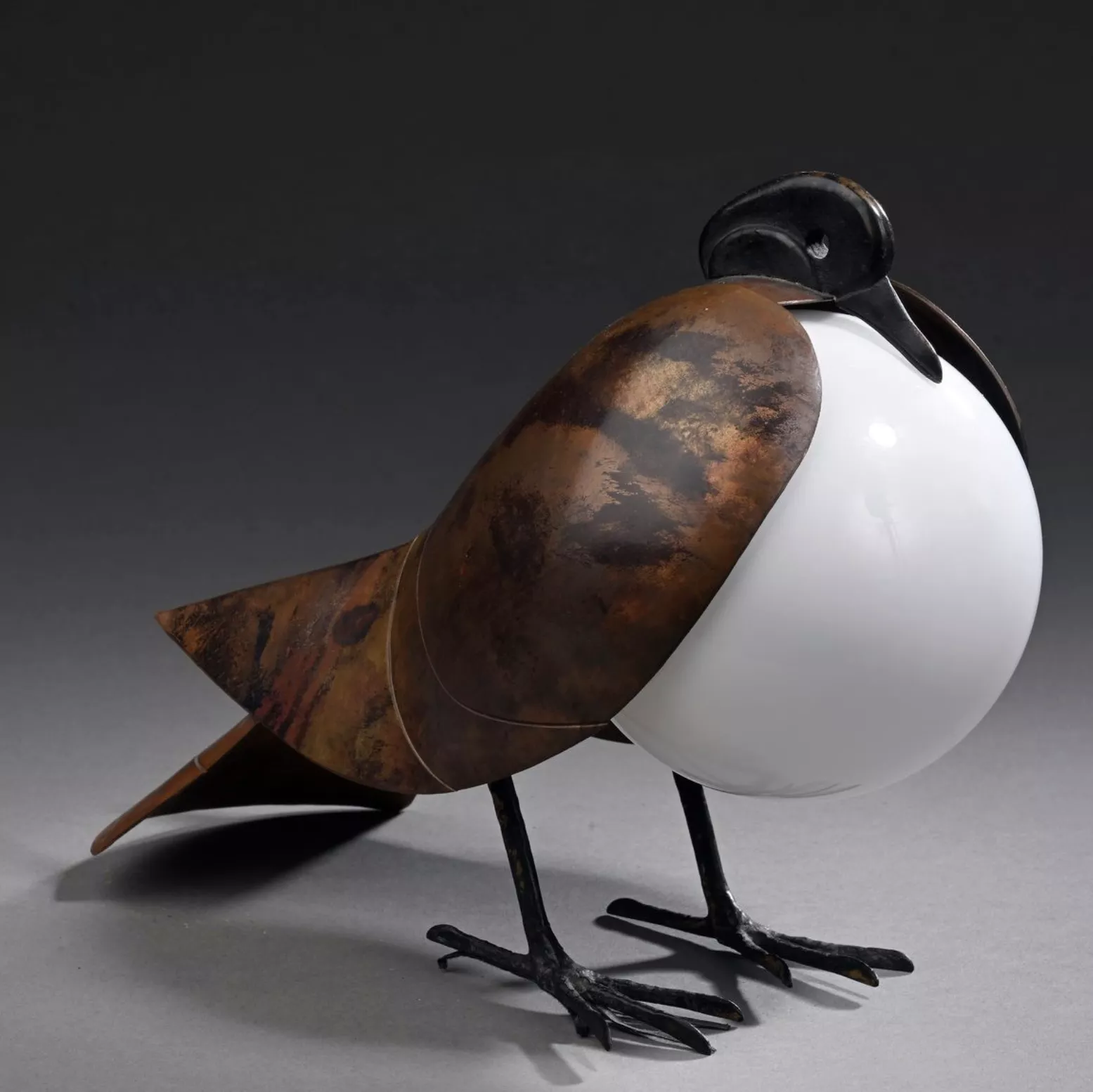
Pigeon lamp | From 3,800 to 140,000€ |
Gilt bronze lamp | From €21,550 to €637,000 |
Lamp in patinated bronze | From €20,900 to €1,700,000 |
Estimate in less than 24h
Artist's style and technique
François-Xavier Lalanne is a versatile artist who has worked in sculpture in a variety of materials (bronze, metal) but also as a ceramist who has worked for the Manufacture de Sèvres. He has also created lighting fixtures as well as drawings and paintings, not belonging to any particular current.
In François-Xavier Lalanne's lamps, lighting fixtures and candleholders, form retains this function of use, stability, sculpted presence.
But it no longer proceeds from a purely functional logic: it is organized around a transposition, a shift from the animal kingdom to the domestic object. Bronze, patinated, chiselled, is not treated as a simple support: it becomes a living surface, an autonomous volume, a recognizable silhouette.
Light, often concealed in a body - wing, head, plumage - is not given frontally: it flushes out, it lets itself be guessed, it slips into the thickness of the sculpture.
The forms are full, closed, balanced in their mass, without superfluous decoration. In the Oies candélabres or the Singes lampes, the object doesn't comment on nature, it transforms it into a device: a spout becomes a flame, a back becomes a pedestal.
Then, removed from ornamentation as well as abstraction, light according to Lalanne becomes part of a held, stable, gentle figuration, where the animal is no longer image but structure, and brilliance a secondary, contained form.
François-Xavier Lalanne, his life, his work
Born in the Lot et Garonne region of France in 1927, François-Xavier Lalanne began his artistic training in 1946, first studying sculpture. He then took an interest in drawing and painting at the Académie Julian in Paris. He befriended artists such as René Magritte and Salvador Dali, two very important figures of surrealism who were to influence his work.
He began by exhibiting his painting in Paris in 1953, organizing his first solo show. Rubbing shoulders with important figures from the worlds of art and fashion, in the 1950s he decorated the Dior boutique on avenue Montaigne, in collaboration with the designer Yves Saint Laurent, at that time assistant to the house.
François-Xavier Lalanne works in collaboration with his wife, Claude, near the Jardin des Halles in Paris. The latter is also, and above all, a sculptor. Both artists are very focused on animal subjects, whether domestic or wild.
He produced ceramics for the Manufacture de Sèvres at the end of his career, but also worked on his own account with ceramics and porcelain, producing egg cups, salt and pepper shakers in addition to the simple sculptures much appreciated by collectors and private individuals. The preparatory drawings also reveal his talent and his way of working.
Lalanne died in 2008 in Ury, aged 81.
Focus on the Lampe singe, François-Xavier Lalanne
In the Lampe Singe (fig. 1), the structure retains this function of seating, bearing, stability of the object. But it no longer rests on an identifiable base or a dissociated volume: it coincides with the figure itself, absorbs into it, disappears into the continuity of the animal body.
The monkey, seated, arm raised, presents the light bulb as an offering: it doesn't support the light, it integrates it. The base is no longer a plinth, but an extension of the movement. The outstretched arm is at once gesture, column and conduit.
The light is not added to the sculpture: it depends on it. The whole functions only through fusion, with no break between figure, function and material.
The bronze, uniformly patinated, gives the object a compact density, a silent presence, a continuity of surface. No detail is emphasized: fur, facial features, fingers are treated without excess, in a controlled economy.
The figure seeks neither realism nor expressiveness. It stands still. The gaze is fixed, the volumes closed, the gesture suspended. The electric wire, often concealed, is also part of this logic of unity: it doesn't interrupt, it follows.
The animal is not an image, it is not a symbol: it is a structure, a stable body, a support.
Thus, removed from ornamentation as well as quotation, the Lampe Singe affirms a conception of the sculpted object as a functional totality, where light is not an addition, but an extension - a form contained, posed, traversed by use.
François-Xavier Lalanne's imprint on his period
In François-Xavier Lalanne's work, sculpture retains this function of presence, materiality, immediate legibility.
But it is no longer part of a monumental logic or a strictly ornamental tradition: it slides towards the object, towards furniture, towards use, without ever losing formal rigor or manufacturing quality.
This position, singular in the artistic landscape of the second XXᵉ century, gives his work a place apart, between art and design, between animal sculpture and the interior object.
The imprint he leaves on his period rests precisely on this constant articulation between function and fiction, between the visible and the possible, between figure and matter. In contrast to the abstract avant-gardes, his work asserts a figuration that is held, stable, immediately recognizable, without anecdote but with a calm, contained humor.
This positioning finds a direct echo in the art market, where the scarcity of available pieces, mostly kept in private collections, fuels a constant demand.
Auctions, buoyed by international interest in the decorative arts of the XXᵉ century, regularly enshrine his sculptures - Moutons de Laine, Grand Wapiti, Oies candélabres - as benchmark pieces, sought after as much for their sculptural dimension as for their hijacked function.
Light fixtures, which are rarer, are also prized for their integrated design, their balance between use and formal presence.
Subtracted from the classic hierarchy between major and applied art, François-Xavier Lalanne's work stands out for its coherence, its precision, and its ability to inscribe the living in the continuity of furniture, metal and light.
A work without rupture, without emphasis, but with an immediately legible plastic force.
The stylistic influences of François-Xavier Lalanne
In the work of François-Xavier Lalanne, figuration retains this function of legibility, of immediate anchorage in recognizable form, of stable inscription in the object.
But it no longer responds to a logic of imitation or a search for expression: it is organized according to a principle of equivalence between figure and function, between sculpture and use.
In contrast to a César, who pushes the material to the point of accident, or a Arman, who fragments the object in repetition, Lalanne maintains the continuity of volumes, the precision of drawing, the fixity of silhouettes. Form doesn't break up: it closes up. It transforms without breaking."
In contrast to the more conceptual approaches of a Bury or a Tinguely, where movement disorganizes the object, Lalanne favors balance, restraint and composed mass. His work seeks neither instability nor surface play, but a compact, silent, often frontal presence.
Even the proximity with Diego Giacometti, in the use of bronze, in the relationship between furniture and sculpture, plays out on a different level: where Giacometti demultiplies details, textures, insertions, Lalanne simplifies, subtracts, closes.
Then, removed from expression, narrative, instability, his sculpture asserts itself in a clean, distinct line, where the figure is not a subject but a structure - stable, useful, visible.
Recognizing François-Xavier Lalanne's signature
It's not always easy to decipher or even have the good fortune to come across a work signed by Lalanne. He did, however, sign his work with his name in cursive letters, and often dated his sculptures.
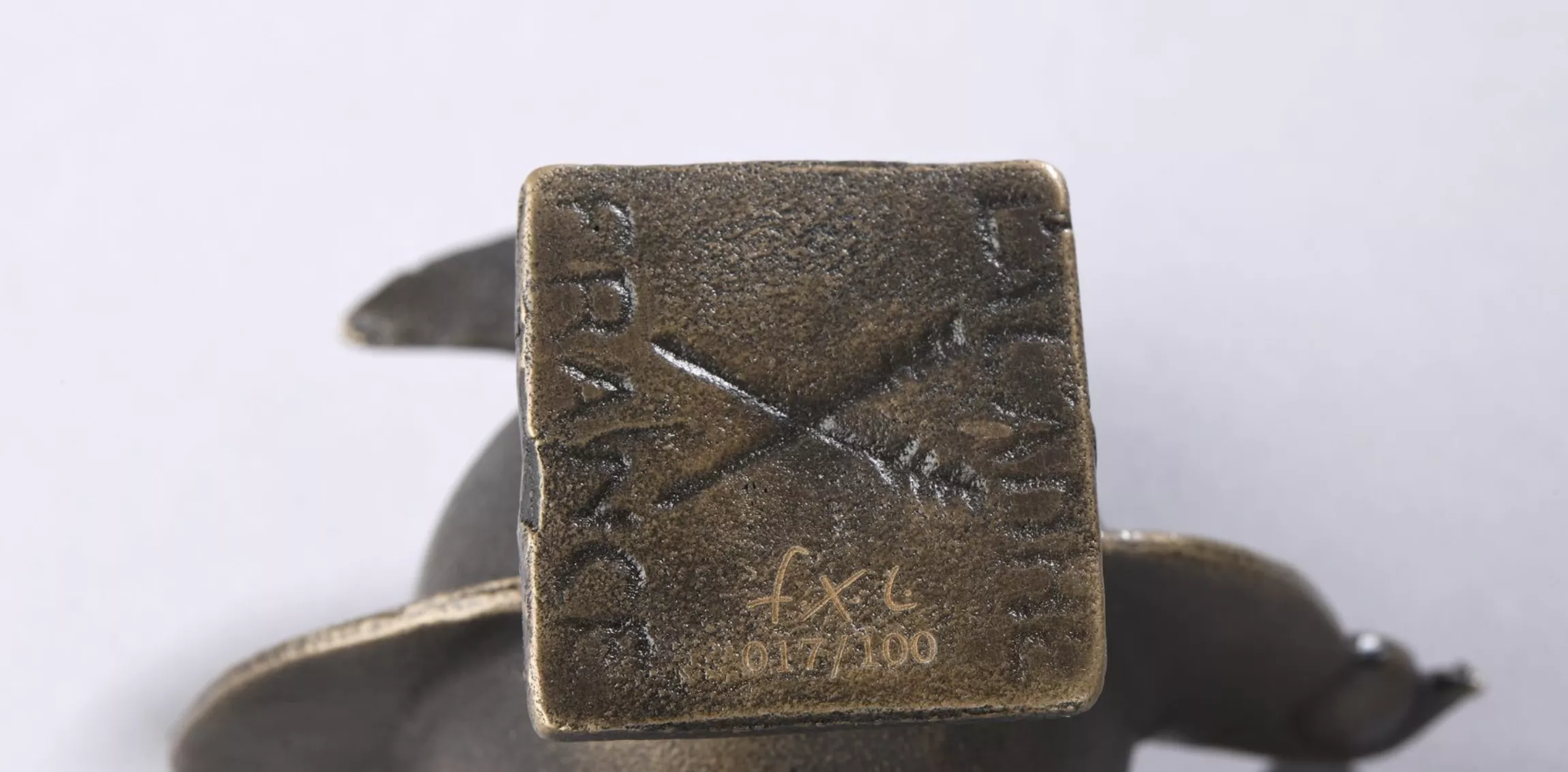
Knowing the value of a work
If you happen to own a work by François-Xavier Lalanne, request a free appraisal without further delay via our form on our website.
A member of our team will contact you promptly with an estimate of the value of your work, not forgetting to send you ad hoc information about it.
If you are considering selling your work, you will also be accompanied by our specialists in order to benefit from alternatives to sell it at the best possible price.
Estimate in less than 24h
Discover in the same theme

Rating and value of works, objects and drawings by Erté
Erté is a 20th-century furniture and fashion designer who is highly prized at auction. His works are highly prized.
Learn more >

Rating and value of works, drawings, paintings by Suzanne Va...
Suzanne Valadon is a 20th-century artist who produced Impressionist and Naturalist works that are highly prized and sought-after at auction.
Learn more >

Rating and value of bronzes, statues, furniture by Claude Vi...
Claude Victor Boeltz is a 20th-century Surrealist sculptor who has produced sculptures that are listed and valued at auction.
Learn more >
Works from the same period sold at auction

Estimated 300 - 400 €
Glazed ceramic statue of Zeus

Estimated 800 € - 1 200 €
MANUFACTURE NATIONALE DE SEVRES Rare porcelain cookie obelisk.

Estimated 2.000 - 3.000 €
Sèvres porcelain plate from the "agronomique" service

Estimated 3.000 - 5.000
Claude LALANNE (1925-2019) Mimosa necklace

Estimated 15.000 - 20.000
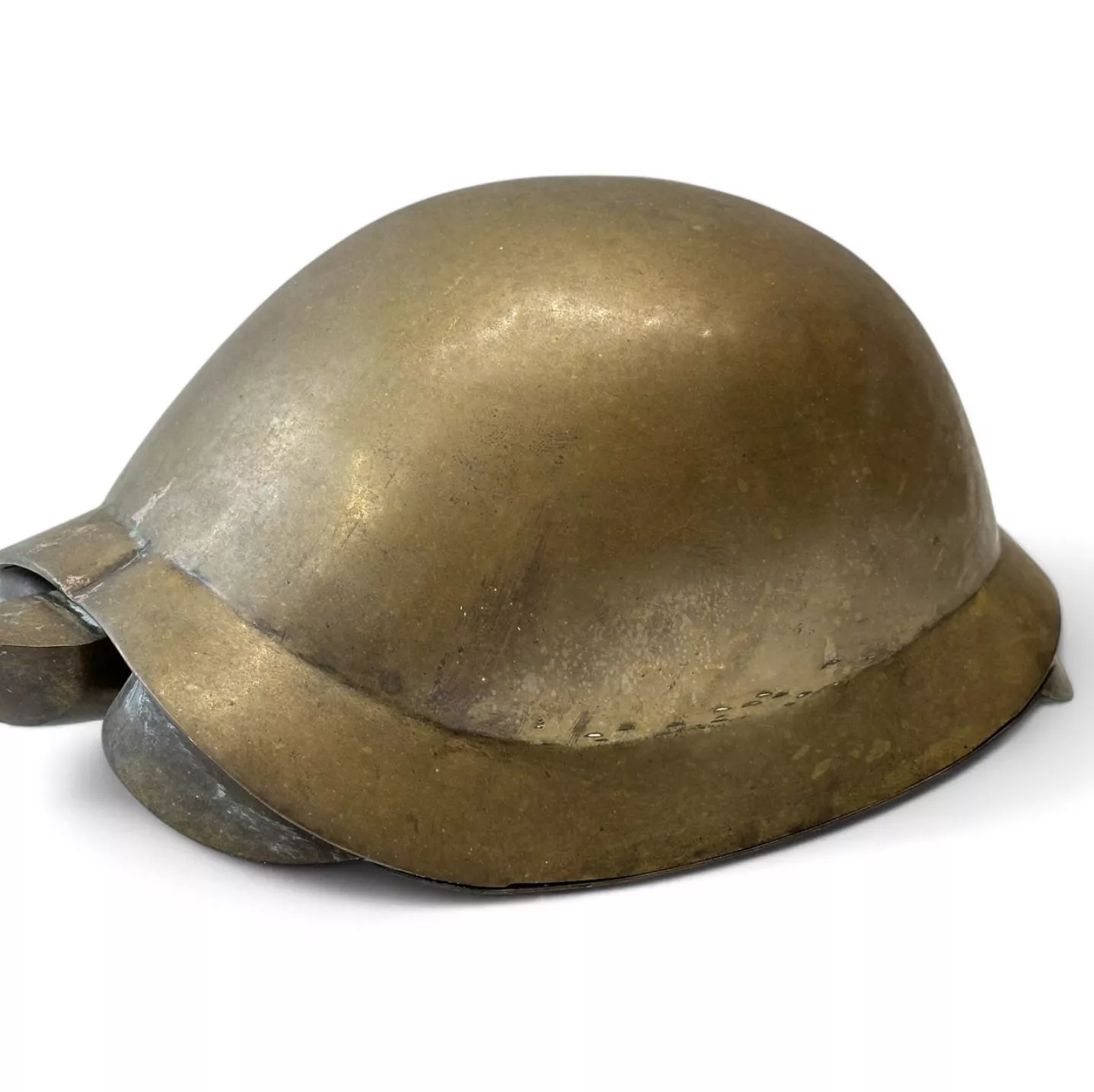
François-Xavier LALANNE (1927-2008) Tortue, 1973 brass patina edition no. 75/100 (traces of oxidation and minor patina damage)

Secure site, anonymity preserved

Auctioneer approved by the State

Free and certified estimates
Frequently asked questions
-
Who is François-Xavier Lalanne, and what is his artistic style?François-Xavier Lalanne (1927–2008) was a renowned French sculptor who specialized in animal sculptures made of bronze, ceramics, and metal. His distinctive style blends sculpture with functional design, particularly evident in his lamps and candlesticks, where the animal form becomes a functional structure. Influenced by Surrealism, he collaborated with his wife Claude and worked for the Sèvres porcelain manufactory, distinguishing himself through a restrained, balanced style devoid of superfluous decoration.
-
What are the price ranges for François-Xavier Lalanne's light fixtures and candleholders?Prices vary considerably depending on the type and rarity of the piece. Candlesticks and candelabras range from €4,500 to €52,000, pigeon lamps from €3,800 to €140,000, while gilded bronze lamps range from €21,550 to €637,000 and patinated bronze lamps from €20,900 to €1,700,000. In 2021, the “Lampe Singe Allumé” exceeded expectations by selling for €1,700,000, despite an estimate of between €150,000 and €200,000, demonstrating the strong demand for his rarest creations.
-
How can you authenticate a work by François-Xavier Lalanne?Lalanne usually signed his works in cursive and often dated them, but it is not always easy to find or decipher his signature. To authenticate a piece with certainty, we recommend requesting a free appraisal via our online form: one of our auctioneers or state-certified experts will contact you within 48 hours to verify authenticity and provide you with an accurate, no-obligation estimate.
-
Is this the right time to sell a work by François-Xavier Lalanne?Yes, this is a favorable time. Lalanne’s market value has been skyrocketing for several years, driven by growing international interest in 20th-century decorative arts and the scarcity of available pieces, most of which are held in private collections. Auctions consistently confirm that his light fixtures and sculptures are highly sought-after benchmark pieces, prized for their integrated design and unique balance between functionality and formal presence.
-
How does the appraisal and sale of a work of art take place at Auctie's?The appraisal is free and non-binding: simply fill out our online form, and an expert will contact you within 48 hours to evaluate your piece and provide you with an accurate appraisal. If you’d like to sell, our specialists will then guide you every step of the way—from appraisal to auction—advising you on the best options to get the highest possible price for your piece.
