



Rating and value of Caesar's sculptures, jewelry and expansions

Key takeaways
- César’s *Compressions*, major works of the 20th century, sell for between €200 and €291,530, depending on size and material.
- The “Expansions” made of polyurethane foam, created beginning in the 1970s, fetch prices of up to €78,000 at auction.
- The artist is skilled in several techniques (bronze, welded iron, compressed jewelry), with prices ranging from €290 to €166,630 depending on the process used.
If you own a sculpture made by Caesar or based on his work and would like to know its value, our state-approved experts and auctioneers will guide you.
Our specialists will carry out a free appraisal of your object, and send you a precise estimate of its value on the current market.
Then, if you wish to sell your object, we will direct you to the best possible arrangement to obtain the optimum price.
Rating and value of César's sculptures
Major works of the 20th century, with high importance in the artistic and theoretical process of its time, César's Compressions sell for between €200 and €291,530 (record for the artist achieved in 2018).
Highly prized by collectors, the price of Compressions varies according to their size and material. The artist also creates other bronze sculptures, less highly priced but equally appreciated.
His sculpture L'homme de Villetaneuse, dating from 1957, sold for €166,630, while it was estimated at between €159,960 and €213,180.
Order of value from the most basic to the most prestigious
Technique used | Result |
|---|---|
Gold presses | From €1,300 to €20,000 |
Small presses (<7cm) | From €350 to €34,650 |
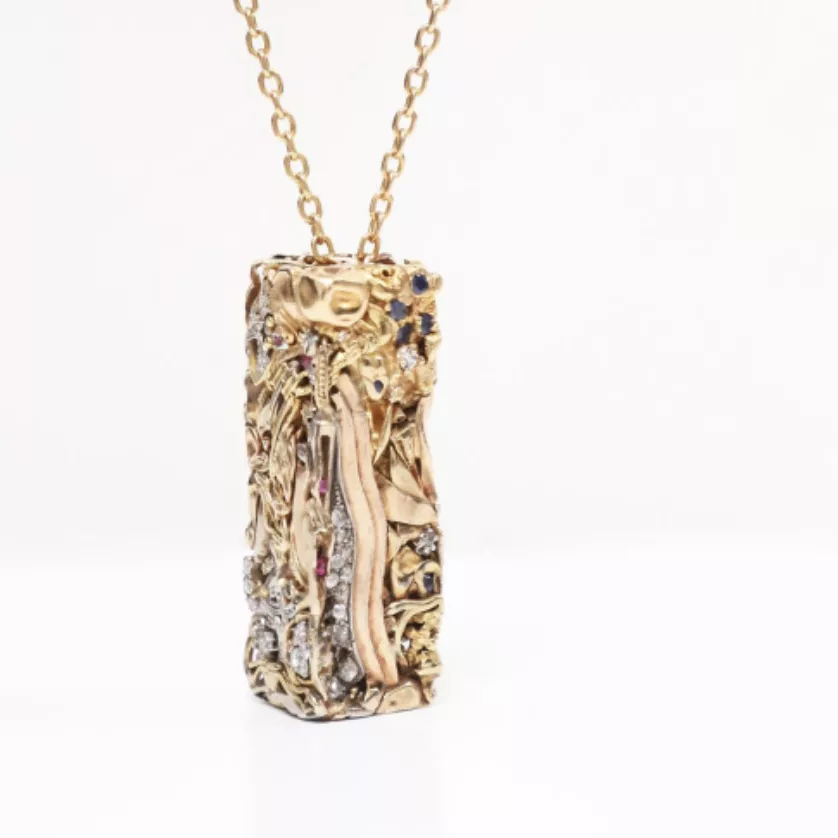
Jewellery compression | From €290 to €38,770 |
Bronze compressions | From 450 to €45,000 |
Expansions | From €130 to €78,000 |
Bronze sculpture | From €330 to €166,630 |
Estimate in less than 24h
Artist's style and technique
César (1921 - 1998) is a major French sculptor of the second half of the 20th century. He demonstrated exceptional mastery of metalworking (bronze, welded iron, stainless steel, aluminum, then industrial materials such as plastic and polyurethane foam).
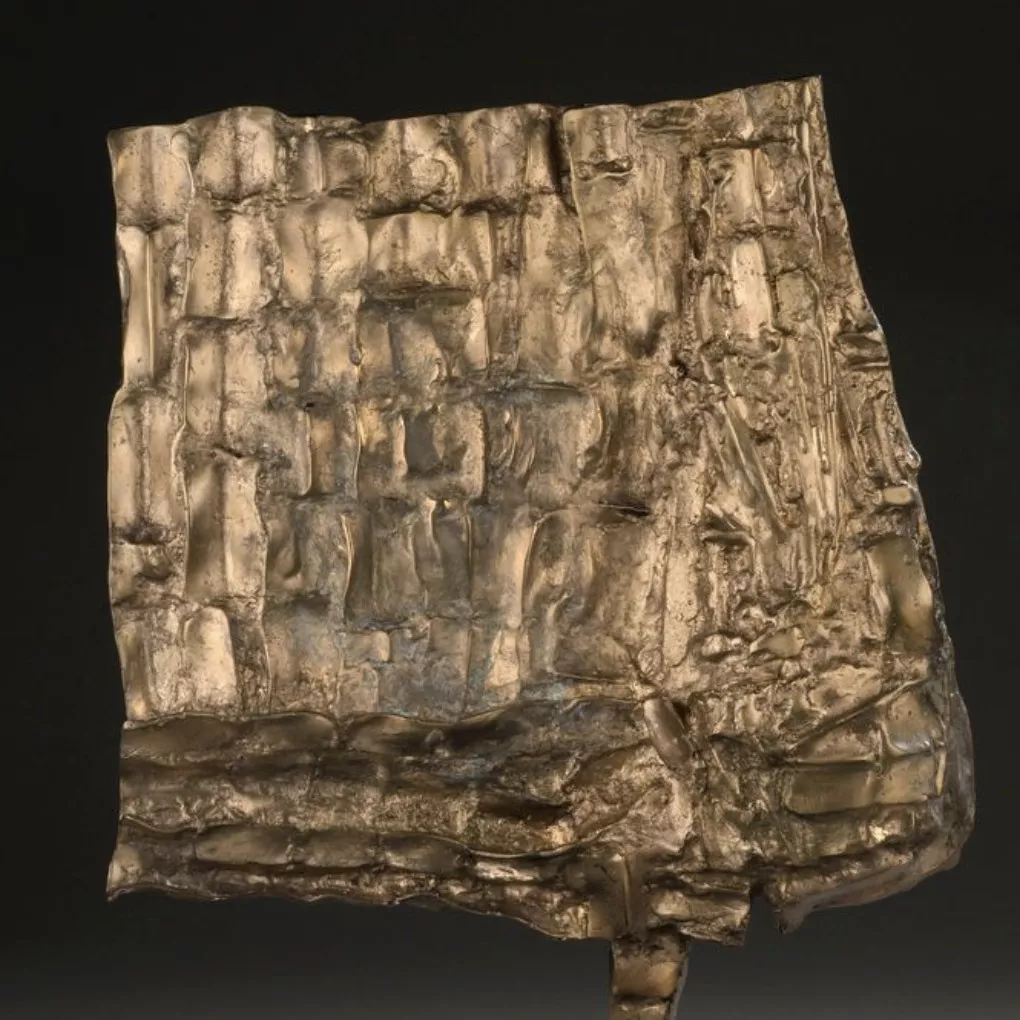
He began in the 1950s with sculptures in welded salvaged iron (fragmented objects or tools, assembled into often zoomorphic figures. In 1960, he introduced the industrial compression process, hijacking a hydraulic press to create his Compressions (cars, boxes, everyday objects are compressed into aesthetic blocks).
In the 1970s, he created Expansions, fast-setting polyurethane foam casts that form unpredictable organic masses. He thus developed a sculptural language based on gesture, directed chance and the hijacking of industrial techniques.
His aesthetic is raw, violent, provocative and often linked to an implicit critique of consumer society. He reduces forms to their pure materiality, replacing traditional modeling with folding, crushing or outgrowth.
The object is no longer reproduced but used as it is and transformed into a work by the sculptor's act, translating a conceptual and physical art.
César uses a series of processes, exploring the visual potential of a single gesture (e.g. frontal, lateral and chromatic compression). Each compression or expansion is unique, but produced according to a reproducible protocol, which also questions the notion of originality.
He also revisits the academic tradition with his Empreintes humaines, direct casts of whole bodies, presented in bronze or resin. César thus establishes himself as a paradoxical heir to Rodin, through his expressive treatment of matter, and to Duchamp, through his use of the found object and the conceptual gesture.
He is part of the Nouveaux Réalistes movement, but with a constant tension with the spectacular, automatism and technical mastery. His work blurs the boundaries between art, craft, industry and performance.
César, metal sculptor
César Baldaccini, known as César, was born in Marseille in 1921. From an early age, César was recognized as a prodigy. Endowed with an innate talent for drawing, he first studied drawing and then sculpture at the Beaux-Arts de Marseille.
He continued his training in Paris and developed an interest in modern sculpture among others Brancusi, Picasso, Matisse and Giacometti.
He produced his first works in iron, an easy-to-handle and inexpensive material. At the time, each of César's works was unique; he worked and welded them himself in the original material.
In 1961, César experimented with Directed Compressions. The elements to be compressed are carefully selected according to shape and color, then weighed.
Similar to car compressions, he applies the Compression process to jewelry, which is now attracting vital interest on the auction market. In response to this creative process, he also creates several sculptures entitled Expansions.
They have the appearance of a thick smear of paint that has dripped onto the floor, and has not finished expanding. During his career, he collaborated and rubbed shoulders with numerous artists, notably giving the idea to Claude Victor Boeltz of exploded bronze.
He was exhibited all over the world, and enjoyed great success during his lifetime.
César Baldaccini died in Paris, aged 77.
Focus on Expansion n°2, 1970
This work is made of tinted polyurethane foam, and cast in free expansion. Its dimensions are variable, depending on casting and setting. It is part of the first major phase of Expansions produced between 1967 and 1974, and is presented on a low or bare plinth (César refuses the traditional pedestal).
The mass is organic, shapeless, smooth and soft, with a viscous, frozen appearance, as if arrested in the midst of overflow. The color is uniform (often beige, ivory or tinged with gold or silver), giving an ambivalent character between nature and artifice.
The work alternately evokes a living matter, a chemical substance, an organ or even a melted Baroque sculpture. He uses a two-component foam, poured directly onto the ground or a support, without molds or retouching.
Expansion takes place in a matter of seconds, the gesture is unique, irreversible and semi-controlled. The artist directs the casting, but the form results from the physical-chemical behavior of the material it's an event-sculpture.
Sometimes tinted or covered with hardened resin to fix the form and give it a smooth, almost lacquered visual effect. The challenge to classical sculpture is radical: no closed volume, no pedestal and no manual modelling.
The work is inscribed in the moment, like a materialized performance, the public sees what the material has produced and not what the hand has constructed. Here, César makes an ironic critique of the precious art object : expanding foam becomes artistic matter in its own right, without hierarchy.
Through this work, he echoes the ideas of Nouveau Réalisme, with industrial materials, a raw gesture and an immediate presence.
This Expansions series established César's reputation in the 1970s, alongside Arman or Spoerri. He exerts a perceptible influence on post-minimalist or conceptual artists by exploring letting go, matter in motion and formal chance.
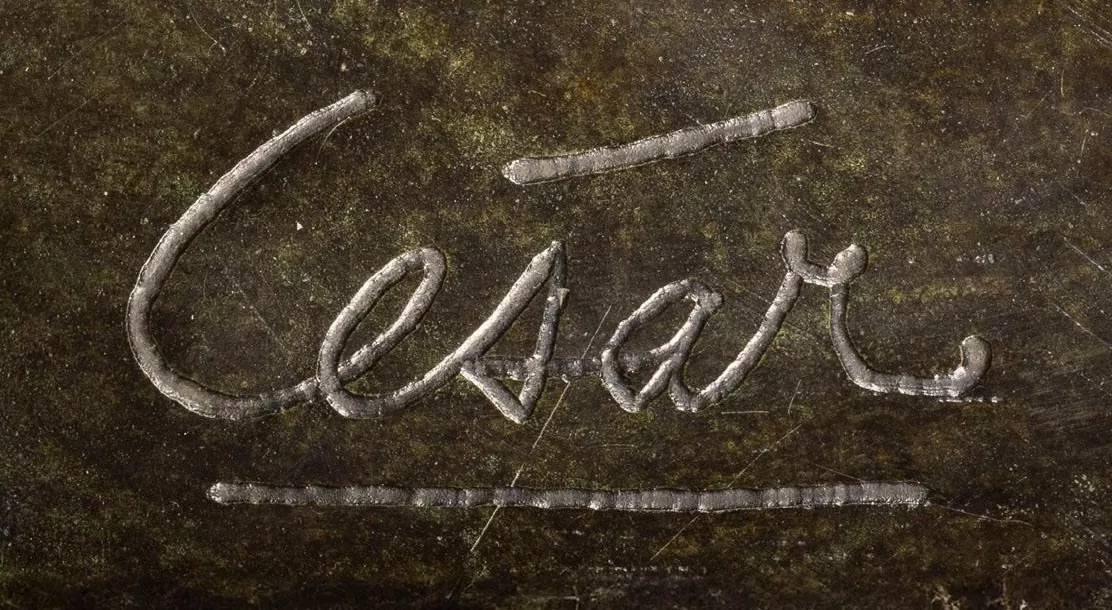
His signature
Not all of Caesar's works are signed.
Although there are variants, here's a first example of his signature:
Expertise your property
If you own a work by César, don't hesitate to request a free appraisal by filling in our online form.
A member of our team of experts and licensed auctioneers will contact you to provide an estimate of the market value of your work.
If you are considering selling your work, our specialists will also guide you through the various alternatives available to obtain the best possible price, taking into account market trends and the specific features of each work.
Estimate in less than 24h
Discover in the same theme

Rating and value of paintings by Ram Kumar
Ram Kumar is a 20th-century Indian abstract artist whose works in a variety of media are highly regarded and sought-after at auction.
Learn more >

Rating and value of works, ceramics, paintings by Jacques Po...
Jacques Pouchain is an artist who has produced modernist ceramics that are highly valued at auction. Estimate in 24h.
Learn more >

Rating and value of paintings by Pierre Bonnard
Pierre Bonnard is a twentieth-century Nabi painter who produced paintings that are highly valued at auction. Estimated 24h.
Learn more >
Works from the same period sold at auction

Estimated Between €2,000 and €4,000
Edouard Marcel SANDOZ (1881-1971) curly stingray, bronze print

Estimated Between €1,500 and €3,000
Renato CARVILLANI (1896-1986), seated woman, gilded bronze print

Estimated Between €800 and €1,500
Claude Victor BOELZ (b. 1937), gilt bronze and quartz centerpiece

Estimated Between €15,000 and €20,000
César BALDACCINI dit CESAR (1921-1998), yellow gold pendant, jewelry compression

Estimated Between €1,500 and €3,000
César BALDACCINI dit CESAR (1921-1998), Poule Cartier, bronze print

Estimated Between €10,000 and €20,000
Baltasar LOBO (1910-1993), female nude in bronze

Secure site, anonymity preserved

Auctioneer approved by the State

Free and certified estimates
Frequently asked questions
-
Who is César, and what are his main sculptural styles?César Baldaccini (1921–1998) was a leading French sculptor of the 20th century and the founder of the Nouveaux Réalistes. He is famous for his *Compressions* (objects compressed using a hydraulic press since 1960) and his *Expansions* (organic forms made of polyurethane foam, created beginning in 1970). His work blurs the boundaries between art, industry, and performance, challenging the hierarchies between “noble” materials and scrap.
-
What are the prices and price ranges for César's sculptures?Prices vary considerably depending on the type of work: the “Compressions” sell for between €200 and €291,530 (a record set in 2018), the “Expansions” between €130 and €78,000, the bronze sculptures between €330 and €166,630, and the “Compressions” jewelry pieces between €290 and €38,770. These price ranges depend on the size, material, and rarity of each piece.
-
How do I have a César sculpture appraised and authenticated?At Auctie's, you can request a free, no-obligation appraisal by filling out our online form. A certified expert or auctioneer will contact you within 48 hours to provide you with an accurate estimate of your artwork's market value, based on current market trends.
-
Is this the right time to sell a César sculpture?Yes, this is a favorable time: César’s sculptures and jewelry—particularly his “Compressions” and “Expansions”—remain highly sought after by collectors and are in high demand at auctions. The market remains vibrant for his major series, with consistent results and global recognition of his significant artistic influence.
-
How does the sale of a work by César take place at Auctie's?After a free appraisal by our experts, we’ll guide you through the best options to achieve the best possible price, taking into account the specific characteristics of your artwork and current market trends. As a licensed auction house, Auctie’s will then support you every step of the way, from the appraisal to the final bid.
