



Rating and value of drawings and paintings by Vladimir Baranoff Rossiné

Works by Vladimir Baranoff-Rossiné sell for up to €3,036,720 at auction. An appraisal allows us to accurately determine the current market value of your Vladimir Baranoff-Rossiné artwork and, if applicable, optimize the sale of the piece.
If you own a work by Vladimir Baranoff-Rossiné and would like to know its value, our state-certified auctioneers will provide a free appraisal based on authenticity, market rating, and recent auction results.
Market Value and Appraisal of Artist Vladimir Baranoff-Rossiné
Vladimir Baranoff-Rossiné is an artist well-known among connoisseurs of the Russian avant-garde and historical abstraction. Most of his works are valued between €2,000 and €500,000, with his Cubist paintings from around 1910 being the most sought-after and commanding prices ranging from several hundred thousand euros to several million.
His Cubist canvases depicting landscapes and figures, as well as his later abstract compositions, most often sell for between €100,000 and €800,000. The record auction price for one of his paintings is €3,036,720, achieved at Christie’s in London in 2008 for the monumental oil on canvas “Le Rythme (Adam & Eve) ,” dated 1910 (202 x 293.3 cm).
His works on paper—gouaches and tempera paintings depicting Cubist nudes—sell for between €10,000 and €35,000, with the record for a drawing being €35,916, achieved at Sotheby’s in London in 2013, for the gouache “Le Parc.”
Order of value from the most basic to the most prestigious
Techniques used | Results |
|---|---|
Works on paper (gouaches, drawings) | Approximately €2,000 to €36,000 |
Cubist and abstract paintings | Approximately €20,000 to €3,000,000 |
Estimate in less than 24h
Placing Vladimir Baranoff-Rossiné in Context
Period
Born Shulim Wolf Baranov in 1888 in Kherson to a Ukrainian Jewish family living in what was then the Russian Empire, Vladimir Baranoff-Rossiné studied painting at the Odessa School of Fine Arts from 1903 to 1908, under the guidance of Kiriak Kostandi and Gennady Ladyzhensky, before continuing his training at the Imperial Academy of Fine Arts in Saint Petersburg, where he immediately showed an affinity for the avant-garde, particularly the work of Cézanne.
He moved to Paris in 1910 and joined La Ruche, a hub of the Parisian artistic bohemian scene, where he rubbed shoulders with Fernand Léger, Alexander Archipenko, Marc Chagall, and Amedeo Modigliani. There, he adopted the artist name Baranoff-Rossiné.
In 1917, he returned to Russia after the Revolution, taught at the Free State Workshops (Svomas), and participated in the emerging Soviet cultural scene, before returning to settle permanently in Paris in 1925.
Artistic Movements
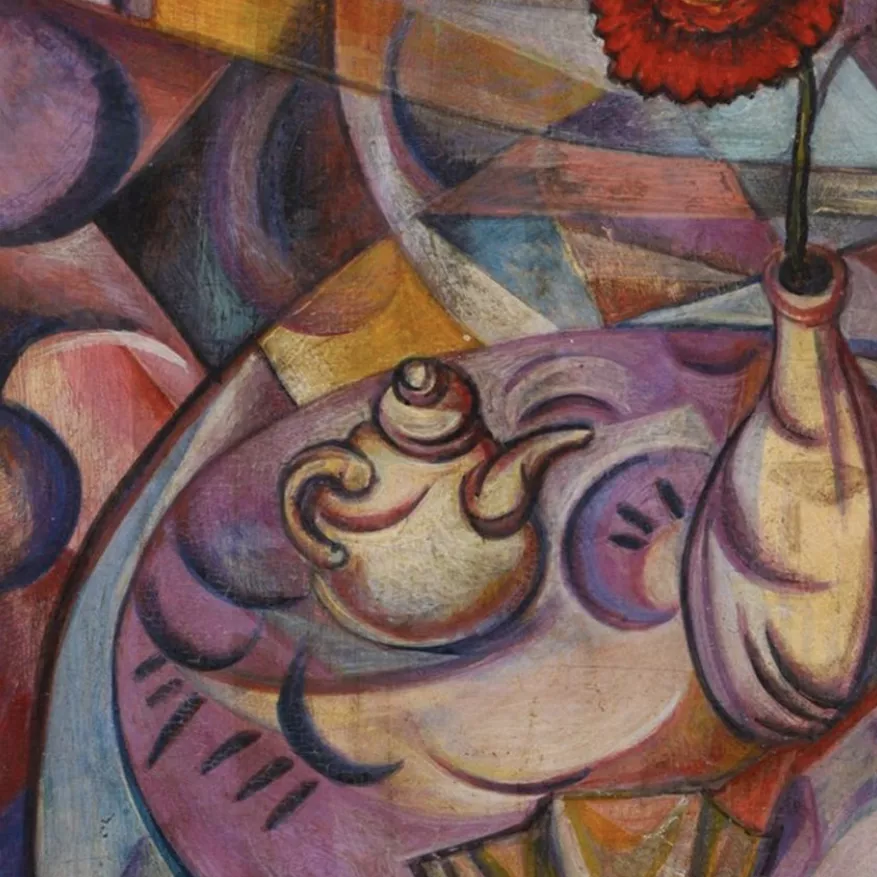
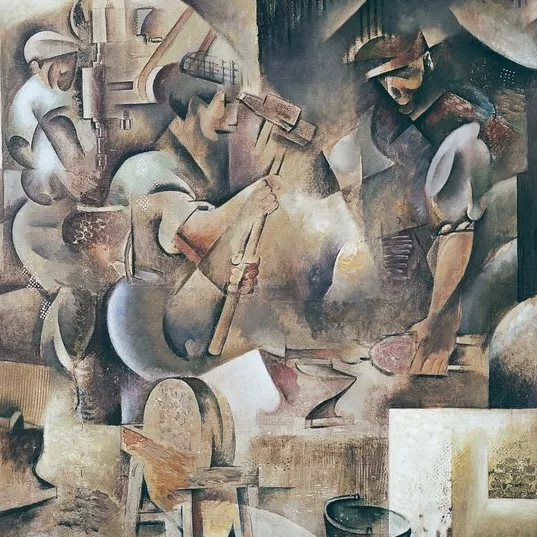
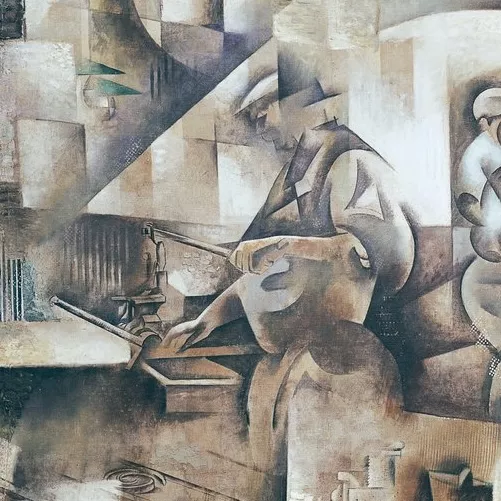
Baranoff-Rossiné was among the very first artists to embrace abstract art, alongside Wassily Kandinsky, František Kupka, Robert Delaunay, and Hilma af Klint. His paintings from the 1910s explored Cubism, before his work evolved into abstract compositions featuring colorful, rhythmic forms.
A multifaceted artist, skilled in music, painting, and sculpture, he also distinguished himself through his synesthetic explorations, linking sound, color, and form within a single work. Between 1920 and 1923, he designed the “optophonic piano,” a pioneering instrument of kinetic and light art capable of projecting patterns of colored light synchronized with music, now housed at the Centre Pompidou.
In 1929, he also created a “Polytechnic Sculpture” combining diverse materials, further evidence of his constant exploration of new mediums.
The Life of Vladimir Baranoff-Rossiné
Cultural Background
A native of Kherson, Ukraine, Baranoff-Rossiné spent most of his career between Russia and France, two countries between which his artistic and personal journey constantly oscillated, ranging from the Parisian bohemian scene at La Ruche to the cultural effervescence of revolutionary Russia.
Arrested in France during the German Occupation because of his Jewish heritage, Vladimir Baranoff-Rossiné was deported and died at Auschwitz in 1944. This tragic trajectory, shared by many Jewish artists of the École de Paris, has left a lasting mark on the reception and documentation of his work.
Intellectual and Artistic Circle
At La Ruche, Baranoff-Rossiné associated with Fernand Léger, Alexander Archipenko, Marc Chagall, and Amedeo Modigliani, at the heart of the Parisian artistic effervescence of the 1910s.
His work was the subject of a major retrospective at the National Museum of Modern Art in Paris in 1972–1973, followed by an exhibition at the State Tretyakov Gallery in Moscow in 2002. Authentication of his works is now handled by his grandson, Dimitri Baranoff-Rossiné, who issues certificates of authenticity recognized by auction houses.
Market Segmentation and the Artist's Market Value
The market for Vladimir Baranoff-Rossiné clearly distinguishes between his Cubist and abstract paintings—the segment commanding the highest prices—and his works on paper, which are more accessible but also highly sought after, particularly the gouaches and tempera paintings depicting Cubist nudes.
The best-documented canvases—those exhibited or featured in reference catalogs (notably Andrei Sarabianov’s monograph, Moscow, 2002), command higher prices, as provenance and traceability are key criteria for an artist whose body of work circulated extensively between Russia and France during the 20th century.
Factors
His status as a pioneer of abstraction, alongside Kandinsky, Kupka, and Hilma af Klint, is the most decisive factor in the valuation of Baranoff-Rossiné’s work, whose contribution continues to be reevaluated in the historiography of abstract art.
The rarity of his body of work—partly dispersed or lost due to his travels between Russia and France and subsequently his deportation—enhances the value of documented pieces with a solid provenance.
The existence of a recognized authentication system, managed by his family, ensures the security of transactions and bolsters market confidence, in a context where forgeries and erroneous attributions remain a risk for Russian artists of this period.

FAQ – How do you appraise a work by Vladimir Baranoff-Rossiné?
1) What types of works by Vladimir Baranoff-Rossiné are legitimately available on the market?
Most commonly found are oil paintings on canvas from his Cubist period (around 1910) and later abstract compositions, as well as works on paper (gouaches, temperas, watercolors, ink drawings, pencil drawings, or charcoal drawings) that served as studies for his painted compositions.
2) How do provenance and documentation support the value of his work?
The inclusion of a work in the retrospectives at the National Museum of Modern Art (1972–1973) or the Tretyakov Gallery (2002), or its inclusion in Andrei Sarabianov’s authoritative monograph, constitutes a significant mark of recognition, as does direct family provenance.
3) How can a work by Vladimir Baranoff-Rossiné be authenticated?
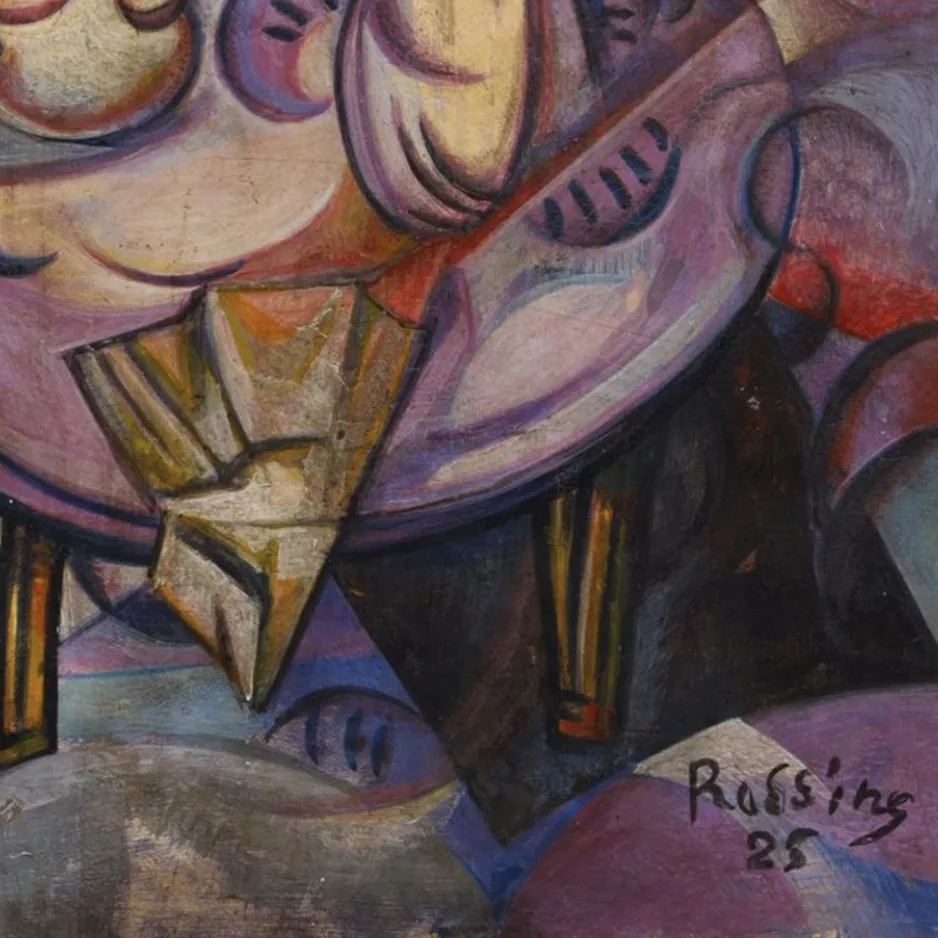
Authentication is most often confirmed by a certificate issued by his grandson, Dimitri Baranoff-Rossiné, who is recognized as an expert on the artist by the leading auction houses. The signature—usually “Rossiné” or “Baranoff-Rossiné”—as well as stylistic consistency with the artist’s documented periods, are also examined.
His Signature
Vladimir Baranoff-Rossiné’s works are most often signed “Rossiné” or “Baranoff-Rossiné,” usually at the bottom of the composition, and are sometimes countersigned on the reverse. In the absence of a certificate of authenticity issued by the artist’s family, a thorough appraisal is strongly recommended prior to any transaction, given the significant value associated with this artist’s work.
Estimate in less than 24h
Discover in the same theme

Rating and value of works, lithographs, paintings by Henri d...
Henri de Toulouse Lautrec is a 20th-century painter who produced lithographs and paintings that are highly successful at auction.
Learn more >

Rating and value of works, drawings, paintings by Leopold Go...
Léopold Gottlieb is a painter of the Paris School who produced drawings and oils on canvas that are listed and successful at auction.
Learn more >

Rating and value of paintings by Jean Soubervie
Jean Sourbevie is a twentieth-century figurative painter who produced drawings, prints and oil on canvas listed at auction. Estimate in 24h
Learn more >
Nos records d'enchères à l'hôtel Drouot

Estimated 10.000 - 15.000 €
Ebridge Ayer BURBANK(1858-1949), Young African-American boy, Oil on panel.

Estimated 20.000 - 30.000
EXCEPTIONAL LARGE OVAL DISH IN VINCENNES SOFT PASTE PORCELAIN FROM THE "BLEU CÉLESTE" SERVICE OF KING LOUIS XV AT THE CHÂTEAU DE VERSAILLES

Estimated 20.000 - 30.000
MANUFACTURE ROYALE DE SÈVRES, 18th century "L'Empereur de la Chine" - Portrait of the Emperor Qianlong, Hard porcelain bisque, 1775

Estimated 1.500 - 3.000
HERMÈS, "Kelly" 32 saddle bag in black box calf

Estimated Between €5,000 and €8,000
KRACHKOWSKY (1854-1914), Before the storm, oil on canvas

Estimated 40.000 - 80.000
Alexandre ROUBTZOFF (1884-1949), Portrait of Arbia, oil on canvas

Secure site, anonymity preserved

Auctioneer approved by the State

Free and certified estimates
Frequently asked questions
-
Qui est Vladimir Baranoff-Rossiné et quelle est son importance dans l'histoire de l'art ?Vladimir Baranoff-Rossiné (1888-1944) est un artiste ukraino-russe et pionnier de l'abstraction, aux côtés de Kandinsky, Kupka et Hilma af Klint. Formé à Odessa et Saint-Pétersbourg, il s'installe à Paris en 1910 à la Ruche, où il côtoie Léger, Chagall et Modigliani, avant de combiner peinture, sculpture et recherches synesthésiques, dont le célèbre « piano optophonique » conservé au Centre Pompidou.
-
Quelle est la fourchette de valeur des tableaux et dessins de Vladimir Baranoff-Rossiné ?Les peintures cubistes et abstraites se vendent entre 20 000 € et 3 000 000 € environ, les toiles des années 1910 étant les plus recherchées. Les œuvres sur papier (gouaches, dessins) sont estimées entre 2 000 € et 36 000 € environ. Le record en vente aux enchères s'élève à 3 036 720 € pour « Le Rythme (Adam & Eve) » de 1910, adjugé chez Christie's à Londres en 2008.
-
Comment authentifier une œuvre de Vladimir Baranoff-Rossiné ?L'authentification passe par un certificat délivré par Dimitri Baranoff-Rossiné, petit-fils de l'artiste, reconnu comme expert par les principales maisons de ventes. Nous recommandons de soumettre votre œuvre à une expertise gratuite chez Auctie's : nos commissaires-priseurs agréés examineront l'authenticité, la signature (généralement « Rossiné » ou « Baranoff-Rossiné »), la cohérence stylistique et la provenance. L'expertise est sans engagement et vous recevrez une réponse sous 48 heures.
-
Est-ce le bon moment pour vendre une œuvre de Vladimir Baranoff-Rossiné ?Oui, le marché de Baranoff-Rossiné est actuellement dynamique, soutenu par la réévaluation croissante de son rôle dans l'histoire de l'abstraction et par la rareté de son corpus, en partie dispersé entre la Russie et la France. L'existence d'un système d'authentification reconnu par sa famille renforce la confiance du marché et la sécurité des transactions.
-
Comment se déroule une estimation chez Auctie's et comment vendre une œuvre ?Chez Auctie's, l'estimation est gratuite et sans engagement : vous transmettez des photos et informations sur l'œuvre, nos experts vous répondent sous 48 heures avec une fourchette de valeur. Après acceptation, nous accompagnons le vendeur de l'estimation à l'adjudication, en vous guidant sur la préparation du bien et en optimisant sa mise en vente aux enchères auprès de collectionneurs et institutions du monde entier.
