



Rating and value of paintings, drawings, prints by François-Xavier Lalanne

Key takeaways
- François-Xavier Lalanne (1927–2008) was a French artist who specialized in animal sculpture; his works sell for between 30 and 155,000 euros.
- His preparatory drawings, particularly those depicting animals, are highly sought after and fetch up to 100,000 euros at auction.
- A painting titled *Preparatory Model for “Rhinocrétaire”* from 1965 sold for 155,000 euros in 2009, far exceeding its initial estimate of 20,000 to 30,000 euros.
If you own a work by or after the artist François-Xavier Lalanne, and would like to know its value, our state-approved experts and auctioneers will offer you their appraisal services.
Our specialists will carry out a free appraisal of your work, and provide you with a precise estimate of its value on the current market.
Then, if you wish to sell your work, we will direct you to the best possible arrangement to obtain the optimum price.
Rating and value of the artist François-Xavier Lalanne
Specializing in sculpture of all kinds, François-Xavier Lalanne is a renowned French artist. He is particularly famous for his preparatory drawings, which sell for a high price, especially those depicting animals.
His works sell on the market for between €30 and €155,000. In 2009, an oil painting, Maquette préparatoire pour " Rhinocrétaire ", dating from 1965, sold for €155,00 whereas it was estimated at between €20,000 and €30,000. Its value is exploding.
Order of value from a simple work to the most prestigious
Technique used | Result |
|---|---|
Estamp - multiple | From €30 to €285,500 |
Drawing - watercolor | From €320 to €100,000 |
Painting | From €500 to €155,000 |
Estimate in less than 24h
The artist's style and technique
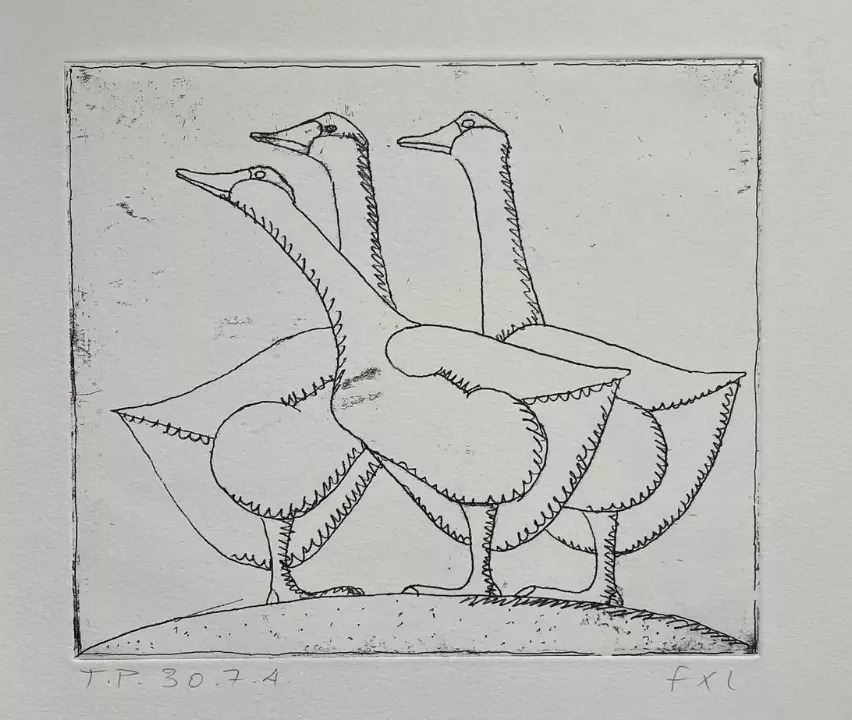
In François-Xavier Lalanne's drawings and paintings, the line retains this function of clarity, of cutting, of immediate structuring of form.
But it does not aim to model or dramatize: it fixes, it isolates, it poses the figures in a calm frontality, without seeking depth or dynamism. The line, often fine, continuous, without hesitation, constructs closed silhouettes, where each element is circled, delimited, ordered in space.
When color is used, it is applied in clean flat tints, without gradation, without illusion of volume. No material effects, no visible gestures: the image is held, stable, articulated around the precision of the contour and the simplicity of the field.
In the preparatory studies for his sculptures as in his independent works, the approach remains the same: to fix the idea, not in a rush, but in a methodical setting.
The animal is not captured in movement: it is inscribed in a posture, reduced to its essential lines, balanced in its occupation of the paper.
Thus, removed from expressionism as well as naturalism, François-Xavier Lalanne's drawing and painting assert themselves as exercises in formal clarity, where line serves to construct a presence, not to evoke a narrative, and where the image, before being representation, becomes visible structure.
François-Xavier Lalanne, his life, his work
Born in the Lot et Garonne region of France in 1927, François-Xavier Lalanne began his artistic training in 1946, first studying sculpture. He went on to study drawing and painting at the Académie Julian in Paris.
He became friends with artists such as René Magritte and Salvador Dali, two very important figures of surrealism who were to influence his work.
He began exhibiting his paintings in Paris in 1953, organizing his first solo show.
Friends with important figures from the worlds of art and fashion, in the 1950s he decorated the Dior boutique on avenue Montaigne, in collaboration with the designer Yves Saint Laurent, at that time assistant to the house.
François-Xavier Lalanne works in collaboration with his wife, Claude, near the Jardin des Halles in Paris. The latter is also, and above all, a sculptor. Both artists are very focused on animal subjects, whether domestic or wild.
Late in his career, he produced ceramics for the Manufacture de Sèvres, but also worked on his own account with ceramics and porcelain, producing egg cups, salt and pepper shakers in addition to the simple sculptures much appreciated by collectors and private individuals. The preparatory drawings also reveal his talent and his way of working.
Lalanne died in 2008 in Ury, aged 81.
The contribution of painting and drawing to Lalanne's work
In François-Xavier Lalanne's work, drawing retains this function of construction, definition, organization of form. But it is not limited to preparing the sculpture: it asserts an autonomy, a logic of its own.
The line follows its course without seeking variation. It surrounds, poses, balances. Paint, used sparingly, applies simple surfaces without material effects or the search for illusion.
Each figure is thought of as a whole, without depth, without narrative. The animal is reduced to its silhouette, the object to its outline, with no expressive charge.
The interest of Lalanne's drawings and paintings lies in this ability to maintain coherence between idea and object. Paper becomes a place of precise adjustment, where form is experienced without overload.
This graphic work reveals method, the refusal of gratuitous gesture, the desire to stabilize the figure before any intervention on volume.
Subtracted from the sketch as from the free sketch, François-Xavier Lalanne's drawings and paintings extend his sculpture in the same space of clarity and necessity.
Focus on Portrait d'un mouton imaginaire, François-Xavier Lalanne
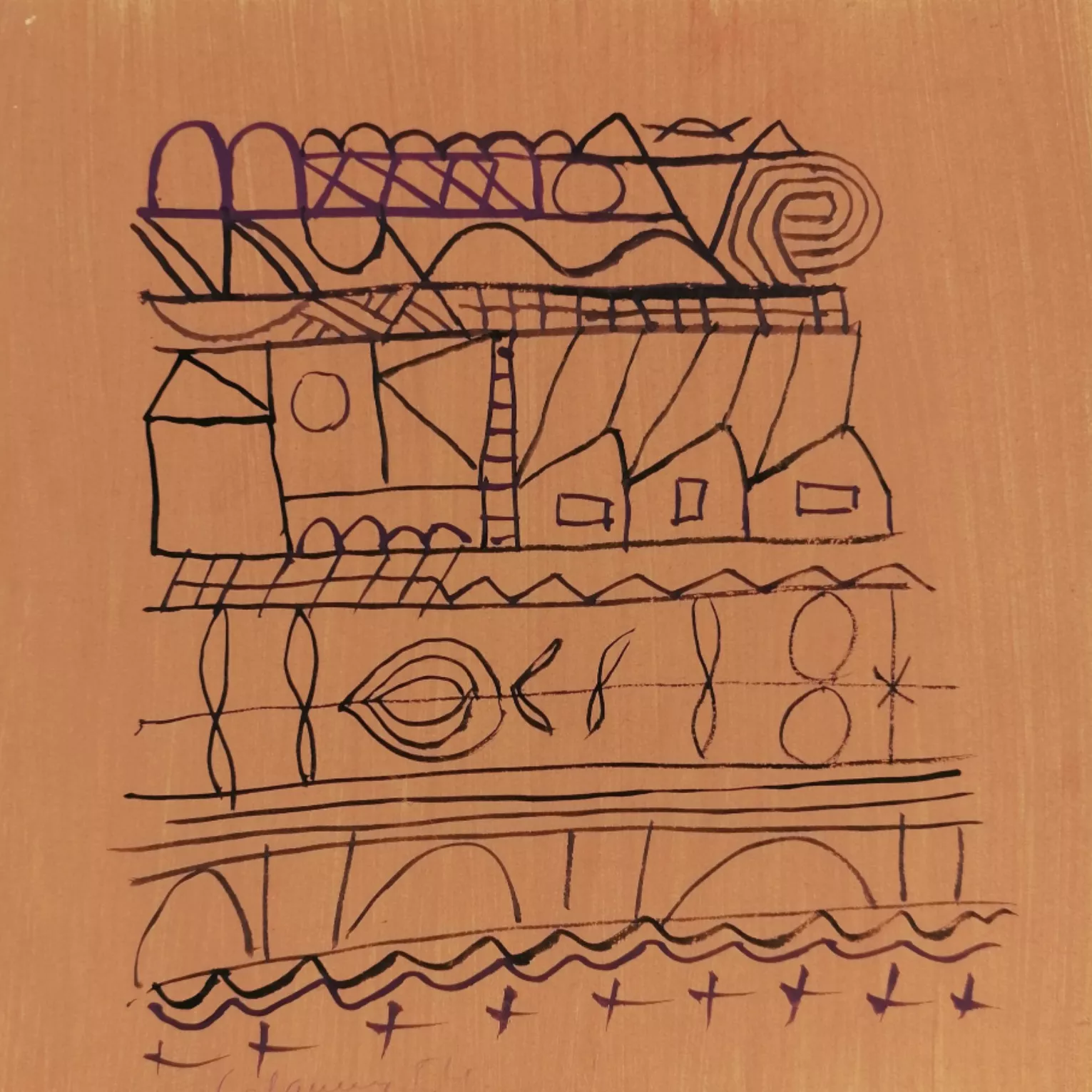
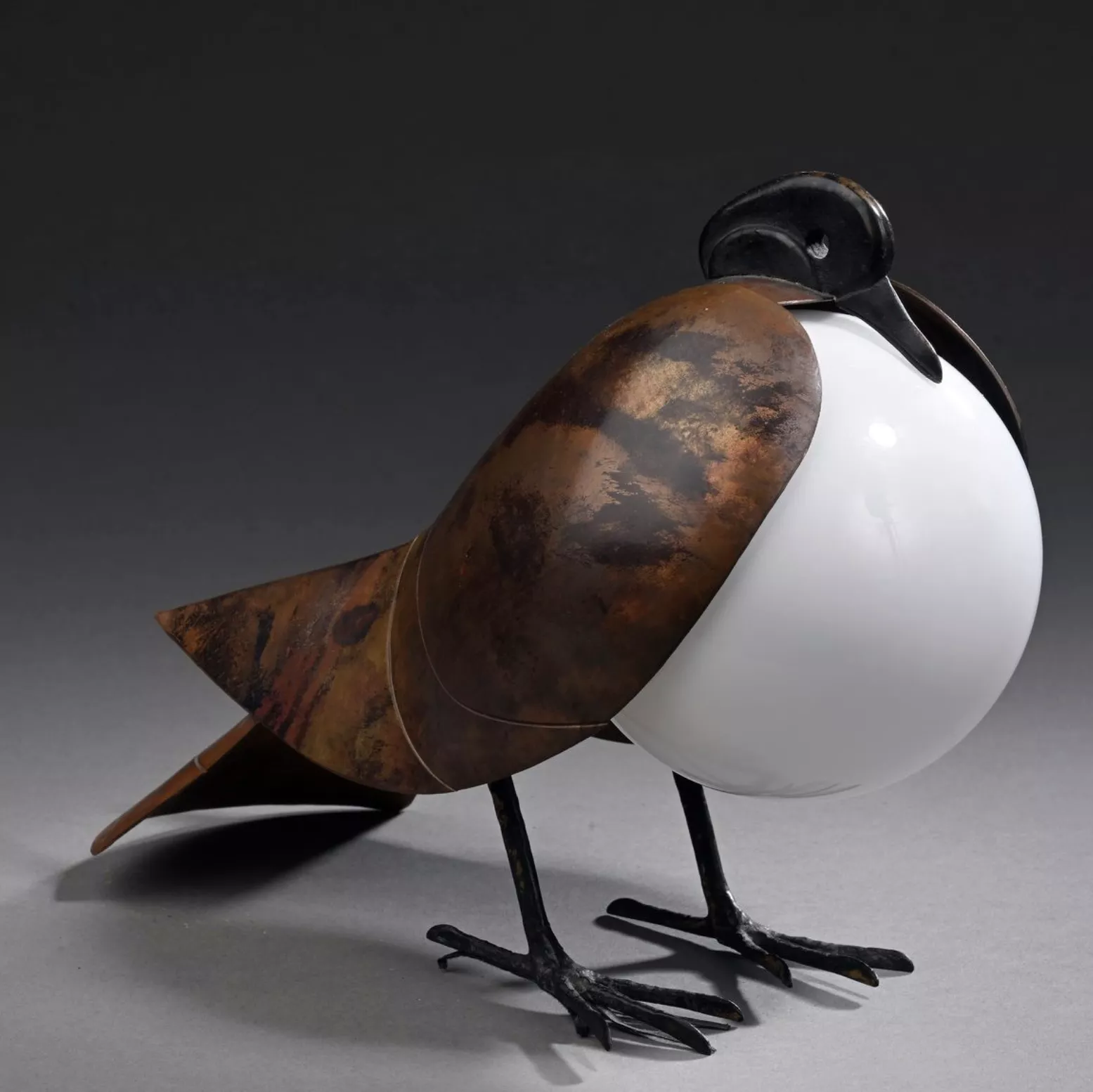
In Portrait d'un mouton imaginaire (fig. 1), the surface retains this function of stable occupation, clean cut, ordering the figure. But it does not construct an illusionist space: it articulates a plane, organizes a silhouette, distributes a few masses of color without depth or modeling.
The sheep, placed in profile, is drawn by a continuous line, without break, without insistence. The background, plain and without gradation, opens onto no horizon: it keeps the figure on the surface, containing it. The color, applied in flat matte tones, underlines the strict separation between the animal and space.
The eye encounters no hesitation of line, no attempt at light or shadow. The coat is not described, but evoked by the compactness of the body, the curvature of the back, the simplicity of the volume.
The legs, slender and straight, support the mass without weighing down the composition. The head, reduced to an oval extended by two discreet horns, does not seek expressiveness: it asserts a presence, immediate, silent.
The painting does not vary in intensity according to the zones: it maintains an equality of treatment, a continuity without rupture.
The whole does not seek to reproduce a real sheep: it proposes an invented form, stabilized, reduced to its essential lines. The surface doesn't deepen, the gaze doesn't sink: it glides, it follows, it holds.
Therefore far removed from any temptation to realism or narrative impulse, François-Xavier Lalanne's painting asserts a logic of posed clarity, of silent figuration, where the image doesn't tell but exposes a contained, isolated, autonomous form, inscribed in space without modifying it.
François-Xavier Lalanne's imprint on his period
In François-Xavier Lalanne's work, painting retains this function of clarity, of cutting out, of fixing forms.
But it is not part of the search for rupture or experimentation in pictorial language that runs through the XXᵉ century: it maintains a stability, an immediate legibility, an untroubled frontality.
In a century when the image deconstructs, fragments, sometimes denies itself, Lalanne affirms another path, discreet, unmanifest, where the animal, the object, the figure give themselves to be seen without alteration, without overload.
His influence on XXᵉ century painting is not through technical innovation or theoretical avant-garde, but through the affirmation of a held space, a posed surface, a stable figure.
Away from the mainstream, he shows that a simple, constructed, balanced image can exist without recourse to rupture or radical abstraction.
Thus, removed from the great movements but aligned with a demand for form and legibility, François-Xavier Lalanne's painting leaves a discreet but persistent imprint, that of a figuration without emphasis, without narrative, entirely contained in the precision of the surface.
François-Xavier Lalanne is an artist well known to lovers of sculpture and painting, and the author of an absolutely considerable artistic output.
Most of his works are now held by private collectors, increasing the value and success of his works on the auction market.
His drawings and paintings are particularly prized as they are absolutely unique pieces that reveal the artist's inspiration and way of working.
Recognizing François-Xavier Lalanne's signature
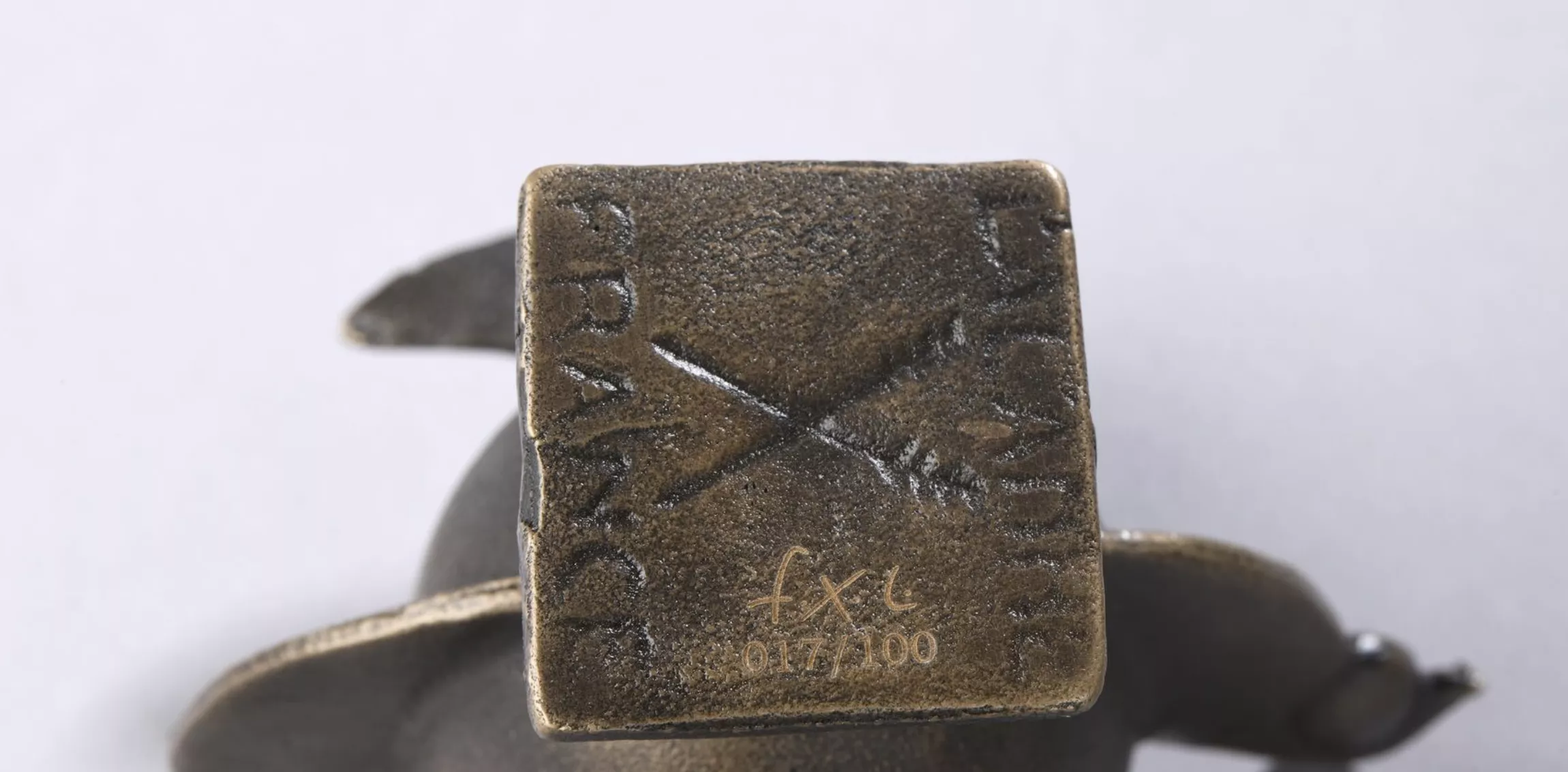
It's not always easy to decipher or even be lucky enough to come across a signed Lalanne work. He did, however, sign his work with his name in cursive letters, and often dated his sculptures.
Knowing the value of a work
If you happen to own a work by François-Xavier Lalanne, request a free appraisal without further delay via our form on our website.
A member of our team will contact you promptly with an estimate of the value of your work, not forgetting to send you ad hoc information about it.
If you are considering selling your work, you will also be accompanied by our specialists in order to benefit from alternatives to sell it at the best possible price.
Estimate in less than 24h
Discover in the same theme

Rating and value of paintings by Igor Tcholaria
Igor Tcholaria is a Georgian painter whose paintings and drawings are highly rated on the auction market. Estimate in less than 24h.
Learn more >

Rating and value of drawings, prints and sculptures by Käthe...
Käthe Kollwitz is a German Expressionist artist who worked extensively in drawing and printmaking. Her works are highly prized.
Learn more >

Rating and value of drawings and paintings by Senkichiro Nas...
Senkichiro Nasaka is a Japanese artist and member of the Gutai movement whose works are highly sought after and valuable. 24-hour estimate.
Learn more >
Works from the same period sold at auction

Estimated 30 € - 50 €
In the spirit of Keith HARING (1958-1990), Pregnant woman and "radiant baby".

Estimated 4.000 - 6.000 €
GASTON CHAISSAC (1910-1964) Composition 1947, Gouache and Indian ink on paper.

Estimated 3.000 - 5.000
Claude LALANNE (1925-2019) Mimosa necklace

Estimated 15.000 - 20.000
François-Xavier LALANNE (1927-2008) Tortue, 1973 brass patina edition no. 75/100 (traces of oxidation and minor patina damage)

Secure site, anonymity preserved

Auctioneer approved by the State

Free and certified estimates
Frequently asked questions
-
Who is François-Xavier Lalanne, and what is his artistic background?François-Xavier Lalanne (1927–2008) was a French artist who specialized in sculpture, drawing, and painting, and was particularly known for his depictions of animals. Born in Lot-et-Garonne, he trained at the Académie Julian in Paris and rubbed shoulders with major figures of Surrealism such as René Magritte and Salvador Dalí. He collaborated with his wife Claude and worked for prestigious fashion houses such as Dior. His approach emphasizes formal clarity and refined figuration, setting him apart from the major avant-garde movements of the 20th century.
-
What is the price range for François-Xavier Lalanne's works?Lalanne's works sell for between €30 and €155,000, depending on the type and complexity. Prints and multiples range from €30 to €285,500, drawings and watercolors from €320 to €100,000, and paintings from €500 to €155,000. Her preparatory drawings depicting animals are particularly sought after and command the highest prices. The artist’s market value is steadily rising.
-
How can you authenticate a work by François-Xavier Lalanne?To authenticate a work by Lalanne, we recommend that you request a free, no-obligation appraisal from our state-certified auctioneers and experts. Contact us using the form on our website: a member of our team will respond within 48 hours with an accurate appraisal and detailed information about your artwork.
-
Is this the right time to sell a work by François-Xavier Lalanne?Yes, now is a good time to sell a work by Lalanne. His market value is steadily rising at auction, and his drawings and paintings are particularly sought after by collectors. The rarity of his one-of-a-kind pieces and the fact that they are held by private collectors drive up both demand and value.
-
How does the appraisal and sale of a work of art take place at Auctie's?The appraisal is free and non-binding: simply submit your artwork via our online form, and you’ll receive a response from an expert within 48 hours. If you’d like to sell, our specialists will guide you through the process from appraisal to auction, offering you the best solutions to achieve the highest possible price at auction.
