



Rating and value of Charles Artus sculptures and bronzes

Key takeaways
- Charles Artus (1897–1978), a leading French sculptor specializing in animal subjects, has works that fetch prices ranging from €140 to €77,380 on the market.
- His bronzes are his most prestigious and sought-after creations, cast to a high standard by Susse, Valsuani, or Rudier.
- Medium-sized pieces (20–40 cm) depicting big cats and antelopes form the core of the market, offering excellent liquidity.
If you own a work by or after the artist Charles Artus, and would like to know its value, our state-approved experts and auctioneers will offer you their appraisal services.
Our specialists will carry out a free appraisal of your work, and provide you with a precise estimate of its value on the current market.
Then, should you wish to sell your work, we will direct you to the best possible arrangement to obtain the optimum price.
Rating and value of artist Charles Artus
Considered an important artist of animal sculpture, Charles Artus leaves behind a unique artistic repertoire, within which bronze works occupy a prominent place.
At present, prices for his works are rising enormously under the auctioneers' hammer. His creations are particularly prized, and the price at which they sell on the art market ranges from €140 to €77,380, a considerable range but one that speaks volumes about the value that can be attributed to Artus's works.
In 2020, a bronze statue, Ibis du Nil, sold for €82,350, while it was estimated at between €82,350 and €123,525.
Order of value from a simple work to the most prestigious
Technique used | Result |
|---|---|
Metal | From €100 to €730 |
Plaster | €200 to €5,000 |
Bronze | €100 to €82,350 |
Estimate in less than 24h
Artist's style and technique
Charles Artus is a 20th-century artist who produced various sculptures that fall within the Symbolist movement. His work is closely linked to François Pompon, whom he assisted. He has worked in a variety of media, including plaster, metal and especially bronze.
He is part of the Nouvelle École de Paris group and the 20th-century revival of animal sculpture. His style combines observed realism, modernist simplification and volumetric elegance, close to a synthesis between Barye, Jouve and Sandoz.
He seeks a balance between animal vitality, beauty of form and decorative sobriety. He specializes in wild animals (felines, deer, canines, bears and monkeys). Many of his models are devoted to African animals (antelopes, lions, panthers).
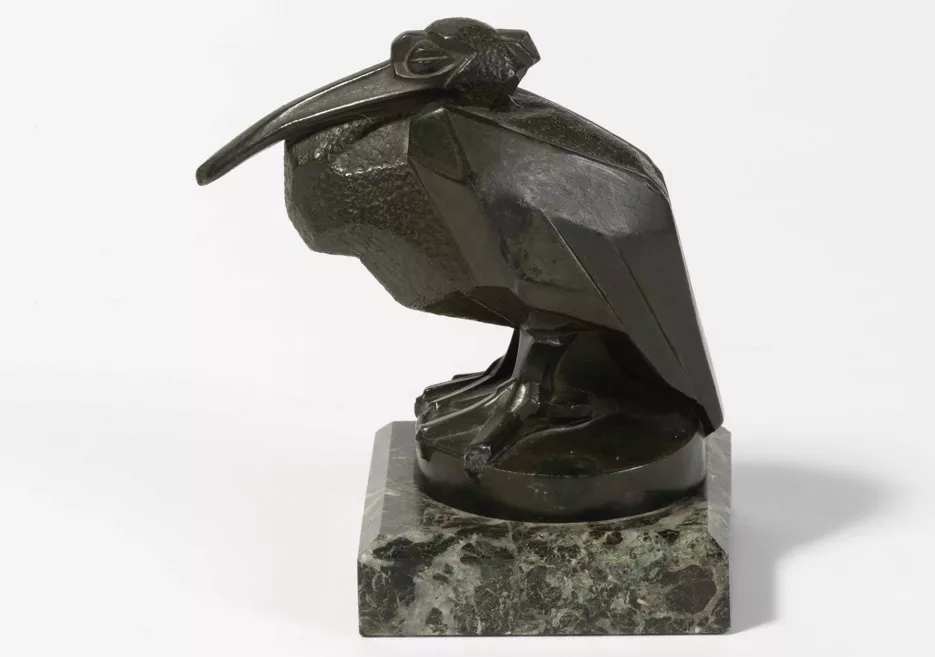
His animals are depicted in calm or concentrated attitudes, walking slowly, in attentive pause and restrained tension. Anatomy is precise but never hyper-realistic, with mass articulation favored over surface detail.
Bodies are built by large volumetric units (shoulders, torso, kidneys modeled in taut flat tints). The silhouettes are balanced and compact, with an internal tension that gives an impression of silent power.
He clearly simplifies the extremities, with muzzles, paws and ears that are reduced to essentials, and shows a preference for static or pre-movement poses rather than dramatic action.
The sculptures are conceived as closed, strongly cohesive volumes. The full/empty relationship is mastered, with an absence of superfluous arabesques and a decorative economy. The positioning of the animal on its pedestal is conceived as a natural extension rather than an artificial support.
The modeling is firm, direct, with a use of tools that preserves lightly vibrated textures. Bronze casting is of the highest quality, often carried out by specialized French founders (Susse, Valsuani, Rudier depending on certain periods).
Charles Artus, his life, his work
Charles Artus (1897-1978), a French artist, became an important figure in 20th-century sculpture, particularly animal sculpture.
A native of Étretat, Normandy, his vocation as a sculptor was born early. He first learned sculpture from Édouard Navellier, then became François Pompon's assistant.
He exhibited his work at the Salon d'Automne, of which he was a member, then at the Salon des Artistes Indépendants. Animal representations being very much in vogue at the time, the various artists mastering this part of creation at the time came together under the name of the " Groupe des XII ", to which Guyot and Poupelet belonged among others.
He opened his own studio on rue de Vaugirard, enjoying success thanks to his exhibitions at the various Salons. This enabled him to work with several Parisian galleries.
In 1940, he decided to leave Paris to continue his activity in Étretat.
Charles Artus's imprint on his period
Charles Artus is a well-known artist among sculpture enthusiasts, and is the author of a sizeable artistic output. Today, most of his works are held by private collectors, which increases the value and success of his works on the auction market.
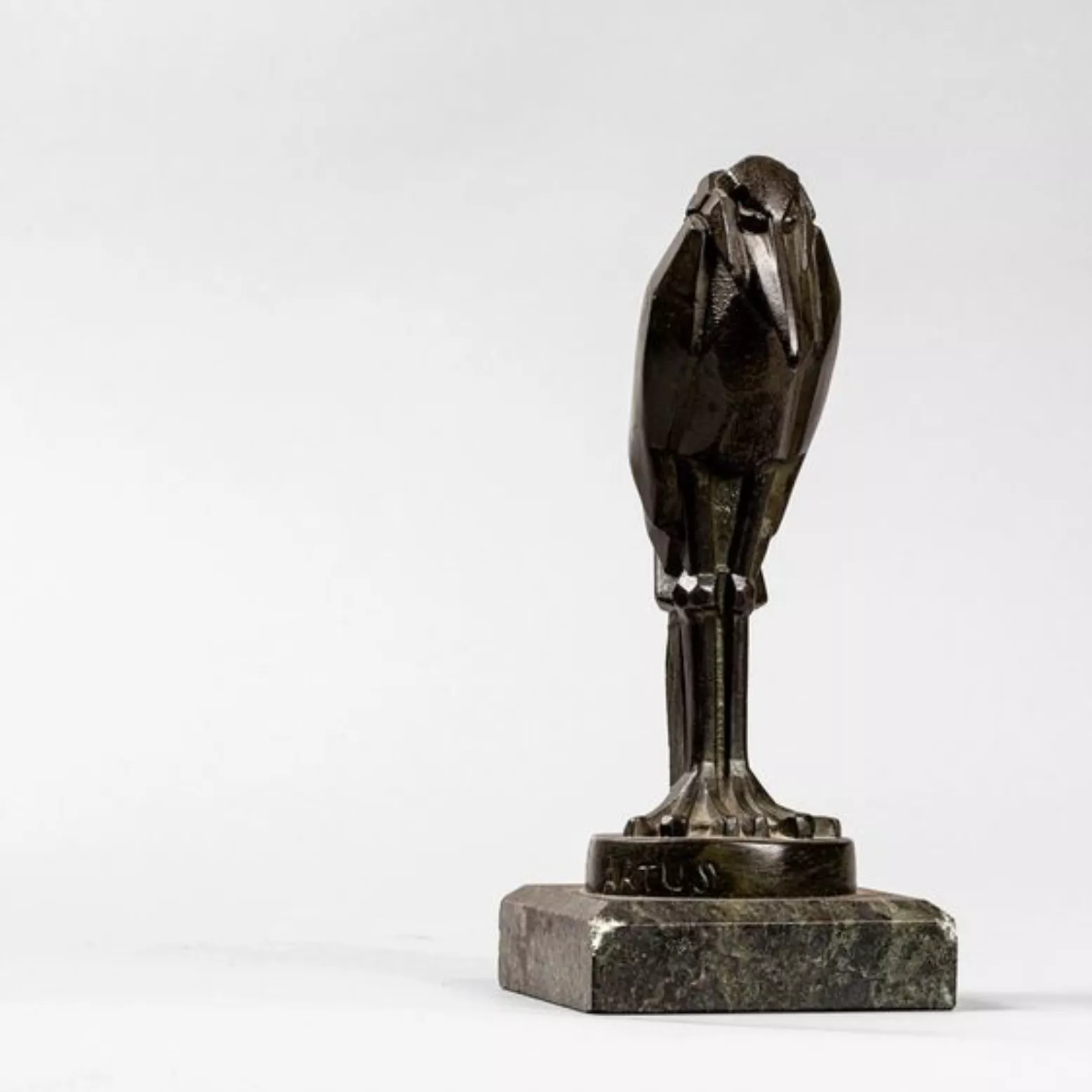
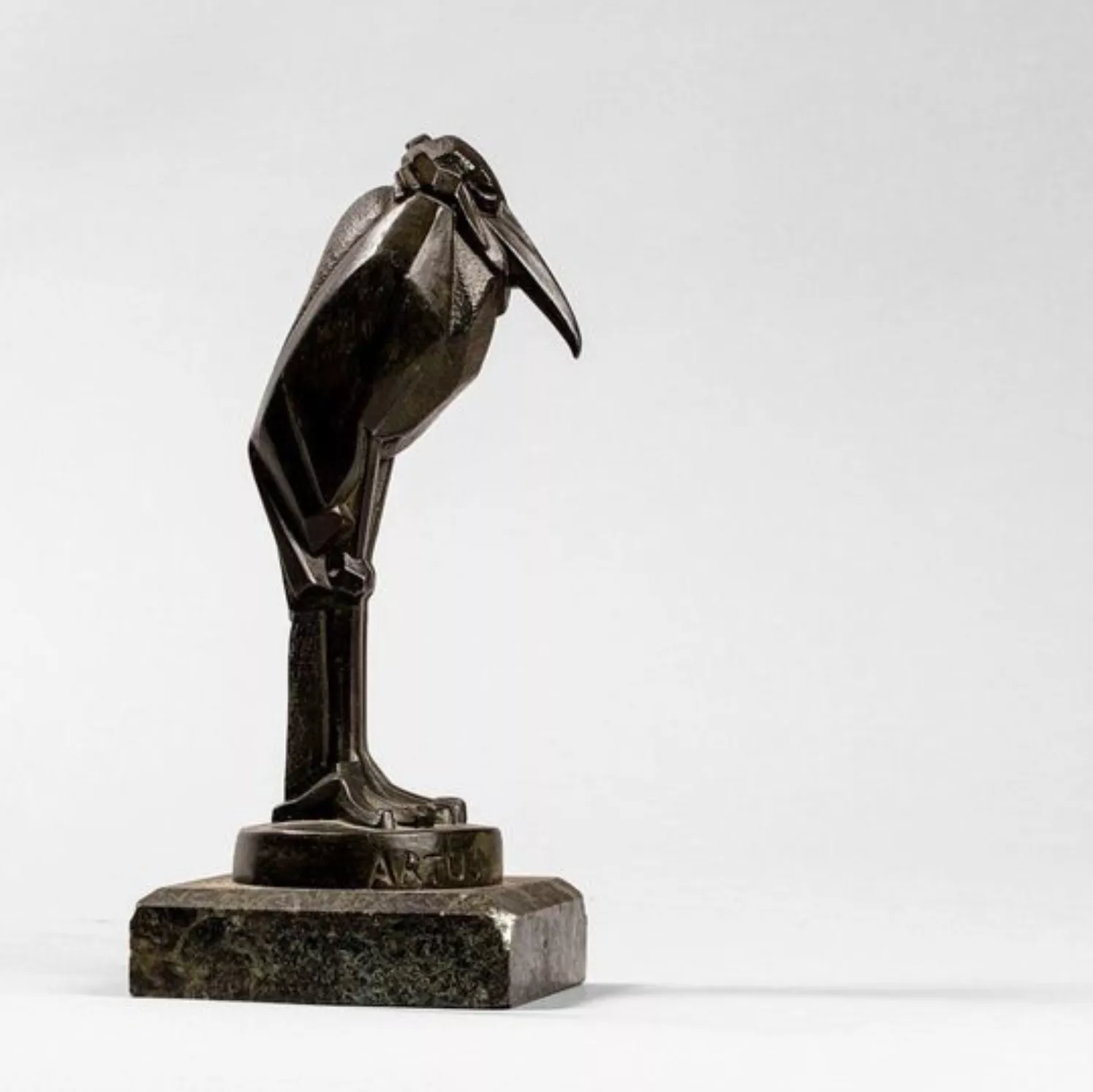
His plaster and metal sculptures are particularly prized as they are absolutely unique pieces that reveal the artist's inspiration and way of working, but his bronzes are indisputably his most famous and prized works, which are constantly breaking records on the auction market.
Market segmentation and artist rating
Animal bronzes form the core of the market (felines, cervids, antelopes, canids and monkeys are highly sought-after). Plasters are rare and often from workshops, a segment mainly collected by specialized enthusiasts.
Terracottas are rarer than bronzes, and their value depends on the surface condition. Drawings and studies are part of a restricted market, mainly animal sketches.
Small formats under 20 cm (simple subjects, antelopes, birds, young felines) are part of an accessible entry segment. Medium formats (20 - 40 cm) form the core of the market, with panthers, lions, wild dogs and stylized antelopes.
Large formats over 40 cm are rare and highly valued, especially majestic felines or monkeys. Valuation criteria include period fonts (Susse, Valsuani, Rudier depending on the print), homogeneous patina, stylistic typicity, rarity of the model, presence of the original base and state of preservation.
France remains the central market, with pieces also found in Belgium, the Netherlands, the USA and the UK. Liquidity is very good for felines and antelopes, particularly in bronze, and good for monkeys and stylized African animals.
Liquidity is more variable for terracottas and plasters, but remains high for old castings, limited editions and typical works.
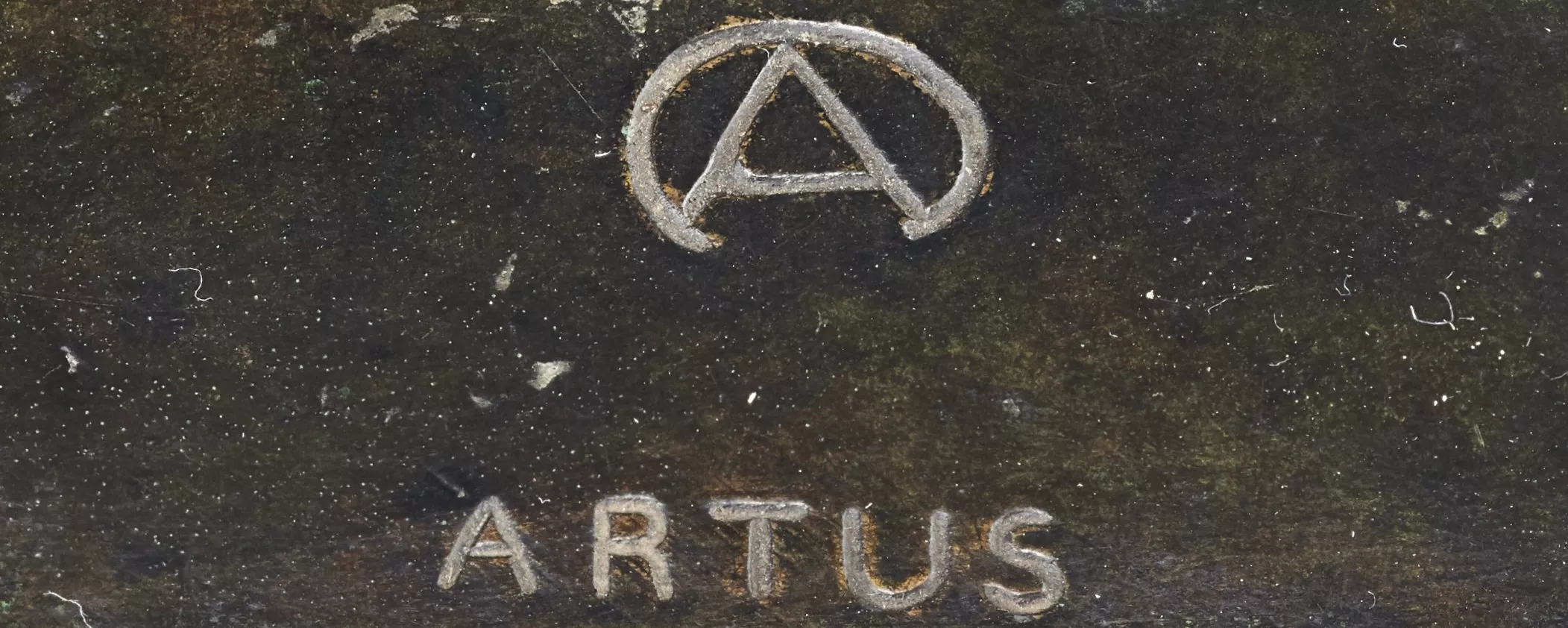
Recognizing the signature of Charles Artus
It's not always easy to decipher or even be lucky enough to come across a signed work by Charles Artus, which is why expertise is important.
Knowing the value of a work
If you happen to own a work by Charles Artus, request a free appraisal without delay via our form on our website.
A member of our team will contact you promptly to provide you with an estimate of the value of your work, as well as ad hoc information about it.
If you are considering selling your work, you will also be accompanied by our specialists in order to benefit from alternatives for selling it at the best possible price.
.Estimate in less than 24h
Discover in the same theme

Rating and value of works, drawings, paintings by Henri Mège
Henri Mège is a 20th-century landscape and still-life painter of the Indochina school. His works are listed at auction.
Learn more >

Market Value and Pricing of Georges Jouve's Sculptures
Georges Jouve is a twentieth-century contemporary sculptor who has produced works that are highly prized at auction.
Learn more >

Rating and value of paintings by Georges Vantongerloo
Georges Vantongerloo is an abstract painter and member of the de Stijl group, whose works are highly regarded and valued.
Learn more >
Similar sculptures sold at auction

Estimated Between €2,000 and €4,000
Edouard Marcel SANDOZ (1881-1971) curly stingray, bronze print

Estimated Between €5,000 and €8,000
Agathon LEONARD (1841-1923), Dancer with scarf, bronze lamp, ed. Susse frères

Estimated Between €800 and €1,500
Claude Victor BOELZ (b. 1937), gilt bronze and quartz centerpiece

Estimated Between €1,500 and €3,000
César BALDACCINI dit CESAR (1921-1998), Poule Cartier, bronze print

Estimated Between €10,000 and €20,000
Baltasar LOBO (1910-1993), female nude in bronze

Secure site, anonymity preserved

Auctioneer approved by the State

Free and certified estimates
Frequently asked questions
-
Who is Charles Artus, and what is his historical context?Charles Artus (1897–1978) was a leading French sculptor of the 20th century, specializing in animal sculpture. A native of Étretat, he served as François Pompon’s assistant and was associated with the Symbolist movement and the New School of Paris. He exhibited regularly at the Salon d’Automne and the Salon des Artistes Indépendants, and was a member of the prestigious “Groupe des XII,” a group of animal sculptors of his time.
-
What is the price range for Charles Artus's sculptures?Charles Artus's works sell for between €140 and €77,380, depending on the type of object and its rarity. His bronzes, his most sought-after creations, range from €100 to €82,350, while his plaster casts range from €200 to €5,000. Medium-sized pieces (20–40 cm) form the core of the market, with bronze depictions of big cats and antelopes enjoying very high liquidity.
-
How can I authenticate a sculpture by Charles Artus and determine its value?To authenticate and appraise a work by Charles Artus, request a free, no-obligation appraisal from Auctie's using our online form. Our state-certified auctioneers and experts will examine your piece and provide you with an accurate estimate of its market value within 48 hours.
-
Is this a good time to sell a sculpture by Charles Artus?Yes, this is an excellent time to sell a work by Charles Artus. His prices are rising sharply at auction, his creations are particularly sought after, and market liquidity is very good, especially for his bronze depictions of felines and antelopes. The French market remains dynamic, with strong demand also in Belgium, the Netherlands, the United States, and the United Kingdom.
-
How does the sale of a work of art work at Auctie's?Auctie's supports you every step of the way: a free, no-obligation appraisal by an expert, and then, if you decide to sell, guidance on the best approach to get the highest price. Our specialists guide you through the entire process, from listing your item for sale to the auction.
