



Rating and value of works, paintings, drawings by Paul Jouve

Key takeaways
- Paul Jouve, a French animal painter (1878–1973) who specialized in depicting big cats, has works valued between €30 and €300,000, depending on the technique and the artist’s reputation.
- Oil-on-canvas paintings command the highest prices (€80 to €300,000), while prints range from €30 to €56,000 and watercolor drawings from €120 to €84,000.
- In 2014, his painting “Prayer at the Camp” sold for €300,000, far exceeding its initial estimate of €30,000 to €40,000, confirming the growing appreciation of his works.
If you own a work by or after the artist Paul Jouve, and would like to know its value, our state-approved experts and auctioneers will offer you their appraisal services.
Our specialists will carry out a free appraisal of your work, and provide you with a precise estimate of its value on the current market.
Then, if you wish to sell your work, we will direct you to the best possible arrangement to obtain the optimum price.
Rating and value of the artist Paul Jouve
Paul Jouve is a 20th-century animal painter. His works are mainly inspired by wild animals (panthers, lions, tigers...). His legacy consists of paintings, watercolor drawings and prints.
At present, the prices of his works are rising under the auctioneers' gavels. His paintings are particularly prized especially by French buyers, and the price at which they sell on the Art market ranges from €30 to €300,000, a considerable delta but one that speaks volumes about the value that can be attributed to Paul Jouve's works.
In 2014, his composition Prière au campement, depicting savannah animals, sold for €300,000 while it was estimated at €30,000 to €40,000.
The artist's quotation is quite high and varies according to the quantity of work present on the auction market.
Order of value from a single work to the most prestigious
Technique used | Result |
|---|---|
Estamp | From €30 to €56,000 |
Drawing - watercolor | From €120 to €84,000 |
Oil on canvas | From €80 to €300,000 |
Estimate in less than 24h
Jouve - The Jungle Book
Style and technique of artist Paul Jouve
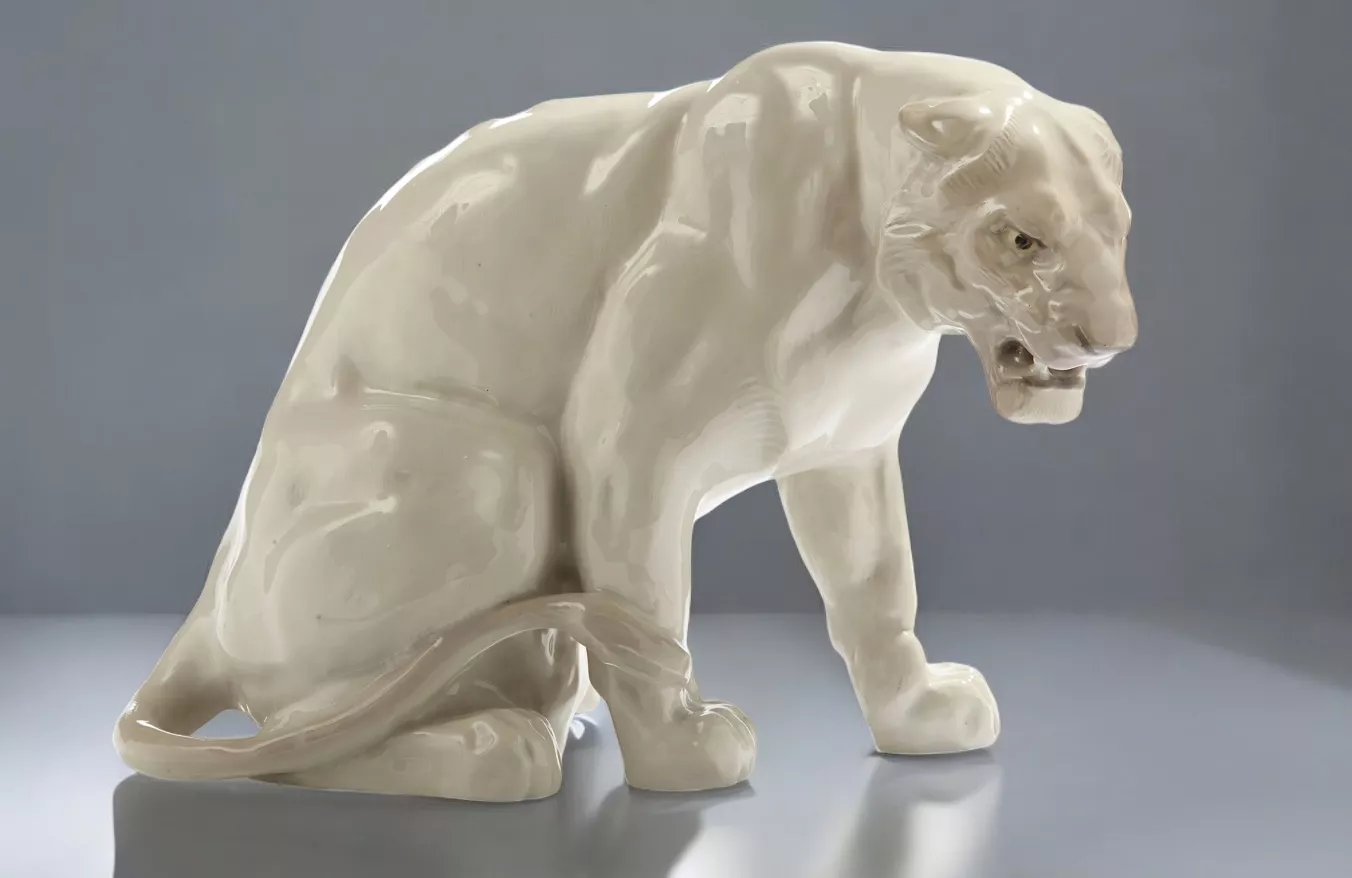
Paul Jouve's style is underpinned by exceptional technical mastery, enabling him to capture the strength and nobility of animals with rare intensity.
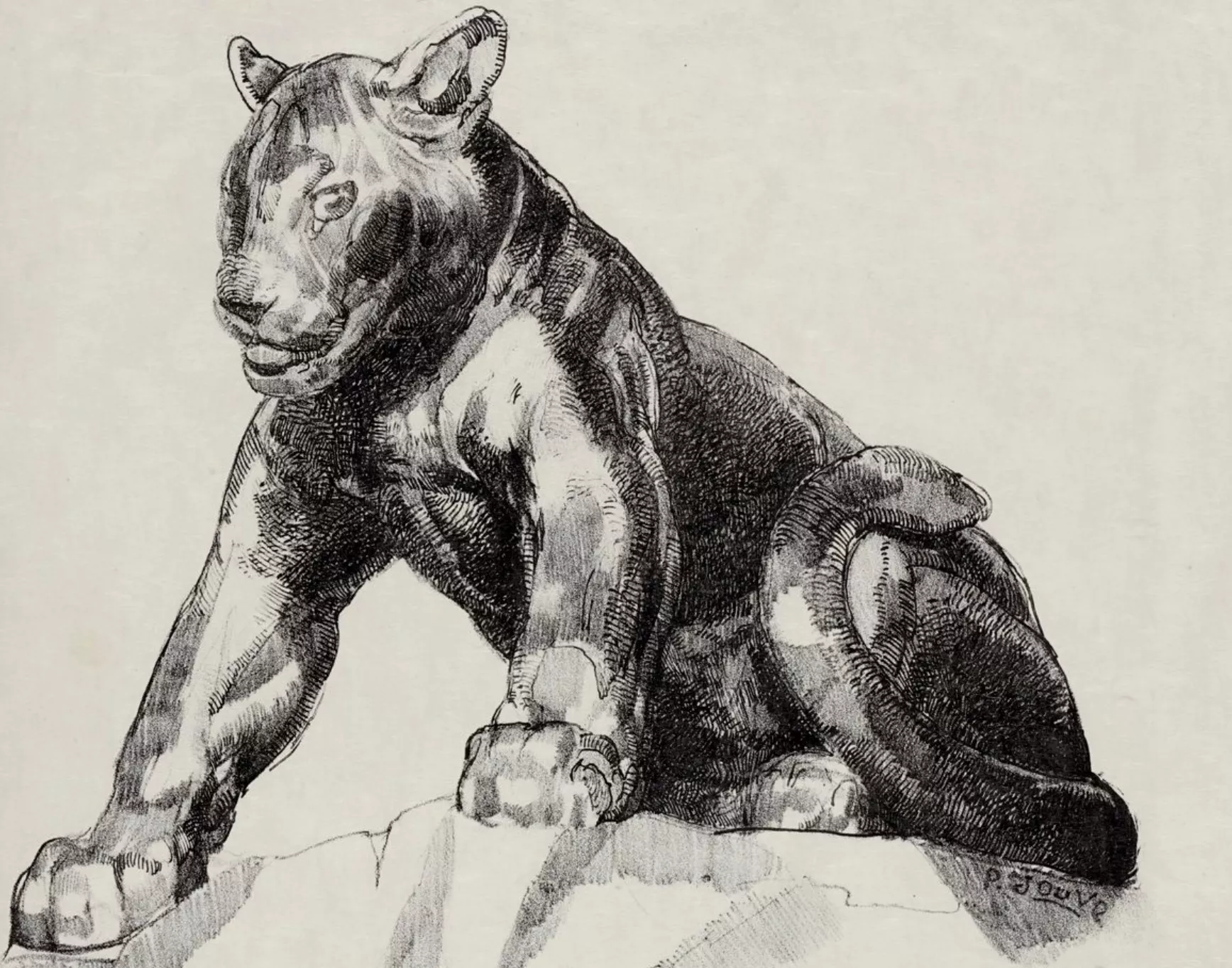
An animal artist par excellence, he deploys an extremely precise drawing technique, marked by sharp contours and deep shading that accentuate the volume and musculature of the fawns he's so fond of.
Each stroke is thought out to render movement and energy, as if the animal were coming to life on paper. The rigor of his observation, which he honed from his first visits to the Jardin des Plantes, shines through in every detail of his works: the textures of the coats, the radiance of the glances, the tension of the bodies.
In sculpture, he approaches the material with the same attention to detail, carving powerful forms with majestic poses, reminiscent of the intensity of Bugatti's bronzes or Pompon's elegant stylization.
His work in metal or stone reveals a remarkable ability to translate the robustness and suppleness of animals, paying homage to their natural grandeur.
Inspired by oriental techniques, Jouve pays particular attention to patinas and finishes, giving his pieces a radiance that captures the eye.
Through this precise, respectful approach to the animal, Paul Jouve turns each work into a celebration of wildlife, affirming his status as a key artist in twentieth-century animal art.
The career and life of Paul Jouve
Paul Jouve (1878-1973), a French artist with a remarkable career, established himself as a major 20th-century figure in animal art, alongside such talents as François Pompon and Rembrandt Bugatti.
Born in Seine-et-Marne, he was introduced to art at an early age by his father, Auguste Jouve, a painter and photographer, who encouraged his taste for drawing and observation.
This artistic family background led him to enter the École des arts décoratifs in Paris, where he cultivated a fascination for animals, which he studied assiduously at the Jardin des Plantes, capturing their power and elegance in his sketches.
Like Bugatti, who translated the vitality of wild animals into bronze, Jouve sublimated felines, rendering them almost mystical in his works.
His proximity to Orientalist painters, who like him were fascinated by the exoticism and grandeur of distant landscapes, developed rapidly. As early as 1893, he exhibited at the Salon des artistes français, a decisive step in his career.
This success enabled him to obtain a residence in Algiers with Léon Cauvy, where he married the daughter of Maxime Noiré, an influential painter in the Orientalist movement.
There, he perfected his eye for big cats, as Pompon would do with bears and deer in his own stylized approach.
Jouve's career took a turn with his illustration project for Le Livre de la Jungle, where he managed to capture the wild spirit of the animals with rare intensity. This project, one of the most emblematic of his career, places him on a par with the masters of animal illustration.
His mastery of detail and ability to imbue his figures with a striking presence have earned him worldwide recognition. Throughout his career, he received three gold medals at renowned Parisian exhibitions, consolidating his place in the art world.
In 1931, he presented his work at the Exposition Coloniale Internationale, where his canvases were particularly admired for their vibrant exoticism.
Always in search of adventure and new inspiration, he undertook a trip to the Hoggar massif, in the heart of the Sahara, to study animals in their natural habitat.
In Paris, he collaborated with artists such as Édouard-Marcel Sandoz and Gaston Suisse, with whom he shares a passion for depicting wildlife in a noble and expressive light.
Sandoz, a specialist in stylized geometric forms, also found in Jouve an artistic ally, both paying tribute to the animal kingdom with a pared-down yet emotionally charged approach.
For the rest of his life, Jouve remained faithful to his passion for animals, an artistic commitment that earned him lasting recognition. He died in Paris at the age of 95, leaving an indelible mark on twentieth-century animal art.
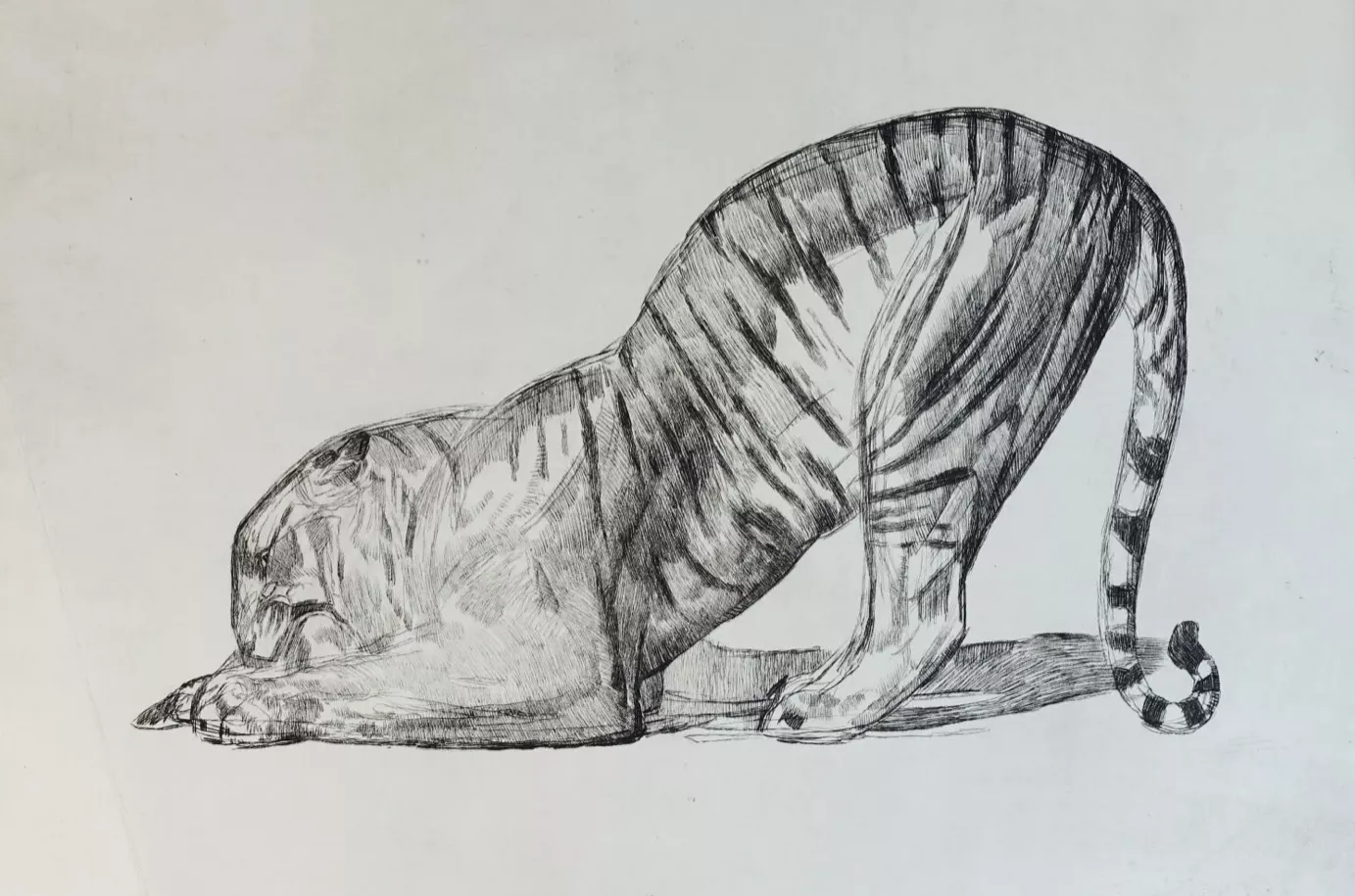
Focus on a drawing, Crouching Tiger, (above), Paul Jouve
This drawing by Paul Jouve reveals all the artist's technical mastery and sensitivity to the animal world. We discover a crouching tiger, concentrated and serene, its front legs bent, its head lowered almost as a sign of submission or intense rest.
The animal's particular position, unusual in the representation of wildcats, conveys a mixture of restrained power and gentleness, a subtle balance that only Jouve knew how to capture with such precision.
There is a deep respect here for the animal, which the artist perceives and renders in all its natural nobility.
The line work is impressive. Jouve uses precise yet subtle linework to sculpt the tiger's forms, playing with the thickness and direction of the strokes to suggest the volume and texture of its striped coat.
The stripes, typical of this species, are not merely decorative; they embrace the animal's powerful musculature, revealing a detailed and perfectly mastered anatomy.
Each line seems to have been drawn with precise intention, accentuating the curvature of the muscles and the suppleness of the legs. Particularly noteworthy is the care taken with the shading, which lends depth and a sculptural dimension to this two-dimensional drawing.
The tiger's tail, slightly raised, adds a touch of dynamism to the composition. It balances the crouching position of the feline, and its curled tip breaks the potential rigidity of the whole.
Jouve manages to express, with apparent minimalism, all the character of the animal: its grace, power and a certain melancholy.
The choice of this pose, almost contemplative, contrasts with the usual representations of fawns in motion, hunting or in full action, preferred by the animal artists of his time.
Here, Jouve offers us a moment of calm, a suspended moment, which invites respectful contemplation.
This drawing also bears witness to the influence of Eastern art on Jouve, particularly in his way of simplifying and stylizing forms without ever losing sight of verisimilitude.
Through this work, Jouve conveys his admiration for wild animals and his talent for capturing their essence without artifice.
This crouching tiger thus becomes much more than a simple study of fauna: it stands out as a true ode to majesty and wild beauty, where every stroke exudes passion and mastery.
The legacy of Paul Jouve
The legacy of Paul Jouve remains vibrant and imposing, symbolizing the excellence of twentieth-century animal art.
In reinventing the depiction of wildcats and other exotic creatures, he left an indelible mark on French art, inspiring generations of artists fascinated by the power of wildlife.
His influence can be measured not only in the precision of his line and the majesty of his sculptures, but also in his respectful, almost spiritual approach to the animal, which he regarded as a noble subject.
Jouve's works are still prized today by collectors and exhibited in prestigious museums, where they captivate with their intensity and refinement.
This master of drawing and sculpture, who combined rigorous technique with profound sensitivity, continues to influence modern animal art and remains an essential reference for contemporary artists and enthusiasts alike.
Paul Jouve, through his unrivalled work, has given animal art a dignity and depth that transcends the ages.
Recognizing Paul Jouve's signature
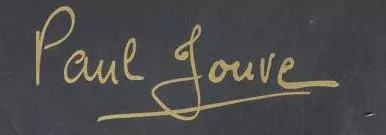
Paul Jouve signs his works in most cases, on the canvas at the bottom of the painting in a color that contrasts with the background. Occasionally, his works are unsigned.
Knowing the value of a work
If you happen to own a work by or after Paul Jouve, don't hesitate to request a free appraisal by filling in our form on our Auctie's website. A member of our team of state-approved experts and auctioneers will contact you promptly to provide you with an estimate of the market value of your work, as well as historical information about it. If you wish to sell your work, you will also be accompanied by our specialists in order to benefit from solutions to sell it at the best possible price, taking into account the inclinations of the market.
Estimate in less than 24h
Discover in the same theme

Rating and value of paintings, drawings and sculptures by Co...
In polychrome resin, our reader's sculpture represents a yellow bird on a kind of rock in shades of Klein blue and red. It is signed C
Learn more >

Rating and value of works, drawings, paintings by Michel Adl...
Michel Adlen is a Ukrainian painter of the École de Paris who has produced drawings and oils on canvas that are highly regarded at auction.
Learn more >

Rating and value of drawings and paintings by Georges d'Espa...
Georges d'Espagnat was a 20th-century Symbolist painter who produced numerous paintings that command high prices at auction.
Learn more >
A work by Paul Jouve sold at auction


Secure site, anonymity preserved

Auctioneer approved by the State

Free and certified estimates
Frequently asked questions
-
Who is Paul Jouve, and what is his artistic background?Paul Jouve (1878–1973) was a leading French painter and sculptor in the field of animal art during the 20th century. Trained at the École des Arts Décoratifs in Paris, he distinguished himself through his exceptional mastery in depicting wild beasts and exotic animals, particularly through his illustrations for *The Jungle Book*. Alongside Pompon and Bugatti, he imbued animal art with a dignity and depth that remain unmatched.
-
What are the price ranges for Paul Jouve's works, depending on the medium?The prices of Paul Jouve’s works vary considerably depending on the medium used: prints range from €30 to €56,000, watercolor drawings from €120 to €84,000, and oil paintings on canvas from €80 to €300,000. This variation reflects the importance of each piece’s size, provenance, and rarity in today’s market.
-
How can you authenticate a work by Paul Jouve?To authenticate a work by Paul Jouve, we recommend that you request a free appraisal from Auctie's. Our experts and state-certified auctioneers will examine your piece, verify the signature (usually located at the bottom of the painting), and provide you with an accurate assessment within 48 hours, with no obligation on your part.
-
Is this the right time to sell a work by Paul Jouve?Yes, now is a good time to sell a work by Paul Jouve. This wildlife artist’s market value continues to rise at auction, with particularly strong demand from French and international collectors. Prices for his works are on an upward trend, as evidenced by the remarkable sale of *Prière au campement* in 2014, which sold for well above its estimate.
-
How does the sales process work at Auctie's?Auctie's supports you from start to finish: after a free, no-obligation appraisal by our experts, we guide you toward the best sales option to get the highest possible price. Our licensed auctioneers manage every step of the process leading up to the auction, taking into account current trends in the wildlife art market.
