



Rating and value of animal sculptures and bronzes by André Vincent Becquerel

Key takeaways
- Bronze sculptures by Becquerel (1893–1981), a French Art Deco animal sculptor, sell for between €20 and €26,000, depending on size and provenance.
- Bronzes constitute the main market segment, commanding higher prices than terracotta pieces (€20–6,000) and gilded bronzes (€100–8,000), with depictions of felines and animals in motion dominating the market.
- The artist’s market value is stable and solid, with strong liquidity for stylized pieces from the 1920s–1940s cast by renowned Parisian foundries (Susse Frères, Valsuani).
If you own a work by or after the artist André Vincent Becquerel, and would like to know its value, our state-approved experts and auctioneers will offer you their appraisal services.
Our specialists will carry out a free appraisal of your work, and provide you with an accurate estimate of its value on the current market.
Then, should you wish to sell your work, we will direct you to the best possible arrangement to obtain the optimum price.
Rating and value of the artist André Vincent Becquerel
André Vincent Becquerel is an animal sculptor who is fairly well known to fans of this type of work. He doesn't have a strong presence on the art market, but his works are enjoying growing success.
His legacy therefore consists mainly of sculptures made from several types of material, especially bronze. At present, the prices of his works are rising recurrently at the auctioneers' gavel.
His sculptures are prized above all by European buyers, and the price at which they sell on the art market ranges from €20 to €26,000, a considerable delta, which speaks volumes, however, about the value that can be attributed to the works of André Vincent Becquerel.
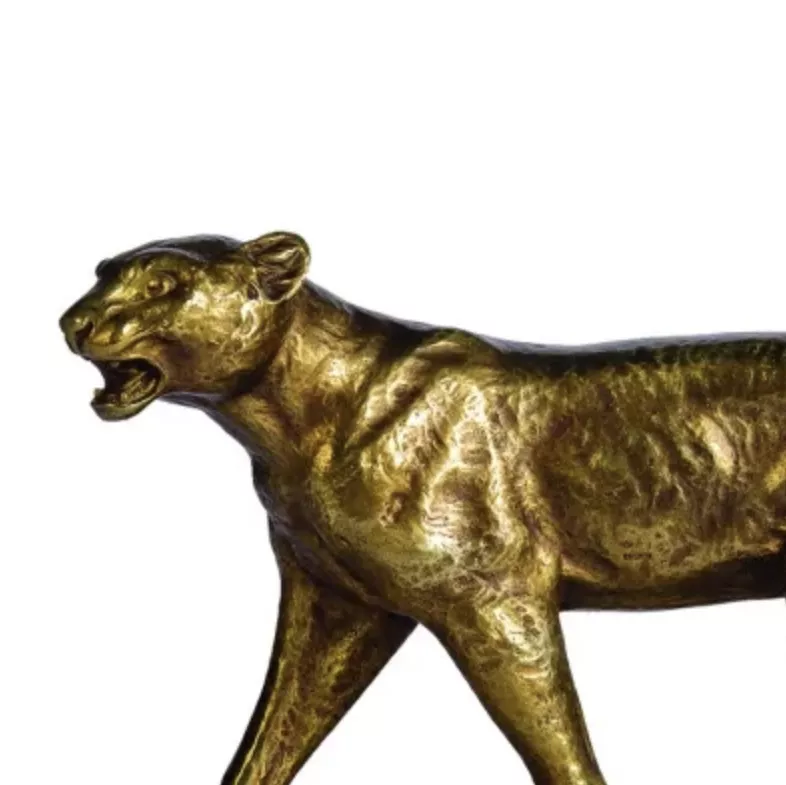
In 2011, one of his bronze sculptures, Two panthers, sold for €26,000 while it was estimated at between €7,000 and €10,000.
Order of value from a simple work to the most prestigious
Technique used | Result |
|---|---|
Baked clay | From 20 to 6 000€ |
Golden bronze | From 100 to 8 000€ |
Bronze | From €20 to €26,000 |
Estimate in less than 24h
Style and technique by artist André Vincent Becquerel
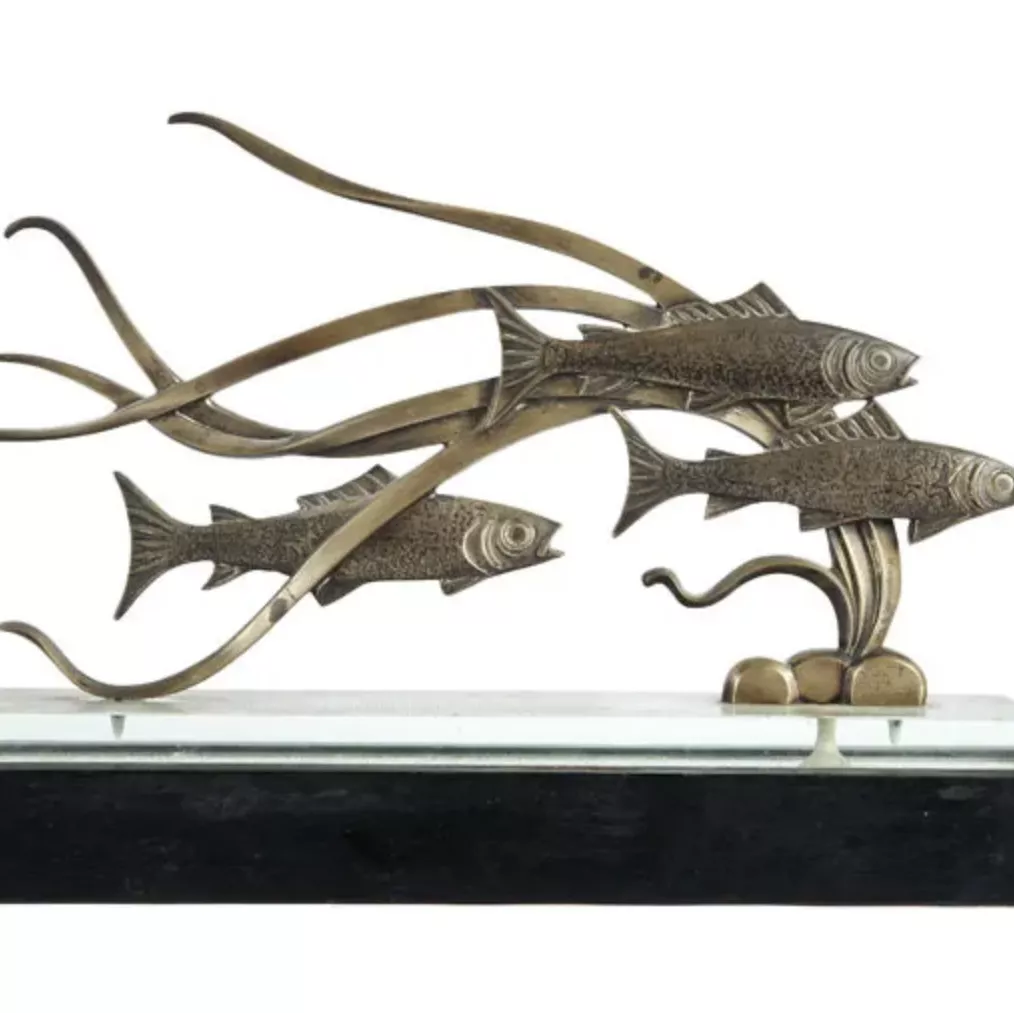
André Vincent Becquerel (1893 - 1981) was a French animal sculptor active in the first half of the 20th century. His aesthetic lies somewhere between Art Deco naturalism and modern stylization. In his work, he sought a balance between observation of reality, taut lines and simplified volumes.
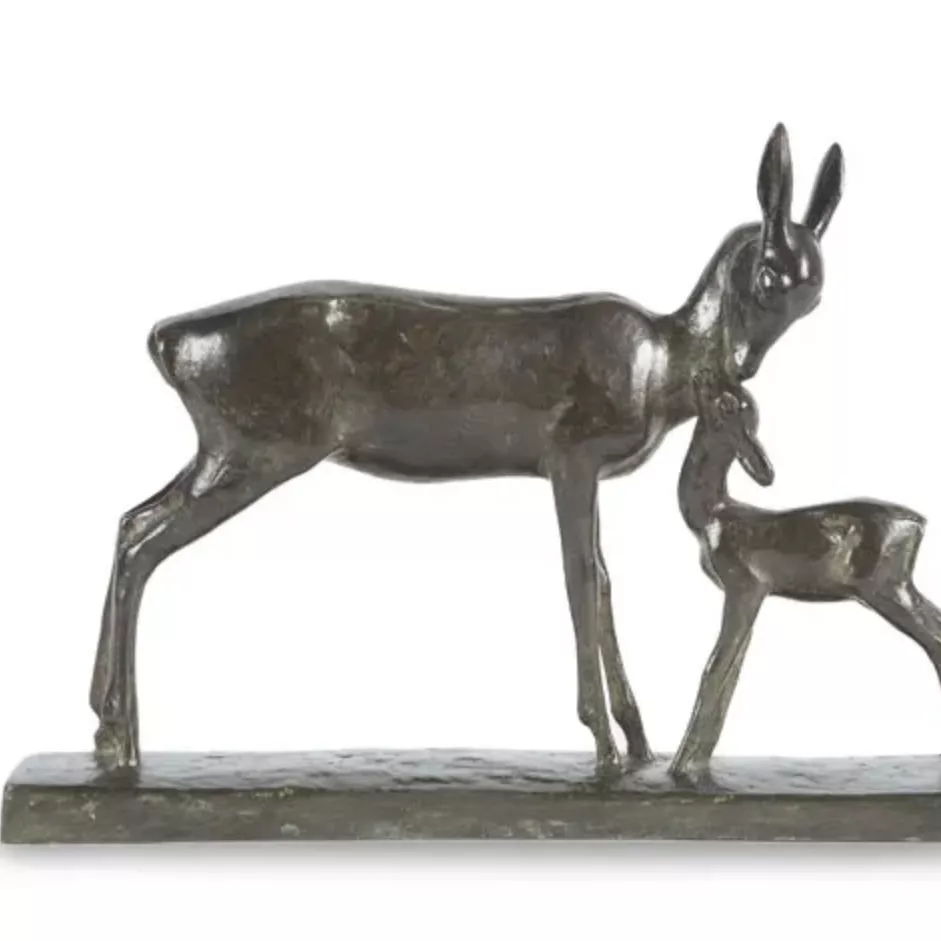
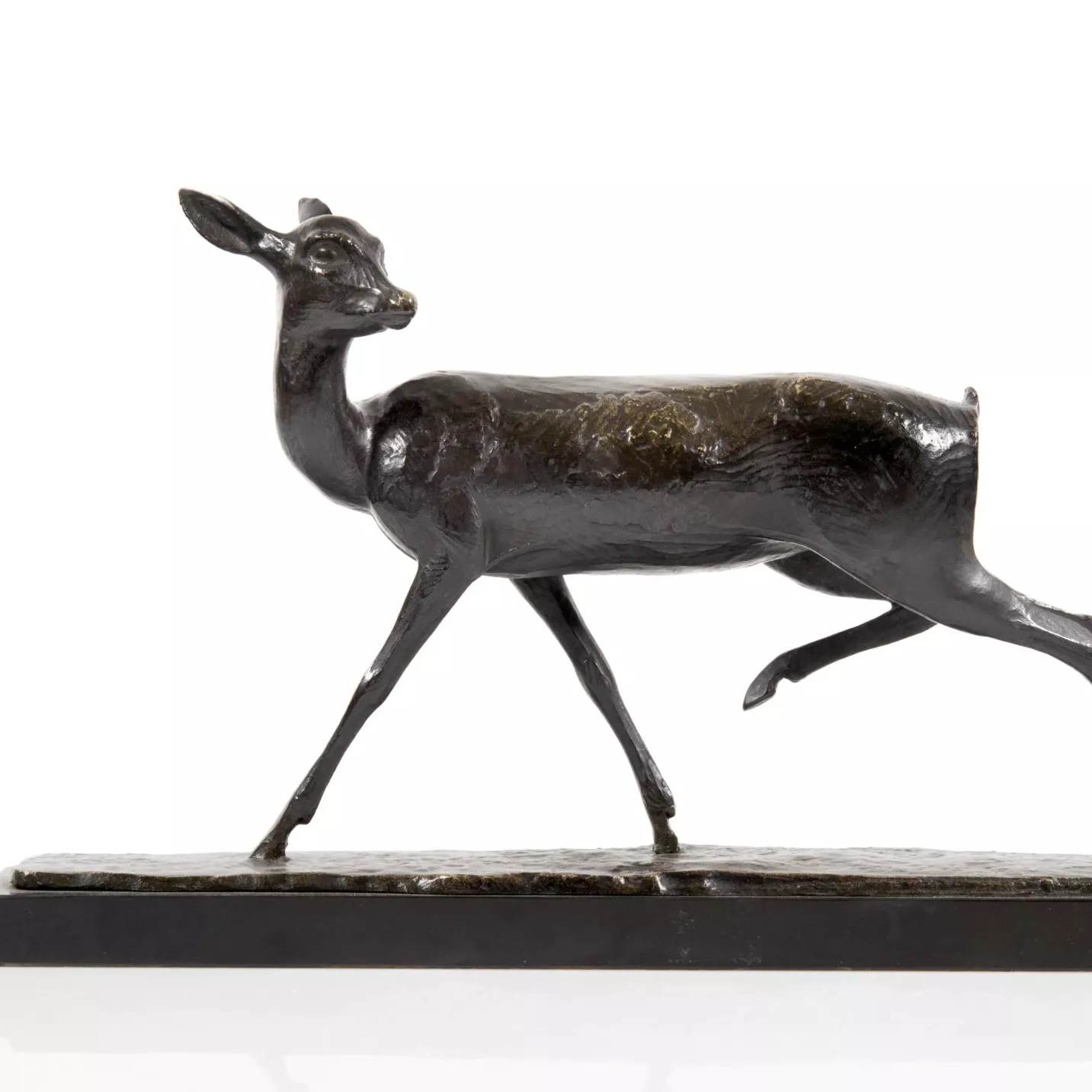
The subjects he favored were felines (panthers, lions), deer, dogs and birds of prey. The attitudes of his subjects are dynamic but controlled, with walking, leaping and restrained running. The silhouettes are contoured and modeled to create an impression of speed or internal tension.
The artist gives great importance to the rhythm of the dorsal lines, continuous curves and elegant diagonals. The anatomy is precise, with a study of muscles, tendons and bony reliefs indicated with sobriety.
Becquerel avoids excessive detail, favoring a fluid reading of the animal body, faithful but stylized. He works with carefully crafted plaster model preparations. His sculptures are cast by renowned Parisian foundries (Susse Frères, Valsuani...)
His works are mostly conceived in medium format, adapted to Art Deco salon sculpture. He works on the compactness of masses with collected bodies, a clear center of gravity and simplified volumes to accentuate muscular tension.
He uses classic Art Deco patinas, with deep browns, red browns or nuanced patinas. The surface is polished or semi-polished, emphasizing the strong lines of the animal body.
Antique prints are clean, precise, with great finesse in sensitive areas (muzzle, paws, ears). Longitudinal compositions predominate, with animals in action aligned on a strong horizontal axis.
André Vincent Becquerel uses few narrative elements, the animals are depicted in formal purity and without decoration. His work is characterized by a controlled elegance, typical of animal Art Deco.
The artist's work makes a decisive contribution to the French tradition of 20th-century animal sculpture, following on from Mène, Pompon and Jouve, but with their own sensibility.
The life of André Vincent Becquerel
André Vincent Becquerel (1893 - 1981) was a French artist born in Paris, in an environment conducive to the applied arts. He trained at the École des Beaux-Arts in Paris, where he studied sculpture in the French naturalist tradition.
He was attracted to zoology and animal drawing from an early age, which he practiced in the zoological gardens of Paris. He began exhibiting at the Salon des Artistes Français in the 1920s, and soon specialized in animal sculpture, a rapidly expanding field in the context of Art Deco modernity.
Public interest grew for his felines and hunting animals, both naturalistic and stylized. He becomes one of the regular representatives of Art Deco animal sculpture alongside Sandoz, Godchaux or Guyot, and receives private commissions for salon sculptures, trophies or pieces of his work in bronze.
He played an active part in the spread of modernized animal language, with streamlined forms, controlled tensions and simplified volumes. In the 1930s - 1950s, he developed the works most representative of his style.
He pursued a search for synthesis between direct zoological observation and Art Deco simplification, and established himself as a sculptor sought after by collectors for the anatomical precision and practical fluidity of his bronzes.
He continued to produce after the Second World War, with an evolution towards a calmer naturalism. His activity is more discreet in the 1960s - 1970s, but his recognition is stable among lovers of Art Deco and classical animal sculpture.
Becquerel is today considered one of the most elegant French animal sculptors of the 20th century, notably for the quality of his bronzes and the balance between realism and stylization.
Market segmentation and the artist's side
Bronzes are at the heart of the market and in the majority, often in medium formats. They are the main vector of value. Studio plaster casts are rare, intended more for specialized collectors, with a lower value.
Monumental pieces are very rare on the market, and generally kept in public collections. Small formats (20 - 30 cm) are the entry-level market with high liquidity. Studio plaster casts are fairly rare, and are more suited to specialized collectors, with a lower value.
For larger formats (over 60 cm), supply is very low and values much higher. The most sought-after subjects are felines (panthers, lionesses), horses, deer and hunting dogs, as well as birds of prey in motion. Dynamic compositions (walking, leaping, tension) are clearly more highly valued than static poses.
Valuation criteria are the signature, the old patina, burne or brown-green, unaltered. They also include stylistic alignment with profiled bodies, smooth modelling and controlled tension to guarantee the desired typicity, as well as provenance, foundry stamp and numbering.
The main market is in France, but there are also works in Belgium, the UK and the USA (secondary but solid markets for animal Art Deco).
Liquidity is good for medium bronzes (feline, stag) and slower for secondary subjects or atypical formats. It is very strong for the stylized pieces emblematic of the 1920s - 1940s.
The artist's quotation is solid and stable, characteristic of recognized Art Deco animal sculptors. The market is sustained by a steady demand for feline bronzes, fairly representative of the aesthetic vocabulary of the 1920s - 1930s.
His positioning is intermediate, an artist more accessible than Pompon or Jouve, but more sought-after than many secondary animal artists.
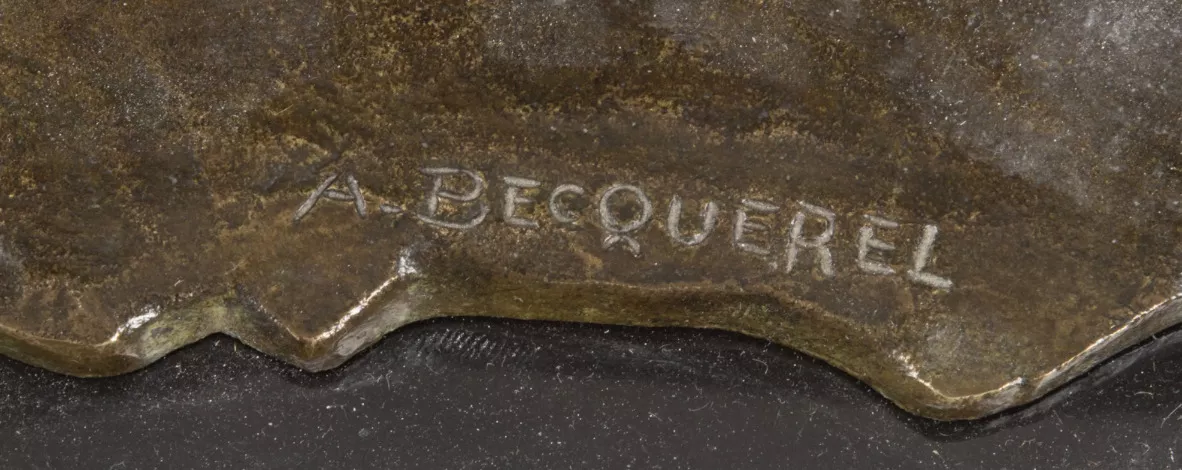
His signature
André Vincent Becquerel usually signs his works. However, it's best to have them appraised if you think you might own some. Here's an example of his signature :
Knowing the value of a work
If you happen to own a work by or after André Vincent Becquerel, don't hesitate to request a free appraisal using our form on our website.
A member of our team of experts and chartered auctioneers will contact you promptly to provide you with an estimate of the market value of your work, as well as ad hoc information about it.
If you are considering selling your work, you will also be accompanied by our specialists in order to benefit from alternatives for selling it at the best possible price, taking into account the inclinations of the market.
.Estimate in less than 24h
Discover in the same theme

Rating and value of works, drawings, paintings by Chu Teh Ch...
Grand master of Chinese art, millionaire auctioneer, major figure of Asian abstract art: Focus on Chu Teh-Chun.
Learn more >

Rating and value of paintings by Jean Roger Sourgen
Jean Roger Sourgen is a twentieth-century impressionist painter from the Landes region who has produced paintings that are highly prized at auction.
Learn more >

Market Value and Price of the Sculptures and Bronzes by Loui...
Louis de Monard is a twentieth-century animal sculptor whose sculptures are highly prized at auction.
Learn more >
D'autres bronzes modernes vendus aux enchères

Estimated Between €2,000 and €4,000
Edouard Marcel SANDOZ (1881-1971) curly stingray, bronze print

Estimated Between €1,500 and €3,000
Renato CARVILLANI (1896-1986), seated woman, gilded bronze print

Estimated Between €1,500 and €3,000
César BALDACCINI dit CESAR (1921-1998), Poule Cartier, bronze print

Estimated Between €10,000 and €20,000
Baltasar LOBO (1910-1993), female nude in bronze

Estimated 5.000 - 8.000
Igor MITORAJ (1944-2014), Bust of Asclepius, Green patina bronze sculpture

Secure site, anonymity preserved

Auctioneer approved by the State

Free and certified estimates
Frequently asked questions
-
Who is André Vincent Becquerel, and what is his artistic background?André Vincent Becquerel (1893–1981) was a leading French animal sculptor of the 20th century, active particularly during the Art Deco period. Trained at the École des Beaux-Arts in Paris, he specialized early on in animal sculpture, particularly felines, horses, and birds of prey. His style lies between naturalism and Art Deco stylization, characterized by streamlined forms, precise anatomy, and controlled tension. He is considered one of the most elegant representatives of French animal sculpture, alongside sculptors such as Pompon and Jouve.
-
What is the price range for Becquerel's sculptures?Becquerel's sculptures range in price from €20 to €26,000, depending on the technique, size, and subject matter. Terracotta pieces range from €20 to €6,000, gilded bronzes from €100 to €8,000, and bronzes from €20 to €26,000. Smaller pieces (20–30 cm) represent the entry-level market, while works larger than 60 cm are very rare and significantly more expensive. The most sought-after subjects (big cats, horses, birds of prey) command higher prices, particularly in medium sizes.
-
How do I have a Becquerel sculpture authenticated and appraised?To authenticate and appraise a work by Becquerel, we recommend that you request a free, no-obligation appraisal using the form on the Auctie's website. A state-certified expert or auctioneer will contact you shortly to examine your piece and provide you with an accurate estimate of its market value. This appraisal is completely free and will allow you to know exactly how much your piece is worth.
-
Is this the right time to sell a sculpture by Becquerel?Yes, now is a good time to sell a sculpture by Becquerel. Prices for this artist’s work have been rising steadily, and his market value is stable, supported by consistent demand for Art Deco animal bronzes. Becquerel’s works enjoy strong liquidity, particularly for medium-sized pieces and iconic subjects (big cats, horses). The primary market is in France, complemented by active secondary markets in Europe and the United States.
-
How does the sale of a work of art work at Auctie's?At Auctie's, the process begins with a free, no-obligation appraisal conducted by our experts and licensed auctioneers. Once the appraisal is complete, our specialists work with you to identify the best sales options to achieve the highest possible price, taking market trends into account. We then guide you through the auction process, handling all administrative and commercial aspects.
