



Rating and value of paintings by Igor Grabar

Key takeaways
- Igor Grabar, a pioneering Russian abstract artist born in 1871, maintains a stable market value, with works fetching several million euros.
- Grabar’s paintings sell for between €140 and €287,300, while his watercolor drawings range from €50 to €4,200 and his prints from €30 to €52,000.
- His oil on canvas "View of the Moscow River" (1922) sold for €287,300 in 2016, reflecting collectors’ growing interest in his works.
If you own a work by or based on the work of artist Igor Grabar and would like to know its value, our state-approved experts and auctioneers will guide you.
Our specialists will carry out a free appraisal of your work, and provide you with an accurate estimate of its value on the current market.
Then, should you wish to sell your work, we will direct you to the best possible arrangement to obtain the optimum price.
Artist's rating and value
A Russian artist and pioneer of abstraction, Igor Grabar established himself as a major artist of his time. He produced works inspired by several twentieth-century currents and his native country, mixing media.
On the art market, his works sell for very good prices and keep a stable quotation.
As such, a work signed by the artist's hand can fetch millions of euros at auction, as evidenced by his oil on canvas View of the Moscow riverdating from 1922, fetched €287,300 in 2016, reflecting the growing interest of collectors in Grabar's works.
Order of value from the most basic to the most prestigious
Technique used | Result |
|---|---|
Drawing - watercolor | From 50 to 4 200€ |
Estamp - multiple | From €30 to €52,000 |
Painting | From €140 to €287,300 |
Estimate in less than 24h
The artist's works and style
Igor Grabar, born in 1871, evolved at a time when landscape painting in Russia was still seeking its own language. Very early on, he managed to break away from the dogmas imposed by the Academy of Fine Arts to assert a personal style that would flourish particularly in the first decades of the 20th century.
Grabar doesn't just paint landscapes: he makes them sensitive. The real, in his works, becomes a kind of pretext for exploring light and its play on natural elements.
Like the French Impressionists who inspired him, he breaks light down into distinct touches, using nuances and contrasts that give his canvases an almost palpable texture.
But unlike the latter, Grabar anchors his art in a deeper, more narrative realism, seeking to render the Russian soul through his landscapes.
His heavy skies, infinite expanses or the banks of the Volga are all symbols of the national character, of this nature that seems both infinite and intimate, of an icy yet luminous beauty, often imbued with a sense of solitude.
His technique, always on the border between impressionism and realism, uses broad brushstrokes and vibrant colors, but Grabar goes further by accentuating the immersive effect. He gives each scene an almost tactile dimension, where the material seems to melt into the atmosphere itself.
His canvases are not mere views; they breathe, they vibrate. The landscape becomes an extension of light, air and space, in an almost abstract way of capturing the soul of the place.
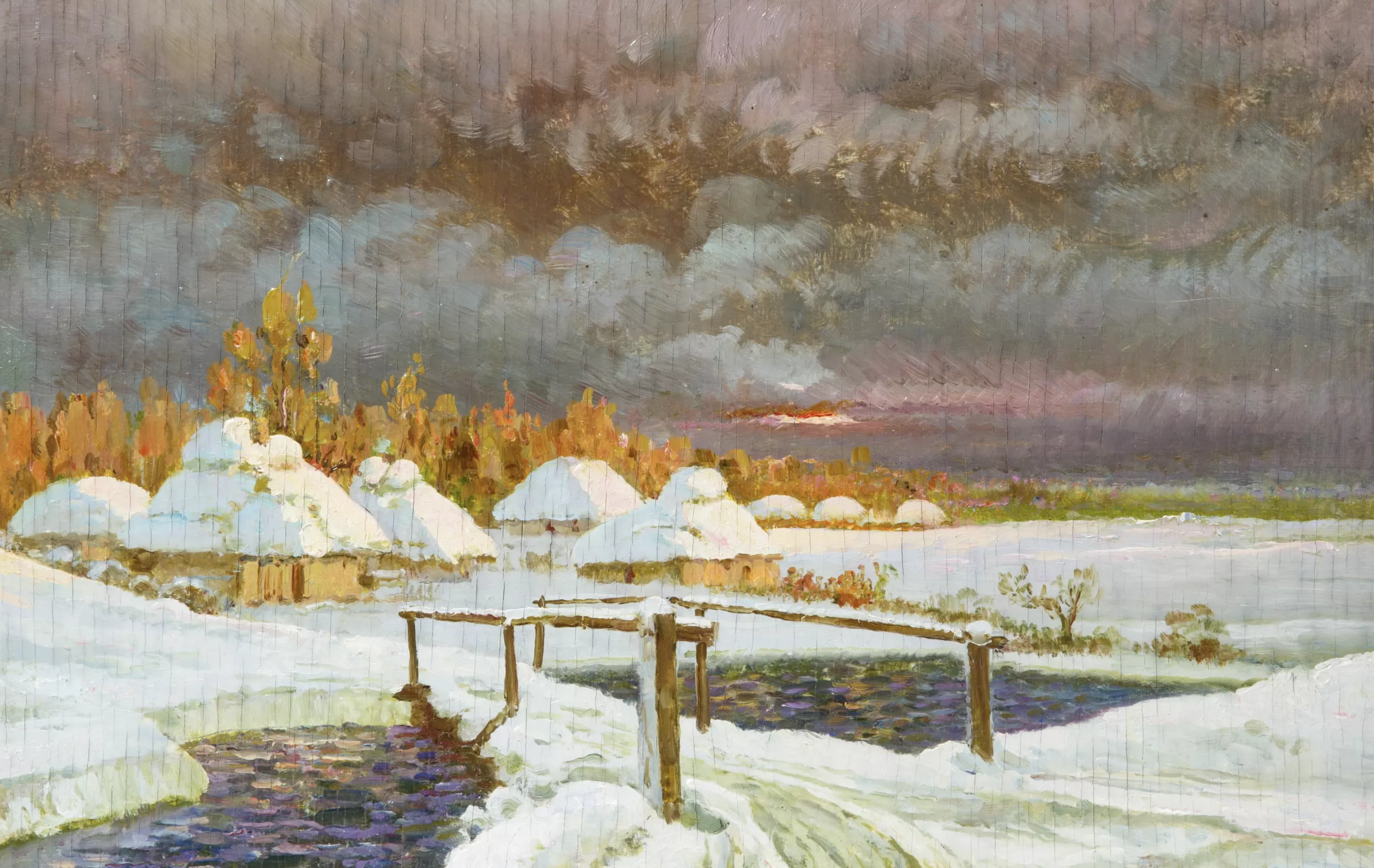
In his depictions of the Russian winter, as in his famous views of the Volga, snow, wind and the light that freezes in the air do not appear as external elements, but as living, dynamic actors that alter the viewer's perception.
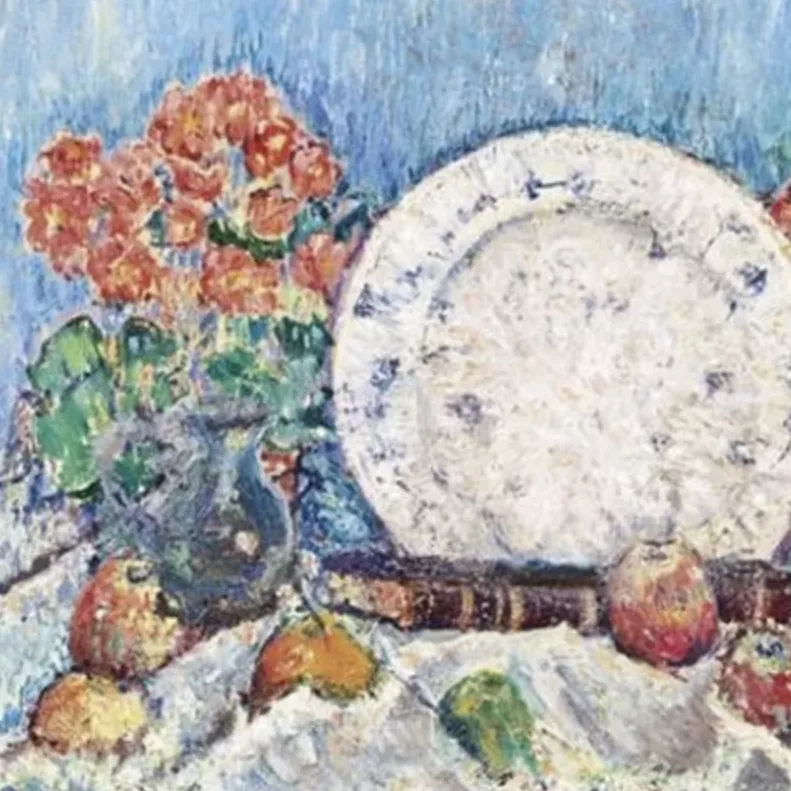
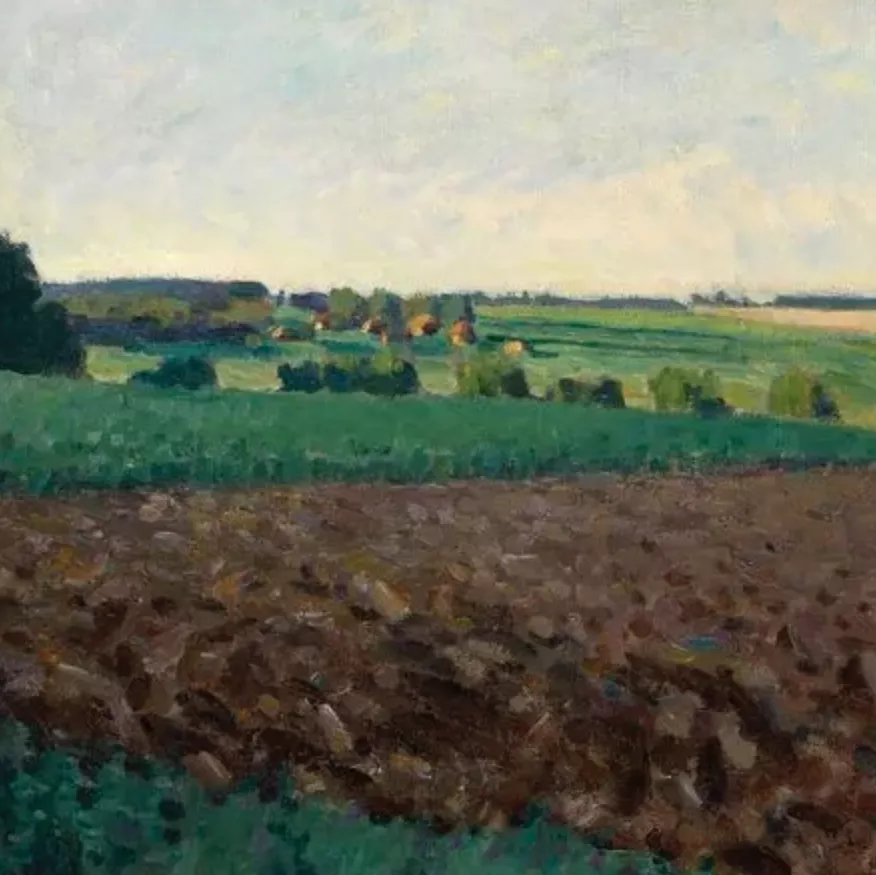
The diversity of the landscapes he paints - from riverbanks to snow-covered expanses - shows his ability to capture unique atmospheres, imbued with solitude and grandeur. His winter landscapes, where cold and light merge, show an eternal, mysterious, almost magical Russia.
Each canvas is an invitation to lose oneself in this immensity that seems to engulf man while leaving him space for contemplation. Light, omnipresent in his works, seems to be the true protagonist of his landscapes.
It is by turns soft and radiant or dark and ethereal, casting shadows that do not weigh down the scene but lend it a mysterious depth.
Grabar makes this light a real character, an invisible link between man and nature, a link that goes beyond the simple representation of reality to verge on the intimate, the purely emotional.
The composition of Grabar's works
But beyond the light, it's the composition of his works that captivates the eye. Space never stands still; it seems to move under the effect of his brushstrokes, as if nature were in perpetual motion.
Each landscape seems suspended between two worlds: that of reality and that of sensation. His winter scenes are not picturesque clichés, nor do they seek to move us with their dazzling beauty.
They plunge us into a harsher, yet poignant reality, that of a space where man and nature are never separated, but where the fragility of human existence is measured against the immensity and strength of nature.
In his landscapes, Grabar succeeds in this tour de force of making visible what often escapes the human eye: the emotional intensity of a landscape, its evocative power, its ability to touch the soul.
In this way, Grabar transforms each landscape into a meditation on Russian nature, its strengths and weaknesses. His canvases, far from being content with mere realistic observation, reflect a deep sense of belonging to a unique space, a space that goes beyond the visible to touch the intangible.
In this, he plays a fundamental role in the evolution of Russian painting, redefining landscape not as a static genre but as a meeting place between man and nature, a place where every element seems charged with meaning and emotion.
The life of Igor Grabar
Born in 1871 in Petersburg, Igor Grabar trained at the Academy of Fine Arts, but quickly distinguished himself from his contemporaries. From his earliest works, light and color seem to be the true subjects of his painting.
Paradoxically, it is in this quest for reality, through the exploration of the effects of light on landscape, that he moves away from classical representation.
His canvases become a subtle interplay of light and shadow, vivid strokes that flirt with the impressionist touch, while remaining faithful to the richness of Russian space.
These early works, which seem to play with shapes, the very texture of paint, are a "perversion" of the traditional landscape, in which the often imprecise contour line dissolves into a variety of nuances.
Like a reinterpretation of light itself, his landscapes become abstractions of nature, where the atmosphere seems to play more than the subject.
In the period following the October Revolution, far from allowing himself to be overshadowed by the political transformations, Grabar would choose to become a curator of the national heritage, while pursuing his painting.
While the country was being torn apart, his work tightened around a more intimate, personal vision of landscape.
Paradoxically, his painting became more fixed, as if to counter the speed of History. The Russian landscape, in its changing light and reflections, seems to freeze in a suspended moment, where every gesture on the canvas becomes testimony to a world that is unravelling, while seeking to capture its essence.
Grabar, as a master of light, captures through his work a Russia that is fading under the layers of time and history, but of which he remains the last witness.
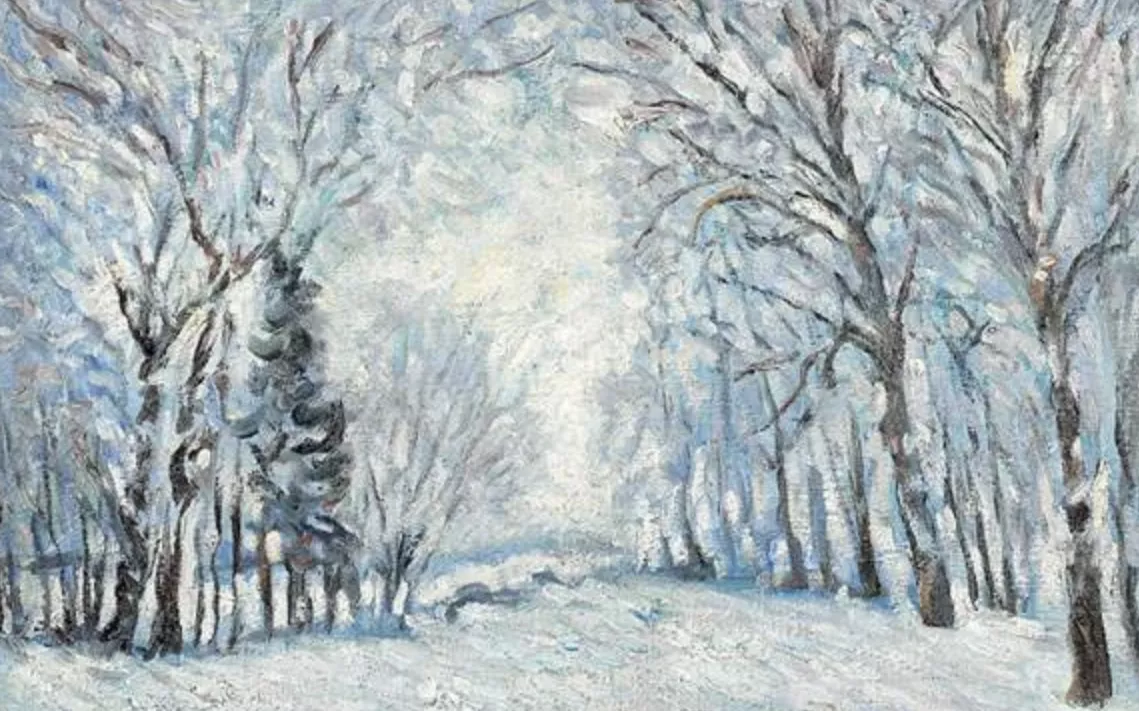
Focus on Spring, Igor Grabar, 1905
The "dissolution" of shapes and contours is reinforced in Spring (1905). Here, nature itself seems to fragment and recompose itself under the effect of light. The subject of the canvas is no longer the figure or object, but the space they occupy, the unfolding light.
Trees, flowers, and sky merge in a waltz of colors that no longer fix, but vibrate, oscillating between frenetic strokes of green and yellow.
The once-defined contours fade, crumble and disappear, giving way to a painting of light and atmosphere, where density and lightness meet and intersect. Light and shadow, dense zones and airy passages no longer simply draw space, they redefine its very dimensions.
In this play of contrasts, form blossoms in evanescence and dilutes in omnipresent light. The landscape thus becomes moving matter, where the brushstroke, increasingly effaced, seems to dissolve in the air.
This is where Grabar, through his impressionist technique, abandons rigid contours and favors an almost organic vibration that frees itself from any pre-existing form.
The canvas seems to react to light, as if the elements of nature were a single entity, dynamic and fluid, escaping gravity, the immobility of forms.
And yet, everything here is painting: in this fluidity, matter asserts itself all the more, unfurls into spaces that seem inaccessible to the illusion of a fixed representation.
Stylistically, he is close to other Russian artists such as Mikhail Guermacheff, Constantin Westchiloff and Constantin Korovine.
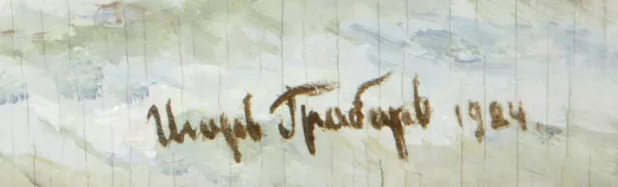
His signature
Not all of Igor Grabar's works are signed.
Although there are variations, here is a first example of his signature:
Expertise your property
If you own a work by Igor Grabar, don't hesitate to request a free appraisal by filling in our online form.
A member of our team of experts and certified auctioneers will contact you to provide an estimate of the market value of your work.
If you are considering selling your work, our specialists will also guide you through the various alternatives available to obtain the best possible price, taking into account market trends and the specific features of each work.
Estimate in less than 24h
Discover in the same theme

Value and quotation of vases, pâte de verre creations by Emi...
Gallé, a 20th-century glassmaker and ceramist, produced a number of series in pâte de verre. They are valuable, sought-after and quoted.
Learn more >

Rating and value of paintings by Louis Icart
Louis Icart is an Art Deco painter who produced works that are listed and valued on the auction market. Estimated in 24h.
Learn more >

Rating and value of works, sculptures, bronzes by Chana Orlo...
Chana Orloff is a Ukrainian artist of the Paris School who has produced works that are highly rated and valued on the art market.
Learn more >
D'autres tableaux modernes russes vendus aux enchères

Estimated Between €800 and €1,500
Alexandre ROUBTZOFF (1884-1949), View of Notre Dame de Paris, oil on canvas

Estimated 2.000 - 4.000
Serge POLIAKOFF (1900-1969), Composition en rouge et bleu. 1965, Lithograph

Estimated 8.000 - 12.000
Robert Rafaïlovitch FALK (Moscow, 1886-1958) View of Paris at night.

Estimated 40.000 - 80.000
Alexandre ROUBTZOFF (1884-1949), Portrait of Arbia, oil on canvas

Estimated 20.000 - 30.000
Alexandre ROUBTZOFF (1884-1949), Portrait of Marie-Madeleine Leroy, oil on canvas

Estimated 3.000 - 5.000
Georges LAPCHINE (1885-1951) The port of St Tropez Oil on canvas

Secure site, anonymity preserved

Auctioneer approved by the State

Free and certified estimates
Frequently asked questions
-
Who is Igor Grabar, and what is his artistic background?Igor Grabar (1871–1950) was a Russian artist who pioneered abstraction and was a major figure in 20th-century Russian painting. Trained at the St. Petersburg Academy of Fine Arts, he distinguished himself by combining Impressionist influences with an intimate exploration of light in Russian landscapes, particularly winter scenes and the banks of the Volga. After the October Revolution, he continued to paint while serving as a curator of national heritage, redefining the landscape as a meeting place between humanity and nature.
-
What is the price range for Igor Grabar's works at auction?Prices vary considerably depending on the medium and the period. Drawings and watercolors range from €50 to €4,200, prints from €30 to €52,000, and paintings from €140 to €287,300. For example, his oil on canvas “View of the Moscow River” (1922) sold for €287,300 in 2016, reflecting collectors’ growing interest in his works.
-
How can you authenticate and appraise a work by Igor Grabar?To authenticate and appraise a work by Grabar, we recommend that you request a free appraisal from Auctie's. Fill out our online form, and a state-certified expert or auctioneer will contact you to provide an accurate estimate of your work’s market value, with no obligation.
-
Is this the right time to sell a work by Igor Grabar?Yes, now is a good time to sell a work by Grabar. The art market is showing growing interest in this major Russian artist; his works maintain stable values and are selling for very good prices at auction. Our specialists can guide you toward the best sales strategy based on current market trends.
-
How does the sales process work at Auctie's?The process begins with a free, no-obligation appraisal of your artwork by our experts and certified auctioneers. Once the appraisal is provided, our specialists will guide you toward the optimal sales approach to achieve the best possible price, taking into account the specific characteristics of your artwork and current market trends.
