



Rating and value of watercolors, drawings and paintings by Le Pho

Key takeaways
- Le Pho’s works sell for between €50 and €1,753,355 at auction, with an oil on canvas selling for €1,749,280 in 2022.
- Paintings on silk from the Indochinese period (1930–1945) fetch between €400,000 and €2 million, commanding higher prices than his later works.
- Depictions of motherhood, female figures, and floral compositions are in the highest demand, with sustained growth since 2015 in the international Asian market.
If you own a work by Le Pho or after the artist, and would like to know its value, our state-approved experts and auctioneers will offer you their appraisal services.
Our specialists will carry out a free appraisal of your work, and will provide you with an accurate estimate of its value on the current market.
Then, if you wish to sell your work, we will direct you to the best possible arrangement to obtain the optimum price.
Rating and value of the artist Le Pho
The artist Le Pho leaves behind a distinctive body of work, composed mainly of drawings and paintings. He is French-Vietnamese. Now, prices for his works are rising under auctioneers' gavels.
The price at which they sell on the art market ranges from €50 to €1,749,280, a significant gap but one that speaks volumes about the value that can be attributed to Le Pho's works. He is especially prized by buyers from Hong Kong, Vietnam and France.
In 2022, an oil on canvas entitled Figure in a Garden sold for €1,749,280, while it was estimated at between €241,280 and €361,920. Its value has exploded in recent years.
Order of value from a simple work to the most prestigious
Technique used | Result |
|---|---|
Estamp - multiple | From €50 to €7,730 |
Drawing - watercolor | From 270 to 1 735 335€ |
Oil on canvas | From 220 to 1 749 280€ |
Estimate in less than 24h
Style and technique by artist Le Pho
At Le Pho, painting becomes a space for reconciling Vietnamese tradition and Western influences, where soft lines unite with vaporous matter.
While his early works follow in the footsteps of Asian painted scrolls, with precise drawing and colors delicately laid on silk, his style evolves towards a freer approach, influenced by Impressionism and French decorative art.
Here, light not only sculpts shapes, it brushes against them, playing on transparencies and superimposed glazes that lend figures an ethereal presence.
Color, often reduced to pastel harmonies, is never plastered over but diffuses an impression of softness, enveloping the scene in an atmosphere of reverie.
In this balance between refinement and fluidity, Le Pho develops a painting where Asian memory intertwines with a Western sensibility, making each composition a suspended evocation between the real and the imaginary.
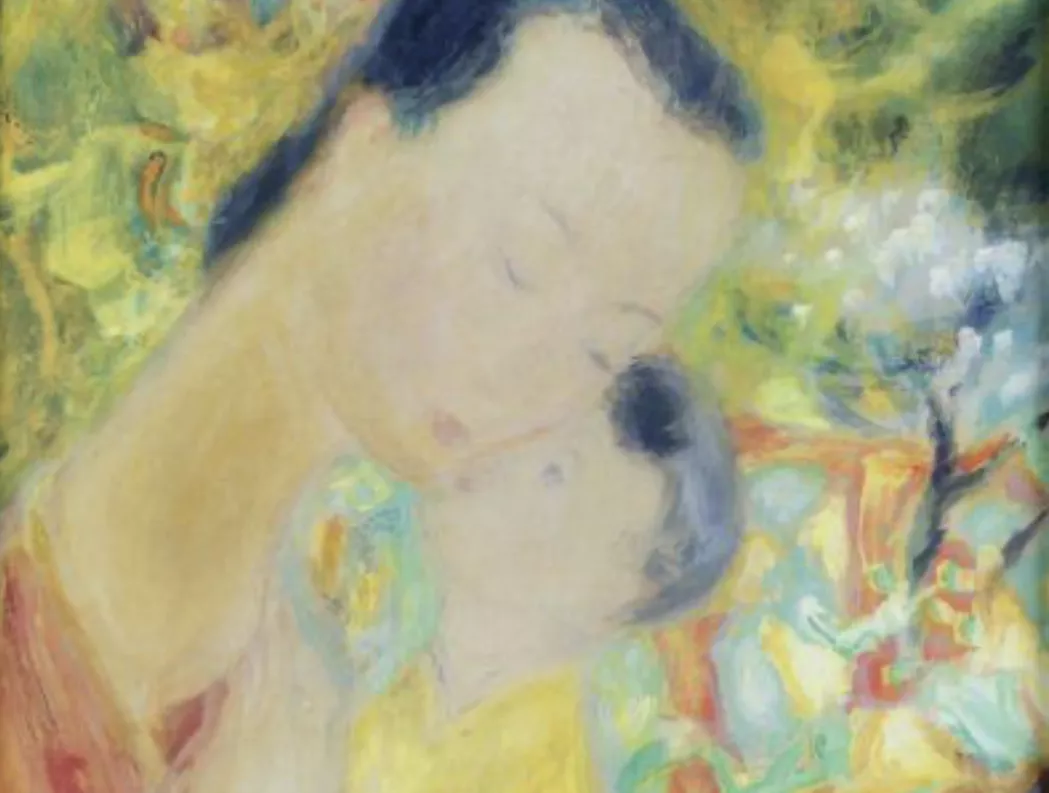
Le Pho's life
Le Pho is a Vietnamese painter born in 1907 into a family of mandarins, he is the son of the last viceroy of Tonkin. He grew up in northern Vietnam and, like Cao Dam Vu, studied at the Indochina School of Fine Arts in Hanoi. His teacher, like many other painters of his generation in Vietnam, was Victor Tardieu. He also studied with Joseph Inguimberty.
During a trip to Europe, he was fascinated by religious art and Renaissance paintings, which he studied in Italy, France and Belgium.
Returning to Vietnam in 1933, he carried out commissions for Emperor Bao Dai. In 1937, he directed the Indochinese section of the Exposition Internationale.
His son, Pierre Le Lan, was also a painter and draughtsman.
Le Pho died in 2001 in Paris, aged 94.
Focus on Women in the Garden, Le Pho
In Women in the Garden, Le Pho transposes onto silk an idealized vision of the world where nature and the female figure merge in delicate harmony.
While the artist draws on the Vietnamese pictorial tradition, this work bears witness to his assimilation of Impressionist principles: here, light is not a simple element of enhancement, but a vector of emotion that envelops the scene in a diaphanous veil.
The supple composition plays on undulating lines that guide the eye smoothly, while the pictorial material, worked in successive glazes, accentuates the effect of depth and transparency.
Instead of the rigor of the drawing, a more intuitive approach is adopted, where color, in its subtle modulations, infuses the image with a feeling of suspended tranquillity.
In this balance between tradition and modernity, Women in the Garden illustrates the quest for a pictorial language in which Asian memory dialogues with Western sensibility, in a synthesis imbued with refinement and poetry.
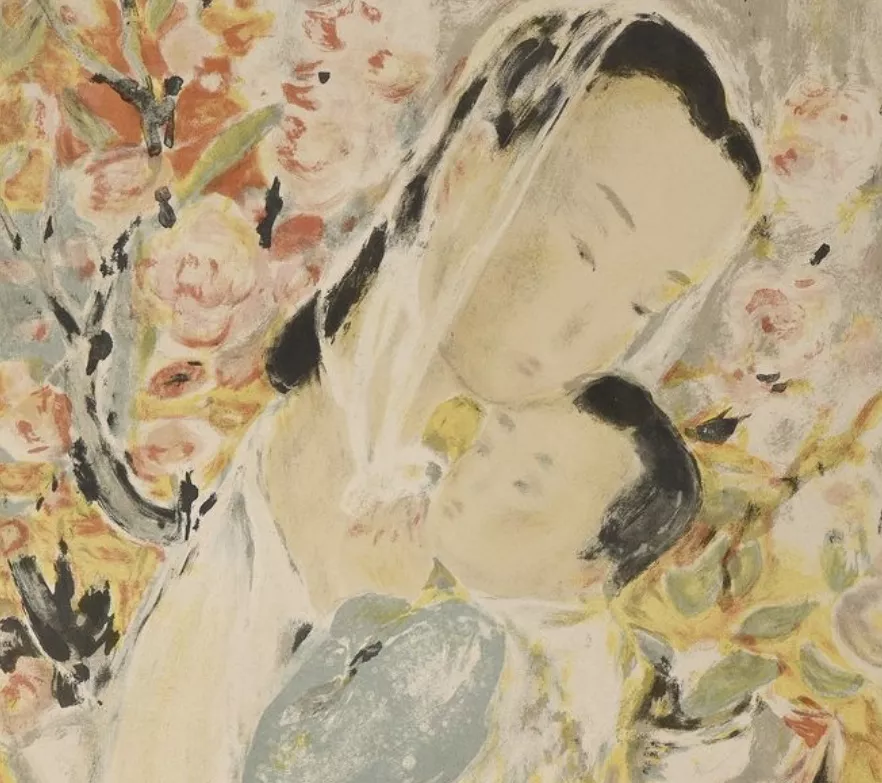
Le Pho's stylistic influences
In his works, Le Pho weaves a subtle relationship between traditional Vietnamese iconography and the Western stylistic influences he encountered during his stay in France.
If, in his early compositions, the artist immersed himself in the techniques of the Hanoi School of Fine Arts, he was soon influenced by Fauvism and Impressionism, particularly by the way these movements exploited color to express emotions rather than simply imitate nature.
The influence of decorative art, too, is felt in the elegance of its lines and the search for simplified forms, close to art nouveau.
However, it is in his encounter with the French masters of figurative painting that Le Pho finds a new dimension: the light, fluid atmosphere, the use of glazes and the transparency of color testify to an assimilation of Impressionist processes, while retaining a touch of Asian poetry.
This hybridization enables the artist to create a singular universe, where each work becomes the reflection of an ongoing dialogue between two cultures.
Today, the artist stands out on the international auction scene and his works have reached record amounts in recent years, such as those by Vu Cao Dam, Nam Son Nguyen and Thuong Lan Nguyen.
Le Pho's legacy on his period
In his works from the 1940s-1950s, Le Pho managed to synthesize the classical and modern influences he had received along the way, while anchoring his work in a search for cultural identity.
Far from confining himself to a simple revival of Vietnamese traditions, the artist redefines the visual language by creating compositions where the softness of the curves and the light of the backgrounds evoke the serenity of Asian landscapes while borrowing from the West the idea of a soothed abstraction.
His mastery of the portrait, the nude and the landscape, treated with great finesse, becomes the foundation of his legacy: an exploration of line and color where each form seeks to express a universal harmony.
Le Pho's legacy thus lies in this ability to combine, without hierarchy, Western and Asian art, in the search for an aesthetic specific to his own vision of the world.
Through his technique, marked by glazes and subtle colors, the artist profoundly influenced subsequent generations of Asian artists, while contributing to the development of a figurative abstraction at the crossroads of traditions.
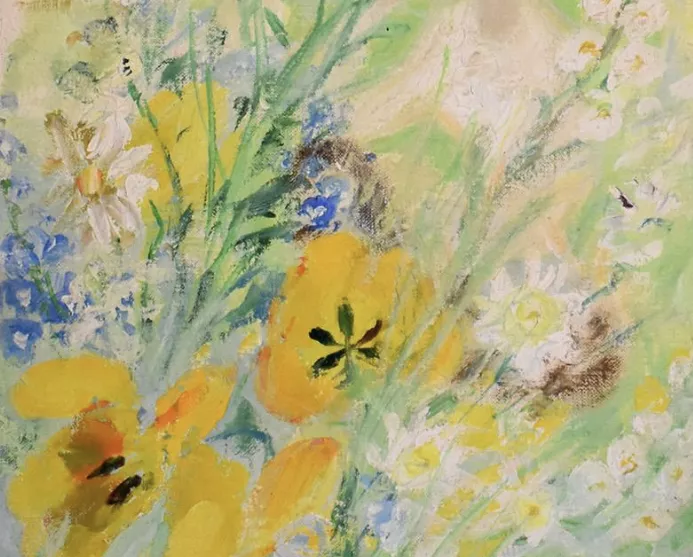
Le Pho's posterity
In 2023, the retrospective devoted to Le Pho at the Musée Guimet revisited a fundamental aspect of his work, that of the relationship between form and material.
His early works, executed on silk, reveal a measured use of line and glaze, drawing inspiration from both traditional Sino-Vietnamese painting and the rigor of the Japanese schools.
The surface of the canvas, then the very texture of the silk, were then so many substrates where light and color mingled in a subtle dance of reflections and transparencies.
The execution remained marked by an impression of fluidity, a restrained sensuality that had its origins in the ancient practices of Southeast Asia.
In 1962, the exhibition devoted to him at the São Paulo Biennale marked a turning point in his work. There, Le Pho confronts his pictorial vocabulary with the West, modifying the geometry of his compositions, but never abandoning this tactile search for the surface, which becomes both form and substance.
At this point, it is clear that his evolution towards abstraction does not follow a purely optical logic, but rather an intimate understanding of texture and material.
The works of this period, sometimes close to the experiments of Art Informel, transform the "pictorial fact" into a living, vibrant material, nourished by the experience of an increasingly dematerialized world.
There, in an almost kinetic dynamic, the canvas becomes charged with vibrations, superimpositions that seem to destabilize space.
In this approach, the very notion of outline almost completely disappears, giving way to an ensemble where light and matter, all at once, take shape in the unity of a continuous fabric.
The duality of figure and ground, so important at the start of his career, dissolves to make way for a new conception, where the surface itself becomes the subject.
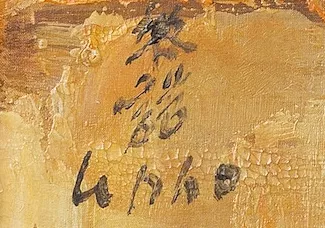
Recognizing the artist's signature
The Pho signs his works most of the time, in French and Chinese, and marks his watercolors with a seal. However, it is essential to have your work appraised to be sure of its originality. What's more ; there are naturally many copies.
Knowing the value of a work
If you happen to own a work by or after Le Pho, don't hesitate to request a free appraisal using our form on our website.
A member of our team of experts and certified auctioneers will contact you promptly to provide you with an estimate of the market value of your work, not forgetting to send you ad hoc information about it.
If you wish to sell your work, you will also be accompanied by our specialists in order to benefit from alternatives for selling it at the best possible price, taking into account market inclinations.
Estimate in less than 24h
Discover in the same theme

Rating and value of paintings by Constantin Terechkovitch
Terechkovitch is a Russian Expressionist painter who has produced works that are quoted and valued on the auction market.
Learn more >

Rating and value of paintings by Georges Valmier
Georges Valmier was a cubist painter who lived through several currents of modern art. His works are of great value today.
Learn more >

Rating and value of drawings and paintings by Tran Van Can
Tran Van Can is a painter of Vietnamese realism who has produced paintings and ink drawings whose value is high at auction.
Learn more >
Works from the same period sold at auction

Estimated 3 000 - 5 000
Gaston SUISSE (1896-1988), Engraved polychrome lacquer panel on tortoiseshell lacquer background.

Estimated 4.000 - 6.000 €
EUGÈNE LEROY (1910-2000), Maison dans un sous bois, oil on canvas mounted on panel.

Estimated 15.000 - 20.000 €
Jacques MAJORELLE (1886-1962) - Fishermen embarking, Abidjan, Ivory Coast - Oil on canvas.

Estimated 1000 - 2000 €
NGUYEN TUONG LAN (1906-1947) - Ink and gouache painting on silk depicting a temple.

Estimated 12.000 - 15.000
Nguyễn Tường Lân (1906-1946), (Workshop of) Tuong Lan NGUYEN "Hiện vẻ hoa - Showing the flowers" Ink and colors on silk, mounted on paper.

Secure site, anonymity preserved

Auctioneer approved by the State

Free and certified estimates
Frequently asked questions
-
Who is Le Pho, and what is his significance in art history?Le Pho (1907–2011) was a leading painter of the first generation of Vietnamese modernism, trained at the Indochinese School of Fine Arts in the 1920s. He settled in France in the late 1930s and developed a unique synthesis of Western academic art and the Vietnamese pictorial tradition, notably through his pioneering use of silk as a modern painting medium. His work, characterized by slender female figures and refined floral compositions, contributed to the internationalization of modern Asian painting in the 20th century.
-
What is the price range for Le Pho's works at auction?Le Pho’s works sell for between €50 and €1,753,355, depending on the type and period. Silk paintings from his Indochinese period generally fetch between €400,000 and €2 million, while oil paintings on canvas range from €300,000 to €1.5 million. Drawings and gouaches form a mid-range market, fluctuating between €10,000 and €80,000. Works from the 1930s–1945 and those featuring maternity themes or floral compositions command a significant premium.
-
How can you authenticate a work by Le Pho?To authenticate a work by Le Pho, it is essential to have it appraised by qualified professionals. Auctie's offers a free, no-obligation appraisal conducted by its state-certified auctioneers, who assess authenticity by examining the signature, technique, period of creation, and comparative market data. Our expert assessment will be sent to you within 48 hours.
-
Is this the right time to sell a work by Le Pho?Yes, now is a good time to sell a work by Le Pho. The market for modern Vietnamese painting has been growing steadily since the 2000s, with growth accelerating after 2015, driven by the internationalization of the Asian art market and the growing recognition of the Indochinese School of Fine Arts in museum collections. International demand remains strong, particularly among collectors in Hong Kong, Vietnam, and France.
-
How does the appraisal process work at Auctie's?Appraisals at Auctie's are free and non-binding. Simply submit your request via our online form, providing photos and information about the artwork. Our experts and certified auctioneers will conduct a thorough analysis and provide you with a reliable estimate of the market value within 48 hours. If you decide to sell, we’ll guide you through the process from the appraisal to the auction to ensure you get the best possible price.
