



Paintings Vu Cao Dam - Value, price, artist

Key takeaways
- Cao Dam Vu's works sell for between €100 and €690,340, with prices rising significantly in recent years.
- A Franco-Vietnamese artist (1908–2000) trained at the École des Beaux-Arts d’Indochine, he blended Vietnamese tradition with Western influences through silk painting.
- Watercolor drawings command the highest prices (up to €690,340), while multiple prints are the most affordable (€100 to €6,500).
If you own a work by Cao Dam Vu or after the artist, and would like to know its value, our state-approved experts and auctioneers will offer you their appraisal services.
Our specialists will carry out a free appraisal of your work, and provide you with a precise estimate of its value on the current market.
Then, if you wish to sell your work, we will direct you to the best possible arrangement to obtain the optimum price.
Rating and value of the artist Cao Dam Vu
The artist Cao Dam Vu leaves behind a distinctive body of work, composed mainly of drawings and sculptures. He is French-Vietnamese.
Now, prices for his works are rising under the auctioneers' gavels. The price at which they sell on the art market ranges from €100 to €690,340, a significant gap but one that speaks volumes about the value that can be attributed to Cao Dam Vu's works.
He is especially prized by buyers from Hong Kong, Vietnam and France.
In 2019, a terracotta statue of a kneeling woman sold for €204,750, while it was estimated at between €29,550 and €40,920. Its value has exploded in recent years.
Order of value from a simple work to the most prestigious
Technique used | Result |
|---|---|
Estamp - multiple | From €100 to €6,500 |
Sculpture - volume | From €1,100 to €204,570 |
Oil on canvas or panel | From €140 to €261,760 |
Drawing - watercolor | From €1,070 to €690,340 |
Estimate in less than 24h
Style and technique of artist Cao Dam Vu
Cao Dam Vu, an emblematic figure of Vietnamese painting in the XXᵉ century, has distinguished himself with a style that skilfully combines tradition and modernity, making him a bridge between his country's cultural heritage and Western artistic currents.
Trained at the Indochina School of Fine Arts, he brilliantly masters the classical techniques of silk painting, a medium he reinvents with a deeply personal sensibility and vision.
His compositions, often imbued with poetry, are characterized by delicate lines, pastel shades and meticulous attention to detail, which infuse his works with an atmosphere of serenity and contemplation.
The precision of his strokes, combined with a touch of chromatic boldness, reflects a deep attachment to Vietnamese culture, while incorporating Western influences perceptible in the balance of forms, subtle perspective and structuring of space.
His works explore with finesse timeless themes such as rural life, family scenes and landscapes, sublimated by a soft, enveloping light that lends them an almost dreamlike dimension.
Enriching the Vietnamese pictorial tradition with innovative processes, Cao Dam Vu has pushed back the boundaries of the medium, transforming each canvas into a celebration of harmony and delicacy.
Through this unique approach, he has established himself as a major figure of Indochinese art, whose legacy continues to inspire artists and art lovers around the world.
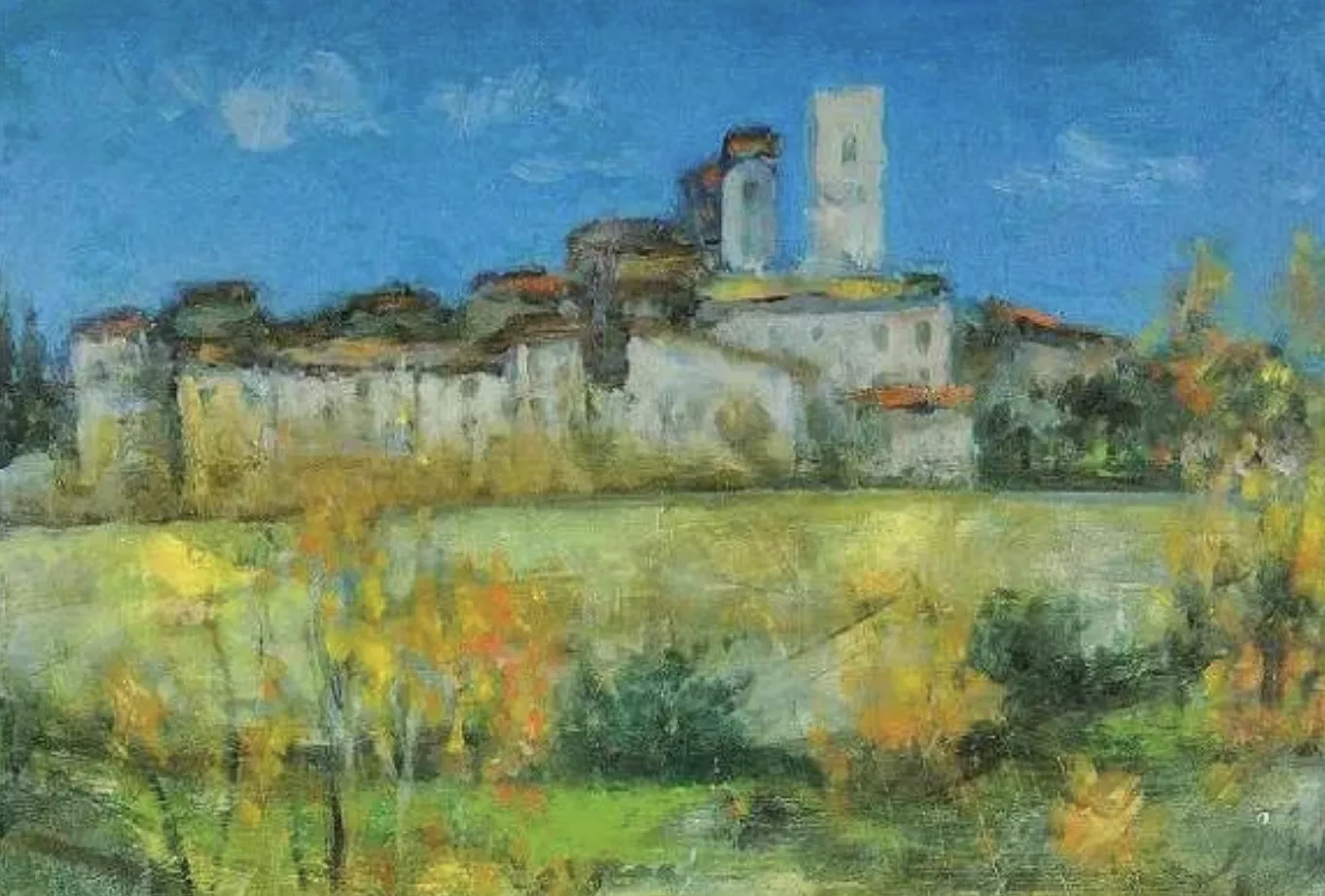
The life of Cao Dam Vu
Cao Dam Vu was born in 1908 in Hanoi, into a Catholic Vietnamese family of 14 children.
His father mastered Chinese calligraphy but studied Latin and French, among other languages, which led to him being sent to Paris by the Vietnamese Government for the 1889 Universal Exhibition.
In this prolific family context to a first-rate artistic education, Cao Dam Vu studied at the Hanoi School of Fine Arts, where he was encouraged by Victor Tardieu, co-founder of the school.
He was one of the first students to join the sculpture department, where he began sculpting in terracotta and bronze.
In 1931, he received a scholarship to continue his studies in Paris, and took part in that year's Colonial Exhibition at the Porte Dorée. He also exhibited some of his work at the Maison d'Indochine, and discussed his production with Rodin and Giacometti.
He studied the classics of Western painting from Rembrandt to Matisse, which influenced some of his output. He marries pianist Renée Appriou, whom he meets in Paris; they have two children.
During Ho Chi Minh's visit to Paris, he asks to meet him so that he can create his bronze portrait. At the same time, he also produced a few silk paintings.
Due to health problems, he moved to the south of France, where he met Chagall and Matisse. He ended his career in Saint Paul de Vence, where he produced prints of his lithographs. He died there in 2000.
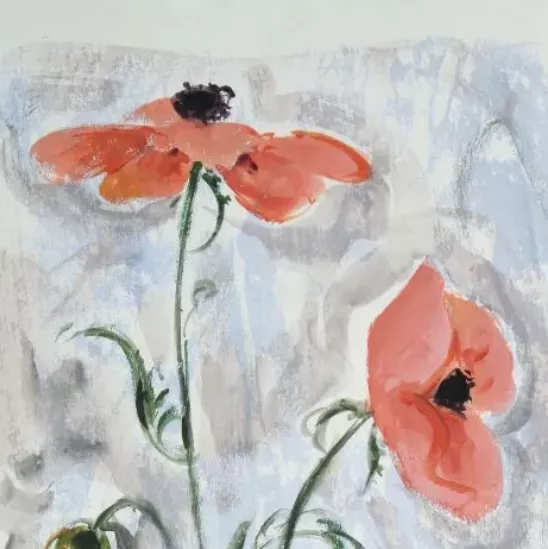
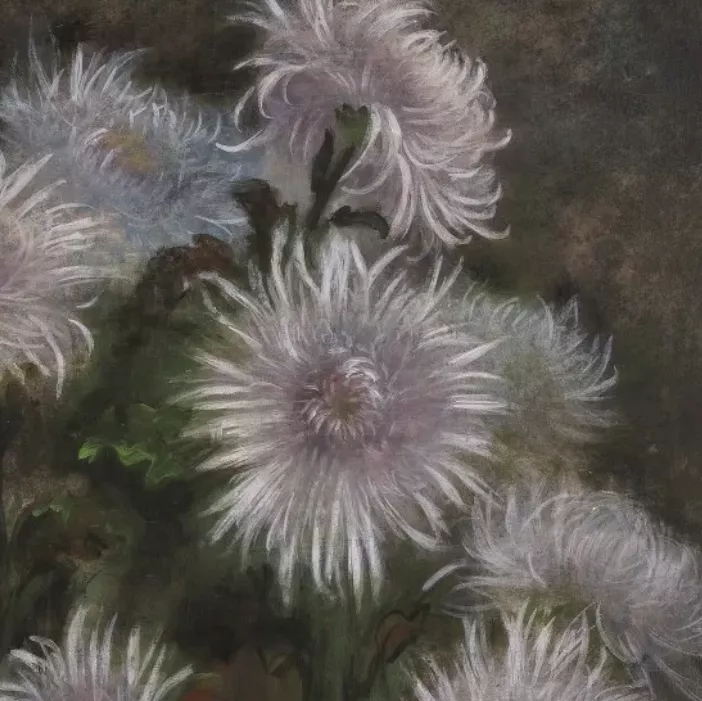
Focus on Young Woman in Kimono, Cao Dam Vu
The work Young Woman in Kimono, by Cao Dam Vu, embodies the elegance and subtlety of his art. Painted on silk, it illustrates with rare delicacy the harmony between tradition and modernity that so characterizes the artist's work.
The young woman, with her pensive gaze, is wrapped in a flowing kimono whose floral motifs seem almost palpable thanks to the finesse of the details.
The pastel tones, mainly in shades of blue and ochre, create a soothing ambience, reinforced by a soft play of light that skims the folds of the fabric and subtly illuminates the subject's face.
The composition, though spare, reflects a remarkable mastery of space. The central figure occupies a balanced position, surrounded by carefully preserved voids that underline its elegance and serenity.
This dialogue between subject and environment, typical of Cao Dam Vu's work, invites the viewer to contemplate the apparent simplicity while imbibing the emotional intensity it conveys.
Through this painting, Cao Dam Vu celebrates both Vietnamese tradition and the influence of European techniques, notably in the rendering of textures and the play of shadows.
Young Woman in Kimono is not simply a portrait; it is a window onto the intimacy and soul of its model, revealing the artist's deeply human and poetic approach.
Cao Dam Vu's imprint on his period
Cao Dam Vu marked his era by embodying an artistic bridge between millennia-old Vietnamese traditions and the effervescence of European influences in the XXᵉ century.
Trained at the École des Beaux-Arts d'Indochine, he was part of the innovative trend that aimed to redefine local art by opening it up to new perspectives while respecting its essence.
His delicate, meticulous works on silk bear witness to a deep attachment to ancestral techniques, which he has reinterpreted with striking modernity.
At a time when Vietnam was undergoing profound cultural and political transformations, Cao Dam Vu preserved the richness of his visual heritage while integrating it into a global artistic dialogue.
His compositions, marked by a quest for harmony and exceptional sensitivity, influenced a whole generation of artists seeking to combine heritage and innovation.
By exploring intimate themes such as everyday Vietnamese life or the female figure, he offered an authentic, poetic vision of his country, capturing both the beauty of the moment and the soul of a people.
Cao Dam Vu's imprint on his time lies in this ability to magnify traditions while inscribing them in a universal artistic dynamic, making him an emblematic figure of modern Indochinese art.
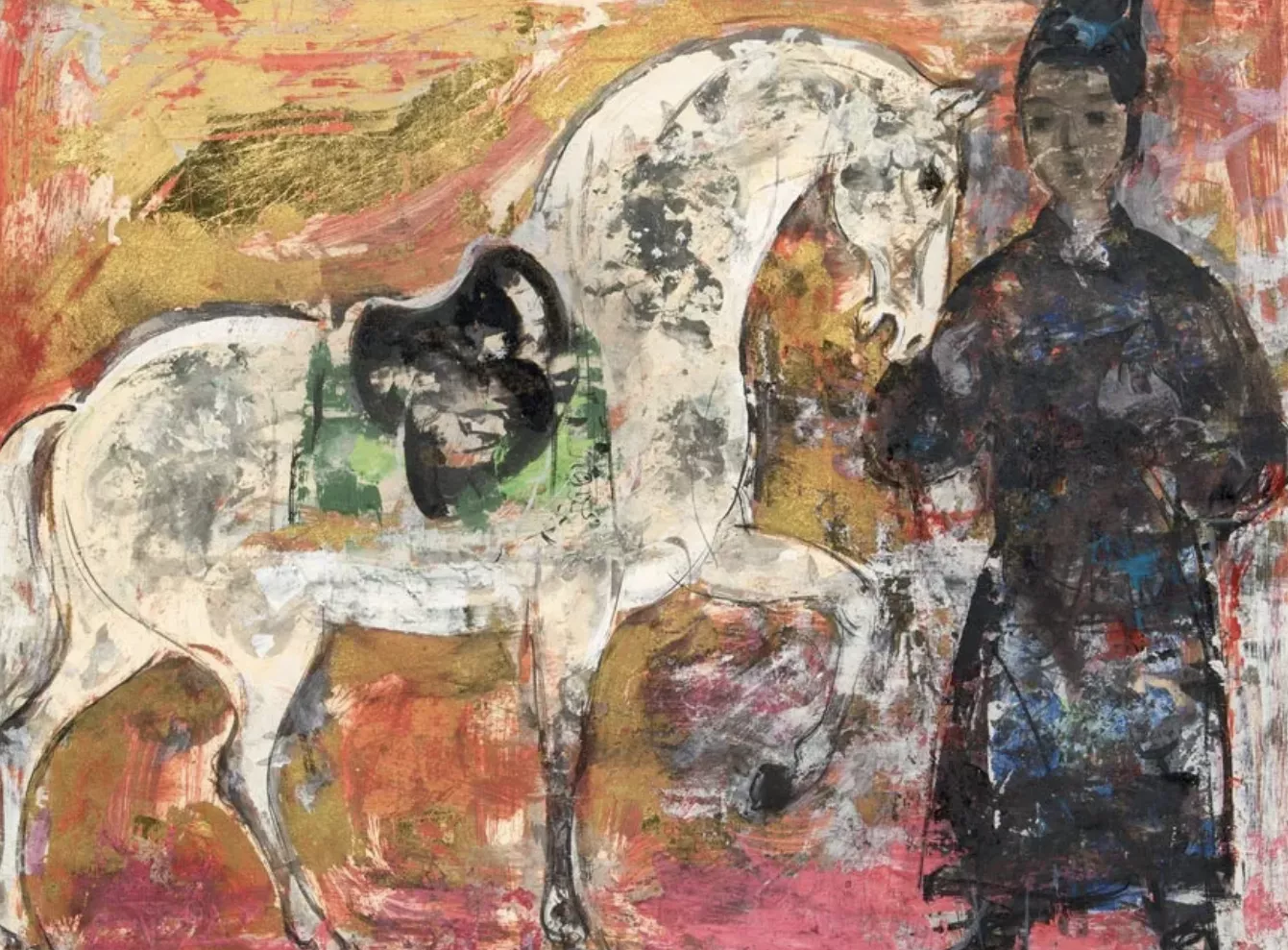
The influences of Cao Dam Vu
Cao Dam Vu is part of an artistic lineage deeply marked by Vietnamese cultural heritage and the modernist currents introduced by the Indochina School of Fine Arts.
His creations reveal an admiration for ancestral techniques, particularly silk painting and lacquer, which he has sublimated with a contemporary approach.
The influence of European masters such as Maurice Denis and Paul Gauguin, conveyed by his teachers such as Victor Tardieu and Joseph Inguimberty, can be seen in his treatment of color and his sense of composition, where refinement and simplicity are balanced.
Asian pictorial traditions, notably the use of a subtle palette and the search for visual harmony, also permeate his work, as do the motifs of everyday Vietnamese life that enrich his artistic universe.
This dual influence, Western and Eastern, has enabled Cao Dam Vu to forge a personal aesthetic where modernity dialogues with cultural authenticity.
Through his works, he pays homage to classical techniques while exploring new avenues, making him a key player in the artistic fusion between two worlds.
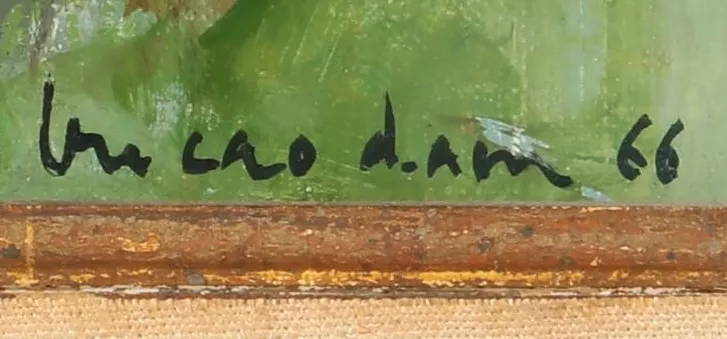
Recognizing the artist's signature
Cao Dam Vu signs his works most of the time. However, it is essential to have your work appraised to be sure of its originality. What's more ; there are of course many copies.
Knowing the value of a work
If you happen to own a work by Cao Dam Vu or after the artist, don't hesitate to request a free appraisal using our form on our website.
A member of our team of experts and licensed auctioneers will contact you promptly to provide you with an estimate of the market value of your work, not forgetting to send you ad hoc information about it.
If you wish to sell your work, you will also be accompanied by our specialists in order to benefit from alternatives to sell it at the best possible price, taking into account market inclinations.
Estimate in less than 24h
Discover in the same theme

Rating and value of works, drawings, paintings by Marcel Cos...
Marcel Cosson is a twentieth-century postimpressionist painter who produced drawings and oil on canvas that are valued at auction.
Learn more >

Gaston Suisse lacquer panels: rating and value
Gaston Suisse is an Art Deco artist who produced works that are highly valued at auction. Estimate in 24h.
Learn more >

Rating and value of paintings and drawings by Alexandre Altm...
Alexandre Altmann is a Russian post-impressionist painter who has produced works that are highly rated and valued at auction.
Learn more >
Similar works sold at auction

Estimated 3 000 - 5 000
Gaston SUISSE (1896-1988), Engraved polychrome lacquer panel on tortoiseshell lacquer background.

Estimated 4.000 - 6.000 €
EUGÈNE LEROY (1910-2000), Maison dans un sous bois, oil on canvas mounted on panel.

Estimated 15.000 - 20.000 €
Jacques MAJORELLE (1886-1962) - Fishermen embarking, Abidjan, Ivory Coast - Oil on canvas.

Estimated 1000 - 2000 €
NGUYEN TUONG LAN (1906-1947) - Ink and gouache painting on silk depicting a temple.

Estimated 12.000 - 15.000
Nguyễn Tường Lân (1906-1946), (Workshop of) Tuong Lan NGUYEN "Hiện vẻ hoa - Showing the flowers" Ink and colors on silk, mounted on paper.

Secure site, anonymity preserved

Auctioneer approved by the State

Free and certified estimates
Frequently asked questions
-
Who is Cao Dam Vu, and what is his contribution to Indochinese art?Cao Dam Vu (1908–2000) is an iconic figure in 20th-century Vietnamese painting. A Franco-Vietnamese artist trained at the Indochina School of Fine Arts, he created a unique body of work that blends Vietnamese tradition with Western influences. His compositions, characterized by delicate lines, pastel hues, and meticulous attention to detail, explore timeless themes such as rural life and family scenes, enhanced by a soft, enveloping light.
-
What is the price range for a work by Cao Dam Vu?The prices of Cao Dam Vu’s works vary considerably depending on the medium and rarity: prints range from €100 to €6,500, sculptures between €1,100 and €204,570, oil paintings on canvas between €140 and €261,760, and watercolor drawings between €1,070 and €690,340. His market value has skyrocketed in recent years, as evidenced by the 2019 sale of a terracotta statue that sold for 204,750€, well above its initial estimate.
-
How do I have a work by Cao Dam Vu authenticated?To authenticate a work by Cao Dam Vu, we recommend that you request a free appraisal through our website from our state-certified experts and auctioneers. They will assess the authenticity of your artwork, verify the signature, and provide you with a comprehensive evaluation of its market value, with no obligation on your part.
-
Why is now the right time to sell a work by Cao Dam Vu?Yes, now is a very good time to sell a work by Cao Dam Vu. His market value has been skyrocketing for several years, and his paintings have been performing remarkably well at auction, often selling for well above their initial estimates. Demand remains strong among buyers in Hong Kong, Vietnam, and France, which ensures that your artwork will fetch a good price.
-
How does the sale of a work of art work at Auctie's?At Auctie's, the process is simple and secure: request a free estimate for your artwork using our online form, and our experts will contact you within 48 hours with an accurate appraisal. If you’d like to sell, our specialists will guide you every step of the way—from advice to sales strategy—to help you achieve the best possible price based on current market trends.
