



Rating and value of works, drawings, paintings by Lavinia Fontana

Key takeaways
- Lavinia Fontana’s market value is skyrocketing: her *Portrait of Antonietta Gonsalvus* sold for €1,250,000 in 2023, far exceeding its estimate of €80,000–120,000.
- Works by this 16th-century artist—who painted portraits and religious scenes in oil on canvas or copper—are estimated at between €2,500 and €1,250,000 depending on their prestige.
- A Bolognese portrait painter trained by her father, she possessed an exceptional mastery of depicting the details of women’s clothing, jewelry, and hairstyles in a refined Mannerist style influenced by Raphael and the Carracci.
If you are in possession of a work by or after painter Lavinia Fontana, and would like to know its value, our state-approved experts and auctioneers will offer you their appraisal services.
Our specialists will carry out a free appraisal of your work, and provide you with an accurate estimate of its value on the current market.
Moreover, if your wish is to sell your work, we will advise you on the best device to obtain maximum price for it.
Rating and value of the artist Lavinia Fontana
Lavinia Fontana is an artist known to portrait lovers. Her visibility on the art market continues to grow, her quotation is exploding and she is increasingly in demand : it is speculated that her works could reach unprecedented amounts at auction.
In 2023, your painting Portrait of Antonietta Gonsalvus sold for 1,250,000, while it was estimated at between €80,000 and €120,000.
Order of value from a simple work to the most prestigious
Technique used | Result |
|---|---|
Oil on panel, canvas or copper | From €2,500 to €1 250,000 € |
Estimate in less than 24h
Artist's style and technique
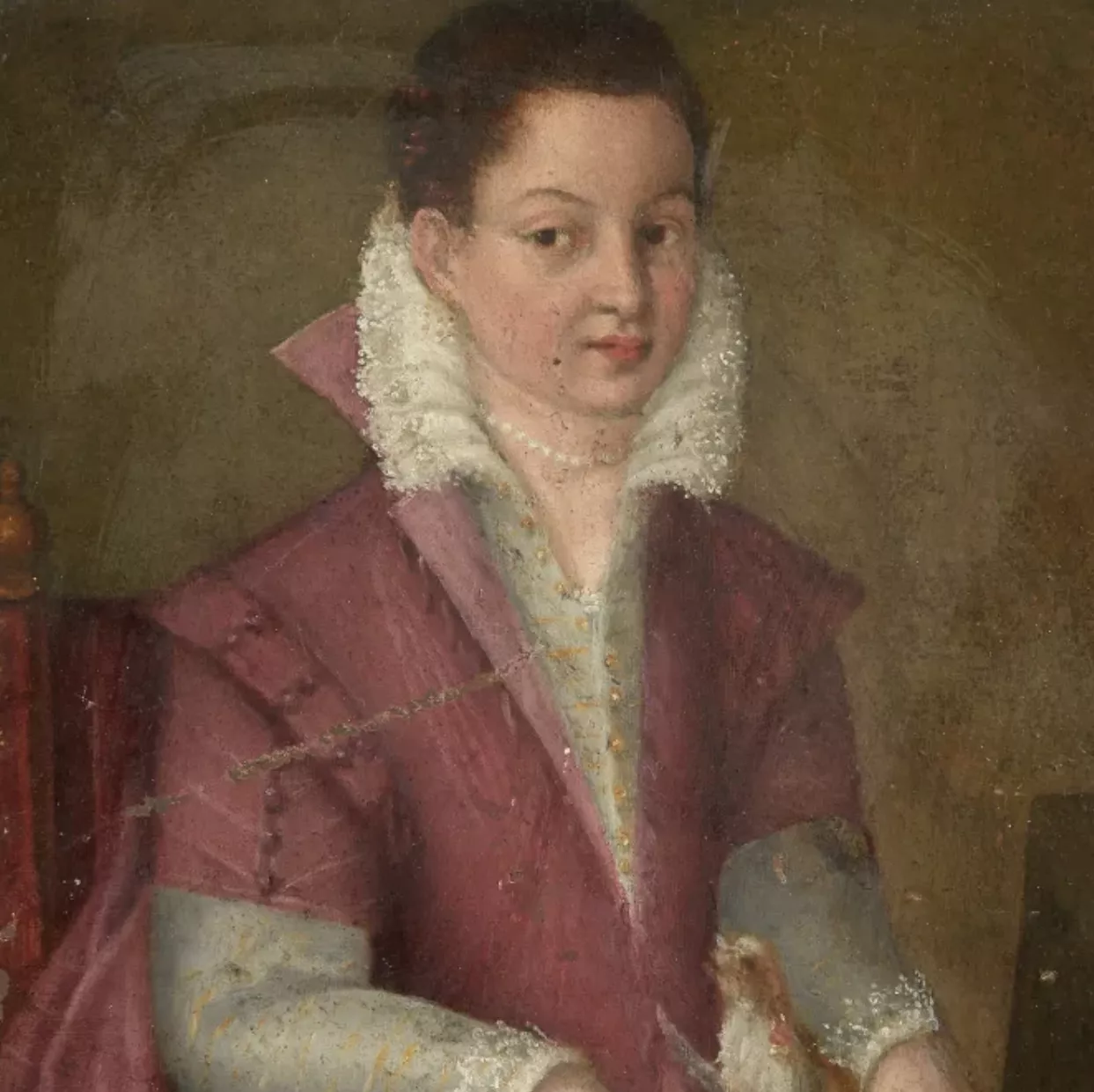
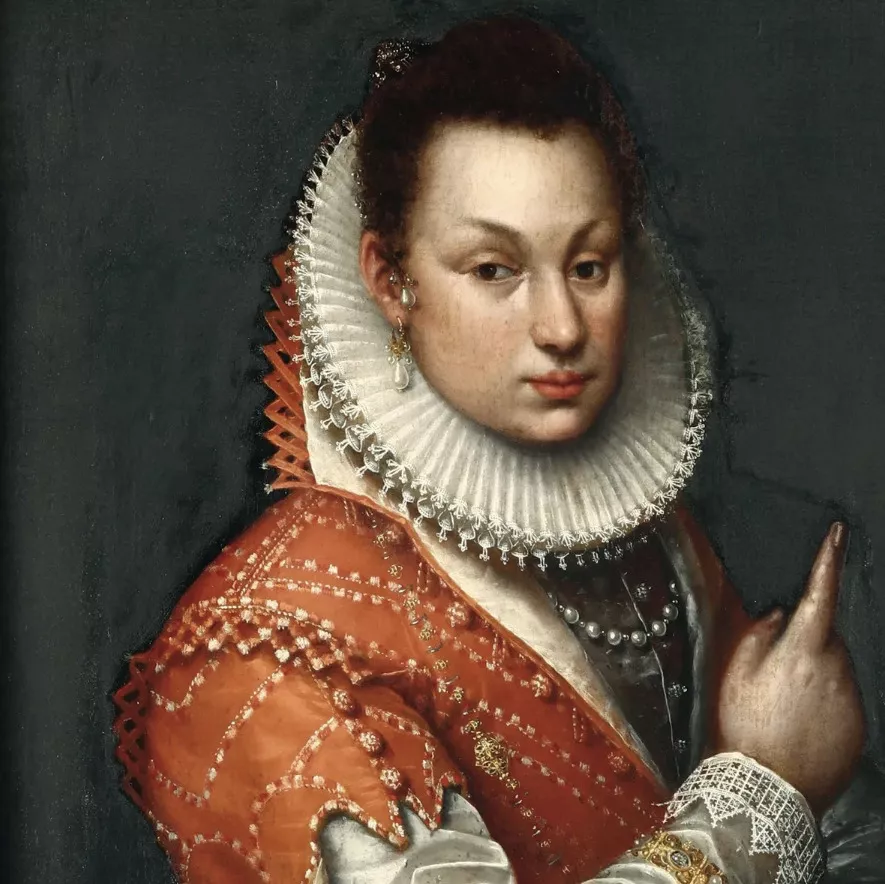
It was once unacceptable for a female artist to devote herself to historical or religious painting. Lavinia Fontana, aware of this reality, therefore began her career as a portrait painter prized among the upper middle classes of Bologna (Italy).
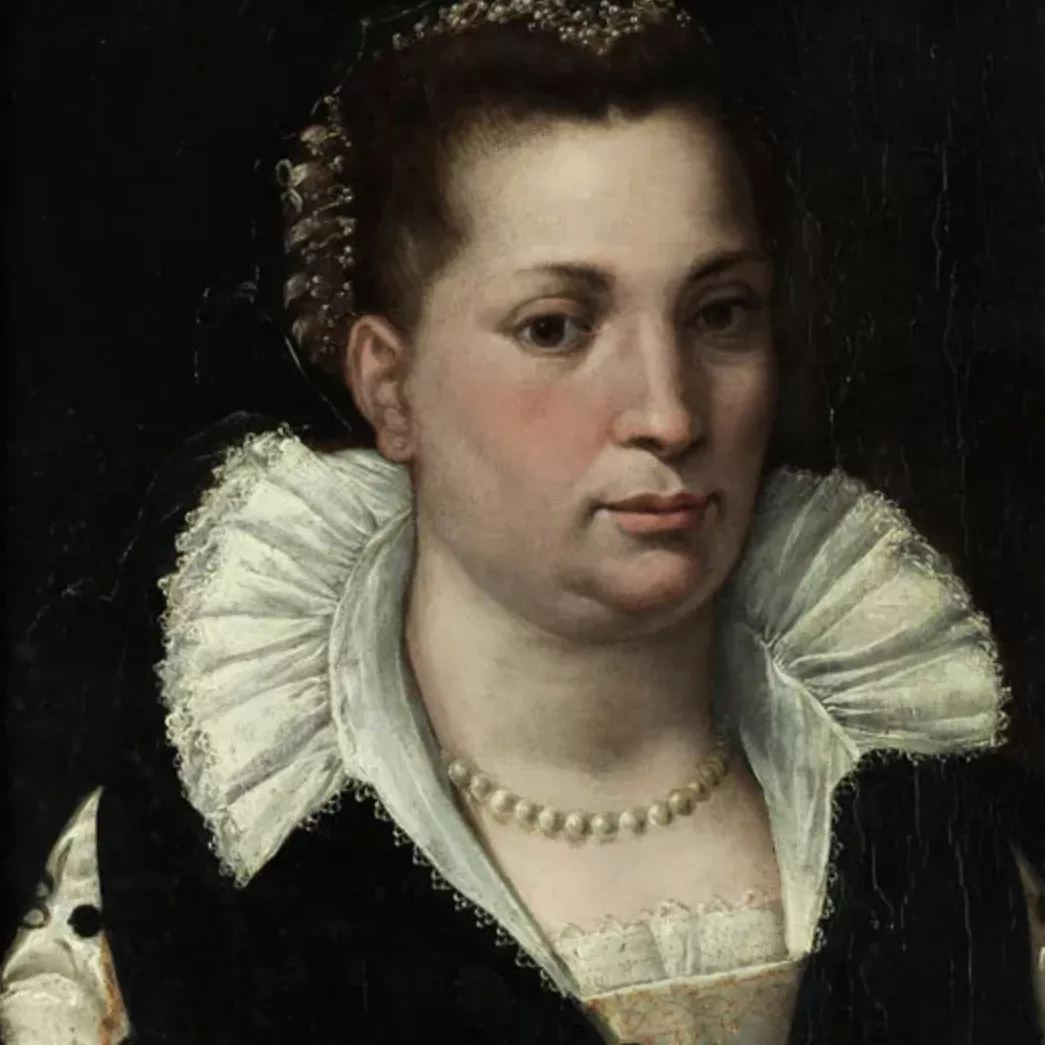
She succeeds in magnifying women and enhancing them through her works through attention to detail. Her exceptional mastery of depicting women's hairstyles and clothing leaves the viewer breathless, while her dexterity, inherited from ancient statuary, lends her works a remarkable quality.
She developed a refined mannerist style influenced by the Bolognese tradition. Trained by her father Prospero Fontana, she adopted a Mannerist pictorial style, marked by the elongated elegance of figures, dense compositions and theatrical gestures.
Her style is in the 16th-century Bolognese tradition, influenced by Parmigianino, the Carracci and Raphael, combining naturalism with decorative sophistication.
She constructs her paintings according to a rigorous structure, often pyramidal or diagonal, with strong narrative clarity. Her portraits reveal anatomical precision, with careful modeling of faces and hands, treated with light sfumato or small, smoothed crosshatching.
Lavinia Fontana works with a visible underlying drawing, particularly in her portraits, and works in thin superimposed layers (glazes) in the tradition of Italian oil painting.
The bulk of her work depicting religious subjects and portraits is presented on media such as canvas and copper. She also painted numerous self-portraits.
The life of Lavinia Fontana
Lavinia Fontana was born into a family of artists in Bologna in 1552. Her father, Prospero Fontana, was a renowned Mannerist painter and an active member of the Bolognese school. Trained in her father's studio, she benefited from a complete artistic education, rare for a woman at the time.
From an early age, she showed exceptional talent for drawing and painting, and both her father and her father actively encouraged her career. She began painting portraits of Bolognese nobles as early as the 1570s, quickly forging a solid local reputation.
Bologna was at the time a more liberal city than other Italian centers, allowing women access to certain forms of intellectual and artistic recognition. She was one of the first women to regularly sign her works and work on commission, as an independent artist.
She married Gian Paolo Zappi in 1577, an Italian aristocrat who also painted. Her husband accepted an atypical role for the time: managing the household and assisting Lavinia in her studio, while she pursued a professional artistic activity.
The couple are said to have had eleven children, several of whom died in infancy, underlining Lavinia's double burden as mother and artist.
In 1603, she was called to Rome by Pope Clement VIII and then Paul V to execute religious commissions and official portraits. There she became portraitist to the pontifical court, a rare and prestigious position for a woman artist.
Lavinia Fontana was then elected a member of the Accademia di San Luca, a major artistic institution in Rome, confirming her official status.
She died in Rome in 1614, at the height of her reputation. Her oeuvre comprises over 100 identified paintings, including portraits, religious and mythological scenes, and an exceptional output for a woman of her time. She was rediscovered in the 20th and 20th centuries as a pioneer of the female career in art history.
Focus on Portrait of noble lady with her maid, Lavinia Fontana, circa 1580
This painting, housed at the Walters Art Museum in Baltimore, depicts a richly dressed noblewoman, accompanied by a black maid, in a plush interior. The main figure is depicted standing, front-on, in a dignified posture and holding a fan or letter.
The maid stands in the background, slightly turned towards her mistress, in a self-effacing but dignified and individualized position, which was rare at the time.
The arrangement creates a solemn vertical axis, typical of ceremonial portraiture, equilibrated by a neutral background and refined accessories (curtain, table, jewelry). The artist excels in the representation of materials : gilded embroidery, pearls, silk ribbons, lace ... which she paints with meticulousness and brilliance.
The noble lady's costume displays extreme richness : embroidered bodice, ruffled cuffs, gold chain, signaling her social rank and virtue. Every jewel and every fold of the garment is an opportunity for the artist to demonstrate her technical expertise and observational skills.
The inclusion of the black servant girl is exceptional in 16th-century Italian painting, reflecting both a taste for the exotic and the social reality of European elites. The attitude of the two women suggests a gentle yet explicit hierarchy.
The ensemble functions as an image of status, but also as an affirmation of the artist's ability to handle complex subjects and to inscribe multiple bodies within a single narrative.
This painting perfectly illustrates his mastery of the female ceremonial portrait, his ability to combine elegance, psychology and decorative richness. It also demonstrates his sensitivity to social diversity, at a time when female painting was still often confined to isolated portraits or pious scenes.
This is therefore a rare and precious work that testifies to the intellectual and technical freedom the artist has carved out for herself in a male-dominated society, where other artists such as Anne Vallayer-Coster, Élizabeth Vigée le Brun or Clara Peeters.
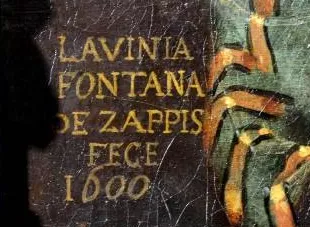
Recognizing the signature of Lavinia Fontana
While it is considered indecent and licentious for a woman to paint nudity, Lavinia Fontana sometimes borrowed her husband's signature and affixed it alongside her own. For example, she paints nudity in the work Minerve s'habillant in 1613, preserved at the Galleria Borghese in Rome, defying the viewer's gaze while donning her cloak.
How to find out the value of a painting
If you own a painting by Lavinia Fontana or after the artist, don't hesitate to request a free valuation by filling in our online form.
A member of our team of experts and licensed auctioneers will contact you to provide an estimate of the market value of your work.
If you are considering selling your work, our specialists will also guide you through the various alternatives available to obtain the best possible price, taking into account market trends and the specific features of the work.
Estimate in less than 24h
Discover in the same theme

Rating and value of paintings by Antonio Tempesta
Antonio Tempesta is an Italian Mannerist painter who produced works that are listed and valued on the auction market.
Learn more >

Rating and value of painting by Bernardino Luini
Bernardino Luini was an early 16th-century Lombard painter of religious subjects.
Learn more >

Rating and value of drawings and paintings by Jacopo Zucchi
Jacopo Zucchi is a Mannerist painter whose paintings and drawings command high prices at auction.
Learn more >
Antique paintings sold at auction

Estimated 2 000 € - 4 000 €
DANISH SCHOOL circa 1790, entourage of Jens JUEL Presumed portrait of Sophie of Hesse-Cassel, Queen Consort of Denmark.

Estimated 1500 - 3000 €
Louis de Caullery (1580-1621), Oil on copper.

Estimated 1500 - 3500€
Neapolitan school, late 18th century, oil on canvas

Estimated 1700€ - 2000€
Claude Vignon (Tours 1593-1670 Paris) The Crucifixion of...

Estimated 300€ - 400€
Jacques CALLOT (1592 - 1635) The Temptation of...

Secure site, anonymity preserved

Auctioneer approved by the State

Free and certified estimates
Frequently asked questions
-
Who is Lavinia Fontana, and what is her historical context?Lavinia Fontana (1552–1614) was an Italian painter born in Bologna, trained by her father, Prospero Fontana, in the family studio. A pioneer in women’s artistic careers, she developed an exceptional reputation as a portraitist of Bologna’s upper middle class before being summoned to Rome in 1603 to become a portraitist for the papal court. She was one of the first women to regularly sign her works and to work as an independent artist, producing more than 100 identified paintings.
-
What is the price range for Lavinia Fontana's works?Lavinia Fontana’s works vary considerably in price depending on their size and provenance, with prices ranging from €2,500 to over €1,250,000. In 2023, the painting “Portrait of Antonietta Gonsalvus,” initially estimated at between €80,000 and €120,000, exceeded expectations by selling for €1,250,000. His market value is steadily rising in the contemporary art market, particularly for portraits and religious compositions.
-
How can you authenticate a work by Lavinia Fontana?To authenticate a work by Lavinia Fontana, we recommend that you request a free appraisal from Auctie's. Our state-certified auctioneers and experts will examine your artwork and provide you with an accurate estimate of its current market value, with no obligation. You’ll receive a response within 48 hours by filling out our online form.
-
Is this a good time to sell a work by Lavinia Fontana?Yes, this is an excellent time to sell a work by Lavinia Fontana. Visibility and demand for this artist continue to grow in the art market, her value is steadily rising, and collectors are actively seeking out her portraits and religious compositions. Recent auction results demonstrate a renewed interest in the female masters of the Italian Renaissance.
-
How does the appraisal and sales process work at Auctie's?Auctie's supports sellers from the appraisal to the auction. The appraisal is free and non-binding: you fill out an online form, an expert contacts you, and provides you with an appraisal within 48 hours. If you decide to sell, our specialists will guide you through the various available options and help you achieve the best possible price based on market trends and the specific characteristics of your artwork.
