



Rating and value of works, paintings by Louise Hersent

Key takeaways
- Oil-on-canvas paintings by Louise Hersent, a 19th-century artist, sell for between €1,500 and €4,800 on the current market.
- Her style combines academic neoclassicism with a gentle expressiveness, and she is particularly renowned for her portraits of women and children.
- Her works remain very rare at auction, offering significant appreciation potential for discerning collectors.
If you own a work by or after the artist Louise Hersent, and would like to know its value, our state-approved experts and auctioneers will offer you their appraisal services.
Our specialists will carry out a free appraisal of your work, and provide you with a precise estimate of its value on the current market.
Then, if you wish to sell your work, we will direct you to the best possible arrangement to obtain the optimum price.
Rating and value of the artist Louise Hersent
Louise Hersent is a little-known 19th-century artist. Now, prices for her works are rising under auctioneers' gavels.
Hers oils on canvas are particularly prized, especially by French buyers, and the price at which they sell on the art market ranges from €1,500 to €4,800, a significant delta but one that speaks volumes about the value that can be attributed to the artist's works.
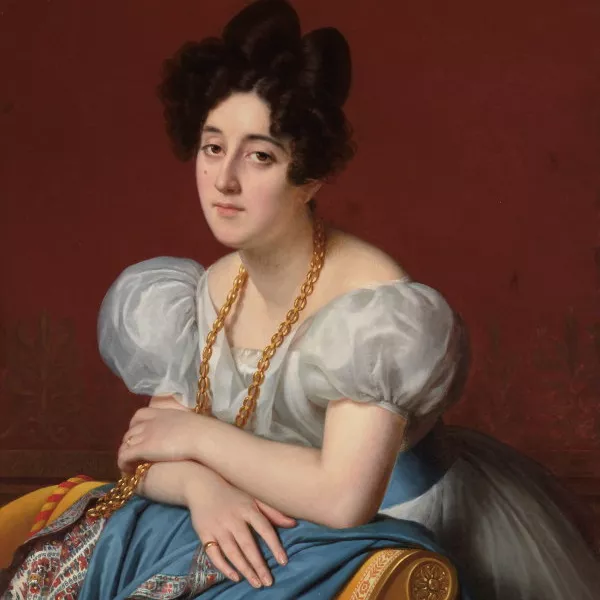
In 2019, his oil on canvas entitled Portrait de femme à la robe bleue,dating from 1831 was sold for €2,000, while it was estimated at €1,200 to €2,000. Its quotation is stable.
Order of value from a simple work to the most prestigious
Technique used | Result |
|---|---|
Oil on canvas | From €1,500 to €4,800 |
Estimate in less than 24h
Style and technique of artist Louise Hersent
Louise Hersent produces work characteristic of academic figuratism, she mainly creates portraits, genre scenes and history paintings. Her preferred medium is oil on canvas, and works produced exclusively in this medium are currently on sale at auction.
She was trained by Jean-Baptiste Regnault, a leading exponent of French neoclassicism, and developed a rigorous, sculptural drawing style, characteristic of history and edifying scenes. She adopted the principles of the neoclassical style: clarity of composition, controlled anatomy, codified gestures and explicit symbolism.
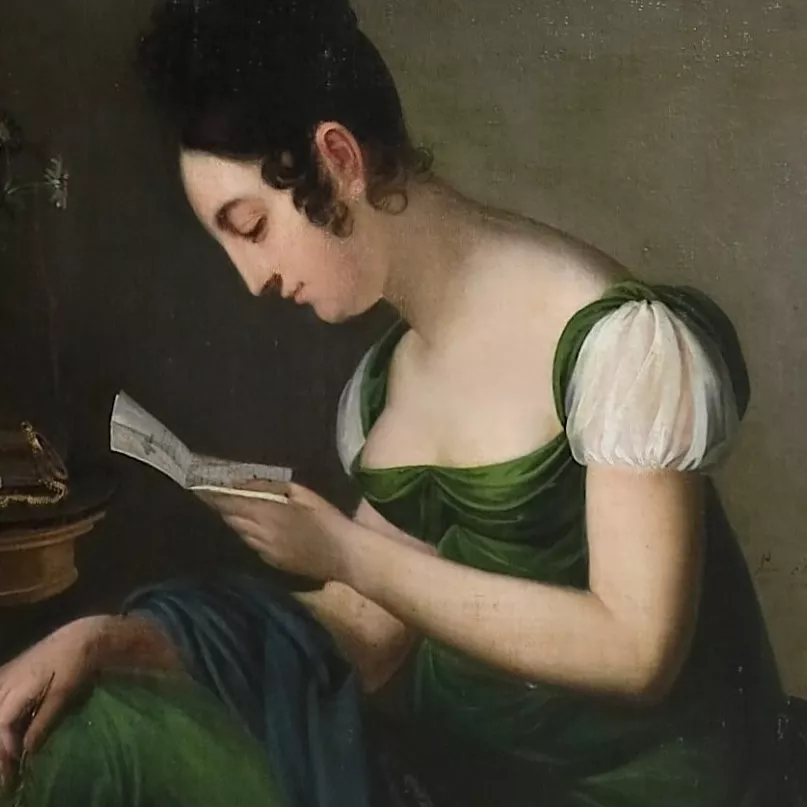
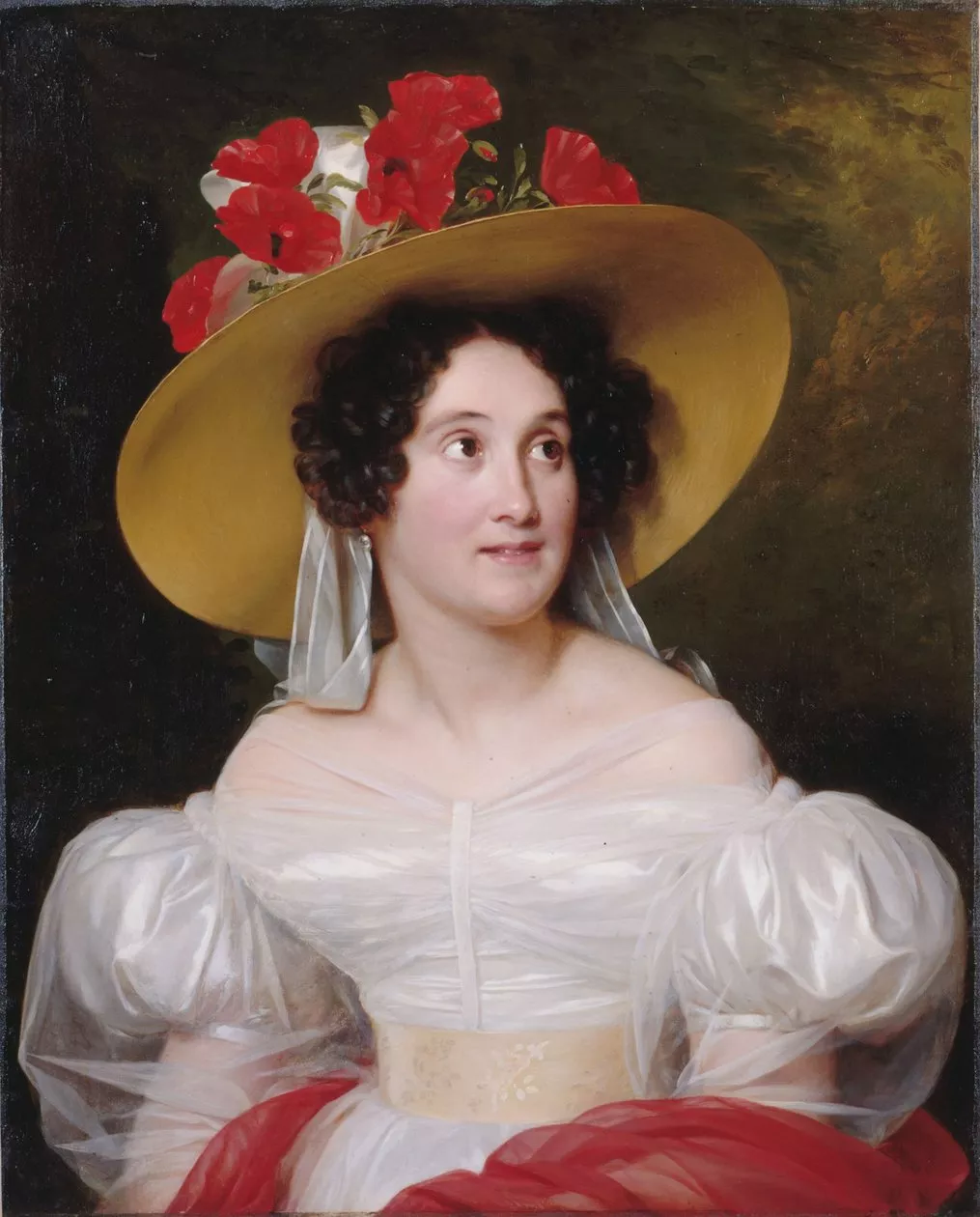
Although she painted religious and mythological subjects, she is best known for her portraits, often of women and children. Her style combines precision of line with a certain gentleness of expression, with particular attention paid to skin tone, eyes and hands.
She favors an idealized yet individualized representation, between fidelity to the model and academic nobility. She uses a reduced palette: warm tones, golden browns, deep blues and muted pinks. Louise Hersent uses controlled chiaroscuro effects, often influenced by the French and Italian masters of the 17th century.
Light often emanates from one side only, gently shaping the face and giving relief without harshness. She takes great care in rendering materials : velvets, laces, and fine fabrics. Clothes are not only decorative, but also contribute to the character's social and moral structure. The rendering is meticulous, without excess or overload, in a balance between ornament and restraint.
She paints in oil on canvas, with thin layers, and a smooth background with no visible impasto. The finished look of her works testifies to great academic mastery, with a more affective and tender touch than her male counterparts.
Louise Hersent is often compared in her approach to Élisabeth Vigée Le Brun, whose tradition of female portraiture she extended into a more austere century.
The life of Louise Hersent
Louise Marie Jeanne Hersent (1784-1862) was a 19th-century French artist whose fame rested mainly on her exceptional talent as a portraitist. She was born into a wealthy family; her father was a professor at the Collège de France, a writer and mathematician.
She begins her artistic training with Charles Meynier. She exhibited her work for the first time at the Salon of 1810, and twice won first-class medals. She marries the painter Louis Hersent (the two artists are often confused due to the similarity of their first names). Their works are stylistically similar.
She is best remembered in art history for having opened a painting school for women. One of her most promising students, Louise Adelaïde Desnos, would go on to head the school.
As for Louise Hersent, she portrays important figures of her time on commission, but also creates history paintings such as Louis XV visits Tsar Peter the Great, a historical anecdote from before her time that she wanted to depict by reading Saint Simon's Mémoires.
Louise Hersent's imprint on her period
Louise Hersent did not make a lasting mark on 19th-century art, she is today a forgotten artist although her school for women is known in 19th-century art history.
Hers works are very rare at auction and could therefore reach unprecedented amounts.
In a context where women had little visibility in the official arts, Louise Hersent established herself as one of the rare female painters recognized by the institution.
She exhibited regularly at the Paris Salon from the Empire and under the Restoration, alongside the most prominent artists of the day. Her works, often commissioned or purchased by the state, were included in the major exhibitions of the early 19th century.
Her style, at the crossroads of neoclassicism and bourgeois sentimentalism, reflected the moral, religious and family values upheld by successive regimes. She embodies the possibility for a woman to achieve academic recognition without breaking with the pictorial conventions of her time.
Her career illustrates the limits imposed on women artists, often confined to acceptable genres such as portraiture, allegorical scenes and piety. She was married to Louis Hersent, Grand Prix de Rome, professor and influential figure at the Académie. Their union strengthened her position in artistic circles.
Although she did not depend solely on this relationship for her existence, her husband's proximity to institutional circles favored the dissemination of her work.
From the mid-19th century, her work became less visible, eclipsed by more realistic Romantic movements. Today, she is being rediscovered in the context of research into 19th-century women painters, as a pivotal figure between the legacy of Vigée le Brun and the generation of female academic portraitists.
Louise Hersent's career also bears witness to the ability of women artists to exist in the public arena, long before official access to the École des Beaux-Arts (1897).
Recognizing the artist's signature
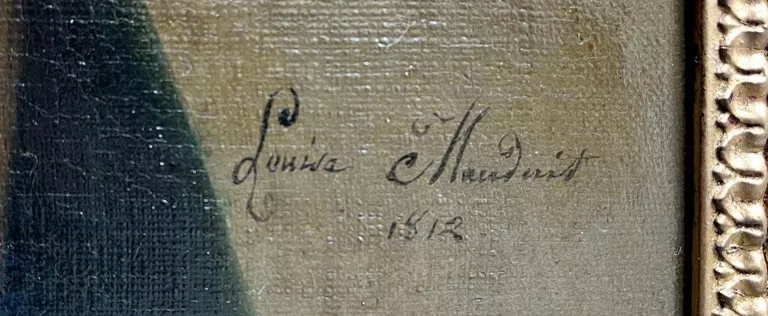
Louise Hersent does not necessarily sign her works. Copies may exist, which is why expertise remains important.
Knowing the value of a work
If you happen to own a work by or after Louise Hersent, don't hesitate to request a free appraisal using our form on our website.
A member of our team of experts and chartered auctioneers will contact you promptly to provide you with an estimate of the market value of your work, as well as ad hoc information about it.
If you are considering selling your work, you will also be accompanied by our specialists in order to benefit from alternatives for selling it at the best possible price, taking into account the inclinations of the market.
.Estimate in less than 24h
Works from the same period sold at auction

Estimated 2 000 € - 3 000 €
Delphin ENJOLRAS (1857-1945) "A Midsummer Night's Dream", Oil on canvas

Estimated 600 - 800 €
Alexandre Gabriel DECAMPS (1803-1860) Two children reading.

Estimated 9 000 - 12 000 €
Guillaume FOUACE (1837-1895) Pheasant and hare.

Estimated 10.000 - 15.000 €
Ebridge Ayer BURBANK(1858-1949), Young African-American boy, Oil on panel.
Discover in the same theme

Market Value and Pricing of Henri Rousseau's Paintings, Draw...
Henri Rousseau is a painter of 19th-century naive art, whose works are extremely highly valued.
Learn more >

Rating and value of paintings by Paulin Bertrand
Paulin Bertrand is a 19th-century landscape painter whose works are highly regarded and valued at auction.
Learn more >

Rating and value of paintings by Louise Adéone Drölling
Louise Adéone Drölling is a 19th-century neoclassical artist who produced rare works of great value.
Learn more >

Secure site, anonymity preserved

Auctioneer approved by the State

Free and certified estimates
Frequently asked questions
-
Who is Louise Hersent, and what is her historical context?Louise Hersent (1784–1862) was a 19th-century French painter who studied under Jean-Baptiste Regnault. Recognized as a talented portraitist, she made her mark on art history by founding a painting school for women—a remarkable achievement at a time when women had little visibility in the official art world. She was part of the Neoclassical movement and served as a pivotal figure linking the legacy of Vigée Le Brun to the generation of female academic portraitists.
-
What is the market value of Louise Hersent's works?Louise Hersent’s oil-on-canvas paintings—her preferred medium—currently sell for between €1,500 and €4,800 on the art market. Her market value is stable. For example, in 2019, her *Portrait of a Woman in a Blue Dress* (1831) sold for €2,000, even though it had been estimated at between €1,200 and €2,000. Since his works are very rare at auction, they could potentially fetch unprecedented prices.
-
How can you authenticate a work by Louise Hersent?To authenticate a work of art and determine its value, we recommend that you request a free appraisal from Auctie's using our online form. Our team of experts and state-certified auctioneers will contact you promptly to provide an accurate estimate of your artwork’s market value, with no obligation.
-
What is Louise Hersent's style and technique?Louise Hersent produced work characteristic of neoclassical academic figurative art, creating primarily portraits, genre scenes, and historical paintings. Her style combines rigorous, sculptural draftsmanship with a gentle expressiveness, particularly evident in her rendering of skin tones and the eyes. She works in oil on canvas using a limited palette (warm tones, golden browns, deep blues), masterful chiaroscuro effects, and meticulous attention to the rendering of textiles, without excess or over-detailing.
-
Is this the right time to sell a work by Louise Hersent?Yes, now is a good time to sell a work by Louise Hersent. Her prices are rising steadily at auction; her oil-on-canvas paintings are particularly sought after, especially by French buyers; and her works are very rare on the market. This scarcity, combined with the growing rediscovery of 19th-century women painters, creates a favorable market environment. Contact Auctie’s for expert guidance to ensure your sale achieves the best possible price.
