



Rating and value of paintings by Louise Adelaïde Desnos

Key takeaways
- Oil-on-canvas paintings by Louise Adelaïde Desnos (1807–1878) sell for between €990 and €4,240 at auction, with stable prices.
- A 19th-century academic portrait painter, she ran a painting school for women in Paris and exhibited at the Salon from 1831 to 1853.
- Her works are rare on the market and could fetch unprecedented prices; a free pre-sale appraisal is recommended.
If you own a work by or after the artist Louise Adelaïde Desnos, and would like to know its value, our state-approved experts and auctioneers will offer you their appraisal services.
Our specialists will carry out a free appraisal of your work, and provide you with a precise estimate of its value on the current market.
Then, if you wish to sell your work, we will direct you to the best possible arrangement to obtain the optimum price.
Rating and value of the artist Louise Adélaïde Desnos
Louise Adelaïde Desnos is an artist known to 19th-century painting enthusiasts. Now, prices for her works are rising under auctioneers' gavels.
Her oils on canvas are particularly prized, especially by French buyers, and the price at which they sell on the art market ranges from €990 to €4,240, a significant delta but one that speaks volumes about the value that can be attributed to the artist's works.
In 2022, his oil on canvas La Toilette, dating from 1839 was sold for €4,240, while it was estimated at between €4,460 and €6,240. Its quotation is stable.
Order of value from a simple work to the most prestigious
Technique used | Result |
|---|---|
Oil on canvas | From €990 to €4,240 |
Estimate in less than 24h
Style and technique of the artist Louise Adelaïde Desnos
Louise Adelaïde Desnos mainly produces oils on canvas, especially history paintings and portraits, and follows the academic canons of the 19th century.
She mainly produces oils on canvas, in the academic tradition of the 19th century. She uses careful preparatory drawing, often in black stone or red chalk, before moving on to oil.
She applies thin, superimposed layers that enable her to achieve glazes and a satin finish. The modeling is smooth and even, and few traces of the brush are visible, due to her desire for a finished, polished rendering.
She highlights faces with soft chiaroscuro, inherited from the classical tradition, with great attention to textile and ornamental detail (lace, jewelry, drapery), demonstrating a rather virtuoso mastery of textures.
His portraits are generally frontal or three-quarter-length, in the tradition of 19th-century ceremonial portraits. The figures are centered, often set in a neutral or slightly ornamental frame.
His painting reflects a quest for balance between psychological likeness and social staging of the sitter. The palette is refined, dominated by warm, light tones (ochres, beiges, pinks, browns) that are balanced by more intense highlights (deep blues, greens, reds).
She uses glazes to achieve soft, luminous complexions, a process typical of academic painting. Chromatic contrasts are mastered to accentuate the visual hierarchy (face and hands in the foreground, secondary accessories in the background).
Her primary aim is to remain faithful to her model and enhance her social standing. Her work is marked by a moderate idealism, with softened features to enhance the dignity of the figures she portrays.
Her work is influenced by the neoclassical portrait tradition, sometimes enriched by romantic elements in expression and setting.
She is heir to the codes of official portraiture, with particular attention paid to the psychology of individuals, but above all to their social status. Her style reflects a desire to reconcile descriptive accuracy and classical idealization, in line with the expectations of the patrons of her time.
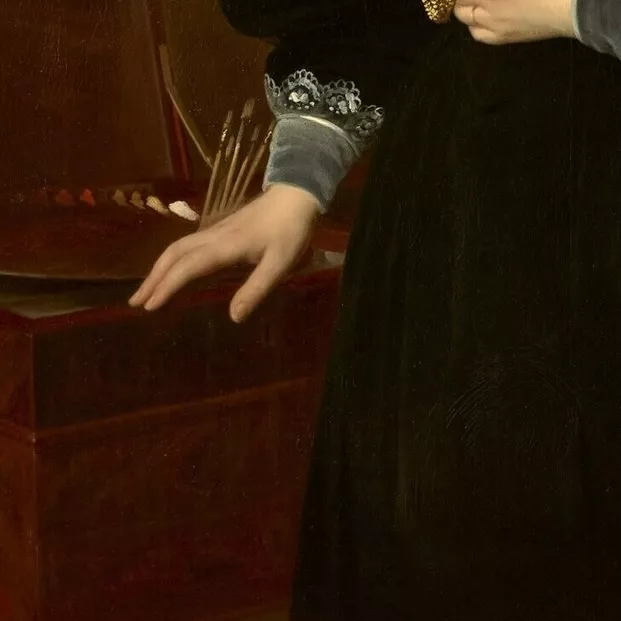
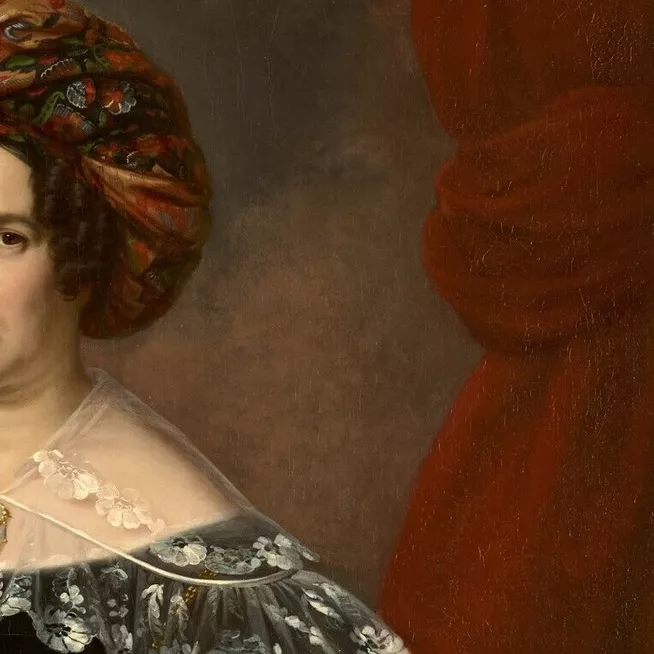
The career of Louise Adélaïde Desnos
Louise Adelaïde Desnos was a German artist born in 1807. She was born in Paris, and studied painting with Louis Hersent and Louise Hersent, two renowned academic painters, which anchored her in the tradition of official portraiture and history painting.
She received classical training in drawing and oil, with technical mastery recognized from her earliest works. She began her career in the 1830s, a period when academicism still dominated the official Salons.
After Louise Hersent, she took over the direction of the women's painting school set up in the 6th arrondissement of Paris, Auguste Gallimard will succeed her, she is most famous for this reason in nineteenth-century art history.
Louise Desnos exhibited her paintings at the Salon from 1831 to 1853, and in this capacity produced numerous portraits, including that of French King Louis Philippe and copies of that of Emperor Napoleon III and Empress Eugénie.
Louise Adélaïde Desnos won critical acclaim for the finely rendered psychological quality of her portraits. She developed a sustained activity as a portraitist of the bourgeoisie and aristocracy.
Her works were intended for a private clientele, concerned with social representation. Her style is appreciated for its balance between faithful likeness and flattering idealism. She was recognized as a professional woman painter at a time when they were still rare on the academic scene.
Her works were circulated and commented on in the specialized press, testifying to a not inconsiderable visibility in the Parisian artistic milieu. His name appears in dictionaries and catalogs of 19th-century artists, a sign of a career embedded in official networks.
His career is marked by his fidelity to the academic language inherited from the Hersents. She continued to paint until 1870, despite the shift in artistic tastes towards realism and impressionism.
She died in the Somme in 1878.
She continued to paint until 1870, despite the shift in artistic tastes towards realism and impressionism.
She died in the Somme in 1878.
Louise Desnos's imprint on her period
Louise Adelaïde Desnos makes her mark on 19th-century art, she is today a unsung but in-demand artist, famous for her contribution to training women painters in the 19th century more than for her works in themselves.
Her works are quite rare at auction and could therefore fetch unprecedented sums.
She belongs to a generation in which women painters are beginning to be more visible, but remain a minority and often confined to certain genres (portraiture, still life).
Her career illustrates the possibility of female public recognition in a still largely male and academic milieu. Her name appears regularly in Salon catalogs and artists' dictionaries, a sign of rare institutional integration for a woman.
Specializing in society and ceremonial portraiture, she met the expectations of the 19th-century bourgeoisie and aristocracy. Thanks to the quality of her execution, she helped perpetuate the art of official portraiture at a time of transition to freer forms (romanticism, realism).
Her mark lies in the ability to combine psychological fidelity and idealization, a major requirement of official portraiture in her day. She thus represents the conservative, institutional face of 19th-century painting, in contrast to the avant-garde.
As a woman exhibiting at the Salon, she participated in the gradual legitimization of the female presence in academic circuits. She didn't revolutionize the codes, but her career contributes to documenting the social and cultural role of painted portraits in 19th-century France.
Her work embodies the continuity of a respected academic tradition, at a time when art history has mostly retained the innovators.
Long in the shadows, she is one of those female artists of the 19th century rediscovered by recent art history, attentive to the question of women's place in creation.
Recognizing the artist's signature
Louise Desnos did not necessarily sign her works. Copies may exist, which is why expertise remains important.

Knowing the value of a work
If you happen to own a work by or after Louise Adelaïde Desnos, don't hesitate to request a free valuation using our form on our website.
A member of our team of experts and certified auctioneers will contact you promptly to provide you with an estimate of the market value of your work, as well as ad hoc information about it.
If you are considering selling your work, you will also be accompanied by our specialists in order to benefit from alternatives for selling it at the best possible price, taking into account the inclinations of the market.
.Estimate in less than 24h
Similar works sold at auction

Estimated 2 000 € - 3 000 €
Delphin ENJOLRAS (1857-1945) "A Midsummer Night's Dream", Oil on canvas

Estimated 600 - 800 €
Alexandre Gabriel DECAMPS (1803-1860) Two children reading.

Estimated 9 000 - 12 000 €
Guillaume FOUACE (1837-1895) Pheasant and hare.

Estimated 10.000 - 15.000
ABBÉMA Louise, 1853-1927 Portrait of Mme ***, 1879 Oil and gold paint on canvas
Discover in the same theme

Rating and value of works, paintings, drawings by Étienne Pr...
Berne Bellecour is a successful 19th-century painter of military art. His quotation is stable and the value of his paintings high.
Learn more >

Rating and value of animal sculptures and bronzes by Clovis...
Clovis Edmond Masson, a pupil of Barye, was a 19th-century animal sculptor whose works are now auctioned.
Learn more >

Rating and value of drawings and paintings by Henri Martin
Henri Martin was a 19th-century Post-Impressionist painter whose works command high prices at auction.
Learn more >

Secure site, anonymity preserved

Auctioneer approved by the State

Free and certified estimates
Frequently asked questions
-
Who was Louise Adelaïde Desnos, and what was her historical context?Louise Adelaïde Desnos (1807–1878) was a French painter trained in the academic tradition by Louis and Louise Hersent. She gained significant recognition in the 19th century as a portraitist of the aristocracy and the bourgeoisie, exhibiting regularly at the Salon from 1831 to 1853. She is particularly famous for having directed a painting school for women in Paris, a rare position for a female artist of her time.
-
What is the price range for works by Louise Adelaïde Desnos?Louise Adelaïde Desnos’s oil-on-canvas paintings—her major works—sell for between €990 and €4,240 on the current market. For example, her 1839 painting “La Toilette” sold for €4,240 in 2022. Her market value remains stable, and since her works are still rare at auction, they could fetch unprecedented prices.
-
How can you authenticate a work by Louise Adelaïde Desnos?To authenticate a work of art and determine its exact value, we recommend that you request a free appraisal from Auctie's by filling out our online form. A certified auctioneer or appraiser will contact you promptly to examine the work and provide you with an accurate estimate, with no obligation on your part.
-
Is this a good time to sell a work by Louise Adelaïde Desnos?Yes, now is a good time to sell: prices for Desnos’s works are rising steadily at auction, his paintings are in high demand—particularly among French collectors—and his canvases remain rare on the market. This rarity, combined with a growing recognition of his historical significance, creates favorable conditions for a sale.
-
How does the appraisal and sale process work at Auctie's?The appraisal is free and non-binding: simply contact us via our online form, and an expert will respond within 48 hours with an accurate appraisal. If you’re looking to sell, our auctioneers will guide you through the entire process—from appraisal to auction—offering you the best terms to maximize the value of your artwork in today’s market.
