



Rating and value of works, drawings, paintings by Félicien Rops

Key takeaways
- Works by Félicien Rops sell for between €10 and €230,000; his drawing *Pomokrates* fetched €230,000 in 2017.
- Drawings and watercolors command the highest prices (€60 to €230,000), followed by prints (€10 to €52,400) and paintings (€90 to €46,500).
- A leading artist of the Decadent movement (1833–1898), Rops is known for his provocative Symbolist style, which combines eroticism, anticlericalism, and mastery of the graphic arts.
If you own a work by or based on the artist Félicien Rops and would like to know its value, our state-approved experts and auctioneers will guide you.
Our specialists will carry out a free appraisal of your work, and send you a precise estimate of its value on the current market.
Then, if you wish to sell your work, we will direct you to the best possible arrangement to obtain the optimum price.
Rating and value of the artist
By his provocative art inclined to symbolism, Félicien Rops became a major representative of decadantism. The artist's works are quite present and appreciated on today's art market.
The prices at which they currently sell range from €10 to €230,000, a considerable delta but one that says a lot about the value that can be attributed to your paintings, prints, drawings and pictures.
Prized by collectors, some of his exceptional works can fetch hundreds of thousands of euros, as evidenced by his drawing Pomokrates, sold for €230,000 in 2017.
Order of value from the most basic to the most prestigious
Technique used | Result |
|---|---|
Painting | From €90 to €46,500 |
Estamp - multiple | From €10 to €52,400 |
Drawing - watercolor | From €60 to €230,000 |
Estimate in less than 24h
The artist's style and technique
The works of Félicien Rops are naturally characterized by their scabrous, dark and provocative aesthetic. His sultry artistic style combines the technical precision of the graphic arts with suavity and sensuality.
Rops was also accustomed to playing with light and shadow to emphasize the dramatic and arresting aspect of his subjects, and reinforce the emotion and violence expressed in his works.
Eroticism being at the heart of Félicien Rops' work, he made a point of representing everything unfiltered, dramatizing his depictions in often exaggerated fashion. His nudes, often very crude, break the aesthetic codes of the time.
He even speaks of "pornocracy" when commenting on his work, assuming at every moment to shock and disturb his audience. In the end, Rops painted a number of resolutely blasphemous religious pictures in a style reminiscent of Rubens's Baroque compositions.
Félicien Rops takes an assertively anti-clerical stance, which is quite evident in his compositions.
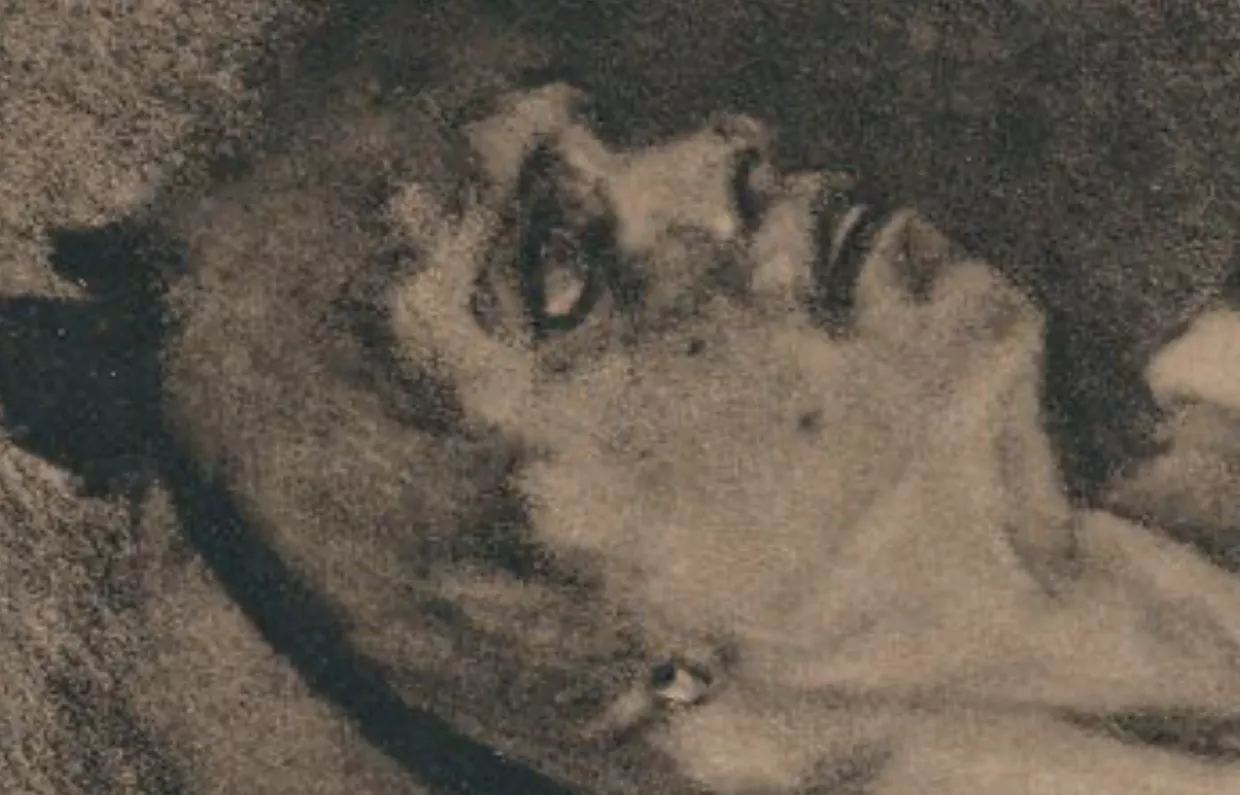
The life of Félicien Rops
Félicien Rops (1833-1898) came from a bourgeois Belgian family and began his artistic apprenticeship at the Namur academy. He was not fulfilled there and needed freedom, so he emancipated himself from the family environment, which he found oppressive.
In 1851, Félicien Rops entered the Université libre de Bruxelles and met a number of important artists. Alongside his studies, the young artist was a member of several literary circles and think tanks bringing together many representatives of the Belgian avant-garde.
Later, Rops entered the Atelier Saint-Luc, where he became familiar with the technique of lithography. His first commissions were mainly caricatures and book illustrations.
It was in France, however, that Félicien Rops' artistic career was to develop. The artist frequented several Parisian circles and settled there in 1874. In Paris, the artist met publisher Auguste Poulet-Malassis, who entrusted him with numerous engraving projects, mainly illustrations for licentious works.
While naturally curious, with his great culture and excellent memory, Rops greatly impressed his contemporaries, including Victor Hugo.
Félicien Rops was, however, much criticized, as he was known to lead a very libertine lifestyle, unburdened by all obligations, constraints and prejudices. His depictions of women shock because they wither conventional propriety.
The artist's highly singular vein of expression sets him apart from other expressionist artists of his time, such as Odilon Redon, Gustave Doré, or Marc Chagall.
Nevertheless, he managed to acquire a certain notoriety during his lifetime, and was adulated by the end of his life. In 1889, he was awarded the Légion d'Honneur, while the Hôtel Drouot consecrated him by exhibiting his work.
Fragile health forced Félicien Rops to interrupt his artistic career in the 1880s. He devoted himself to horticulture and continued painting, withdrawn from Paris and all artistic contacts in Essonne. Rops died a few years later.
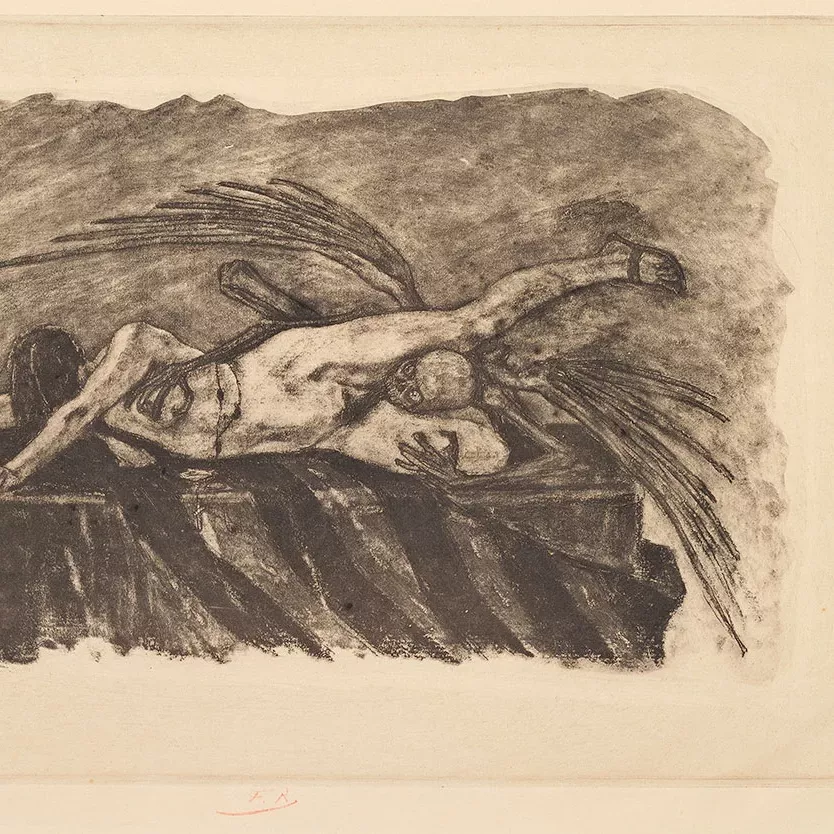
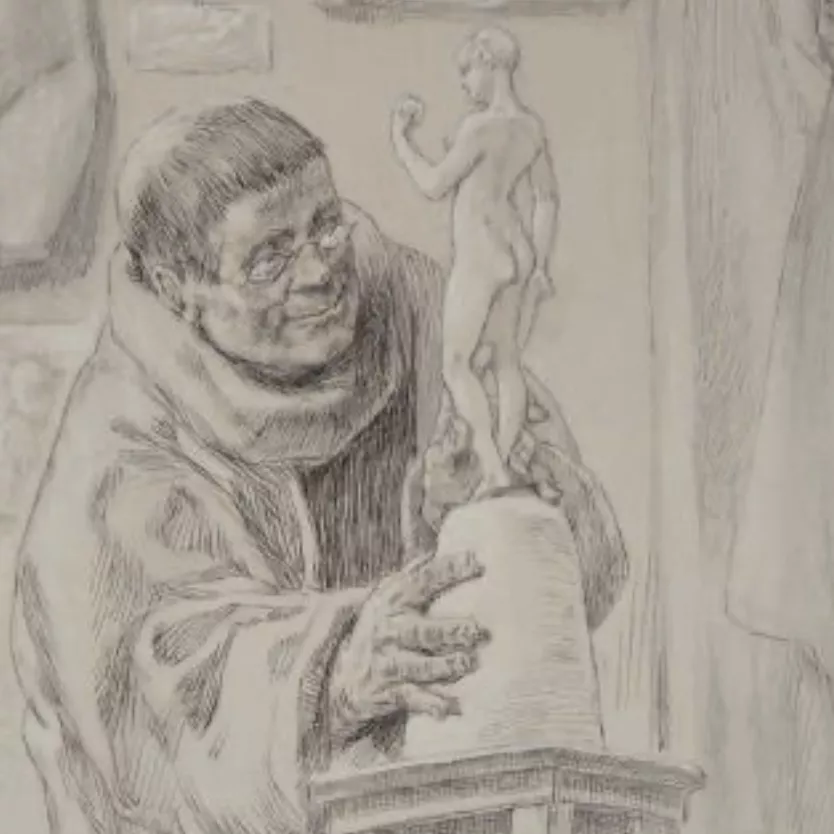
Focus on Agonie, Félicien Rops, etching
In Agonie, Félicien Rops explores the dark and morbid themes dear to him, offering a striking depiction of human suffering. Produced during his stay in Antwerp, this work testifies to the artist's mastery of capturing emotional intensity through etching.
Rops, known for his attraction toprovocative and macabre subjects, is distinguished here by a simple yet powerful composition.
The scene shows a figure lying prone, his naked, emaciated body resting on a surface evocative of an altar. The expression of despair and fatigue is accentuated by the menacing presence of a large black bird, reminiscent of a raven, the symbol of death.
In this work, Rops focuses on the essential: the confrontation between man and his inevitable destiny. The contrast between the paleness of the body and the surrounding darkness reinforces the idea of vulnerability and solitude, recurring themes in the artist's work.
Agonie also shows Rops' ambition to transcend mere illustration to achieve psychological depth. By discarding superfluous detail, he favors a minimalist approach in which every stroke, every shadow, is charged with meaning.
This work is both simple and complex: simple in its presentation of a pared-down scene, complex in the emotions it evokes and the interpretations it elicits. Here, Rops creates a universe where human suffering is exposed in all its brutality, without detour or embellishment.
With Agonie, Félicien Rops asserts his unique style, where darkness and the macabre become tools for exploring the human condition. He thus offers a poignant reflection on the fragility of life, while leaving an indelible mark on the history of Symbolist art.
Images from a century : Félicien Rops
Symbolism and anti-clericalism in the 20th century
In the 20th century, symbolism evolved with the expression of a daring and often virulent critique of religious institutions. Artists found it a point of departure in view of the iconography and artistic techniques characteristic of the current.
A direct descendant of the Symbolist movement born at the end of the 19th century, this artistic and literary current sought to move away from naturalism by focusing on the representation of abstract ideas and inner truths, often through complex symbols and metaphors.
Among the themes explored, anti-clerical criticism figured prominently, embodying a rejection of religious dogma in favor of a freer, more introspective quest for spirituality.
Symbolism, as a movement, was marked by a deep interest in the mysteries of existence, dark forces and hidden dimensions of the human soul.
In this context, religion, and in particular the clergy, often appeared as a restrictive force, imposing limits on individual freedom and spiritual exploration.
Many artists thus used their works to challenge ecclesiastical authority and denounce what they perceived as the hypocrisy and corruption of the Church.
The anti-clerical works produced during the 20th century perfectly illustrate this trend. Félicien Rops, for example, established himself as one of the major figures of this critique through works marked by provocative eroticism and bold depictions of religious themes.
His engravings, such as Pornocrats or The Temptation of Saint Anthony, hijacked sacred symbols to reveal a darker, subversive dimension, casting a critical eye on the oppressive influence of the clergy.
In the same spirit, the avant-gardes of the 20th century pursued this critique, often in an even more radical way. The Surrealists, led by André Breton, exploited the subversive potential of art to attack the Church and its dogmas.
Artists such as Salvador Dalí and Max Ernst thus created works in which religious figures are distorted, grotesque, or immersed in absurd scenarios, testifying to a desire for liberation from religious constraints and a rejection of the moral order imposed by the Church.
These works, by directly attacking the ecclesiastical institution, helped to redefine the role of the artist as a critic of society.
They show how, through art, it is possible to question old power structures and propose an alternative vision of the world, more in tune with modern aspirations to freedom and personal autonomy.
Twentieth-century symbolism and anti-clerical works thus remain essential witnesses to an era when art engaged in a profound dialogue with the great questions of its time, particularly those concerning religion and spirituality.
These creations not only reject the past, but also seek to explore new avenues for the expression of individuality and modernity, marking a key stage in the evolution of contemporary art.
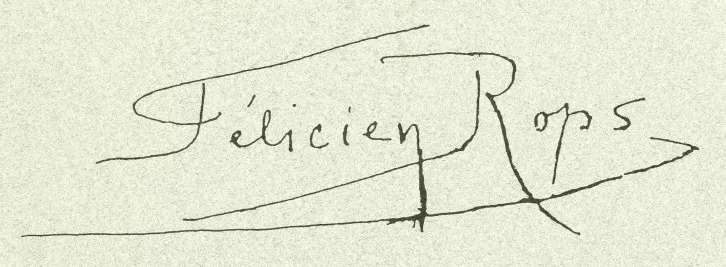
His signature
Not all Félicien Rops' works are signed.
Although there are variations, here's a first example of his signature:
Expertise your property
If you happen to own a work by or after Félicien Rops, don't hesitate to request a free appraisal by filling in our form on our website.
A member of our team, made up of experts and certified auctioneers, will contact you promptly to provide you with an estimate of the value of your work, and will ensure that you receive ad hoc information about it.
If you are planning to sell your work, you will also be accompanied by our specialists in order to benefit from alternatives for selling it at the best possible price, taking into account the inclinations of the market and its specificities.
Estimate in less than 24h
Discover in the same theme

Value and quotation of works by Jean Léon Gérôme : paintings...
Jean Léon Gérôme, a 19th-century painter and sculptor, is one of the most renowned artists of the Second Empire. His works are highly prized.
Learn more >

Rating and value of works, paintings by Jean-Joseph Benjamin...
Benjamin-Constant is a 19th-century Orientalist painter. The author of a rich output, his works are highly valued at auction.
Learn more >

Rating and value of paintings by Stanislas Lépine
Stanislas Lépine was a 19th-century landscape painter who produced many works that are highly valued at auction.
Learn more >
Works from the same period sold at auction

Estimated 2 000 € - 3 000 €
Delphin ENJOLRAS (1857-1945) "A Midsummer Night's Dream", Oil on canvas

Estimated 600 € - 800 €
Henri ZUBER (1844-1909), Bridge at Artemare. Oil on canvas.

Estimated 10.000 - 15.000 €
Ebridge Ayer BURBANK(1858-1949), Young African-American boy, Oil on panel.

Estimated 1.000 - 2.000
Jean COCTEAU (1889-1963) Salut à Orphée, Mylord, 1960, Ink on paper

Secure site, anonymity preserved

Auctioneer approved by the State

Free and certified estimates
Frequently asked questions
-
Who was Félicien Rops, and what was his artistic context?Félicien Rops (1833–1898) was a Belgian artist who became one of the leading figures of Decadentism and Symbolism. Settling in Paris in 1874, he distinguished himself with a provocative style that blended the technical precision of the graphic arts, unabashed eroticism, and virulent anticlerical criticism. His works, often blasphemous and macabre, shocked his contemporaries while earning him a certain notoriety and the Legion of Honor in 1889.
-
What are the price ranges for works by Félicien Rops?The prices of Félicien Rops’s works vary considerably depending on the medium and the piece’s prestige. Paintings sell for between €90 and €46,500, prints and multiples for between €10 and €52,400, and watercolor drawings for between €60 and €230,000. Exceptional works can far exceed these ranges, such as the drawing *Pomokrates*, which sold for €230,000 in 2017.
-
How do I have a work by Félicien Rops authenticated and appraised?Auctie's offers a free, no-obligation appraisal conducted by certified auctioneers and experts. Simply fill out the appraisal form on our website, and a member of our team will contact you promptly to provide you with an accurate assessment of your artwork’s value in today’s market.
-
Is this the right time to sell a work by Félicien Rops?Yes, this is a good time to sell a work by Félicien Rops. His works are currently highly regarded and widely available on the art market, with steady demand from collectors. The artist’s reputation and historical recognition as a major figure of Decadentism and Symbolism support the value of his works.
-
How does the sale of a work of art work at Auctie's?Auctie's supports you every step of the way: a free, no-obligation appraisal by an expert, and then, if you decide to sell, our specialists will guide you toward the best solution for selling your property at the highest possible price, taking into account market trends and the property’s unique characteristics. From the appraisal to the auction, you’ll benefit from the support of a professional auction house.
