



Rating and value of works, drawings, paintings by Raphaël Delorme

Key takeaways
- Paintings by Raphaël Delorme (1886–1962) range in price from €120 to €100,000, with his nudes being particularly sought after by French collectors.
- In 2021, *Female Nude in the Engine Room* sold for €100,000, exceeding its initial estimate (€12,000–15,000) by more than 400%.
- This Art Deco artist blends classical tradition with decorative modernity, combining architectural symmetry with lush imagination and vibrant color palettes.
If you own a work by or after the artist Raphaël Delorme, and would like to know its value, our state-approved experts and auctioneers will offer you their appraisal services.
Our specialists will carry out a free appraisal of your work, and provide you with an accurate estimate of its value on the current market.
Then, should you wish to sell your work, we will direct you to the best possible arrangement to obtain the optimum price.
Raphaël Delorme artist's rating and value
Raphaël Delorme is an artist with an Art Deco background. His legacy consists mainly of paintings and drawings. Now, prices for his works are rising under the auctioneers' gavel.
His nudes are particularly prized especially by French buyers, and the price at which they sell on the art market ranges from €200 to €100,000, a considerable delta but one that speaks volumes about the value that can be attributed to Delorme's works.
In 2021, a painting entitled Feminine Nude in the Engine Room sold for €100,000 while it was estimated at €12,000 to €15,000.
The work therefore exceeded the high estimate by more than 400%. The artist's quotation is quite high and varies according to the quantity of works present on the auction market.
Order of value from a single work to the most prestigious
Technique used | Result |
|---|---|
Estamp | From €1,200 to €1,360 |
Drawing - watercolor | From €200 to €11,430 |
Painting | From €120 to €100,000 |
Estimate in less than 24h
Style and technique by artist Raphaël Delorme
Raphaël Delorme's style and technique are part of a singular aesthetic, where the cross-over influence of classicism and Art Deco can be seen, but transcended by a teeming imagination.
His compositions are characterized by rigorous symmetry and almost architectural precision, reflecting his attachment to the classical values of order and harmony.
However, Delorme departs from traditional canons with his bold use of color and detail, which he pushes to a dreamlike luxuriance.
His figures, often borrowed from a reinvented mythology, unfold in lavish settings, where mosaics, drapery and complex geometric patterns reign.
The meticulousness of his technique recalls that of the old masters, but his aesthetic choices testify to a resolutely modern sensibility, nourished by the decorative experimentation of his time.
Painting in oil on canvas, he succeeds in creating a silky texture, playing with brilliant shades and light effects that lend his works an almost mystical depth.
Through this subtle alliance between tradition and the avant-garde, Raphaël Delorme has managed to set himself apart, inscribing his work in a temporality suspended between past and future.
The life of Raphaël Delorme
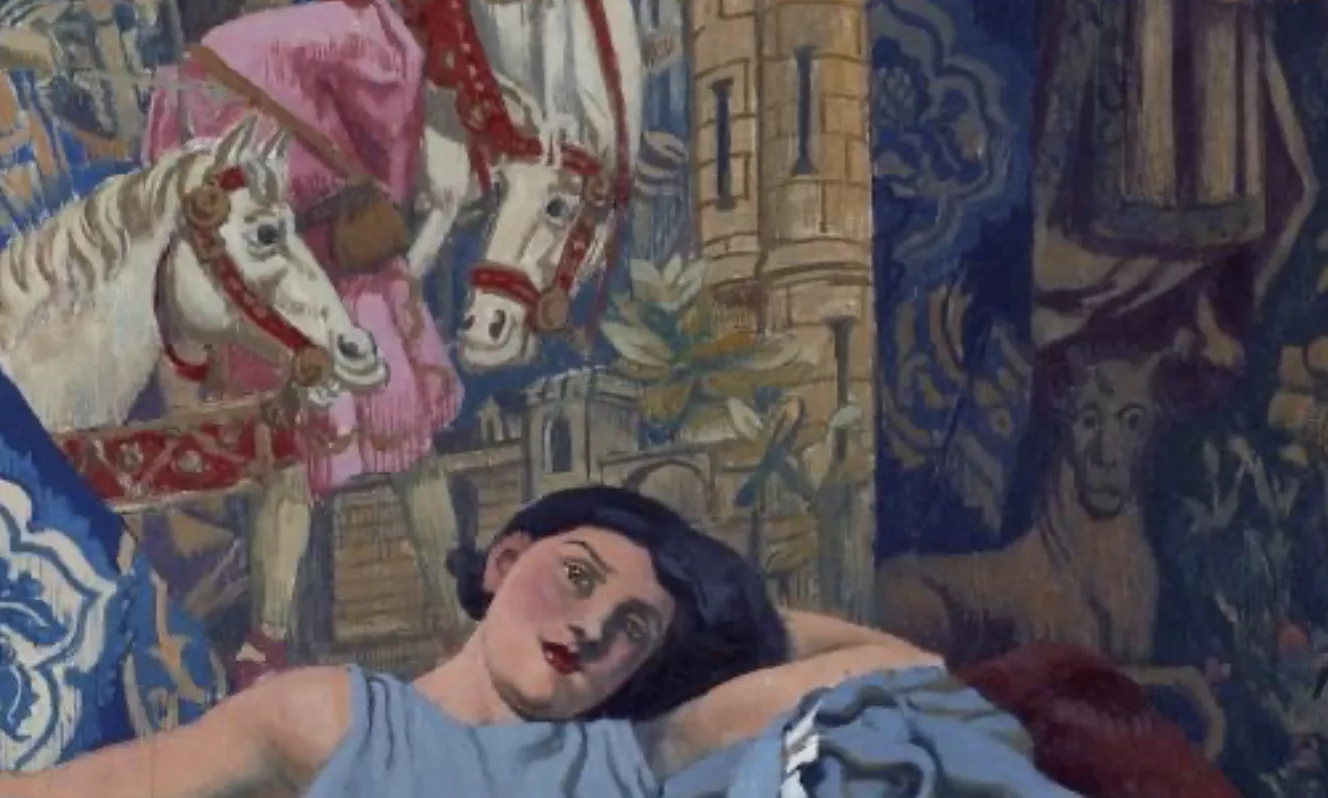
Raphaël Delorme (1886-1962) was a 19th-century French painter and artist, little known in his own time despite the current growing interest in his work.
He was born in Caudéran, near Bordeaux, and trained as an artist there at the École des Beaux-Arts. Neither his teachers nor the public are enthusiastic about his work.
Delorme paid no attention to being successful, and throughout his life produced works characterized by the Art Deco current, painting many nudes in fairly clear, pastelized geometric compositions.
He would say during his lifetime that he had only one real client, Mahradjah of Kapurtala. Delorme nevertheless exhibited his canvases in the capital's most eminent venues ; namely the Salon des artistes français, the Salon d'Automne or the Société nationale des Beaux-Arts.
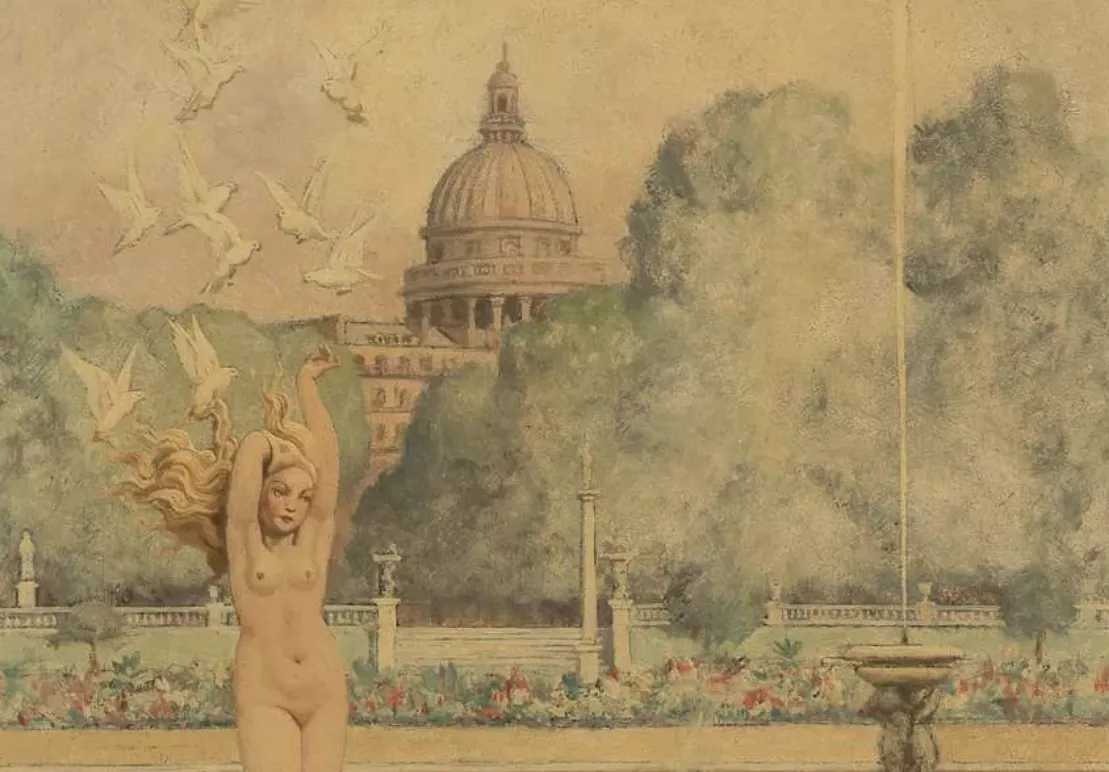
He borrowed many themes from Greek mythology, whose various goddesses he depicted in sometimes unexpected environments (cf Feminine nude in the engine room). The artist thus manages to remarkably reconcile ancient inspiration and contemporary pictorial technique.
Focus on Les Trois Grâces, Raphaël Delorme
In Les Trois Grâces (private collection), Raphaël Delorme reinvents the myth by inscribing it in an aesthetic midway between classical heritage and the luxuriance of Art Deco.
The symmetry of the composition, orchestrated with architectural precision, places three idealized female figures at the center of a lavish setting.
Draped in finely crafted geometrically patterned fabrics, they stand in poses as reminiscent of ancient statuary as they are of modern elegance.
Their luminous, almost unreal complexions contrast with the chromatic richness of the backgrounds, where fantastical architecture blends antique columns and orientalizing arabesques.
The light, diffused and carefully modulated, sculpts every detail, from the folds of the fabrics to the ornaments of the jewelry, testifying to meticulous craftsmanship.
This treatment, while exalting the idea of timeless beauty, also reflects the influence of goldsmithing and the applied arts, fields dear to the creators of the period.
With this work, Delorme not only illustrates a mythological subject: he uses it as a pretext to explore a decorative aesthetic, where pomp and balance compose an ideal universe.
Through Les Trois Grâces, he asserts himself as a painter in search of a dialogue between inherited traditions and a modernity that celebrates the sensuality of detail and the evocative power of the imaginary.
The legacy of Raphaël Delorme
The legacy of Raphaël Delorme lies in his ability to combine classical tradition and decorative modernity, making his work a bridge between two eras.
His compositions, with their fascinating architectural rigor, left a lasting mark on Art Deco with their brilliance and refinement.
Inspired by the Old Masters as much as by the audacity of the avant-garde, he integrated a rich ornamental vocabulary into his painting, where geometric motifs and mythological elements coexist harmoniously.
This balance between idealization and decorative fantasy influenced many decorators and artists concerned with combining art and craft.
His vision, deeply rooted in a quest for formal beauty, is echoed in the creations of mid-20th-century decorative artists, who also claimed a totalizing aesthetic, blending painting, design and architecture.
While Delorme's work remains confidential, it nonetheless illustrates an aesthetic quest in which technical mastery rises to the service of an abundant imagination, leaving a subtle but essential imprint on the history of the decorative arts.
Raphaël Delorme's place in the decorative arts
Raphaël Delorme was at the heart of the decorative arts movement with his approach blending structure and luxuriance, where geometric order is combined with fertile imagination.
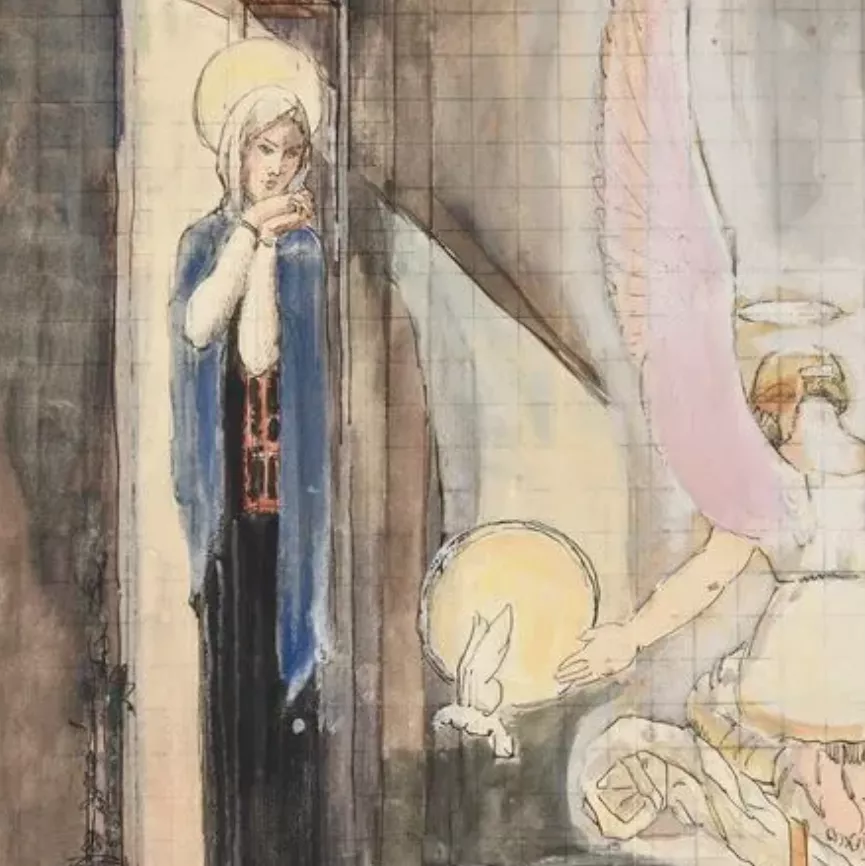
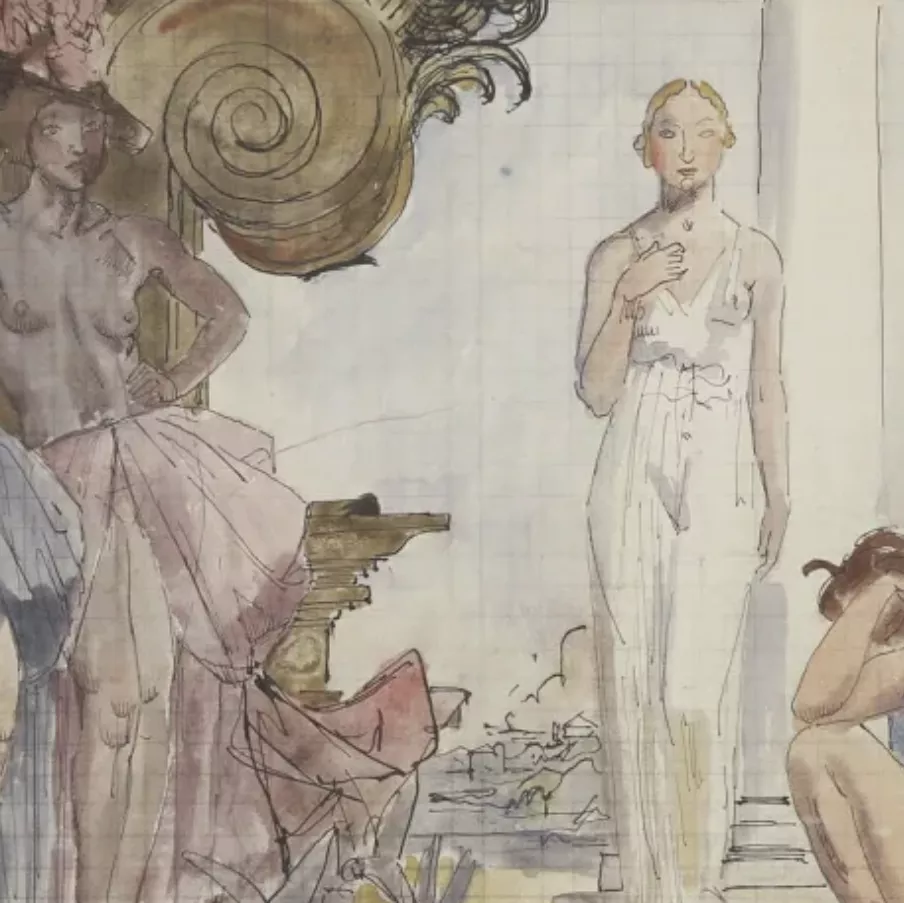
In his large-scale compositions, such as Le Triomphe des Idées (private collection), he favors a rigorous order, inherited from classical frescoes and Byzantine mosaics, while incorporating a modernity specific to Art Deco.
The omnipresent ornament becomes language, oscillating between learned geometry and narrative stylization.
His figures, often hieratic, seem to have emerged from a dreamlike universe, evoking timeless allegories draped in angular forms and bathed in vibrant colors.
Delorme draws as much from Mannerist decorations as from Renaissance symmetries, while remaining rooted in the innovations of his time, notably through his deft use of chromatic contrasts and flat textures.
In this, he illustrates a key trend of the movement: the fusion of the applied and fine arts, in an ideal where each work transcends its purely decorative function to embody a reflection on harmony and expressiveness.
His compositions dialogue with architecture, integrating ornamental elements designed to enhance the built environment, while asserting a pictorial autonomy.
Through this approach, Delorme played an active part in redefining the contours of Art Deco, combining technical virtuosity with a decorative sensibility where elegance and symbolism meet with unrivalled mastery.
Raphaël Delorme's stylistic influences
Raphaël Delorme is imbued with multiple influences, at the crossroads of eras and artistic traditions, which he synthesizes with a sensibility all his own.
His monumental compositions, such as Les Légendes (private collection), testify to a deep attachment to Byzantine art, with its brilliant mosaics and hieratic figures, but also to the Italian Renaissance, from which he takes the architectural perspective and solemnity of the settings.
You can also detect the imprint of Mannerism, in the elongation of forms and the theatrical postures of his figures.
However, Delorme didn't limit himself to looking to the past: he was also inspired by the stylistic advances of Art Nouveau, particularly in the ornamental treatment of motifs, as well as Art Deco, whose precise geometries and vivid chromatic contrasts he adopted.
Stylistically close to artists such as Toulouse-Lautrec, Edgar Brandt or Demetre Chiparus, Raphaël Delorme left his mark on the decorative arts movement.
His rich, vibrant palette evokes the works of Gustav Klimt, while the rigorous organization of his compositions recalls Bauhaus principles, without denying a certain narrative opulence.
Delorme is thus part of a dynamic stylistic crossbreeding, where the ancient dialogues with the modern, where formal rigor rubs shoulders with overflowing imagination.
This interplay of influences enables him to conceive a unique visual language, recognizable among all, where every detail is thought of as a fragment of a harmonious whole.
Through this fusion of styles, he contributes to enriching the decorative tradition while asserting a singular and visionary artistic identity.
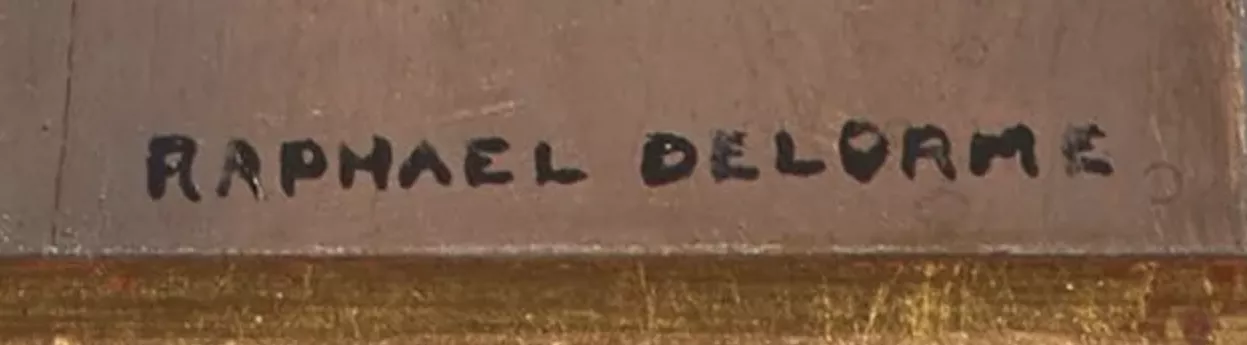
Recognizing Delorme's signature
The artist doesn't always sign his works. If you think you own one, it's best to have it appraised. The signature may differ depending on the type of work: print, drawing or painting. There are also copies, which is why expertise is important.
Knowing the value of a work
If you happen to own a work by or after Raphaël Delorme, don't hesitate to request a free appraisal using our form on our website.
A member of our team of experts and certified auctioneers will contact you promptly to provide you with an estimate of the market value of your work, as well as ad hoc information about it.
If you are considering selling your work, you will also be accompanied by our specialists in order to benefit from alternatives for selling it at the best possible price, taking into account market inclinations.
Estimate in less than 24h
Discover in the same theme

Rating and value of paintings, drawings and lithographs by J...
Joan Mitchell is an American Expressionist artist who has produced paintings and other works that are highly rated at auction. Estimate in 24h
Learn more >

Rating and value of paintings, drawings and watercolors by Y...
Yves Brayer is a twentieth-century figurative painter who has produced numerous works that are quoted and in demand on the auction market.
Learn more >

Rating and value of paintings by Paul Klee
Paul Klee was an Expressionist painter who taught at the Bahaus, and was responsible for a considerable body of work of high value.
Learn more >
Works from the same period sold at auction


Secure site, anonymity preserved

Auctioneer approved by the State

Free and certified estimates
Frequently asked questions
-
Who was Raphaël Delorme, and what was his artistic background?Raphaël Delorme (1886–1962) was a French painter associated with the Art Deco movement who received little recognition during his lifetime, despite exhibiting at the most prestigious Parisian art salons. His work is characterized by a fusion of classicism and Art Deco, featuring precise geometric compositions and mythological nudes imbued with ornate opulence. Although he had only one major client during his lifetime, his market value has risen considerably today.
-
What is the price range for Raphaël Delorme's works?The prices of Raphaël Delorme’s works vary considerably depending on the technique and the nature of the piece. Prints range from €1,200 to €1,360, drawings and watercolors from €200 to €11,430, and paintings from €120 to €100,000. His nudes are particularly sought after by French collectors and can fetch exceptional prices, as was the case in 2021 with a Female Nude that sold for €100,000.
-
How can you authenticate a work by Raphaël Delorme?Raphaël Delorme did not always sign his works, and there are copies in circulation. To authenticate a work attributed to the artist, we recommend that you request a free appraisal from Auctie's using our online form. A certified expert or auctioneer will examine your item and provide you with an accurate estimate of its market value within 48 hours.
-
Is this the right time to sell a work by Raphaël Delorme?Yes, now is a good time to sell a work by Raphaël Delorme. The artist’s value has been rising steadily on the art market, with growing demand from collectors, particularly in France. The market is particularly active for his nudes and decorative compositions, offering good opportunities for profit.
-
How does the appraisal process work at Auctie's?Appraisals at Auctie's are completely free and non-binding. Simply submit a request via our online form, providing details and photos of your artwork. A certified expert or auctioneer from our team will contact you promptly to examine the item and provide you with an accurate estimate of its market value. If you’re considering selling, our specialists will guide you through the process to help you get the best possible price.
