



Rating and value of paintings by Chaïbia Talal

Key takeaways
- Paintings by Chaïbia Talal (1929–2004), a master of Moroccan naïve art, sell for between €160 and €210,000, depending on the technique and quality.
- Oil-on-canvas works are the most sought-after segment, particularly medium-sized pieces (40–80 cm) from the 1970s and 1980s featuring stylized female figures and vibrant color palettes.
- Iconic works combining women, flowers, and protective symbols enjoy strong international liquidity, particularly in France, Europe, and the Gulf region.
If you own a work by or after Chaïbia Talal, and would like to know its value, our state-approved experts and auctioneers will offer you their appraisal services.
Our specialists will carry out a free appraisal of your work, and provide you with an accurate estimate of its value on the current market.
Then, if you'd like to sell your work, we'll direct you to the best possible arrangement to get the best price for it.
Rating and value of the artist Chaïbia Talal
The artist Chaïbia Talal leaves behind a rather colorful and figurative work, she is famous for her canvases and drawings. Now, prices for her works are rising under the auctioneers' gavel.
Her paintings are particularly prized, especially by American buyers. The price at which they sell on the art market ranges from €160 to €210,000, a substantial range but one that says a lot about the value that can be attributed to Chaïbia Talal's works.
In 2020, Les tisseuses de chtouka, Paris, January 1987, a colorful oil on canvas from 1987 was sold for €210,000, whereas it was estimated at €160,000 to €180,000.
Order of value from a simple work to the most prestigious
Technique used | Result |
|---|---|
Estamp - multiple | From €160 to €11,300 |
Drawing - watercolor | From €300 to €58,000 |
Painting | From €1,300 to €210,000 |
Estimate in less than 24h
The style and technique of Chaïbia Talal
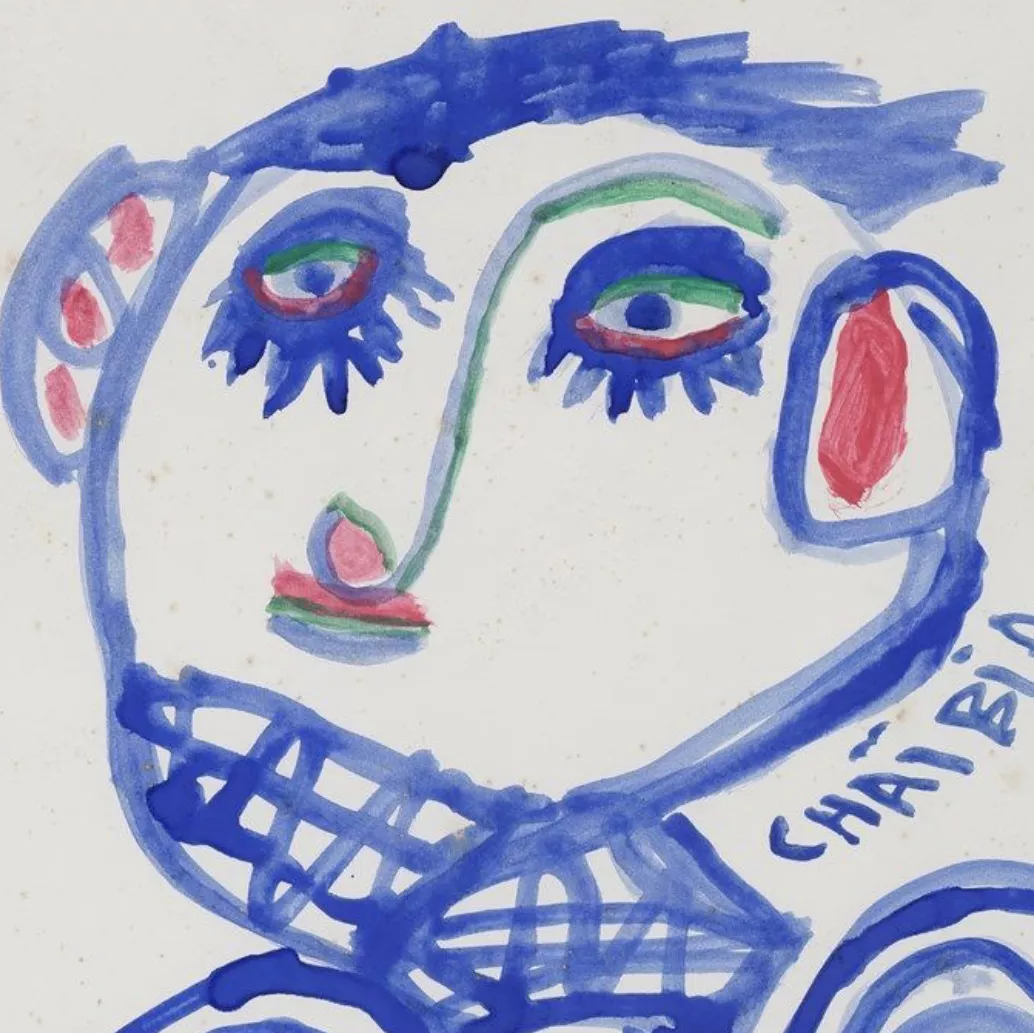
Chaïbia Talal (1929 - 2004)is a major figure of Moroccan naïve art and self-taught modernity. Her aesthetic is intuitive, spontaneous and free of academic canons. Her work has a symbolic, feminine and popular dimension, nourished by Moroccan traditions.
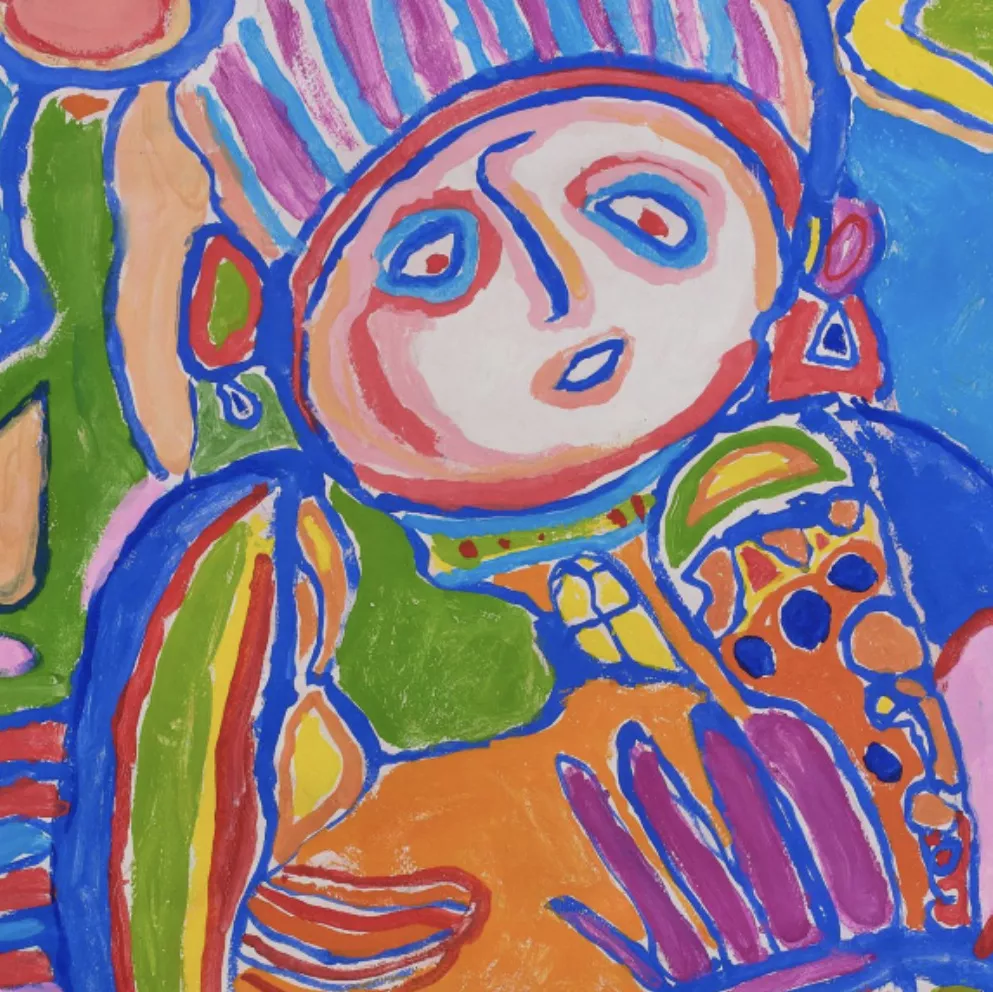
She depicts stylized human figures (women, children, musicians, ritual groups). Her recurring motifs are flowers, birds, moons and ornamental elements inspired by Moroccan fabrics and carpets. His bodies are simplified, sometimes disproportionate, with frontal silhouettes.
His faces are schematic, with large oval eyes and a mouth reduced to a pictorial sign. There's no volumetric modeling, the figure reads more like an icon or symbolic motif than a realistic portrait. Her palette is extremely vivid and saturated, with reds, yellows, cobalt blues, acid greens and pinks.
She uses straightforward flat tints, without gradations, sometimes juxtaposed in strong contrasts. Color is a direct emotional language, associated with celebration and vital energy. Light is conceptual, not naturalistic. There are no cast shadows or identifiable light sources.
The luminous space is created by simple color intensity. The organization is frontal, and quasi-architectural, with figures arranged in rows with intuitive symmetries. The spaces are filled with motifs and ornaments, echoing the popular Moroccan aesthetic.
The spaces are filled with motifs and ornaments, echoing the popular Moroccan aesthetic. It shows a tendency towards decorative flatness, inherited from vernacular arts (weavings, ceramics and ritual paintings). Emptiness is rarely preserved, with compositions that are often dense and saturated, in an ascending movement.
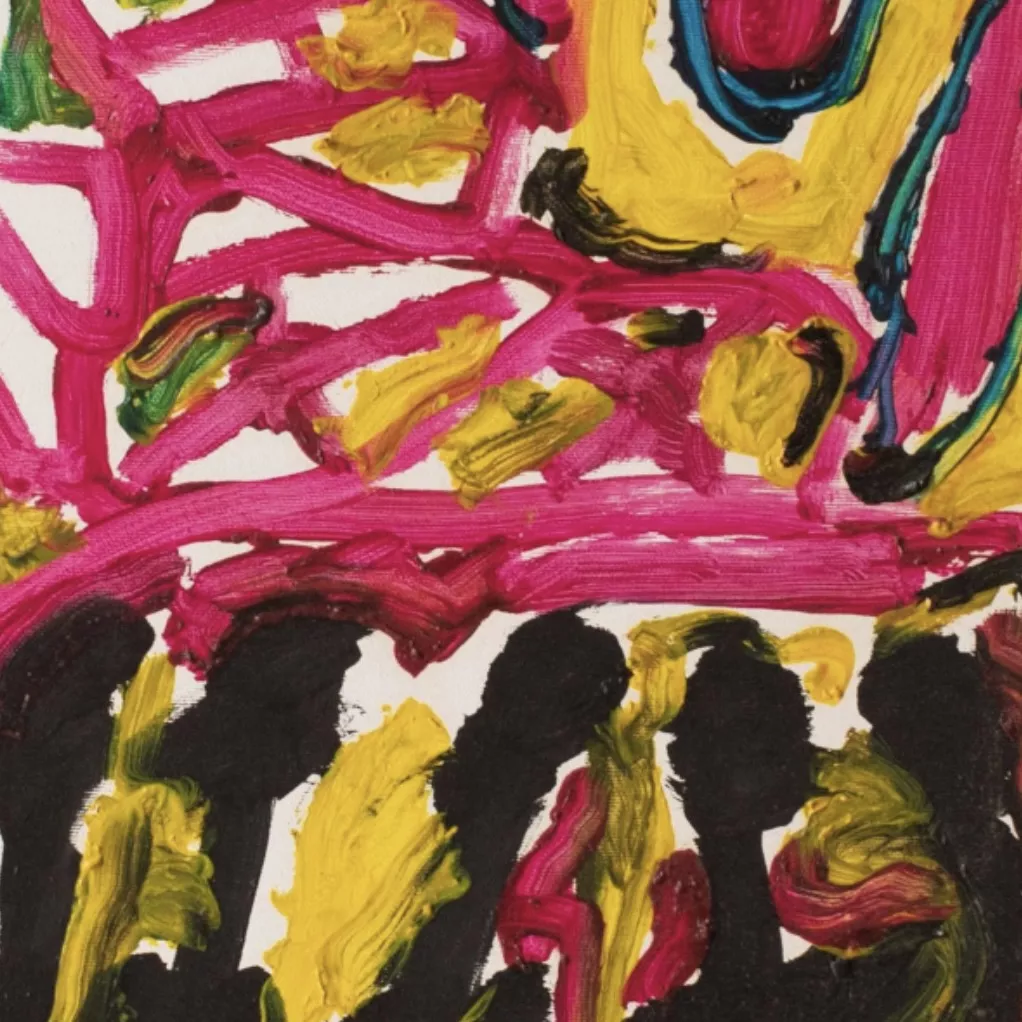
The paint is generally applied in thick flat tints, with no glazes or visible repentirs. The brush is sometimes replaced by a more direct, impulsive gesture. The composition is intuitive, with an absence of preparatory drawing and a claimed spontaneity.
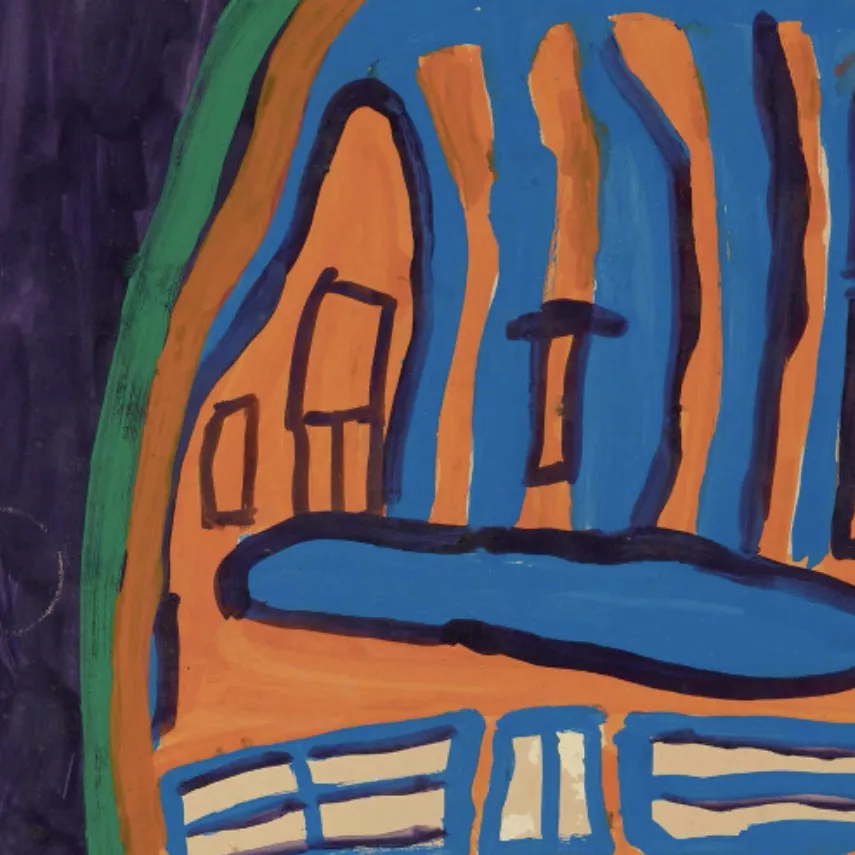
She works on canvas or cardboard, with a deliberately raw and simple material. She is culturally influenced by Berber traditions, textile motifs and the bright colors of the souks, but also by folk tales, dreamlike visions and intuitive cosmology (suns, moons, protective symbols).
Her work is deeply emotional, celebrating joy, community and feminine energy. She represents a protective dream world, in contrast to the difficulties of her real life. She sees art as an act of freedom, rejecting realistic figuration in favor of visual poetry.
The life of Chaïba Talal
Chaïba Talal (1929 - 2004) was born in Chtouka (near El Jadida, Morocco) into a modest, rural background. She was orphaned at an early age and married an older man at 13. She became a mother at 14. Her life was marked by poverty and limited access to education. She is illiterate, and learns mainly by observation, memory and gesture.
Before marriage, she works as a domestic and farm laborer. She was also widowed at a very young age, and had to support her son, the future artist Hossein Talal, alone. Her daily experience was difficult, but her fertile imagination was nourished by oral traditions and vernacular motifs.
According to her, she had a premonitory dream at the age of 25 that told her she would become a painter. She started out self-taught, without any academic training, and used simple materials (cardboard, paper, cheap paints). Her pictorial gesture is totally instinctive, driven by a need for inner expression.
She was spotted by her son, himself a young artist, and by Moroccan painters living in Casablanca. She was introduced to the artist and critic Ahmed Cherkaoui, then to the poet and painter Jean-François Thomé, who played an important role in her discovery.
Chaïma Tabal exhibited for the first time in the early 1960s, arousing astonishment and admiration for the intuitive power of her work. In the 1970s and 1980s, she held numerous exhibitions in Morocco, then abroad (France, Denmark, Italy, Belgium).
Chaïma Tabal first exhibited in the early 1960s, arousing astonishment and admiration for the intuitive power of her work.
She became one of the emblematic figures of Moroccan naive art and self-taught female expression, representing Morocco at major cultural events and actively participating in the recognition of Moroccan painting.
The biographical themes reflected in her work are dignified, colorful women and protective figures with an idealized transposition of her own experiences. She depicts scenes of motherhood, community celebrations and popular rituals.
Chaïba Talal is the first Moroccan woman to achieve major artistic recognition, and is a fundamental figure in the emergence of pictorial modernity in Morocco, outside academism. She inspired several generations of self-taught artists, particularly women, and is today considered a pillar of twentieth-century Moroccan art and an icon of popular female creativity.
Market segmentation and artist rating
The types of work in circulation are mainly oils on canvas, which are the main and most sought-after segment, with strong international demand. There are also gouaches and mixed techniques on paper, with an active, more accessible secondary market.
Behind them, drawings are relatively rare but remain a sought-after segment for collectors of art brut and naïf. His late, typically colorful works have good liquidity, but their valuation is also dependent on their quality.
Small formats (under 40 cm) with stylized portraits and female figures constitute a highly liquid segment. Medium formats (40 - 80 cm) form the core of the market, with full figurative compositions dominating.
Large formats over 80 cm are rarer and highly valued, particularly in Europe and the Gulf. The most sought-after subjects are emblematic female figures, frontlaid silhouettes with large eyes, festive scenes, women's gatherings, maternities, protective symbols with high demand.
Iconic compositions that cumulate several motifs (women, flowers, symbols) are the most highly priced. The valuation criteria are therefore maximum typicity (bright colors, schematic silhouettes, frontal composition), period (1970 - 1980 are the most sought-after decades).
We also note the importance of the palette with saturation, which is better valued than darker works, but also the state of conservation (stable varnish, absence of cracks on thick solids), provenance (elematic Moroccan collections, pioneering galleries (Charpentier, Paris).
France is a historically important market, thanks in particular to the École de Paris and the galleries that supported it. Liquidity is very high for typical small and medium formats, good for gouaches and works on paper, excellent for iconic works with strong stylization and more variable for less structured late works.
She is now one of the highest-priced African artists at auction ; and features prominently among her colleagues-women, following the market's highest rising odds as Bahia Mahieddine, Leonora Carrington, Tamara de Lempicka or Etel Adnan.
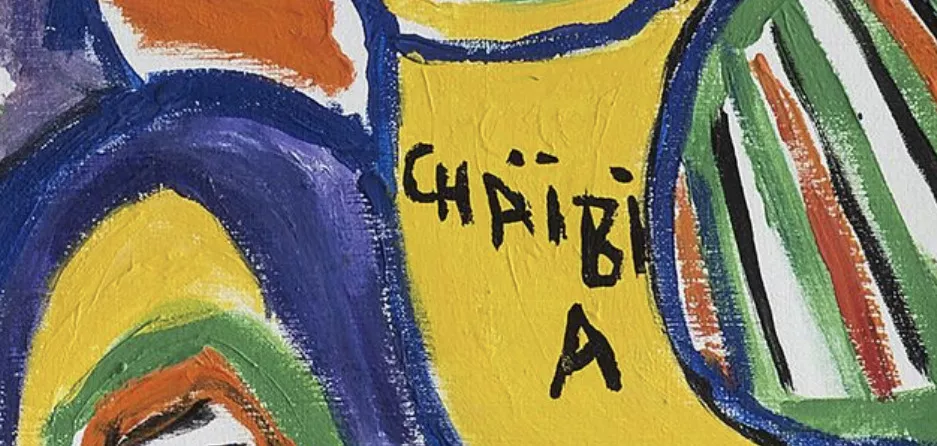
Her signature
Not all of Chaïbia Talal's works are signed.
Although there are variations, here is a first example of her signature:
Expertise your property
If you own a work by Chaïbia Talal, don't hesitate to request a free appraisal by filling in our online form.
A member of our team of experts and certified auctioneers will contact you to provide an estimate of the market value of your work.
If you are considering selling your work, our specialists will also guide you through the various alternatives available to obtain the best possible price, taking into account market trends and the specific features of each work.
Estimate in less than 24h
Discover in the same theme

The value and quotation of Jean Couty's paintings
Jean Couty has produced works of contemporary art that are currently highly prized on the art market. The value of his paintings remains as high as ev...
Learn more >

Value and quotation of works, ceramics by Théodore Deck
Théodore Deck, a 20th-century ceramist, has produced a unique work whose value is growing on the auction market. Estimated in 24h.
Learn more >

Rating and value of Jean Dufy's watercolors and paintings
Jean Dufy is a modern artist who has produced numerous paintings and watercolors that are highly valued at auction.
Learn more >
D'autres tableaux modernes figuratifs vendus aux enchères

Estimated 800 - 1.500
Jean Roger SOURGEN (1883-1978) Trees and dunes Oil on panel

Estimated 3.000 - 5.000
Georges LAPCHINE (1885-1951) The port of St Tropez Oil on canvas

Estimated 18.000 - 30.000
Charles CAMOIN (1879-1965) "Le Port de Marseille, 1928" Oil on canvas.

Estimated 1.500 - 3.000
Jean VANDEN EECKHOUDT (1875-1946), Basket of persimmons, Oil on canvas

Estimated 2.000 - 4.000
Charles LACOSTE (1870-1959) Starry night, Oil on paper mounted on canvas

Secure site, anonymity preserved

Auctioneer approved by the State

Free and certified estimates
Frequently asked questions
-
Who is Chaïbia Talal, and what is her artistic background?Chaïbia Talal (1929–2004) was a leading figure in Moroccan naïve art and self-taught modernism. A self-taught artist born into a modest rural background, she developed an intuitive and spontaneous style inspired by Berber traditions and Moroccan textile patterns. She was the first Moroccan woman to achieve major artistic recognition and stands as a pillar of 20th-century Moroccan art and an icon of women’s folk creativity.
-
What is the price range for Chaïbia Talal's works?Prices for works by Chaïbia Talal range from €160 to €210,000, depending on the medium and quality. Prints and multiples sell for between €160 and €11,300; drawings and watercolors for between €300 and €58,000; while paintings—the most sought-after category—fetch between €1,300 and €210,000. Medium-sized works (40–80 cm) and the highly colorful pieces from the 1970s and 1980s form the core of the market.
-
How can you authenticate and appraise a work by Chaïbia Talal?To authenticate and appraise a work by Chaïbia Talal, we recommend that you submit a request for a free appraisal to Auctie's. Our team of experts and state-certified auctioneers will examine your artwork and provide you with an accurate assessment of its market value within 48 hours, with no obligation on your part.
-
Is this the right time to sell a work by Chaïbia Talal?Yes, this is an excellent time to sell a work by Chaïbia Talal. The artist’s market value is steadily rising, particularly among international buyers. She ranks among the highest-valued African artists at auction and enjoys very high market liquidity, especially for her typical small- and medium-sized works as well as her iconic, colorful compositions from the 1970s and 1980s.
-
How does the sale of a work of art work at Auctie's?At Auctie's, we guide you every step of the way, from appraisal to auction. After an initial free, no-obligation appraisal conducted by our certified auctioneers, our specialists will walk you through the available options to help you achieve the best possible price, taking into account market trends and the unique characteristics of your artwork.
