



Rating and value of Baya Mahieddine's paintings and drawings

Key takeaways
- An Algerian artist (1931–1998) recognized by the Surrealists, her works sell for between €80 and €112,000, with prices rising steadily since the 2000s.
- Drawings command the highest prices (€230 to €112,000), while paintings range from €1,200 to €13,600 depending on the technique used.
- In 2022, a 1950 gouache on paper exceeded its estimate by more than 500%, selling for €112,000 against an initial estimate of €15,000–20,000.
If you own a work by artist Baya Mahieddine or based on her work and would like to know its value, our state-approved experts and auctioneers will guide you.
Our specialists will carry out a free appraisal of your work, and provide you with an accurate estimate of its value on the current market.
Then, should you wish to sell your work, we will direct you to the best possible arrangement to obtain the optimum price.
Artist's rating and value
Algerian artist, Baya Mahieddine won over the critics, dealers and art collectors of her day. Since then, the artist's works have established themselves as sure-fire values on the art market.
From the 2000s onwards, her quotation exploded and showed steady growth, particularly for her works produced from the 50s onwards.
As a result, the price at which Baya Mahieddine's works sell ranges from €80 to €112,000. In 2022, a gouache on paper dating from 1950 entitled Femmes et enfants autour d'une petite table sold for €112,000, whereas it was estimated at between €15,000 and €20,000, over 500% the price of the high estimate.
Order of value from the most basic to the most prestigious
Technique used | Result |
|---|---|
Estamp - multiple | From €80 to €470 |
Painting | From €1,200 to €13,600 |
Sculpture | From €1,200 to €27,000 € |
Drawing | From €230 to €112,000 |
Estimate in less than 24h
The artist's works and style
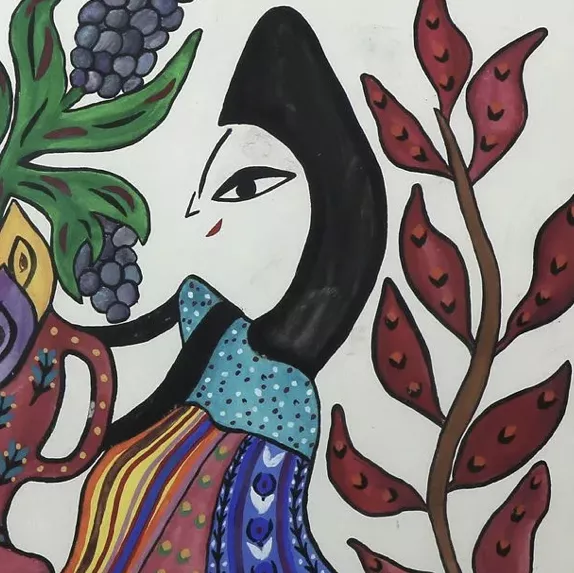
Baya Mahieddine develops a plastic language of astonishing freedom, where color and motif intertwine in a dreamlike celebration of the feminine world.
Her work, instinctive and teeming, escapes the usual classifications, oscillating between figuration and symbolic vision.
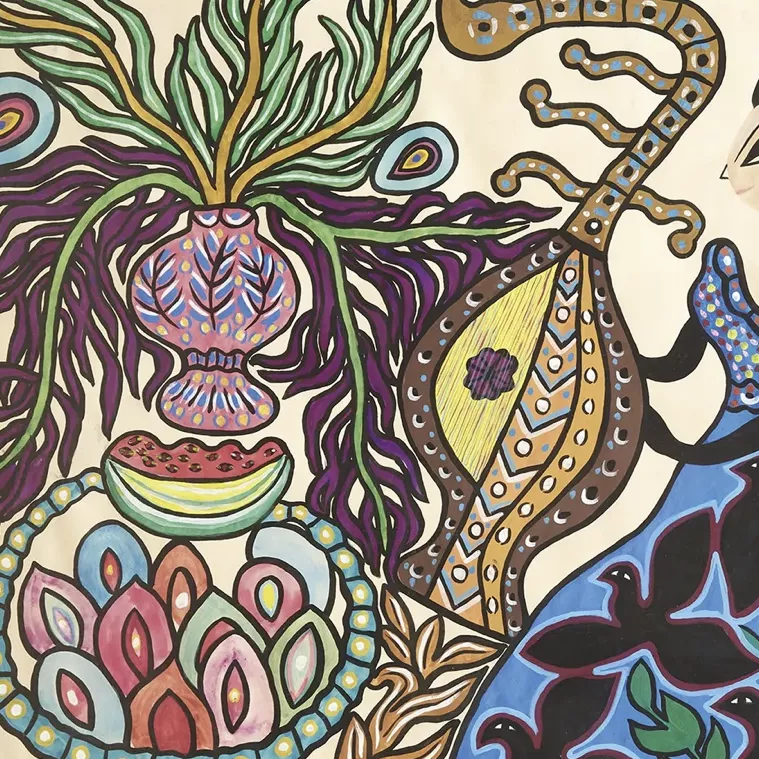
Each composition is organized around a profusion of arabesques and plant motifs, deployed in a brilliant chromatic range dominated by deep blues, solar yellows and vibrant reds.
The supple, fluid line structures hieratic silhouettes, often feminine, queens or musicians frozen in a timeless ritual.
Far from academic principles, Baya composes according to an inner logic, in the manner of self-taught painters, giving her figures an almost incantatory presence.
The background, saturated with motifs, abolishes all traditional perspective, transforming each scene into a dreamlike space, populated by birds, flowers and musical instruments.
Through this approach, she inscribes her work in a filiation that, without being fully surrealist, shares its spirit of freedom and invention, offering a vision of the world where ornament becomes the medium of an intimate and mythological narrative.
Baya Mahieddine, her life, her work
Fatma Haddad, better known as Baya Mahieddine (1931-1998), was an Algerian artist who left her mark on French and European modern art.
She lost both her parents at the age of five and was later hired as a servant by Marguerite Camina Benhoura, thanks to whom she gained a foothold in the art world.
Baya began producing work at an early age, in sculpture as well as painting and drawing, although the first two mediums are less common on the auction market.
She made a name for herself early on, being noticed at the age of 16 by Aimé Maeght, a French collector and gallery owner, who was won over by her talent.
Thanks to him, she became known and exhibited in France as early as the 40s and took the name Baya, then Baya Mahieddine, under which she is known today in the art market.
She had the opportunity to exhibit with Surrealist artists - André Breton would call her a queen. However, Baya always refused to fit into any particular movement or label her work.
A true source of inspiration for many artists, including such masters as Picasso and Matisse, Baya was photographed in 1948 in front of her paintings by Vogue, propelling her fame beyond the art world.
In the exhibition catalogs in which she appeared, Breton, beyond calling her a queen, wrote of her work as a Muslim world " scandalously enslaved ".
In parallel, she spent several months working on ceramics in Provence with Picasso. Few of the works produced during this period have gone to auction, but the fruit of this collaboration suggests a strong potential for results.
Such is her posterity that an exhibition dedicated to her, entitled " Woman of Algiers " was devoted to her in New York to pay tribute to her. The Maeght gallery still exhibits some of her works, and an exhibition has been dedicated to her at the Institut du Monde Arabe in 2023.
Her art, sometimes described as " tribal ", brings her into close contact with Picasso, who drew on elements of primitive art to construct his first cubist paintings.
Focus on Femmes au perroquet, Baya Mahieddine
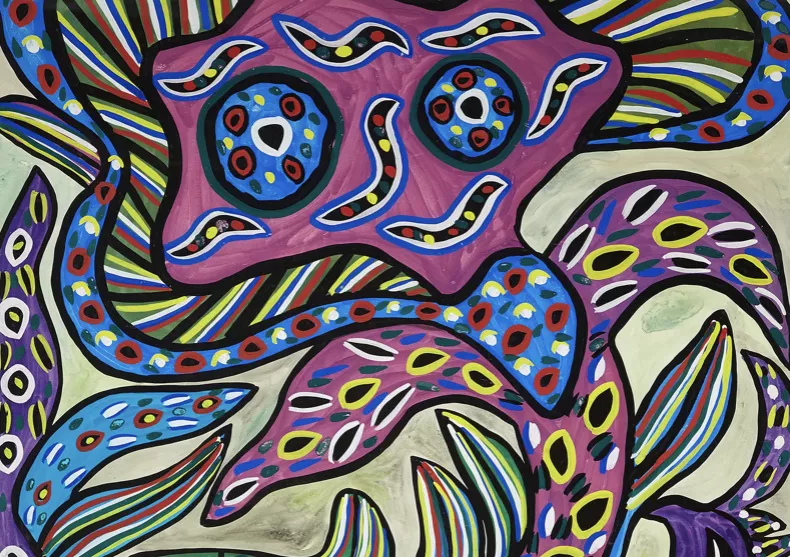
In Femmes au perroquet (private collection), Baya Mahieddine elaborates a composition where line, supple and continuous, defines female figures with stylized contours, inscribed in a space saturated with floral motifs and decorative scrolls.
The treatment of forms, simplified to the essential, recalls Persian miniatures as much as the cloisonné flat tints of traditional ceramics.
The parrot, a recurring element in her iconography, stands out against a background where ornamentation replaces all perspective, abolishing the distinction between figure and decoration. Color, bold and laid down in broad, uniform patches, plays a structuring role: deep blues, intense ochres and bright reds establish a chromatic dialogue where the absence of modeling reinforces the frontality of the subject.
At the crossroads of popular imagination and a modern reinvention of tradition, the work is part of an approach in which narrative gives way to a celebration of the motif, carried by a pictorial language freed from all illusionist constraints.
Baya Mahieddine's imprint on her time
Baya Mahieddine, from her appearance on the art scene in 1947, imposed a singular vision that departed from mainstream trends while dialoguing with the avant-gardes.
Her work, immediately hailed by André Breton, is part of a re-reading of primitivism that eschews the Orientalist clichés then in vogue.
In contrast to the Cubist experiments and lyrical abstraction that marked the post-war period, she developed a pictorial language in which color and ornamentation prevail over any illusionistic construction.
Her influence can be measured by the yardstick of artists from the Maghreb and the diaspora, who find in her work a model of identity affirmation and an aesthetic claim freed from the Western gaze.
In the context of decolonization, his compositions saturated with floral motifs and feminine figures affirm a poetics of the imaginary that transcends cultural divides and inscribes Algerian painting in a dynamic where memory and modernity come together.
The stylistic influences of Baya Mahieddine
Baya Mahieddine develops, from her earliest works, a plastic language that draws on multiple sources, while remaining irreducible to a single filiation.
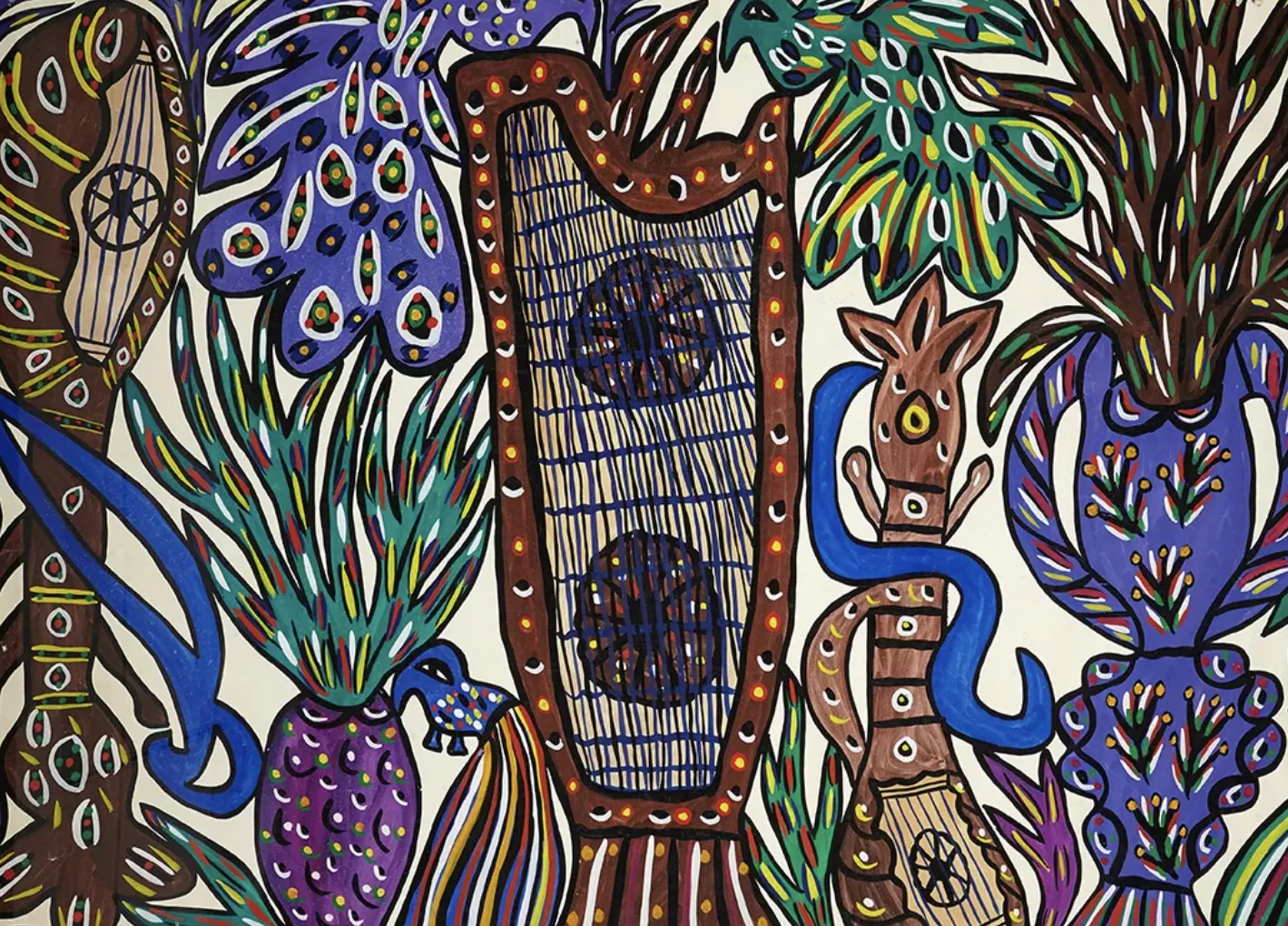
The influence of Persian and Maghrebian miniature is evident in the meticulous arrangement of floral motifs and female figures, where the absence of linear perspective favors an ornamental approach to the pictorial plane.
This structuring, which evokes the tradition of Berber illuminations and ceramics, is echoed in her use of bright colors, applied in flat, ungraduated patches, in the manner of the embroidered fabrics and mosaics that populate her imagination.
While the stylization of silhouettes and plant elements suggests a possible connection with the work of Matisse, Baya's painting moves away from Fauvism with its logic of accumulation and obsessive repetition of motifs, which place it more in line with a decorative thinking close to folk art.
In addition, his encounter with the Surrealist circle in 1947, under the impetus of André Breton, inscribed his work in a dimension where the marvelous is combined with raw expressivity, echoing the research of a Klee, a Miro or a Ernst.
However, Baya yields to neither automatism nor fragmentation of subject, favoring instead dense compositions, where arabesque and floral motif form an unbroken network.
His approach to figuration, which rejects realism in favor of radical stylization, anticipates the research of Maghrebian postmodernist artists, while anchoring itself in a sensibility that is as much a matter of traditional heritage as of an eminently personal vision.
Thus, his work, far from being a simple syncretism, bears witness to a subtle dialogue between visual memory and formal invention, giving his painting an aesthetic autonomy that sets it apart in the twentieth-century artistic landscape.
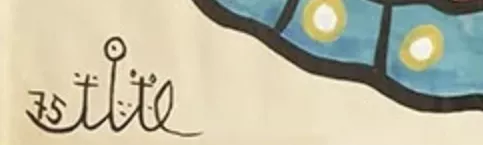
Her signature
Not all of Baya Mahieddine's works are signed, and copies exist.
An example of her signature can be seen in the drawing below.
Expertise your property
If you own a work by Baya Mahieddine, please feel free to request a free appraisal by filling in our online form.
A member of our team of experts and licensed auctioneers will contact you to provide an estimate of the market value of your work.
If you are considering selling your work, our specialists will also guide you through the various alternatives available to obtain the best possible price, taking into account market trends and the specific features of each object.
Estimate in less than 24h
Discover in the same theme

Value and quotation, paintings and works by Maurice de Vlami...
Maurice de Vlaminck, a fully-fledged member of the Fauvist group, produced works and paintings that are gaining in value at auction.
Learn more >

Rating and value of paintings by Vladimir Terlikowski
Vladimir Terlikowski is a twentieth-century Polish painter whose works are highly valued at auction.
Learn more >

Rating and value of drawings and paintings by Arbit Blatas
Arbit Blatas is a painter from the School of Paris whose paintings and sculptures command high prices at auction.
Learn more >
Works from the same period sold at auction

Estimated 2.000 - 4.000 €
PABLO PICASSO (1881-1973) ATELIER MADOURA " Profil de femme n° 67 " Round plate.

Estimated 18.000 - 20.000
PICASSO Pablo (after, 1881-1973) MADOURA (ceramist, publisher) "Femme du barbu" turned pitcher

Estimated 400 - 800
Joan MIRO (1893-1983), Montroig II (M. 954), Lithograph

Estimated 4.000 - 6.000
Pierre HODÉ (1889-1942) Vue de Port, Oil on canvas

Estimated 2.000 - 4.000
Pierre HODÉ (1889-1942) "Étude pour l'Usine" Oil on canvas

Estimated 2.000 - 3.000
Pablo PICASSO (1881-1973) MADOURA Service Black face, A plate

Secure site, anonymity preserved

Auctioneer approved by the State

Free and certified estimates
Frequently asked questions
-
Who is Baya Mahieddine, and what is her artistic background?Baya Mahieddine (1931–1998) was a leading Algerian modern artist who made a name for herself as early as the 1940s. Discovered at age 16 by gallery owner Aimé Maeght, she developed a unique visual language blending Maghreb tradition, Persian miniature art, and surrealist sensibilities, while never allowing herself to be pigeonholed into any particular movement. Hailed by André Breton as a “queen,” her influence extended to Picasso and Matisse, and her work remains a major reference point for artists from the Maghreb and the diaspora.
-
What are the prices and price ranges for Baya Mahieddine's works?Prices for Baya Mahieddine’s works range from €80 to €112,000, depending on the medium and the period. Drawings range from €230 to €112,000, paintings from €1,200 to €13,600, sculptures from €1,200 to €27,000, and prints from €80 to €470. Since the 2000s, his market value has shown steady growth, particularly for his works created from the 1950s onward.
-
How can you authenticate a work by Baya Mahieddine and have its value appraised?To authenticate and appraise a work by Baya Mahieddine, we recommend that you request a free appraisal from Auctie's by filling out our online form. A state-certified expert or auctioneer will contact you to provide an accurate estimate of your artwork’s market value, with no obligation.
-
Is this the right time to sell a work by Baya Mahieddine?Yes, now is a good time to sell a work by Baya Mahieddine. Since the 2000s, her market value has shown steady growth, and her works have established themselves as safe bets in the art market. Furthermore, growing interest in artists from the Maghreb and institutional recognition (the “Woman of Algiers” exhibition in New York, a retrospective at the Arab World Institute in 2023) are driving demand.
-
How does the appraisal and sale of a work of art take place at Auctie's?The appraisal is free and non-binding: simply fill out our online form, and a certified expert or auctioneer will contact you and provide an appraisal within 48 hours. If you’d like to sell, our specialists will guide you through the various options available to help you get the best price, taking into account market trends and the specific characteristics of your item, all the way through to the live auction.
