



Rating and value of Joan Miro lithographs, paintings and sculptures

Key takeaways
- Miró's paintings sell for between €50 and €26,042,000 at auction, while his ceramics fetch up to €450,000.
- A Catalan artist and pioneer of Surrealism since the 1920s, Miró influenced Abstract Expressionism and Lyrical Abstraction with his minimalist style and vivid colors.
- Approximately 30,000 of Miró’s lithographs have been sold at auction, with prices ranging from €10 to €137,630, making his work widely accessible.
If you own a work by or based on the artist Joan Miro and would like to know its value, our state-approved experts and auctioneers will guide you.
Our specialists will carry out a free appraisal of your work, and provide you with an accurate estimate of its value on the current market.
Then, should you wish to sell your work, we will direct you to the best possible arrangement to obtain the optimum price.
Artist's rating and value
Because of his popularity, Lucio Fontana's rating on the art market is high and stable. Highly coveted by collectors, his futuristic paintings can fetch thousands of euros at auction.
The price at which they sell on the auction market ranges from €10 to €26,042,000, a consequent delta but one that speaks volumes about the value that can be attributed to the artist's works.
As witness his lithograph Homenatge à Jean Prats, dating from 2022 sold for €137,630 in 2022, a significant sum for a lithograph.
Order of value from the most basic to the most prestigious
Technique used | Result |
|---|---|
Lithography | From €10 to €137,630 |
Ceramics | From €10 to €450,000 | Sculpture - volume | From €120 to €10,692,000 |
Drawing - watercolor | From €80 to €24,751,000 |
Painting | From €50 to €26,042,000 |
Estimate in less than 24h
The artist's works and style
In the first half of the 20th century, a new pictorial language developed under the impetus of Joan Miró. This Catalan artist, although often associated with Surrealism, went beyond the boundaries of this movement to create a style all his own.
Miró was distinguished by his mastery of simple, almost childlike forms, which he combined with bright, often primary colors, giving his works an inimitable vitality.
In fact, Joan Miró was not content to follow the codes of Surrealism. He appropriated the concepts of dreams and the unconscious, while reinterpreting them through pared-down compositions, as evidenced by his painting "Le Carnaval d'Arlequin".
With this work, he established himself as a pioneer of a surrealism with poetic and colorful accents, where abstraction and figuration respond to each other without ever clashing.
Miró's technique is based on a constant quest for experimentation. From the 1920s onwards, he moved away from traditional painting to explore other mediums such as ceramics and sculpture.
This diversity of approaches testifies to his desire to push back the boundaries of art, while remaining faithful to a quest for spontaneity and simplicity in form and color.
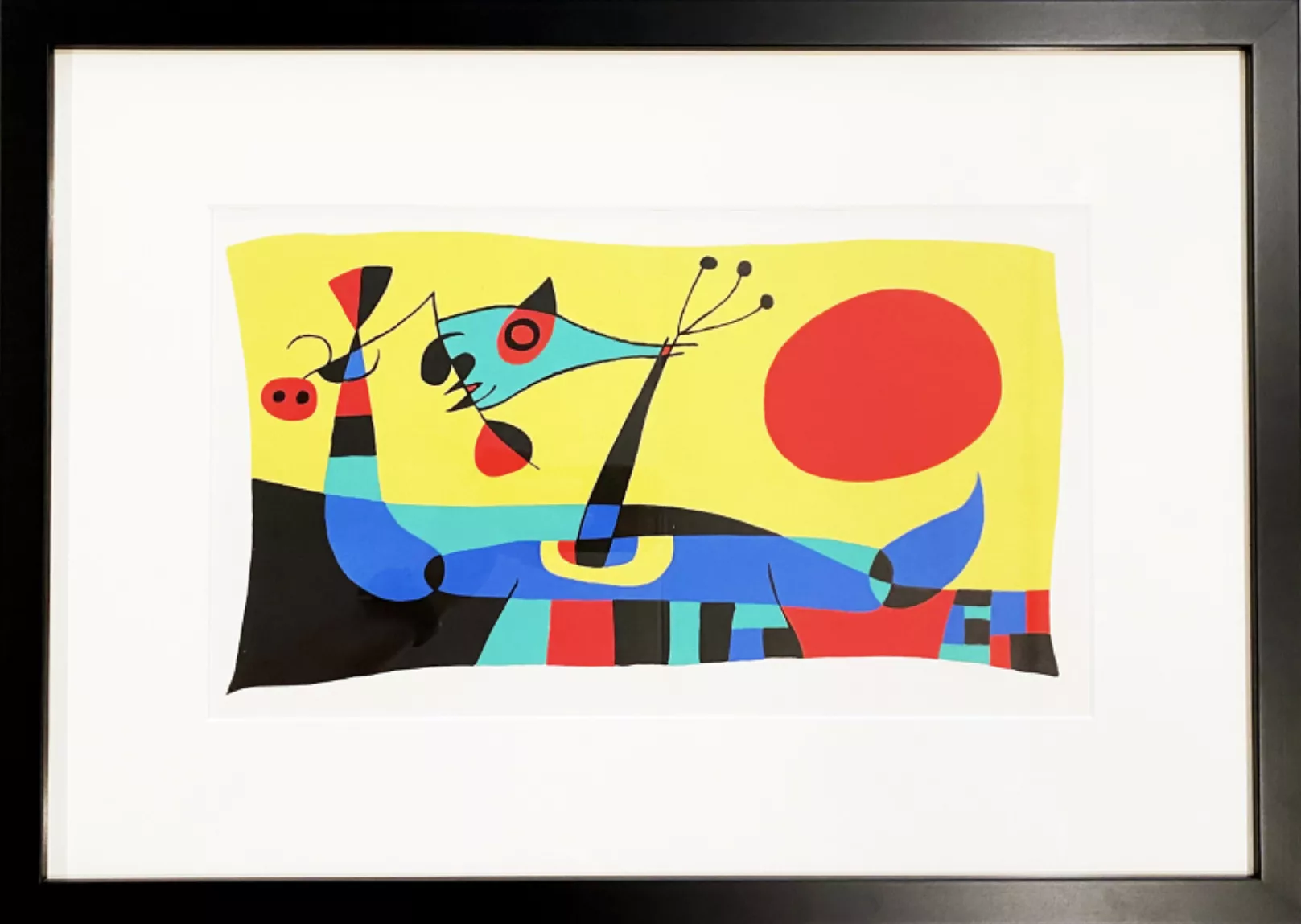
Surrealism and abstraction in Miro
In the first half of the 20th century, a Catalan artist imposed a radically new style: he was Joan Miró. Many artists gravitated around Surrealism at this time: Salvador Dalí was one of the most emblematic figures, but another artist, Miró, stood out from the crowd.
In fact, Miró produced numerous Surrealist works during his career and is still considered one of the masters of this movement today. However, he was to become a precursor of several other currents.
Firstly, abstract expressionism, and secondly lyrical abstraction, two movements that fed off Miró's experiments.
Surrealism, which emerged in the 1920s, actually encompasses a variety of techniques and styles, from automatic painting to the exploration of dreams and the unconscious.
This diversity reflects a desire to go beyond academic conventions, a goal Miró fully shares. He uses simple forms and vivid colors to express a profoundly poetic and imaginative vision of the world.
Although Miró is traditionally associated with Surrealism, his style freed itself early on from strict classification.
In his painting Le Carnaval d'Arlequin, dating from 1924, we can already easily make out a dreamlike universe where abstract forms come to life in a colorful dance, defying all rational logic.
Shapes and compositions are also turned upside down and totally rethought. All these aspects of his work make Miró one of the pioneers of abstraction.
he repeats his experiments in later works such as La Ferme (1921-1922), where pictorial space is revisited in an even more radical way, with objects floating freely on the canvas.
Nevertheless, the first phase of Abstract Expressionism (that influenced by Miró) is thought to begin in the 1940s.
Artists such as Jackson Pollock and Arshile Gorky knew how to use the milestones set by Miró. They, in turn, wanted to free painting from the constraints of reality, while integrating a more spontaneous and instinctive gesture.
The creative process was then transformed into an act of liberation, and artists deconstructed in order to better reconstruct. This is what leads to lyrical abstraction, a current where line and color become direct expressions of emotion and freedom, a direct legacy of Joan Miró's innovations.
10 unusual facts about Joan Miro
The life of Joan Miro
Joan Miró was born in Barcelona in 1893, into a family of jewelers and watchmakers, where art and craftsmanship played an important role. His father, Miquel Miró, encouraged his artistic education from an early age.
Miró initially entered the Barcelona School of Fine Arts, but his career took a decisive turn when he gave up a job in commerce after a severe depression to devote himself entirely to painting.
In 1919, he made his first trip to Paris, where he met artists such as Pablo Picasso and André Masson. Influenced by Dadaism and Surrealism, Miró forged a unique style marked by poetic spontaneity.
In 1921, he painted La Ferme, a work that illustrates his attachment to the landscapes of his native Catalonia. At the same time, he began to explore other media, notably engraving and sculpture.
During the Spanish Civil War, Miró left Spain for Paris, but was confronted there with the rise of Nazism and eventually returned to Spain under Franco's regime. He then settled in Mallorca, where he experimented with ceramics and monumental frescoes.
In 1954, he received the Grand Prix de la gravure at the Venice Biennale, marking international recognition.
In 1975, he inaugurated the Fondation Joan Miró in Barcelona, dedicated to the promotion of contemporary art. Miró died in 1983 at the age of 90, after a life dedicated to creation and the ceaseless exploration of shapes and colors.
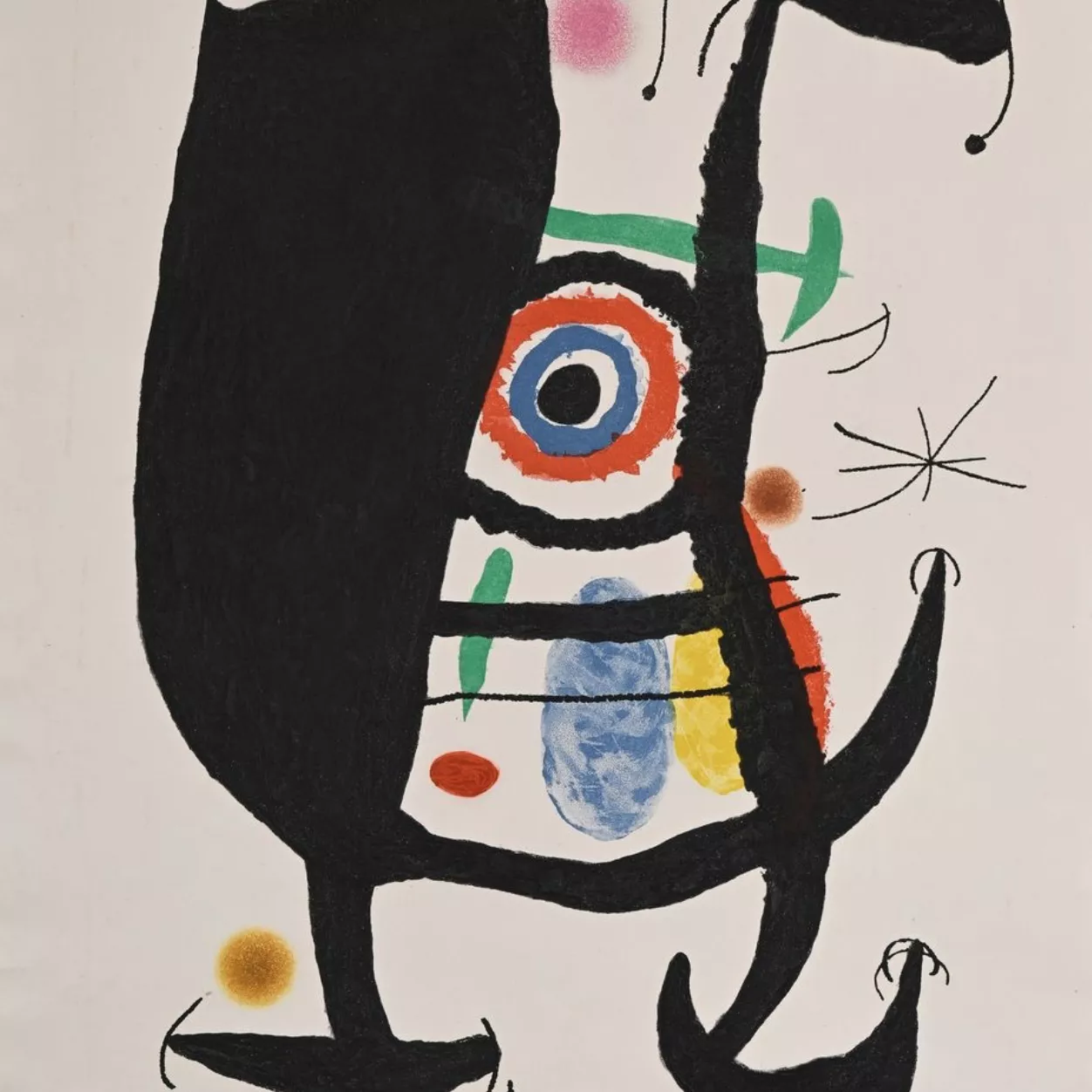
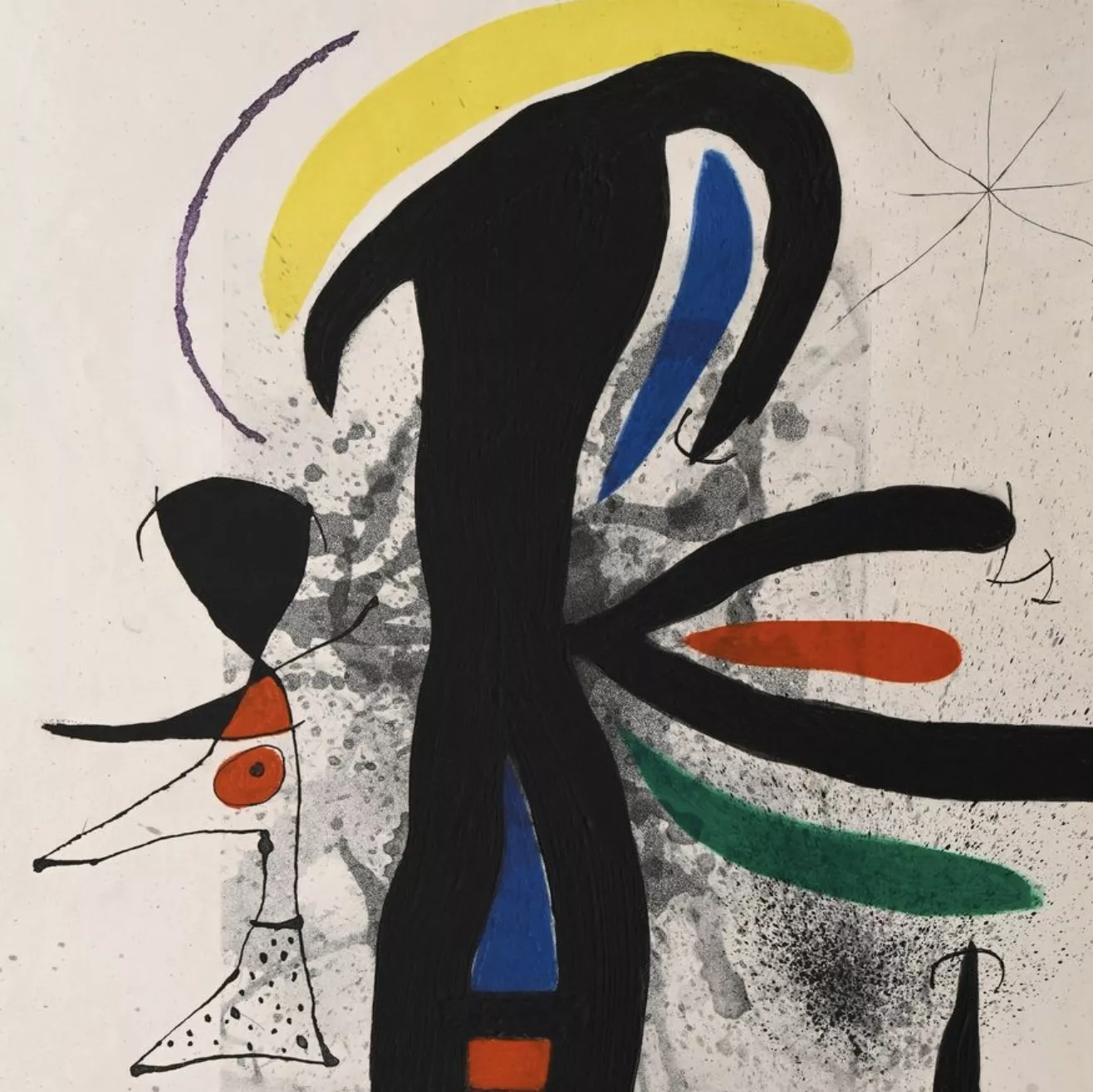
Focus on Ceci est la couleur de mes rêves, Joan Miro, 1967
Ceci est la couleur de mes rêves, created in 1967, is one of the most surrealist works and furthest removed from Joan Miro's artistic vein.
This minimalist painting is characterized by a restricted palette, composed solely of white, blue and black, which accentuates the power of contrasts and the depth of emotions.
The blue spot in the center of the canvas instantly draws the eye, evoking both the fluidity and intensity of dreams, like an open window on the unconscious.
The inscription "This is the color of my dreams" at the bottom of the canvas invites reflection on the subjectivity of personal experience. Miró urges us to consider that color, far from being merely aesthetic, also serves as a vehicle for emotions and associations.
This approach echoes the ideas of Surrealist poets such as André Breton, who promoted the exploration of the unconscious and mental imagess. Blue, often associated with tranquillity and depth, here becomes a symbol of the artist's inner quest.
The mention of "photo" at the top of the work is akin to a comment on the very nature of art and reality. Drawing inspiration from photography, Miró highlights the tension between representation and interpretation, questioning our perception of reality through the prism of our dreams and imagination.
This dialectic between the real and the imaginary is also echoed in the reflections of writers such as Paul Valéry, who examine the limits of art and perception.
Artistically, Miró embarks on a process of simplification, a return to the essential that echoes lyrical abstraction. The reduction of the palette to three colors, as well as the emphasis on stripped-down forms, reveal a search for purity and sincerity of expression.
In this sense, This is the color of my dreams stands as a deeply introspective work, a manifesto of artistic freedom and the universality of human experience.
In this way, Miró invites us to consider dreams not only as escapes, but also as sources of inspiration and truth.
The artist's imprint on his period
Joan Miro was a pioneer in the exploration of Surrealist themes, which he developed in his own artistic vein, creating his own iconographic language.
Lithography production enabled him to distribute his work very widely, all over the world and for relatively affordable prices, while ensuring the authenticity of the prints. Today, almost 30,000 lithographs by the artist are sold on the auction market.
His signature
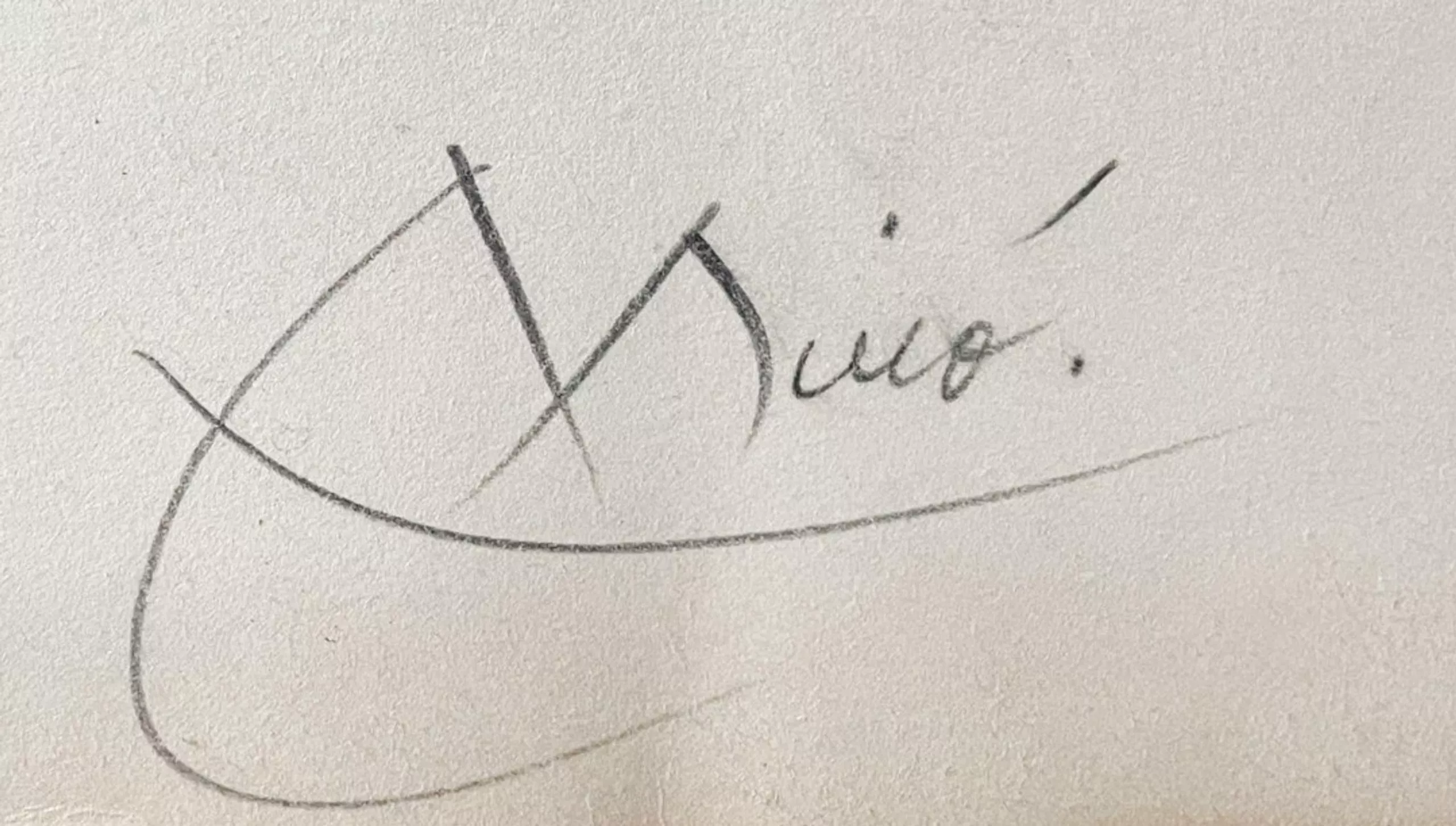
Not all of Joan Miro's works are signed.
Although there are variations, here is a first example of his signature :
Expertise your property
If you own a work by Joan Miro, don't hesitate to request a free appraisal by filling in our online form.
A member of our team of experts and licensed auctioneers will contact you to provide an estimate of the market value of your work.
If you are considering selling your work, our specialists will also guide you through the various alternatives available to obtain the best possible price, taking into account market trends and the specific features of each work.
Estimate in less than 24h
Discover in the same theme

Rating and value of sculptures, drawings and paintings by An...
André Cadere is a Romanian conceptual artist and member of the Op Art movement who has produced paintings and sculptures that are highly rated at auct...
Learn more >

Rating and value of paintings by Pietro di Francisco
Pietro di Francisco is a twentieth-century Franco-Italian painter who produced works of considerable value at auction.
Learn more >

Rating and value of drawings and paintings by Hilma af Klint
Hilma af Klint was a Swedish painter and pioneer of abstract art whose paintings command high prices at auction.
Learn more >
Similar works sold at auction

Estimated 4.000 - 6.000
Igor MITORAJ (1944-2014), Character, Charcoal on paper

Estimated 2.000 - 4.000
Serge POLIAKOFF (1900-1969), Composition en rouge et bleu. 1965, Lithograph

Estimated 400 - 800
Joan MIRO (1893-1983), Montroig II (M. 954), Lithograph

Estimated 4.000 - 6.000
Pierre HODÉ (1889-1942) Vue de Port, Oil on canvas

Estimated 1.000 - 2.000
Jean FUSARO (b. 1925), A gust of wind by the sea in the south of France

Estimated 1.000 - 2.000
Raymond GUERRIER (1920-2002), Composition I, Oil on canvas

Secure site, anonymity preserved

Auctioneer approved by the State

Free and certified estimates
Frequently asked questions
-
Who was Joan Miró, and what is his artistic style?Joan Miró (1893–1983) was a Catalan artist considered one of the masters of Surrealism. He is known for his unique style, which combines simple, clean forms with vivid, primary colors. Although associated with Surrealism, Miró transcended that movement to become a pioneer of lyrical abstraction and abstract expressionism, profoundly influencing generations of artists who followed.
-
What is the price range for Joan Miró's works at auction?The value of Joan Miró's works varies considerably depending on the medium and rarity. Lithographs range from €10 to €137,630, drawings and watercolors from €80 to €24,751,000, and paintings from €50 to €26,042,000. Sculptures and ceramics can reach €10,692,000 and €450,000, respectively, reflecting the importance of the technique used and the specific characteristics of each piece.
-
How do I have a Joan Miró artwork authenticated and appraised?To authenticate and appraise your Joan Miró artwork, we recommend that you request a free, no-obligation appraisal from Auctie's. A certified expert or auctioneer will examine your item and provide you with an accurate estimate of its market value within 48 hours. This process will allow you to determine the current value of your artwork before making any decision to sell.
-
How does the sale of a Joan Miró artwork at Auctie's work?At Auctie's, we support you every step of the way: from an initial free appraisal to advice on the best sales strategies based on current market conditions, and finally, listing your item for auction. Our specialists take into account market trends and the unique characteristics of your artwork to help you achieve the best possible price.
-
Is this the right time to sell a work by Joan Miró?Yes, now is a good time to sell a work by Joan Miró. The artist’s market value remains stable and high in the art market, and his works are highly sought after by collectors. Lithographs, in particular, enjoy wide circulation and strong demand, thanks in large part to the approximately 30,000 prints that have been sold at auction.
