



Rating and value of paintings by Bernard Lorjou

Key takeaways
- Bernard Lorjou’s works sell for between €10 and €33,800 at auction, with his surrealist paintings being particularly sought after by collectors.
- Oil-on-canvas paintings are his most valuable works (€40 to €33,800), compared to €70 to €10,500 for watercolor drawings and €10 to €20,500 for prints.
- As a co-founder of the group “L’Homme Témoin” in 1948, Lorjou established himself as a major figure in 20th-century French figurative expressionism, challenging the prevailing trend toward abstraction.
If you own a work created by artist Bernard Lorjou or based on his work and would like to know its value, our state-approved experts and auctioneers will guide you.
Our specialists will carry out a free appraisal of your work, and provide you with an accurate estimate of its value on the current market.
Then, should you wish to sell your work, we will direct you to the best possible arrangement to obtain the optimum price.
Artist's rating and value
On the art market, Bernard Lorjou's rating is extremely high. His most prized works are his surrealist canvases, whether portraits or landscapes.
The artist is particularly prized among 20th-century Italian painters and draughtsmen. Thus, the price at which Bernard Larjou's works sell ranges from €10 to €33,800 at auction.
His painting Le port de Londres (oil on canvas), dating from 1946, sold for €33,800, whereas it was estimated at €10,000 to €15,000.
Order of value from the most basic to the most prestigious
Technique used | Result |
|---|---|
Drawing - watercolor | From €70 to €10,500 |
Estamp - multiple | From €10 to €20,500 |
Oil on canvas | From €40 to €33,800 |
Estimate in less than 24h
Style and technique of Bernard Larjou
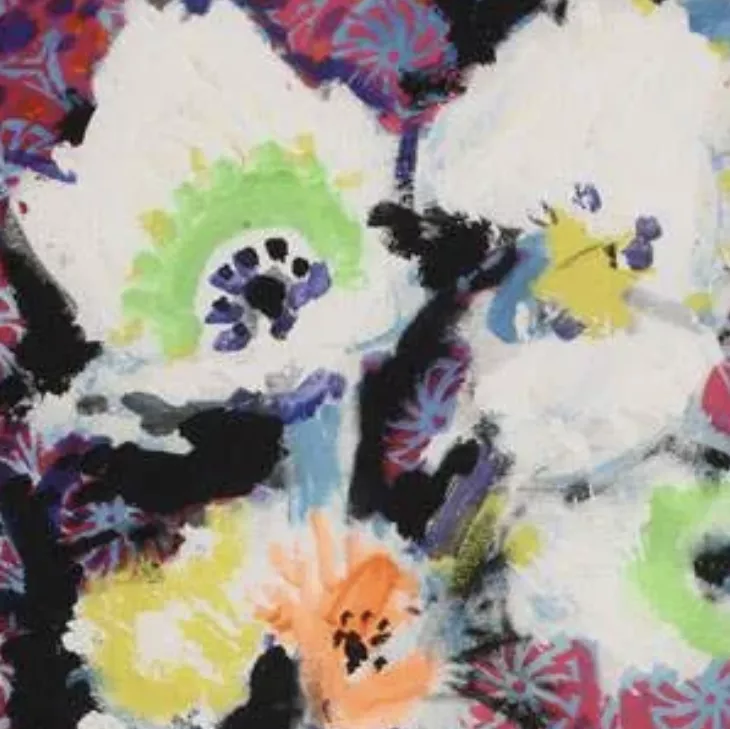
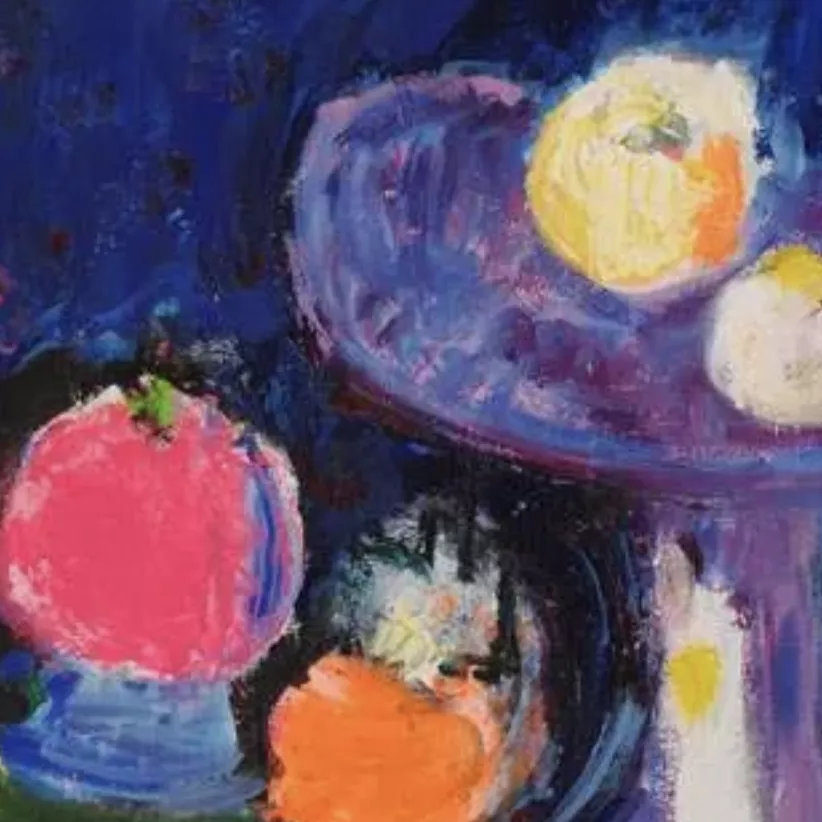
The vibrant burst of color and self-assumed excess is the style of Bernard Lorjou, a singular figure of 20th-century French expressionism.
Defying the conventions of an often abstract modernity, he claims a figurative painting where excess is never gratuitous but viscerally committed.
His canvases, marked by ample gestures and an exacerbated palette, convey an almost primitive urgency, a need to capture the violence and beauty of the world in their tragic cohabitation.
The forms, sometimes distorted to the extreme, oscillate between the grotesque and the sublime, witnesses to a humanity confronted with its own abysses.
Lorjou, a true alchemist of pictorial drama, superimposes layers of dense matter, bringing out vibrant textures that amplify the emotional intensity of the work.
Through this exuberant, uncompromising painting, he seeks not to seduce but to impact, to remind us that art, in its raw essence, is a cry launched at the absolute.
The life of Bernard Lorjou
Born in 1908 in Blois, Bernard Lorjou immediately set himself apart from the dominant currents of his time, asserting an independence that would mark his entire career.
Trained as a self-taught artist, he climbed the ranks of the Parisian art world in the 1930s, first as a poster painter before making his mark on the pictorial scene.
Refusing glossy formalism and the diktats of abstraction, he militated for a free figurative painting, capable of expressing the violence and tumult of his century.
Co-founder, in 1948, of the group "L'Homme Témoin", he set himself up against the academicism of modern art by advocating a return to the subject, to the human, in all its complexity.
His career was marked by controversial exhibitions, where his sometimes provocative and powerful work aroused both admiration and rejection.
From scenes of historical massacres to monumental portraits, Lorjou built up a body of work in which rage and tenderness intertwine, bearing witness to his sharp eye for the tragedies and grandeur of existence.
Far from passing fads, he stands out as a discordant but essential voice, that of an artist for whom painting was an act of faith in the truth of vision.
Focus on La mort de Ghandi, Bernard Lorjou, 1948
In La Mort de Gandhi, a monumental painting from 1948, Bernard Lorjou deploys a striking dramaturgy that strikes with its emotional intensity and resolutely figurative approach.
The work, emblematic of his artistic and political commitment, transcends simple historical homage to achieve a universal scope, that of a meditation on sacrifice and violence.
The composition, dominated by the Mahatma's outstretched body, is articulated around a dramatic centrality that immediately captures the eye.
Wrapped in his traditional white dhoti, Gandhi, a figure of peace and asceticism, here becomes the epicenter of a pictorial tumult in which Lorjou stages the visceral confrontation between light and darkness.
The tones, oscillating between the dazzling purity of white and bloody reds, evoke a battle between spirituality and the brutality of the world. These colors don't just illustrate: they vibrate, they scream, as if the canvas itself bore the stigmata of the event it represents.
Lorjou's brushwork, with its almost ferocious vigor, doesn't seek to soften the violence of the moment. On the contrary, he explodes it in a dense, often impasto material, where contours blur to better suggest the vital and tragic energy that permeates the scene.
Surrounding the martyr lie indistinct figures, sometimes accusing, sometimes annihilated. This silent chorus, echoing ancient frescoes, gives the whole a theatrical dimension that summons both Christian iconography and Eastern narrative traditions.
Lorjou, in a gesture that goes beyond mere denunciation, makes this work a meeting place between the individual and the collective, between history and eternity.
The very texture of the painting, with its striations, impastos and raging brushstrokes, reflects an inner struggle that seems to run through both painter and viewer.
The Death of Gandhi is not a reconstruction. It does not aspire to accuracy or objectivity. It is a vision, a pictorial cry that speaks directly to the viewer's interpretation of it.
By choosing to paint this scene with such intensity, Lorjou is part of a humanist tradition in which art becomes the mirror of the torments and hopes of his time.
But, true to his approach, he refuses all sentimentality: the work, despite its emotional charge, remains anchored in a raw, almost uncompromising materiality.
This painting is the perfect embodiment of Lorjou's singularity: a visceral, committed painting that has no care for fashions or academic expectations.
Exalting the tensions between beauty and horror, between figuration and abstraction, he reminds us that art is not a refuge but a battlefield, a place where the infinite struggle to grasp the elusive is played out before the viewer's eyes.
La Mort de Gandhi thus remains a major work of the post-war period, not only for its formal audacity but for its ability to challenge, disturb and move, reaffirming the essential role of the artist as witness and prophet of his time.
Bernard Lorjou's imprint on his time
Bernard Lorjou, a singular and unsubmissive figure on the twentieth-century artistic landscape, marked his time with a body of work in which figuration rose as an act of resistance to the hegemony of abstract currents.
While abstraction triumphed in the immediate post-war period, carried by figures such as Pierre Soulages or Hans Hartung, Lorjou, like his contemporary Francis Gruber, reaffirmed the power of the real as an inexhaustible source of emotion and questioning.
But where Gruber explored man's existential anxieties, Lorjou positioned himself as a committed chronicler, denouncing the violence and inequalities of his time, often with a brutality that borders on the sublime.
His imprint is distinguished by a deeply narrative and visceral approach, where the tragic and the monumental rub shoulders.
In this respect, his approach could be likened to that of painters such as Renato Guttuso or José Clemente Orozco, who also made their art a space for struggle and testimony.
However, Lorjou steers clear of any didacticism: his brush is less a tool of persuasion than a weapon for shaking up consciences.
Where Guttuso favors more orderly compositions, Lorjou explodes shapes and colors in a tumult that reflects the urgency of his subjects.
Compared with figures such as Bernard Buffet, whose often melancholy figuration also defied the dominant abstraction, Lorjou stands out for a more raging expressiveness and a more ardent palette.
While Buffet builds his works on rigorous lines and static atmospheres, Lorjou lets matter and gesture dominate, sometimes recalling the ardor of Chaïm Soutine or the vehemence of the paintings of Van Gogh.
Lorjou's legacy, though sometimes marginalized by official history, lies precisely in this intransigence. He embodies a vision of art as a mirror of the world's convulsions, refusing the comfort of convention to better capture the tumultuous essence of his time.
With his discordant but necessary voice, Lorjou remains a model of creative freedom, in constant dialogue with the crises and aspirations of humanity.
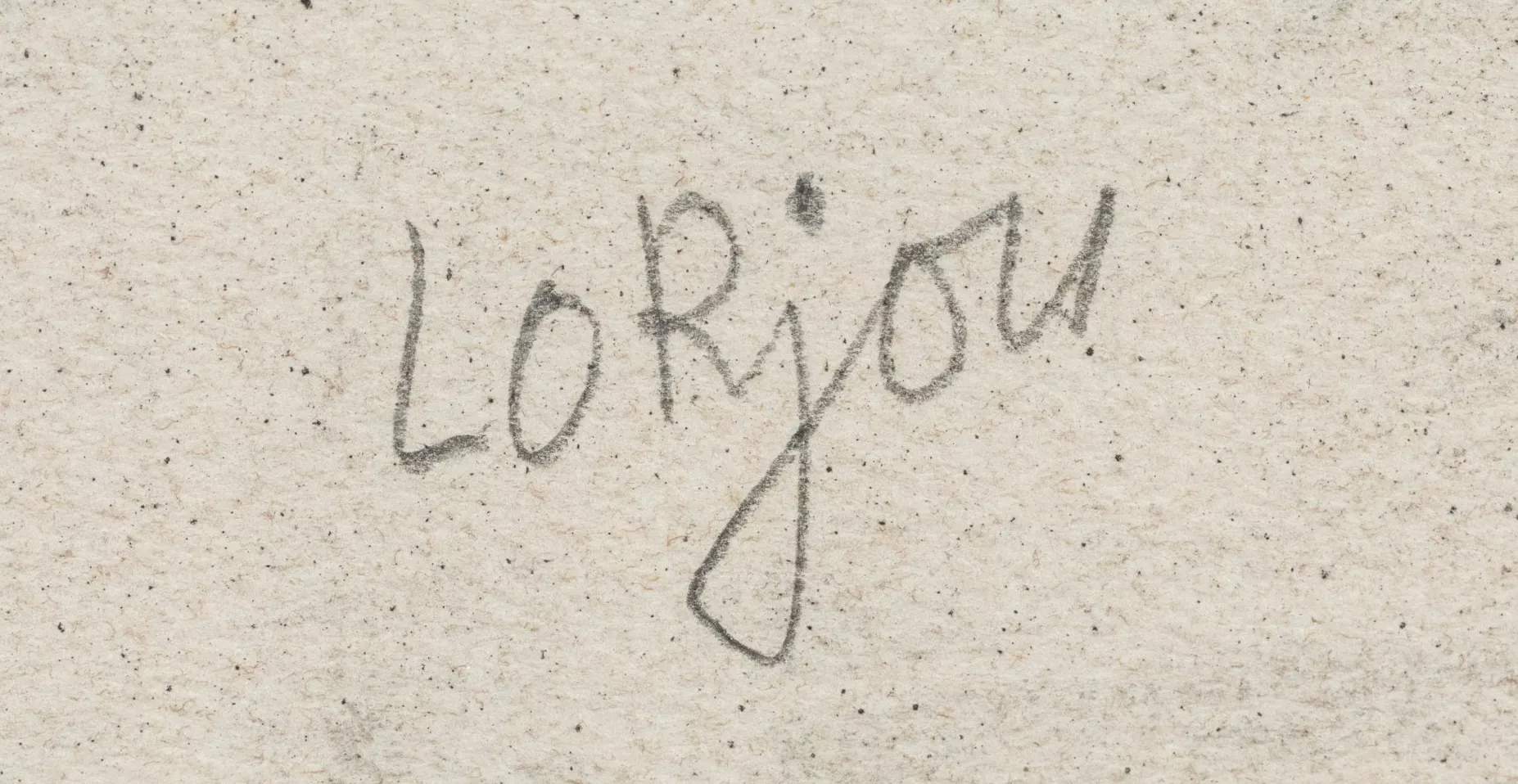
His signature
Although there are variations, here is a first example of his signature:
Expertise your property
If you happen to own a work by or after Bernard Lorjou, don't hesitate to request a free appraisal by filling in our form on our website.
A member of our team of experts and licensed auctioneers will contact you promptly to provide you with an estimate of the value of your work, not forgetting to send you ad hoc information about it.
If you're thinking of selling your work, our specialists will also be on hand to provide you with alternatives for selling it at the best possible price, taking into account the inclinations of the market and its specific features.
Estimate in less than 24h
Discover in the same theme

Value and estimate of Pierre Chapo's furniture
20th-century designer Pierre Chapo has left his artistic mark on 20th-century furniture. Estimated in less than 24h.
Learn more >

Rating and value of works, paintings by Arshile Gorky
Arshile Gorky is a 20th-century Armenian painter of abstract expressionism. His works are quoted and have value at auction.
Learn more >

Rating and value of paintings and laquers by Nguyen Gia Tri
Nguyễn Gia Tri is a leading artist of Vietnamese modernism, who has produced numerous works that are highly prized and valuable.
Learn more >
D'autres tableaux expressionnistes vendus aux enchères


Secure site, anonymity preserved

Auctioneer approved by the State

Free and certified estimates
Frequently asked questions
-
Who is Bernard Lorjou, and what is his artistic background?Bernard Lorjou (1908–...) was a leading figure in 20th-century French Expressionism. An independent figurative artist, he distinguished himself by rejecting the dominant postwar trend toward abstraction and by co-founding the group “L’Homme Témoin” in 1948. His visceral work, characterized by a vivid color palette and often distorted forms, reflects his artistic and political commitment through dramatic and humanistic subjects.
-
What is the price range for Bernard Lorjou's works at auction?Prices for Bernard Lorjou’s works range from €10 to €33,800 at auction, depending on the medium and provenance. Drawings and watercolors range from €70 to €10,500, multiple prints from €10 to €20,500, and oil paintings on canvas from €40 to €33,800. His painting “The Port of London” (1946) sold for €33,800, exceeding its initial estimate of €10,000 to €15,000.
-
How can you authenticate and appraise a work by Bernard Lorjou?To authenticate your Bernard Lorjou artwork and obtain an accurate estimate of its value, we recommend that you request a free appraisal from Auctie's. Our team of experts and state-certified auctioneers will examine your item and provide you with a detailed assessment of its current market value, with no obligation on your part.
-
How does the appraisal process for a work of art work at Auctie's?Appraisals at Auctie's are free and require no obligation. Simply fill out the form available on our website. A certified appraiser or auctioneer will contact you promptly to examine your artwork, provide you with an estimate, and share all relevant information regarding its attribution, condition, and provenance.
-
If I want to sell a work by Bernard Lorjou, how do I go about it?As an auction house, Auctie's supports you every step of the way: from the initial free appraisal to the final sale. Our specialists will advise you on the best options for selling your artwork at the highest possible price, taking into account current market trends and the specific characteristics of your item.
