



Price and value of Alexander Calder's jewels, rings, tiaras and necklaces

Key takeaways
- Calder's jewelry sells for up to 2.7 million euros, with brooches ranging from 750 euros to 2.7 million euros depending on their prestige and historical documentation.
- The most sought-after pieces are necklaces, rings, and brooches made of wire or hammered silver, created as wearable sculptures between the 1930s and 1970s.
- Authentication is based on an examination of handcrafted techniques (hammering, riveting), documented provenance, and the presence of the piece in the archives of the Calder Foundation in New York.
Alexander Calder (1898-1976) is an American artist who is highly regarded on the auction market today. His extraordinary career testifies to his genius and the scope of his production. His extraordinary career is a testament to his genius and the breadth of his output. The artist's current market value is a testament to the passion his works arouse among collectors, defying time and trends.
If you own a work by or based on the work of artist Alexander Calder and would like to know its value, our state-approved experts and auctioneers will guide you. Our specialists will carry out a free appraisal of your work, and provide you with a precise estimate of its value on the current market. Then, if you wish to sell your work, we will guide you towards the best possible arrangement to obtain the optimum price.
Rating and value of the artist
By the success and notoriety of his works, Alexander Calder established himself from his lifetime as a sure value on the art market. In recent years, the artist's market value has continued to grow. Calder's most sought-after works are his paintings, mobiles and volume sculptures (including jewelry), which are very popular on the French and American markets. Thus, a work by Calder can fetch thousands of euros, as evidenced by his Flower necklace dating from 1938, adjudged €413,050 at Sotheby's in 2020, whereas it was estimated at between €168,590 and €252,990.
Order of value from the most basic to the most prestigious
Type of jewel | Result |
|---|---|
Wreath | From €2,060 to €37,050 |
Tiara | From 17,430 to €92,000 |
Pendant | From €2,300 to €129,400 |
Ring | From €5,000 to €348,400 |
Brooch | From €750 to €2,700,000 |
Estimate in less than 24h
The artist's creations and style
Throughout his career, Calder's artistic output was prolific and varied. His works stand out for their innovative use of all types of metal, including brass and bronze. He meticulously researched the structure of his sculptures and paintings in order to achieve balance. His ingenuity is also evident in his pictorial compositions, where every detail is calculated.
His production and style are quite apart in the history of the twentieth century, although they are part of the kinetic art movement; consisting in producing works in motion or giving the impression of motion.
.
Alexander Calder, his life, his work
Alexander "Sandy" Calder was an American artist born in 1898 in Pennsylvania into a family of already talented and famous artists. His mother, Nadette Lederer Calder, excelled in painting, while his father, Alexander Stirling Calder, excelled in sculpture. From childhood, he was educated in the art world and developed a certain singularity and stylistic identity as an artist.
He graduated in mechanical engineering from the Stevens Institute of Technology. He then entered the Art Students Legaue of New-York in 1923, to complete his artistic training. He had been making art since he was a child, using his father's equipment, and eventually never stopped. Arriving in Paris in 1926, the following year he presented a series of toys he had created at the Salon des humoristes.
From 1929, being passionate about the circus, he began to produce a large quantity of sculptures for Calder's Circus. Here, he creates and sculpts miniature automata that he inlays. This was a real performance, which he presented all over Europe for around two hours. In Paris, he met artists such as Joan Miro, Jean Cocteau, Robert Desnos and Le Corbusier.
It's possible to notice a strong artistic affinity with Miro in some of his creations, particularly in the way he uses shapes and colors. He also used the same color palette as Mondrian in the latter parameter.
In 1932, he began production of his Mobiles, which would be similarly named by Marcel Duchamp. During the Second World War, he fled to the United States with other artists like Chagall to continue producing in peace. He won several awards, including the Grand Prix at the Venice Biennale.
Alexander Calder's legacy and the success of his jewelry
Alexander Calder is an artist who has inevitably left his mark on the twentieth century, through his absolutely gigantic output and ever greater, unexpected innovation. Today, his value continues to evolve positively on the auction market ; he is a particularly sought-after artist.
Calder's jewelry is a big hit at auction. Auctie's presented two exceptional pieces for sale in 2023, a ring as well as a tiara, which sold for €58,880 and €75,520 respectively. These results are just one indication of the current popularity and success of Calder's creations on the auction market. The pieces are utterly unique and prized by many collectors worldwide.
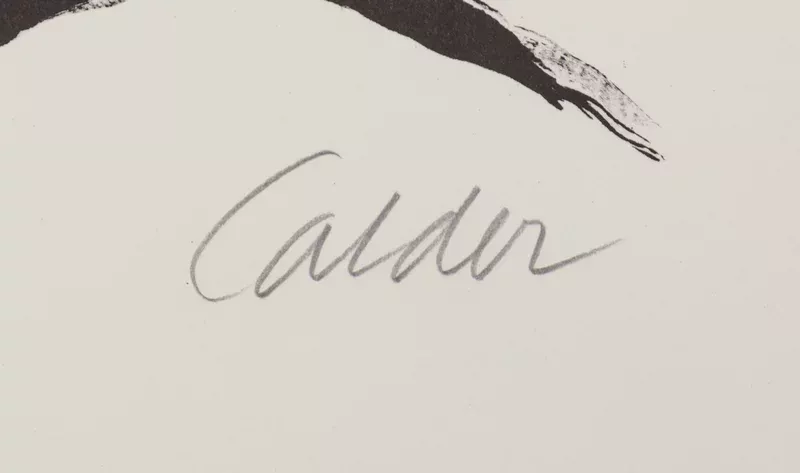
His signature
Not all of Alexander Calder's works are signed.
Although there are variations, here is a first example of his signature:

Artist's techniques
Alexander Calder's style
The artist develops a sculptural language based on line in space, where balance, movement and lightness are structuring principles.
He introduces the mobile as a kinetic form, transforming sculpture into a dynamic experience linked to air and the viewer's perception. He inherits his formal simplification from abstraction, favoring elementary signs, open volumes and biomorphic silhouettes.
He uses industrial and modest materials (wire, sheet metal, brass), revealing an aesthetic of construction and a valorization of the manual gesture. He transposes his plastic research into the field of jewelry, conceived as a wearable sculpture rather than a traditional ornamental object.
Focus on a key work
Brass spiral bracelet (circa 1940)
The open structure is made from hammered brass wire, highlighting the manufacturing process and the primacy of line. The spiral shape evokes continuous movement, a fundamental principle in Calder's aesthetics transposed to the scale of the body.
There are no gems or superfluous ornamentation, thus asserting a modernist conception of jewelry as an autonomous sculptural object. There's a balance between geometric rigor and spontaneity of line, perceptible in the deliberate irregularities of the hand-worked metal.
This is a work that illustrates the continuity between Calder's monumental production and his intimist creations, where the same plastic principles are condensed.
FAQ - How to estimate Alexander Calder jewelry
1) What is the first step in estimating Alexander Calder jewelry ?
The appraisal begins with the identification of the jewel (brooch, necklace, bracelet or pair of earrings) with an examination of the manufacturing technique, usually based on direct hammered or twisted wirework, as well as the dimensions, weight and possible presence of a signature.
2) How important is material and technical authenticity ?
As most of Calder's jewelry is handcrafted in brass, silver or steel, examining bending, riveting and hammering techniques is an essential part of distinguishing authentic works from later productions or copies.
3) What role do provenance and archives play?
Documented provenance, particularly when linked to private commissions, historic galleries or exhibitions, as well as the presence in the archives of the Calder Foundation, located in New York, significantly enhances the value and security of the estimate.
Market segmentation
Jewelry prices
Jewelry is a specific segment of Calder's market, situated between miniature sculptures and wearable art. These are unique pieces made in wire, brass or silver, with a clear hierarchy according to form and plastic complexity.
Pins sell for between €750 and €2,700,000 for iconic and historically documented models. Rings generally sell for between €5,000 and €350,000. Pendants go for around €2,300 to €130,000, while tiaras and monumental pieces go for €18,000 to €92,000.
The middle segment of the market is often between €20,000 and €150,000 for significant necklaces, bracelets and brooches, while some major pieces can reach €300,000 or more.
Valuation factors
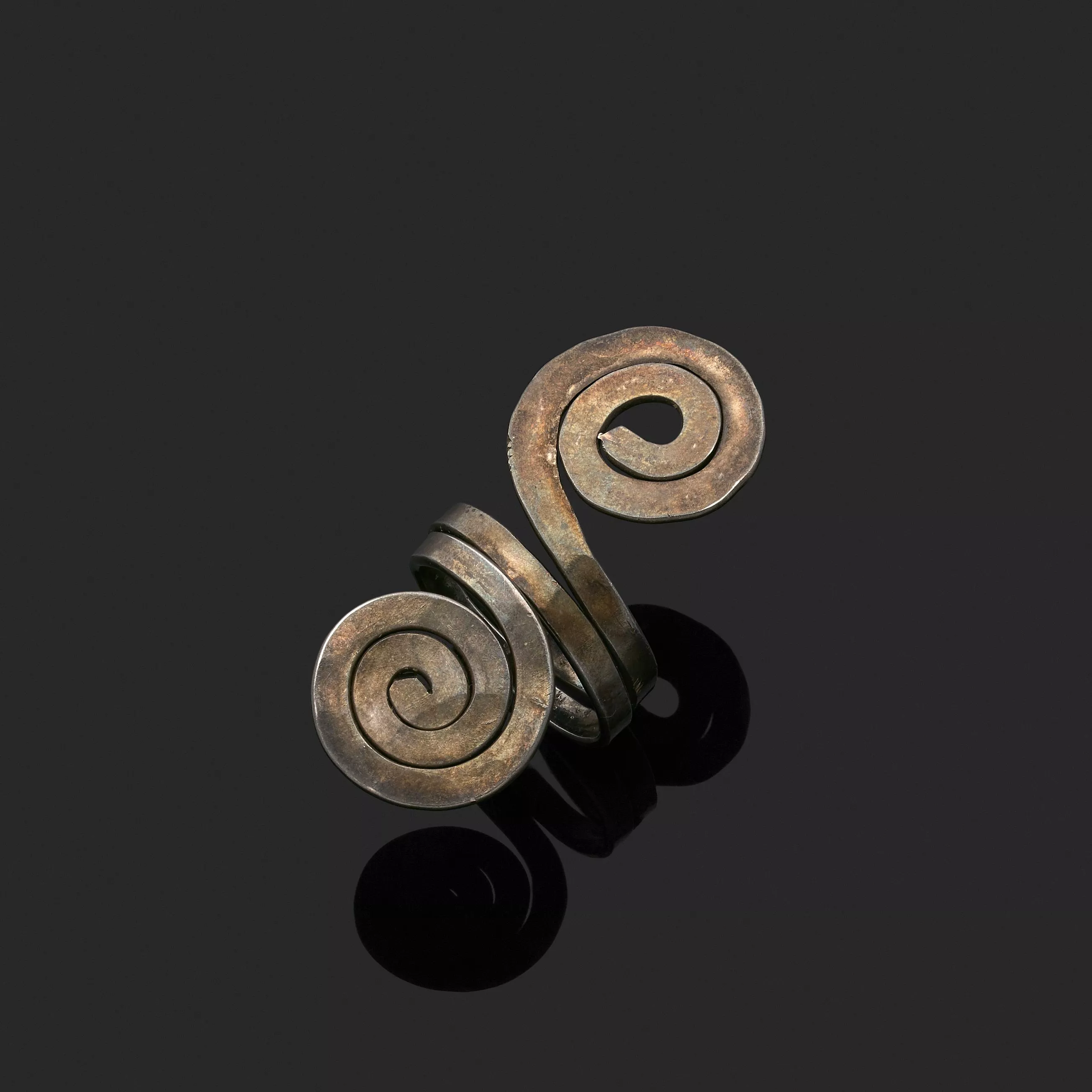
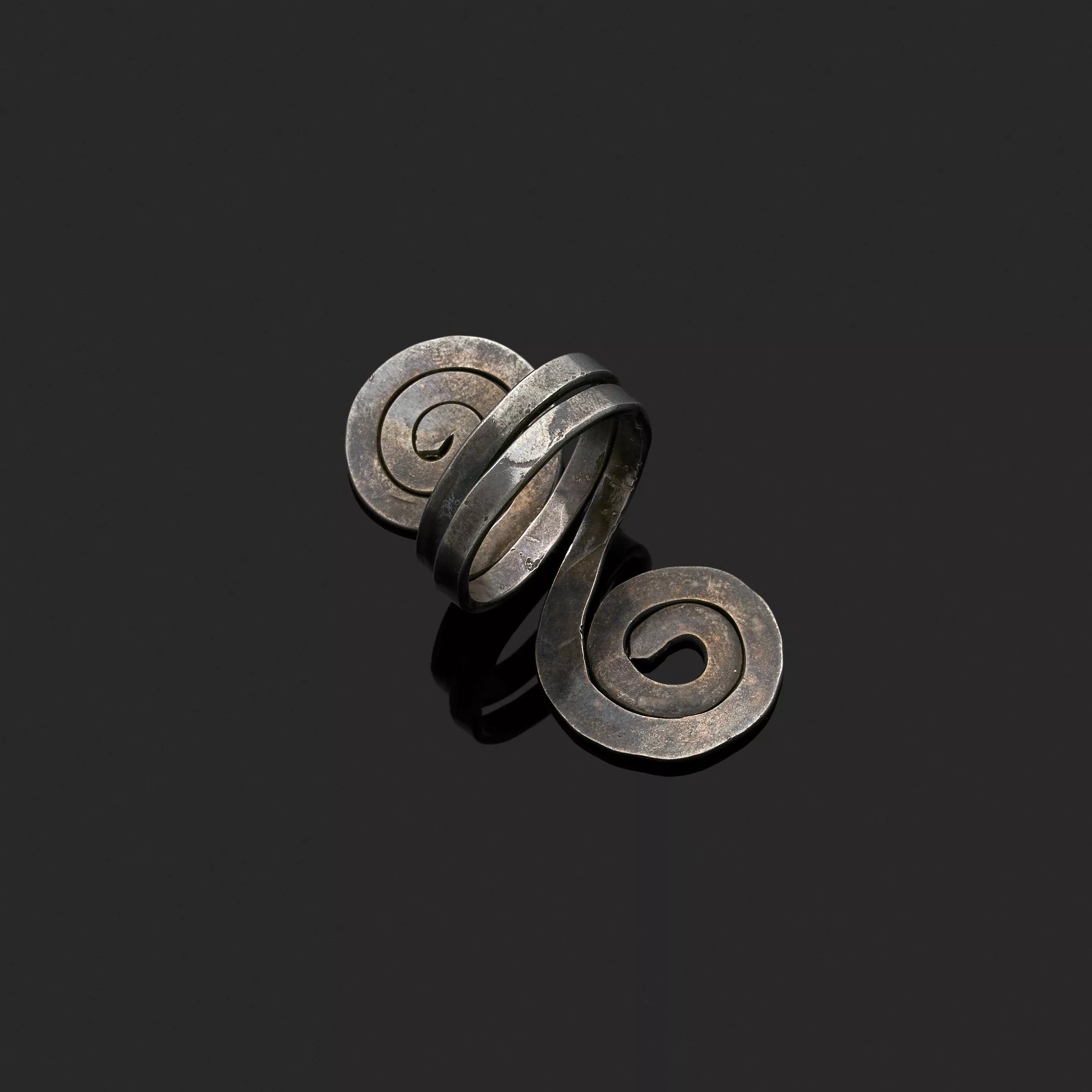
Wire or hammered silver pieces, often hand-executed and unedited benefit from high valuations. A silver Spirale ring, for example, sold for around €20,000, revealing the level of the market for signed but unexceptional models.
The growing interest in artists' jewelry, such as that by Lalanne in another register, and for twentieth-century portable sculpture supports a sustained upward trend, the rarity of the pieces and their status as unique objects reinforcing the structural stability of the quotation.
His signature
Not all of Alexander Calder's works are signed.
Although there are variations, here's a first example of his signature:
Expertise your property
If you own a work by Alexander Calder, don't hesitate to request a free appraisal by filling in our online form. A member of our team of experts and licensed auctioneers will contact you to provide an estimate of the market value of your Dunand-signed work.
If you're considering selling your work, our specialists will also guide you through the various alternatives available to obtain the best possible price, taking into account market trends and the specific features of each object.
Estimate in less than 24h
Discover in the same theme

Rating and value of works, paintings, drawings by Georges So...
Georges Souillet is a 20th-century painter who produced landscape paintings and a few drawings. His works are highly regarded.
Learn more >

Rating and value of Roberto Matta's paintings and drawings
Roberto Matta is a 20th-century Surrealist artist whose works are highly regarded and valued on the auction market.
Learn more >

Rating and value of paintings by Lucio Fontana
Lucio Fontana is a twentieth-century spatialist artist whose works are highly prized at auction.
Learn more >
Works from the same period sold at auction

Estimated 1 000 - 1 500 €
VAN CLEEF AND ARPELS Brooch in yellow gold (750) featuring a connected bird, the body composed of an oval cabochon turquoise.

Estimated 10.000 - 15.000 €
BOUCHERON - "Ava" - White gold necklace set with a brilliant-cut diamond (1.56 cts)

Estimated 10.000 - 20.000 €
Alexander CALDER (1898-1976) Silver ring with double spiral motif

Estimated 20.000 - 40.000 €
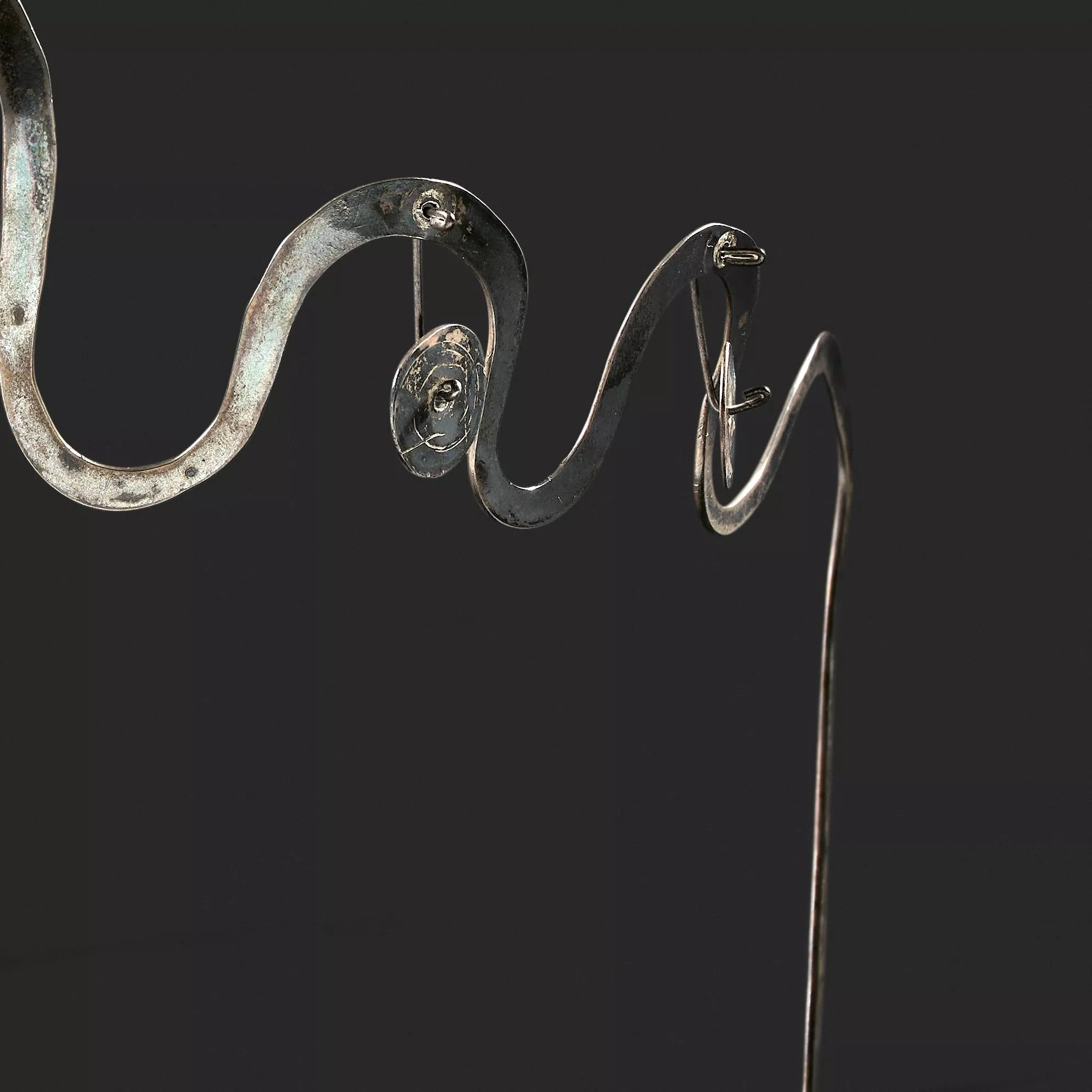
Alexander CALDER (1898-1976) Silver tiara with wave motifs holding pendants

Estimated 3.000 - 5.000
Claude LALANNE (1925-2019) Mimosa necklace

Estimated 4000€ - 6000€
Claude LALANNE (1925-2019) Hydrangea" ornamentation in gilt bronze...

Secure site, anonymity preserved

Auctioneer approved by the State

Free and certified estimates
Frequently asked questions
-
Who was Alexander Calder, and what was his contribution to the art of jewelry?Alexander Calder (1898–1976) was a major American sculptor of the 20th century and the founder of the kinetic mobile. Beginning in the 1930s, he designed jewelry as wearable sculptures, blurring the line between decorative objects and independent works of art. He applied the same principles of line, balance, and movement that characterize his monumental mobiles to a scale appropriate for the human body, favoring wire, brass, and hammered silver over traditional precious ornamentation.
-
What is the price range for Alexander Calder's jewelry at auction?Calder's jewelry sells for up to 2,700,000€ at auction. Brooches range from €750 to €2,700,000, rings from €5,000 to €348,400, pendants from €2,300 to €129,400, and tiaras from €17,430 to €92,000. The mid-range segment of the market generally falls between €20,000 and €150,000 for significant pieces.
-
How can you authenticate a piece of jewelry by Alexander Calder and determine its exact value?Authentication is based on an examination of manufacturing techniques (bending, riveting, hammering of the metal wire), verification of materials (brass, silver, steel), and an analysis of documented provenance. Auctie's offers you a free, no-obligation appraisal by its state-certified auctioneers, who will analyze the authenticity, market rating, and recent market results to accurately determine the value of your piece.
-
Why is now the right time to sell a piece of jewelry by Alexander Calder?Calder's market value has been steadily rising for several years. Growing interest in artists’ jewelry and 20th-century wearable sculpture is driving a sustained upward trend, reinforced by the rarity and one-of-a-kind status of these pieces, which ensure a stable market structure that favors sellers.
-
How does the appraisal and sale of a Calder jewelry piece work at Auctie's?Auctie's offers a free, no-obligation appraisal via an online form. Our experts and certified auctioneers will conduct an appraisal and provide you with a reliable valuation within 48 hours. If you’re considering selling, we’ll guide you through the process from the initial estimate to the auction to ensure you get the best possible price for your artwork.
