



Rating and value of Alexander Calder's mobiles, luminaires and installations

Key takeaways
- Calder's mobiles have fetched up to 16.7 million euros at auction, notably the "Flying Fish" (1957), which was sold at Christie's in 2014.
- Prices vary considerably: furniture €750–28,000, lighting €1,530–178,390, and mobiles €650–16,714,100, depending on the type and complexity.
- Mobiles from the 1930s–1950s (the period of their invention) are worth 1.5 to 3 times more than those from the 1960s–1970s, with strong international institutional demand.
Alexander Calder (1898-1976) is an American artist who is highly regarded on the auction market today. His extraordinary career testifies to his genius and the scope of his production.
The artist's current market quotation testifies to the infatuation his works arouse among collectors, defying time and trends.
If you own a work by or based on the artist Alexander Calder and would like to know its value, our state-approved experts and auctioneers will guide you.
Our specialists will carry out a free appraisal of your work, and provide you with a precise estimate of its value on the current market. Thereafter, if you wish to sell your work, we will guide you towards the best possible arrangement to obtain the optimum price.
Artist's rating and value
By the success and notoriety of his works, Alexander Calder established himself from his lifetime as a sure value on the art market. In recent years, the artist's stock has continued to rise.
With a strong presence on the French and American markets, Calder's most sought-after works include paintings, mobiles and volume sculptures (including jewelry). Thus, a work by Calder can fetch millions of euros, as evidenced by his mobile Poisson volant dating from 1957, adjudged €16,714,100 at Christie's in 2014.
Order of value from the most basic to the most prestigious
Type of work | Result |
|---|---|
Furniture | From 750 to 28 000€ |
Lighting | From 1,530 to 178,390€ |
Mobile | €650 to €16,714,100 |
Estimate in less than 24h
Learn more about Alexander Calder
In just a few minutes, discover the origin, and interest of Alexander Calder's sculptures, mobiles and works. An aerial work influenced by artists
The life of Alexander Calder
Cultural context
Alexander Calder's mobiles appear in the context of the abstract avant-gardes of the 20th century, marked by the questioning of static sculpture and the search for a work integrating time and real movement.
From the 1930s, Calder developed a kinetic sculpture based on balance, gravity and the lightness of materials, introducing a dynamic dimension unprecedented in the history of modern sculpture.
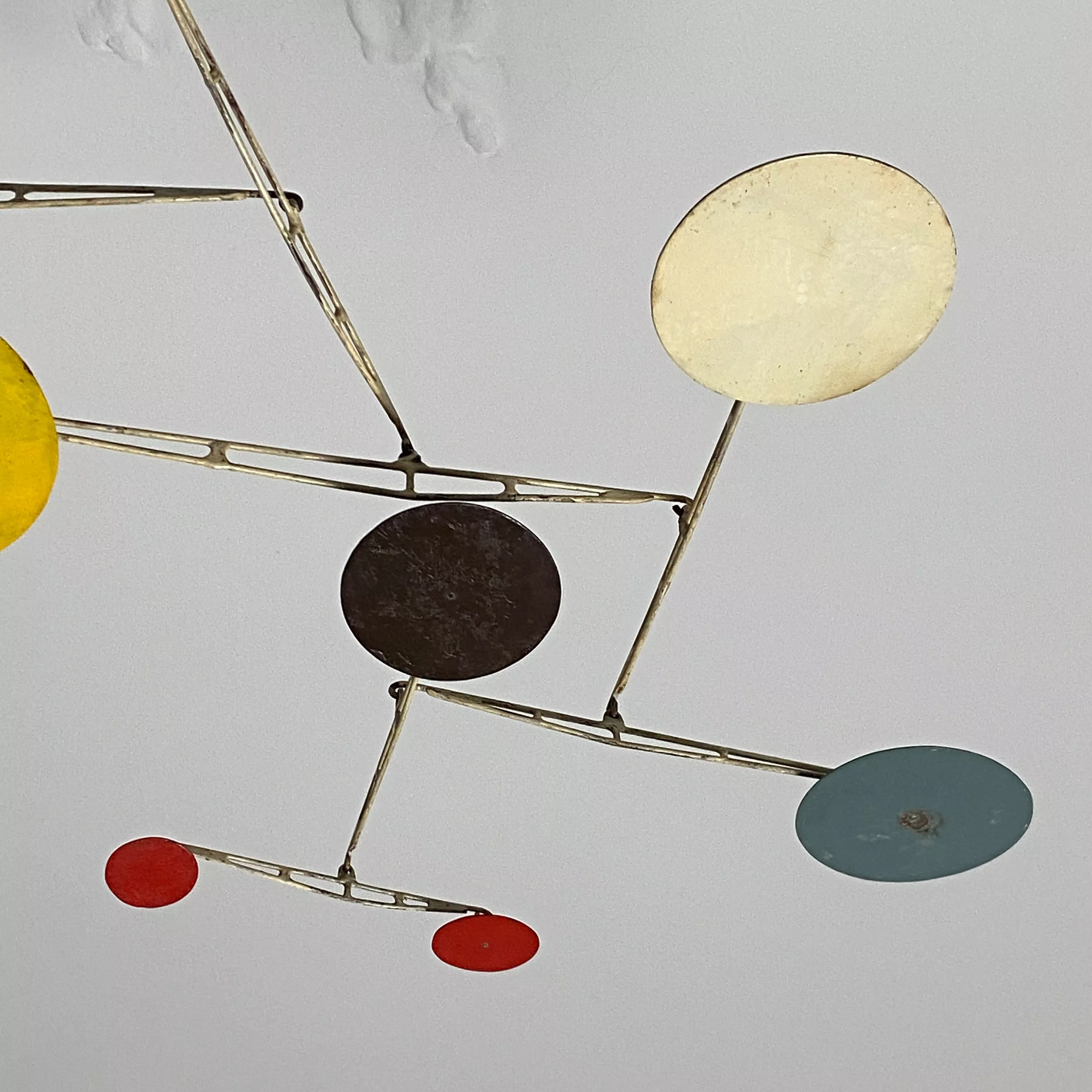
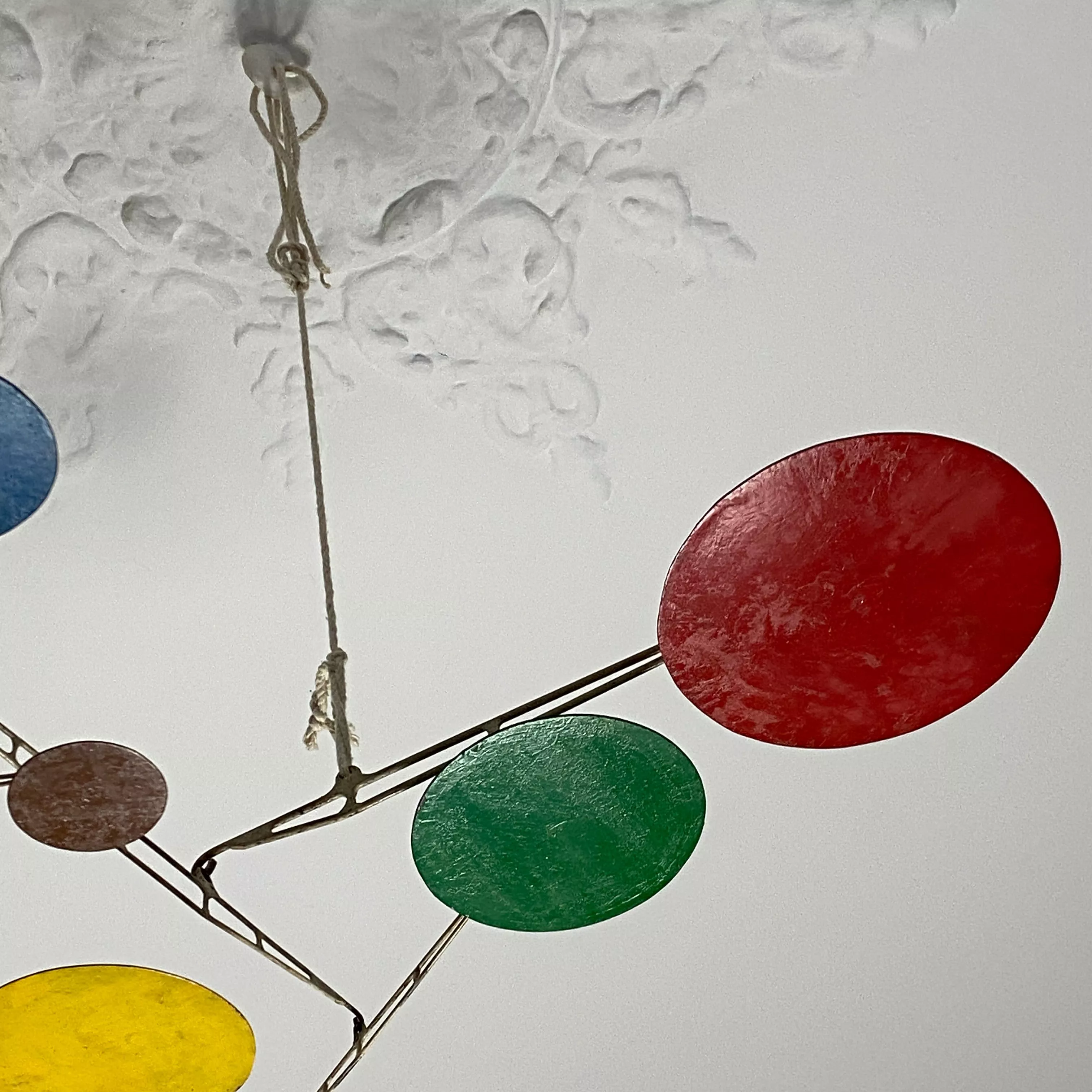
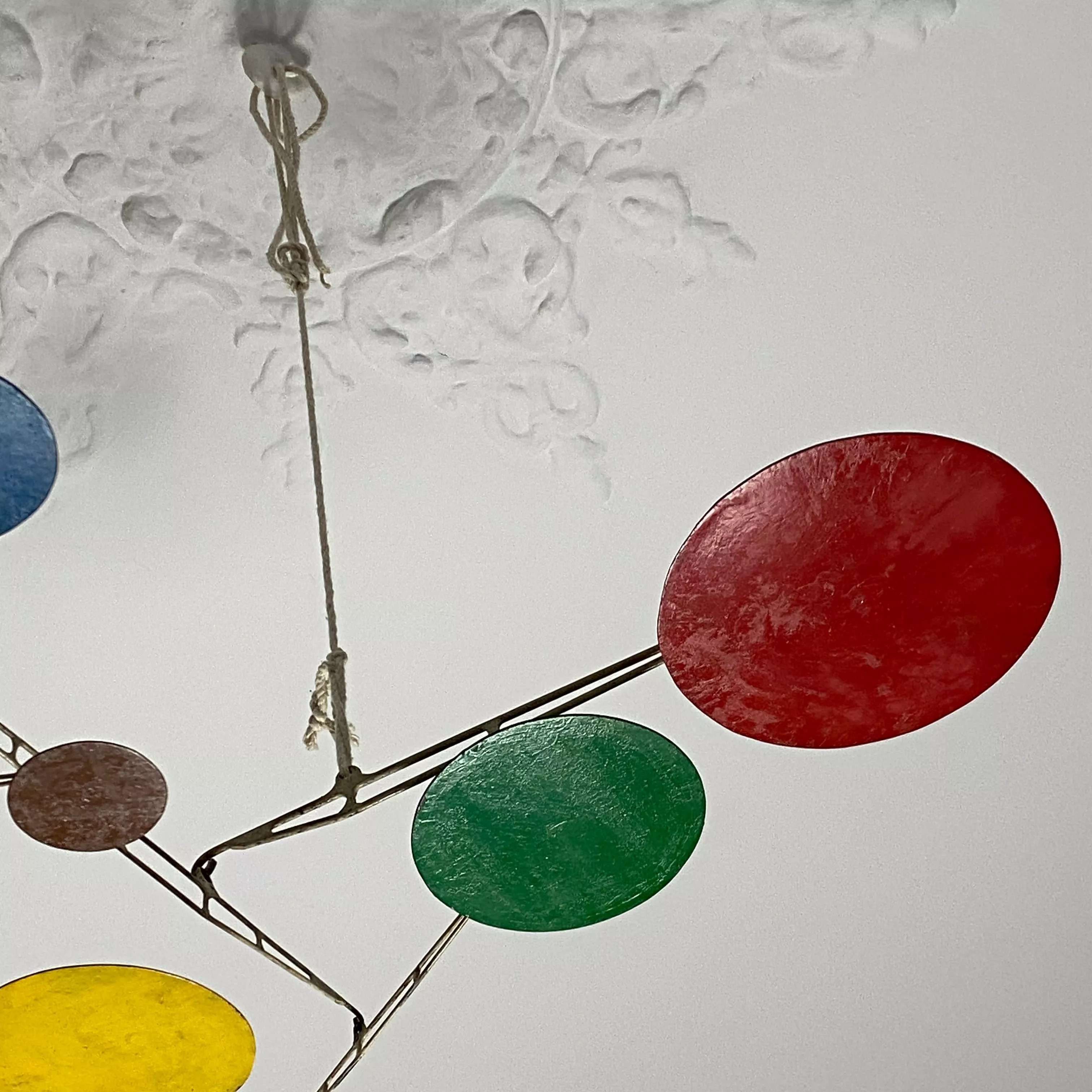
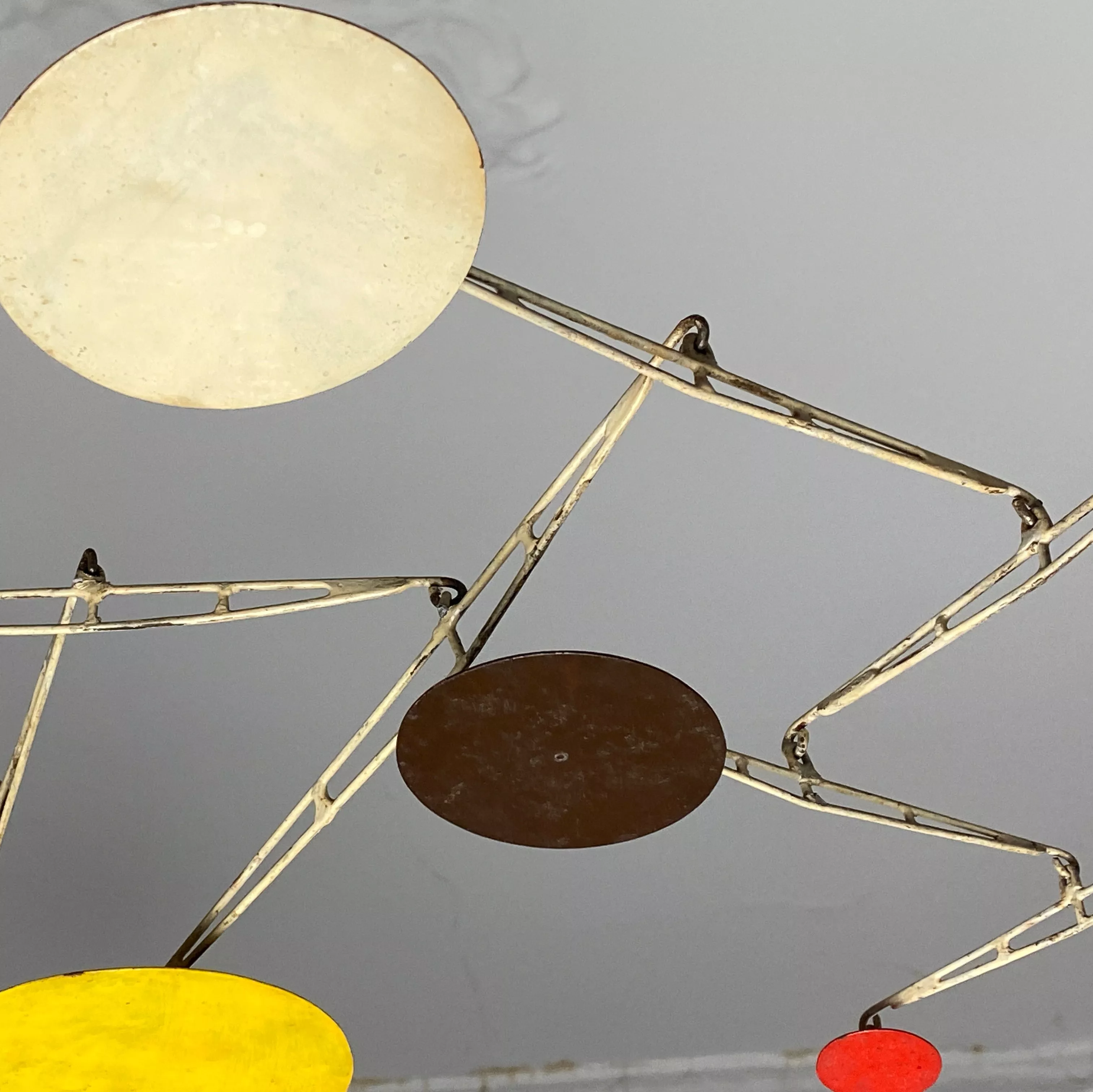
The mobile is defined by a suspended structure that is composed of abstract, often biomorphic elements, animated by air currents, transforming the work into an evolving system rather than a fixed form.
This production is part of a modernist reflection on the relationship between art, space and spectator, where the permanent variation of visual configurations becomes constitutive of aesthetic experience.
Artistic entourage
The term " mobile " was suggested to him by Marcel Duchamp, revealing Calder's inclusion in the intellectual network of the Parisian avant-garde. Exchanges with Mondrian influence his thinking on abstraction, balance and the spatial structuring of forms.
He shares with Joan Miro and Jean Arp a sensibility for organic forms and plastic experimentation, which contributes to inscribing the mobile in an international aesthetic of abstraction.

Artist's techniques
Alexander Calder's mobile style
He invented a kinetic sculpture based on real movement, where the work evolves continuously under the action of air and the environment. He constructs his works from cut-out and suspended metal elements, organized according to a precise system of balance inspired by physical principles.
The colors used are bold, with red, black and white in particular, serving to accentuate spatial legibility and visual dynamics. He dissolves the sculptural mass in favor of a line in space, transforming the sculpture into a three-dimensional drawing.
The mobile creates a direct interaction with the viewer and the surrounding architecture, the mobile being conceived as a perceptual device in constant variation.
Focus on a key work
Red mobile (circa 1950)
The Red mobile is a structure composed of thin metal rods supporting suspended red shapes, creating an aerial spatial organization. Calder achieves a dynamic balance through the careful distribution of masses and suspension points, revealing an empirical understanding of gravity.
The movement is slow and unpredictable, producing a temporal experience of the sculpture rather than a static perception. The chromatic contrast is strong between the colored elements and the surrounding space, reinforcing the perception of emptiness as an active component.
There is no solid base, accentuating the sensation of immateriality and the work's integration into the architectural space. This mobile is an emblematic example of the Calderian revolution: sculpture ceases to be a stable object to become a mobile and variable system.
Alexander Calder, his life, his work
Alexander "Sandy" Calder was an American artist born in 1898 in Pennsylvania into a family of already talented and famous artists. His mother, Nadette Lederer Calder, excelled in painting, while his father, Alexander Stirling Calder, excelled in sculpture. From childhood, he was educated in the art world and developed a certain singularity and stylistic identity as an artist.
He graduated in mechanical engineering from Stevens Institute of Technology. In 1923, he joined the Art Students Legaue of New-York to continue his artistic training. Since he was a child, he had been creating works with his father's materials, and never stopped producing. Arriving in Paris in 1926, he presented a collection of toys he had made at the Salon des humoristes the following year.
From 1929, being passionate about the circus, he began to make a large number of sculptures for Calder's Circus. Here, he creates and sculpts miniature automata that he inlays. This was a real performance, which he presented all over Europe for around two hours. In Paris, he met artists such as Joan Miro, Jean Cocteau, Robert Desnos and Le Corbusier.
It's possible to notice a strong artistic affinity with Miro in some of his creations, particularly in the way he uses shapes and colors. He also uses the same color palette as Mondrian in the latter parameter.
In 1932, he began making his Mobiles, which would be similarly named by Marcel Duchamp. During the Second World War, he fled to the United States with other artists like Chagall to continue producing in peace. He won several awards, including the Grand Prix at the Venice Biennale.
The legacy of Alexander Calder and the importance of his mobiles
Alexander Calder is an artist who has inevitably left his mark on the twentieth century, through his absolutely gigantic output and ever greater, unexpected innovation. Today, his value continues to evolve positively on the auction market ; he is a particularly sought-after artist.
His mobiles are among his most emblematic works, with no equivalent in the history of art in general, nor in his artistic period or the American context of his production.
The artist's talent, as well as his engineering and mathematical skills, go into making them. The structure is ordered, and calculated to the millimeter.
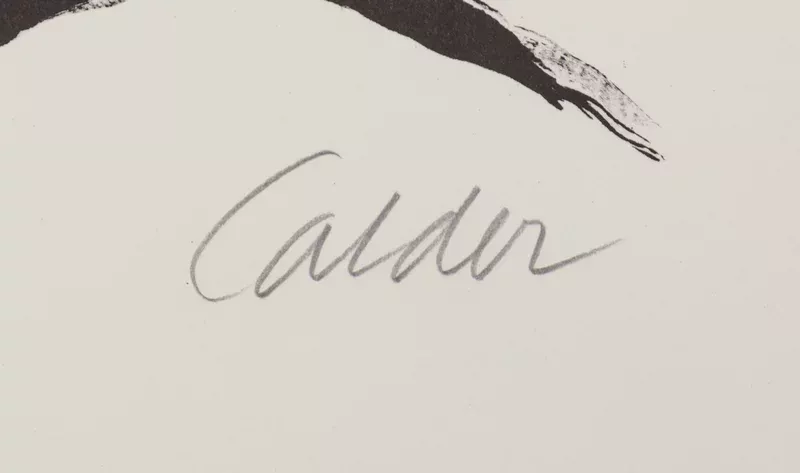
His signature
Not all of Alexander Calder's works are signed.
Although there are variations, here's a first example of his signature:
Market segmentation
Price of mobiles
Mobiles are the most emblematic and valued segment of Calder's oeuvre, and occupy a " blue chip " position on the international 20th-century art market, with strong institutional and private demand.
Monumental mobiles frequently count auctions between €5 and €20 million, with some major examples exceeding this threshold depending on provenance. Intermediate hanging mobiles make up a central segment of the market, often fetching between €800,000 and €5 million.
Small mobiles or tabletop models generally fetch between €80,000 and €600,000, depending on the formal complexity of the work.
Valuation factors
Several major mobiles have exceeded $20 million at public sale, confirming the centrality of this medium in the artist's overall valuation and the extreme rarity of historic pieces.
The mobile of the 1930s - 1950s corresponds to the phase of invention and maturity of Calder's abstract language, and can achieve prices 1.5 to 3x higher than those of the late productions of the 1960s - 1970s.
Multiple-branched compositions with sophisticated dynamic balance and primary polychromy are the most sought-after. Size, apparent lightness and kinetic quality strongly influence price formation.
His signature
Not all of Alexander Calder's mobiles are signed or numbered.
Although there are variations, here's a first example of his signature:
Expertise your property
If you own a work by Alexander Calder, don't hesitate to request a free appraisal by filling in our online form. A member of our team of experts and licensed auctioneers will contact you to provide an estimate of the market value of your Dunand-signed work.
If you're considering selling your work, our specialists will also guide you through the various alternatives available to obtain the best possible price, taking into account market trends and the specific features of each object.
Estimate in less than 24h
Discover in the same theme

Rating and value of paintings by Sayed Haider Raza
Sayed Haider Raza is a twentieth-century Indian abstract painter who has produced works whose value is exploding on the auction market.
Learn more >

Rating and value of Lalan's paintings and drawings
Lalan is a Chinese artist who has produced abstract paintings that are highly rated and valued at auction. Estimated in 24h.
Learn more >

Rating and value of drawings and paintings by Arbit Blatas
Arbit Blatas is a painter from the School of Paris whose paintings and sculptures command high prices at auction.
Learn more >
Works from the same period sold at auction

Estimated 30 € - 50 €
In the spirit of Keith HARING (1958-1990), Pregnant woman and "radiant baby".

Estimated 10.000 - 20.000 €
Alexander CALDER (1898-1976) Silver ring with double spiral motif

Estimated 20.000 - 40.000 €
Alexander CALDER (1898-1976) Silver tiara with wave motifs holding pendants

Secure site, anonymity preserved

Auctioneer approved by the State

Free and certified estimates
Frequently asked questions
-
Who is Alexander Calder, and what is his contribution to modern sculpture?Alexander Calder was a 20th-century sculptor who revolutionized art by inventing the mobile, a kinetic sculpture based on actual movement. Beginning in the 1930s, he introduced movement and dynamic balance as essential components of sculptural work, redefining sculpture as an arrangement of suspended volumes animated by air and the environment. His biomorphic abstraction, developed in dialogue with Mondrian, Arp, and Miró, is part of the international abstract avant-garde and transforms the relationship between art, space, and the viewer.
-
What is the price range for Alexander Calder's mobiles?Calder's mobiles are sold at a wide range of prices depending on their size and the period in which they were created. Small tabletop mobiles generally sell for between 80,000 and 600,000 euros, medium-sized suspended mobiles between 800,000 and 5 million euros, while monumental mobiles frequently fetch between 5 and 20 million euros at auction. The market record stands at €16,714,100 for the 1957 mobile “Poisson volant.”
-
How do you authenticate a mobile by Alexander Calder?The authentication of a Calder mobile is based on an examination of the materials (painted sheet metal, wire), dimensions, signature, or edition number, as well as an analysis of the balance of masses and kinetic quality. Documented provenance and registration in the Calder Foundation’s archives are key elements for validation. We recommend that you submit your work for a free appraisal to our state-certified auctioneers, who will provide a reliable appraisal within 48 hours.
-
Why is now the right time to sell a mobile by Alexander Calder?Calder’s market value has been trending upward for several years, and his mobiles hold a “blue-chip” position in the international market for 20th-century art, with strong demand from both institutions and private collectors. Mobiles from the 1930s–1950s—corresponding to the artist’s period of innovation and artistic maturity—can fetch prices 1.5 to 3 times higher than those of his later works. This is therefore an excellent time to sell if you own a piece from this period.
-
How does the appraisal and sale of a work of art take place at Auctie's?The appraisal is free, with no obligation, and is conducted by our state-certified auctioneers. You’ll receive a response within 48 hours with a reliable market value. If you decide to sell, we’ll guide you every step of the way—from advice on valuation to the presentation of the artwork through to its auction, ensuring the best possible terms of sale for your Calder mobile.
