



Kurt Schwitters, analysis and rating of his value on the art market

Key takeaways
- Works by Kurt Schwitters, a leading figure of the Dada movement, sell for between €300 and €15.5 million, depending on the type and rarity.
- His collages, paintings, prints, and sculptures span a wide price range, with one collage fetching €64,947 in 2022.
- Schwitters created assemblages from discarded materials, incorporating torn paper and found objects to represent a fragmented reality.
- His Merz movement, founded in 1919, had a lasting influence on contemporary art, extending to the Fluxus and Pop Art movements of the 20th century.
If you own a work of art by or about Kurt Schwitters, and would like to know its value, our state-approved experts and auctioneers will offer you their appraisal services. Our specialists will carry out a free appraisal of your work, and provide you with a precise estimate of its current market value. Thereafter, if you wish to sell your work, we will guide you towards the best possible arrangement to obtain an optimal price.
Rating and value of works by Kurt Schwitters
Inseparable from the Dada movement, Kurt Schwitters produced an exponential number of interdependent and eclectic works of art, including paintings, collages, typography, sculpture, assemblages and sound poetry. The art market is teeming with his works, which sometimes sell for as much as €300 to €15,527,280. In 2022, one of his collages entitled " Mz 255 dromedar " sold for €64 947
Order of value from a simple work to the most prestigious
Estimation | |
Drawing-watercolor | 300 - 890 516€ |
Painting | 300 - 15 527 280€ |
Estamp | 80 - 103 873€ |
Sculpture | 7,900 - 663 630€ |
Estimate in less than 24h
Style and technique of an eccentric, maverick artist
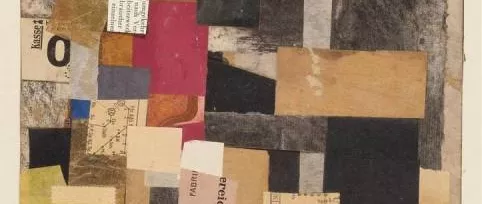
Kurt Schwitters mainly made collages from torn paper and salvaged scrap elements, brought back and glued together. He adds painted and drawn interventions. The aim of these interventions is to integrate the materials into the surface of the work. His creations no longer reflect reality in a mimetic way, but present an equivalent of the fragmented, broken reality at the end of the war.
Kurt Schwitters, poet of the Dada movement
Born in 1887, Kurt Schwitters came from a family of merchants. In 1908, he entered the Hanover School of Applied Arts. Declared unfit for combat service in 1917 (probably because he had pretended to be a scatterbrain), Schwitters was assigned as an industrial draughtsman in a metal factory. During this period, he ventured into the twists and turns of Expressionist and Cubist painting, and at the same time wrote poems in the tradition of German Romanticism. In Berlin, he fell in love with Herwarth Walden, the founder of the famous DerSturm newspaper, and in June 1918, Schwitters exhibited two abstract paintings at a group show organized by the gallery of the same name. He thus met the Dadaists and struck up a friendship with those to whom he devoted total admiration : Raoul Hausmann and his companion Hannah Höch.
How Kurt Schwitters shaped his time
Kurt Schwitters, paragon of the Dada hotbed in Hanover, founded his own artistic current, positioning himself as leader and sole member, under the strange name Merz, derived from the inscription "Kommerz- und Privatbank". In 1919, he published his manifesto in Walden's magazine and unveiled Merz works for the first time at Der Sturm gallery.
In 1923, the launch of Merz magazine propelled the artist to the forefront of the art scene. Devoted to an exceptional tour, entitled De Stijl-Dada, the first issue is brilliantly orchestrated by Theo Van Doesburg and Schwitters. The second issue was a revelation and an earthquake in the artistic community: the artist published the "Manifesto of Proletarian Art", which was also signed by such emblematic figures of the time as Franz Arp, Theo Van Doesburg and Tristan Tzara. In this manifesto, the artist insists on the need not to confine himself to the limits of the opposition between proletariat and bourgeoisie, but that art must influence integral culture, regardless of social categories.
While Dada publications had ceased to circulate in Germany and France, Merz magazine became a prosthetic extension of the movement not neglecting this legacy until 1932. The magazine established an indestructible link between Dada and constructivism and neo-platonism, as evidenced by its collaboration with El Lissitzky and the layout from which it drew its inspiration. At the same time, Schwitters debuted his magnum opus, the illustrious Merzbau, which invaded every nook and cranny of his Hanover mansion with sharp angles, sloping columns in which hideaways and grottoes could be found, where he concealed keepsake boxes for his friends.
The impact of Kurt Schwitters' protean and synergistic oeuvre is perceptible in a wide range of contemporary artistic creations. Arman's accumulations of objects, Claes Oldenburg's pop art sculptures or Tinguely's meta-matic machines remain bravura pieces that conceal Schwitters' undeniable imprint. The Fluxus movement also drew inspiration from his work.

How to recognize Kurt Schwitters' signature
Kurt Schwitters signs his works, at the bottom of the page when it is two-dimensional, with his full name in a fluid, almost calligraphic script.

How to appraise a work by Kurt Schwitters
If you happen to own a work by or after Kurt Schwitters, ask without hesitation for a free appraisal via our form on our website. A member of Auctie's will contact you promptly with an estimate of the value of your work, and provide you with all the relevant information. If you are considering selling your work, you will also be accompanied by our specialists in order to benefit from alternatives for selling it at the best possible price.
Estimate in less than 24h
Discover in the same theme

Rating and value of François Raty vases
François Raty's history, the price of his works and their current market value. Ranging from 200 to 50,000 euros, only an expert can authenticate them...
Learn more >

Rating and value of works, drawings, paintings by Marcel Bas...
Marcel Bascoulard was a self-taught, marginal painter and draughtsman of the 20th century, whose works are now highly prized at auction.
Learn more >

Rating and value of paintings by André Lagrange
André Lagrange is a painter of military and historical scenes, whose paintings are highly valued at auction.
Learn more >

Secure site, anonymity preserved

Auctioneer approved by the State

Free and certified estimates
Frequently asked questions
-
Who is Kurt Schwitters, and what was his role in the Dada movement?Kurt Schwitters (1887–1948) was a leading figure in the Dada movement and the founder of the Merz art movement. He is known for his innovative collages made from found objects, his paintings, sculptures, and sound poetry. His influence extends far beyond his own era, inspiring contemporary artists such as Arman, Claes Oldenburg, and the Fluxus movement.
-
What is the price range for Kurt Schwitters' works on the market?Kurt Schwitters’ works sell for between €300 and €15,527,280, depending on their type and size. Paintings range from €300 to €15,527,280, watercolor drawings between €300 and €890,516, sculptures between €7,900 and €663,630, and prints between €80 and €103,873. For example, in 2022, the collage “Mz 255 dromedar” sold for €64,947.
-
How can you authenticate a work by Kurt Schwitters?To authenticate a work by Kurt Schwitters, we recommend that you request a free, no-obligation appraisal using our online form. A state-certified expert or auctioneer will contact you to examine your work and provide you with an accurate appraisal within 48 hours.
-
Is this the right time to sell a work by Kurt Schwitters?Yes, now is a good time to sell a work by Schwitters. The art market is full of his works, and demand remains strong, particularly for his collages and paintings. Our experts will advise you on the best sales strategy to achieve the best possible price based on current market trends.
-
How does the sales process work at Auctie's?At Auctie's, we guide you every step of the way, from the appraisal to the auction. After you request a free, no-obligation appraisal on our website, a specialist will contact you with an accurate valuation. If you decide to sell, we’ll guide you toward the best options and assist you throughout the process to maximize the price of your artwork.
