



Rating and value of paintings by Jacques Fouquier

Key takeaways
- Jacques Fouquier (1580/91–1659), a Flemish court painter to Louis XIII, enjoys stable and high market values despite his limited presence on the art market.
- The artist’s paintings range in price from €3,750 to €163,730, while his drawings and watercolors range from €2,720 to €7,000.
- A specialist in Baroque landscapes featuring wide perspectives and secondary human figures, his style evolved around 1622 toward more focused compositions and a more serene atmosphere.
If you own a work by artist Jacques Fouquier or based on his work and would like to know its value, our state-approved experts and auctioneers will guide you.
Our specialists will carry out a free appraisal of your work, and provide you with a precise estimate of its value on the current market.
Then, if you wish to sell your work, we will direct you to the best possible arrangement to obtain the optimum price.
Rating and value of the artist
Popular during his lifetime and court painter to Louis XIII, Jacques Fouquier (or Fouquières) made his mark on the art market as early as the 17th century. Today, the artist's quotation is high and stable, despite his low presence on the market.
Highly prized by lovers of landscape painting, some of his works can fetch thousands of euros at auction.
His painting City in winter, with frozen river and figures herding was sold for over €163,700.
Order of value from the most basic to the most prestigious
Technique used | Result |
|---|---|
Drawing - watercolor | From €2,720 to €7,000 |
Paintings | From €3,750 to €163,730 |
Estimate in less than 24h
The style and technique of Jacques Fouquier
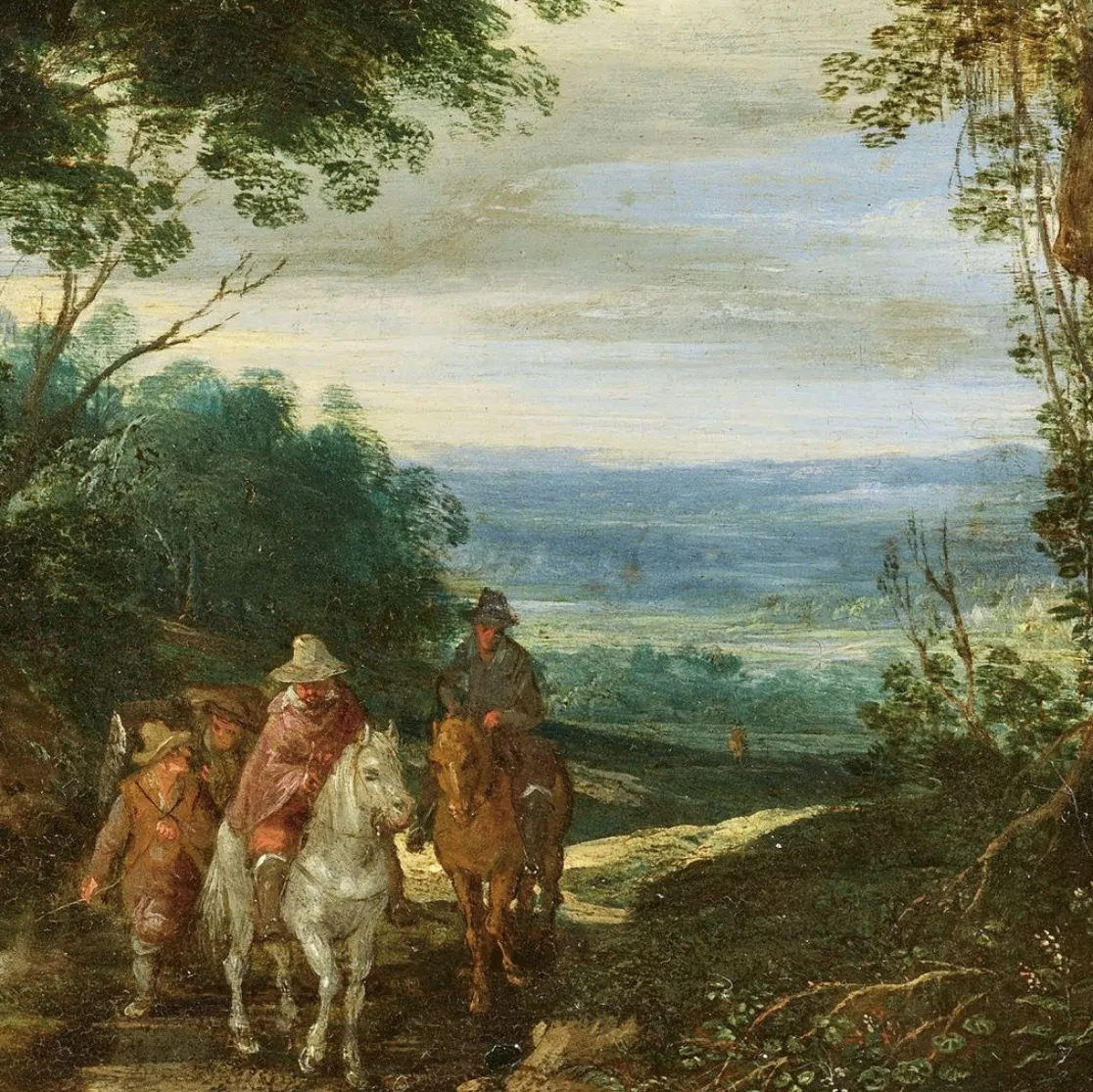
Jacques Fouquier or Jacques Fouquières (1580/91 - 1659) was a specialist in Flemish Baroque landscape. His works show a broad perspective, often a vast, animated nature and integrated human figuration.
He is heir to the tradition of " word-landscapes " (northern panoramic landscapes), with distant mountains, vast skies, rivers, groves and expansive vistas dominating the smaller figures. Around 1622, he made a transition to a more focal composition, with trees in the foreground, a reduction in panoramic depth and a more unified space and serene atmosphere.
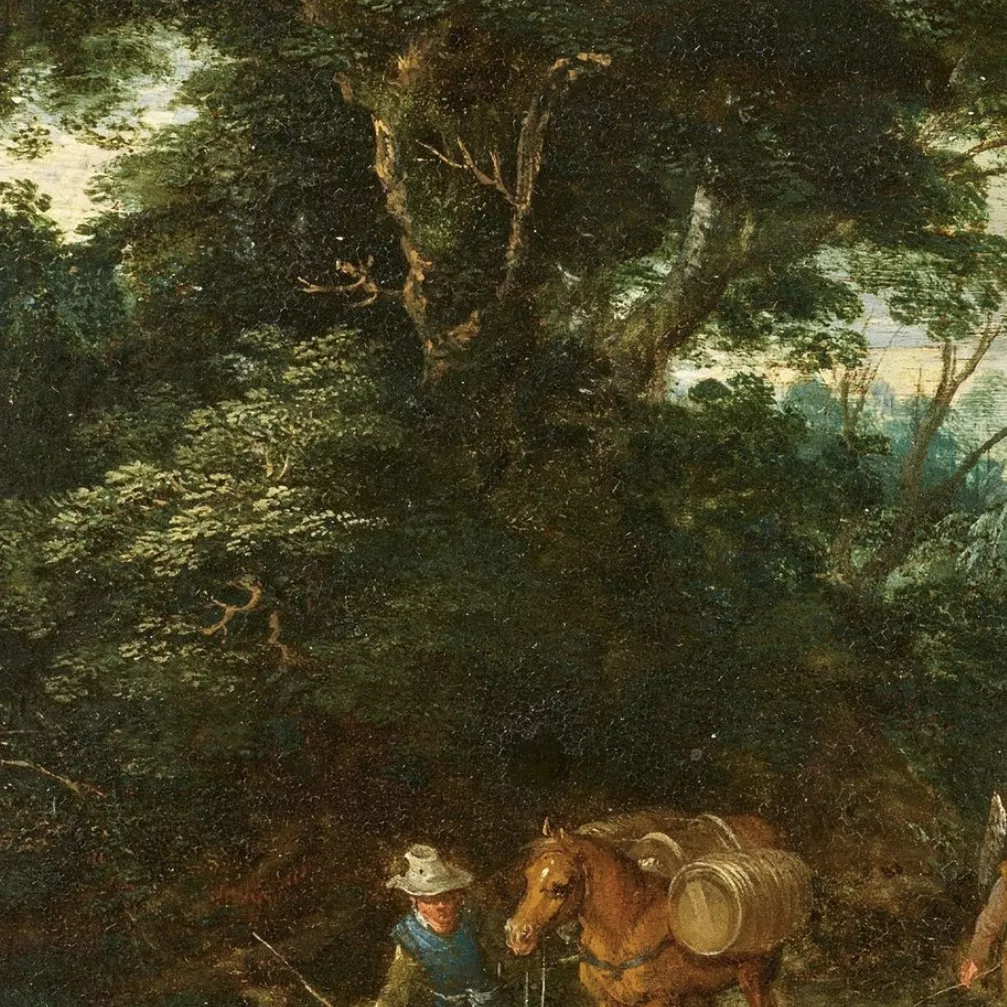
His chromatic palette is controlled, with deep greens, ochres, browns for foliage and ground, and blues - grays for background and atmosphere. The contrast between light and shadowed areas is quite subtle.
Human figures are present but secondary : unlike some contemporaries who gave great prominence to figures, with Fouquier nature remains the protagonist. The support and medium used remain mainly oil on panel and canvas, with the occasional tempera technique or pigment dilution reminiscent of the miniaturists.
The artist works with layers, superimposing them to modulate light and dark areas in order to create depth and atmosphere. His compositions are structured, with a use of successive planes (foreground, middle ground, background), and an evolution towards a reduction in stratification and a more homogeneous space.
Details are meticulous and despite the scale of the landscapes foliage, distant architecture and figures are rendered with precision. Ex-cities or castles are visible from a distance.
The artist pays particular attention to the quality of the air, light and skies are treated with perceptible distance effects, influenced by the classical landscape.
The life of Jacques Fouquier
Jacques Fouquier or Jacques Fouquières (1580/91 - 1659) was a Flemish painter born in Antwerp (Belgium). His date of birth is uncertain, since records are not consistent. On January 5, 1604, he inscribed on a drawing " aetatis suae 13 ", which however allows us to roughly date his birth.
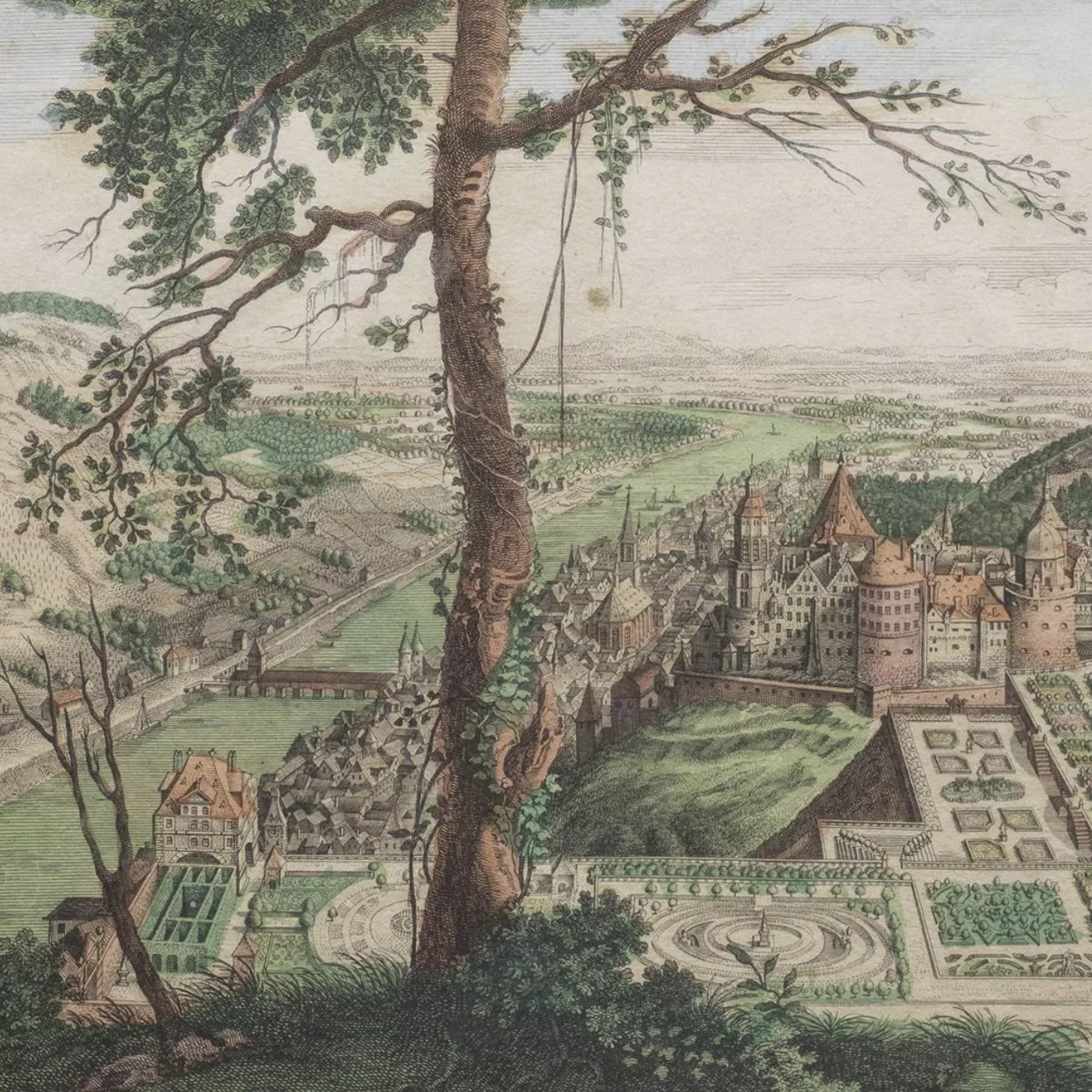
In 1614, he is registered as a master in the Guilde de Saint-Luc d'Anvers under the name " Jacques Foucque ". Around 1616-1619, we find traces of his activity in Heidelberg, Germany, in the service of Elector Palatine Frederick V, for the decorative program of " l'Englischer Bau " at Heidelberg Castle.
From 1619 to 1621, he returned to Brussels for a period, with a possible stay in Italy around 1620. In 1621 (at the latest), he moved to Paris, where he became court painter to Louis XIII. On July 15, 1626, he received a royal commission to paint landscape views for the Grande Galerie in the Louvre Palace. The same year, his ennoblement was reported.
He traveled to France to execute royal commissions : in 1626 to Toulon, in 1627 to Aix-en-Provence, and in 1629 to Marseille and Toulon.
It is documented that in 1644, he was living in Paris with other Flemish artists. He died in France between late 1655 and early 1656, or 1659 according to some sources. His after-death inventory (January 4, 1656) indicates that he had debts and few possessions, so we can assume that he died in some precarious state.
His notable pupils included Philippe de Champaigne, Matthieu van Plattenberg and Étienne Redu. He is informally referred to as " Flemish Titian " due to his high reputation at the time. Many of his large-scale decorative works for the Louvre palace or the Tuileries were lost, notably when the palace burned down in 1871.
He collaborated with and was esteemed by other masters of the time, indicating an independent European artistic network.
Focus on Panoramic view of Avignon, Jacques Fouquier
This work features a monumental tree in the foreground, dominating the entire scene. To the right, it depicts an inn and a few characters clearly visible in space. In the background, the city of Avignon stands out in a more diffuse landscape, with its illuminated roofs.
The work illustrates a transition for Fouquier. The interplay of planes (foreground, middleground, background) is still visible, but the background is treated with a more homogenous atmosphere, an indication of the transition to a less stratified landscape.
The palette favors blue-greens for the countryside, a bright red for a woman's dress in the center-right, and a golden light on the city of Avignon, and creates a contrast between urban brightness and rural quietude. Unlike some landscapes where the artist delegates the figures, here Fouquier seems to paint the figures alone.
They are precisely integrated into the setting, but remain secondary to the tree and landscape. His pictorial technique uses oil on panel, with dense layers of paint applied for the foreground, and a concern for detail (foliage, architecture), as well as a progression towards broader, atmospheric strokes at the back.
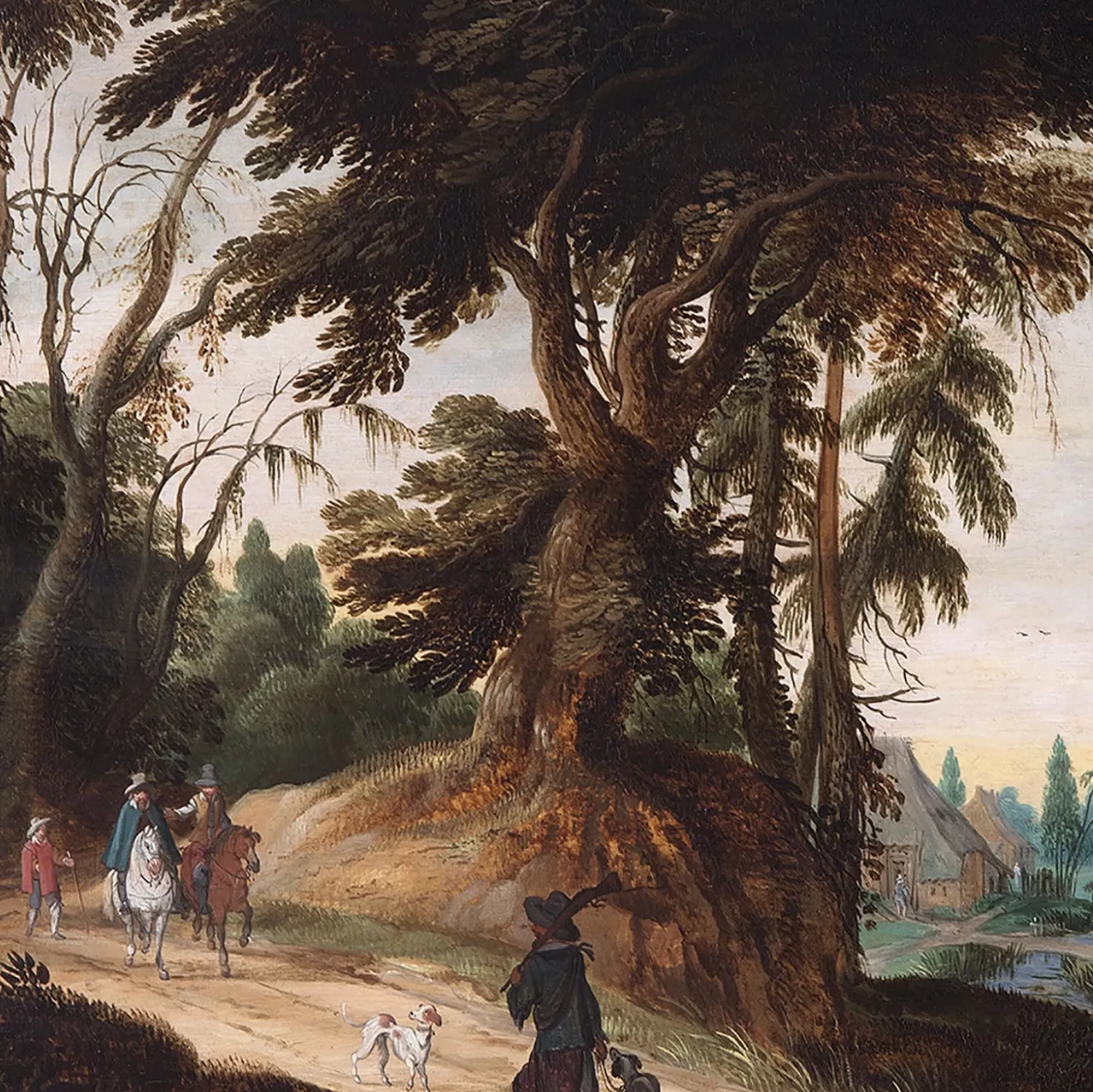
The treatment of foliage remains schematic rather than naturalistic, marking a formal rigor. The giant tree is conceived as a visual pivot, evoking an almost majestic natural presence. The cityscape of Avignon evokes human order in nature, and the union of the two suggests the coexistence of man and nature, a theme dear to Flemish Baroque landscape.
The work is part of the royal decorative program that Fouquier would lead for Louis XIII, with the valorization of nature and French royalty, which can be read in this panoramic view of an emblematic French city.
This work illustrates an evolution in Fouquier's work, namely the gradual abandonment of vast, open " word-landscapes " in favor of more contemplative, centered compositions, with a powerful foreground.
It allows us to compare his approach with that of contemporaries, for example Claude Lorrain or Nicolas Poussin, who for their part favored a classical antecedent and a smoother atmospheric depth. Fouquier still retains the Nordic robustness of the landscape while slipping into 17th-century French art.
The highly visible presence of the tree recalls solutions seen in Gillis van Coninxloo or other Flemish painters, with the tree motif as a central structure, which becomes a motif of visual interiority rather than mere decorative filler.
His signature
Not all of Jacques Fouquier's works are signed.
Expertise your property
If you own a work by Jacques Fouquier, feel free to request a free appraisal by filling out our online form.
A member of our team of experts and certified auctioneers will contact you to provide an estimate of the market value of your work.
If you are considering selling your work, our specialists will also guide you through the various alternatives available to obtain the best possible price, taking into account market trends and the specific features of each work.
Estimate in less than 24h
Discover in the same theme

Rating and value of paintings by Jean Raoux
Jean Raoux, a painter of religious subjects and history paintings, produced many oil-on-canvas works appreciated at auction. Estimated in 24h.
Learn more >

Rating and value of paintings, drawings and engravings by Re...
Rembrandt Van Rijn is one of the most famous artists of the Dutch Golden Age. Today, he is one of the most highly-rated and sought-after artists of hi...
Learn more >

Rating and value of drawings and paintings by Pierre Mignard
Pierre Mignard was a Classical-style artist who worked during the reign of Louis XIV and produced numerous portraits of great value.
Learn more >
Other paintings from the same period sold at auction

Estimated 1.000 - 2.000
Early 17th-century Flemish school, after Luca Longhi (Ravenna 1507-1580 Ravenna) or Barbara Longhi (Ravenna 1552 - 1638 Ravenna) Virgo Lactans Oil on panel (parquetage)

Estimated 800 - 1.500
Attributed to Michelangelo des Batailles ou des Bamboches, Michelangelo Cerquozzi (1602-1660)

Estimated 1.000 - 2.000
19th-century Flemish school, after Antoon Van Dyck (Antwerp 1599-1641 London), Portrait of Anna Wake (1605-1669), Oil on canvas

Estimated 300 - 500
Surroundings of Hieronymus Francken (Herentals 1578-1628 Paris) The Circumcision of Our Lord Jesus Christ Oil on panel

Estimated 1000€ - 2000€
Jan Jansz. Van der Stoffe (Leiden 1611-1682 Leiden)...

Estimated 3000€ - 5000€
Attributed to Simon de Vlieger (Rotterdam 1601-1653 Weesp)...

Estimated 200€ - 300€
Jacques CALLOT (1592 - 1635) La grande Chasse....

Secure site, anonymity preserved

Auctioneer approved by the State

Free and certified estimates
Frequently asked questions
-
Who was Jacques Fouquier, and what was his historical context?Jacques Fouquier (1580/91–1659) was a Flemish painter from Antwerp who specialized in Baroque landscapes. Popular during his lifetime, he became court painter to Louis XIII in 1621 and received a royal commission in 1626 to decorate the Grand Gallery of the Louvre. He was informally nicknamed the “Flemish Titian” because of his high reputation at the time.
-
What are the prices and market values of Jacques Fouquier's paintings and drawings?Jacques Fouquier's market value remains high and stable despite his limited presence on the market. His drawings and watercolors range in price from €2,720 to €7,000, while his paintings fetch prices ranging from €3,750 to over €163,700, depending on their size and condition. His panoramic landscapes are particularly prized by art lovers.
-
How can you authenticate a work by Jacques Fouquier?To authenticate a work by Jacques Fouquier, we recommend that you request a free, no-obligation appraisal from Auctie's. Our auctioneers and certified experts will conduct a thorough examination and provide you with an accurate estimate within 48 hours, with no obligation to sell.
-
When is the right time to sell a painting by Jacques Fouquier?Now is a good time to sell a work by Fouquier. Prices remain stable and high, with steady demand from collectors of Flemish Baroque landscapes. This master’s 17th-century works regularly find buyers at auction, particularly those depicting French landscapes.
-
How do I sell a work by Jacques Fouquier at Auctie's?Auctie's supports you every step of the way: start by requesting a free estimate through our online form. Once our experts have approved your request, we’ll guide you toward the best sales option based on your artwork’s characteristics and market trends. We handle every aspect, from preparation to the auction.
