



Rating and value of drawings and paintings by Pierre Mignard

Key takeaways
- Pierre Mignard’s paintings sell for between €50 and €150,000 at auction, with historical paintings representing the highest-value segment of the market.
- 17th-century aristocratic portraits and religious compositions are the most sought-after segments, while drawings and studies fetch between €1,000 and €4,000.
- Authentication is essential, as the difference in value between works painted by the artist himself and those produced in his studio can range from a factor of 4 to 10 in the final price.
Paintings and drawings by Pierre Mignard or based on his works sell for up to €150,000 at auction. An appraisal allows us to accurately determine the current market value of your Pierre Mignard artwork and, if applicable, optimize the sale of the piece.
If you own a work by Pierre Mignard and would like to know its value, our state-certified auctioneers will provide a free appraisal based on authenticity, market rating, and recent market results.
Market Value and Appraisal of Artist Pierre Mignard
Pierre Mignard was a 17th-century French painter. Although he is a world-renowned figure, relatively few works attributed to him are found on the art market; however, those that are exist are highly prized and command high prices.
Most of his body of work consists of paintings, though a few drawings and prints have also been preserved.
Pierre Mignard’s works sell for between €50 and €150,000 (attributed to him or his studio for the lower-priced pieces). His oil on canvas, *Louis XIV Before a Flemish Town*, dating from 1680, sold for €150,000, while it had been estimated at between €150,000 and €200,000.
Ranking of works from the simplest to the most prestigious
Technique used | Result |
|---|---|
Print - multiple | From €50 to €200 |
From 500 to 4,800€ | |
From 1,300 to 150,000€ |
Estimate in less than 24h
Placing the Artist in Context
Period
Pierre I Mignard (1612–1965) was a painter who worked during the rise of French Classicism under the reign of Louis XIV, particularly in the 1650s and 1660s.
He initially trained in Italy during the 1630s–1650s, a period that would prove decisive for his assimilation of the models of Italian Baroque painting.
He returned to France in the second half of the century, a time when artistic production was becoming institutionalized around the Royal Academy of Painting and Sculpture.
The end of his career was marked by his appointment as First Painter to the King following the death of Charles Le Brun.
Artistic Movements
Pierre Mignard’s body of work is fully rooted in French Classicism, which is characterized by a pursuit of harmony, balance, and compositional clarity based on the imitation of ancient and Renaissance models.
It also falls within the academic Baroque tradition, incorporating decorative and monumental effects inherited from Italian painting, while maintaining a rigorous classical structure.
He produced numerous history paintings, in which he depicted mythological, religious, or allegorical subjects—considered the noblest genre in the academic hierarchy. He also painted portraits of aristocrats, characterized by an idealization of the figures.
He was clearly influenced by Italian painters, drawing on 17th-century Roman models—particularly those associated with Guido Reni—which are evident in the softness of the modeling and the grace of the figures.
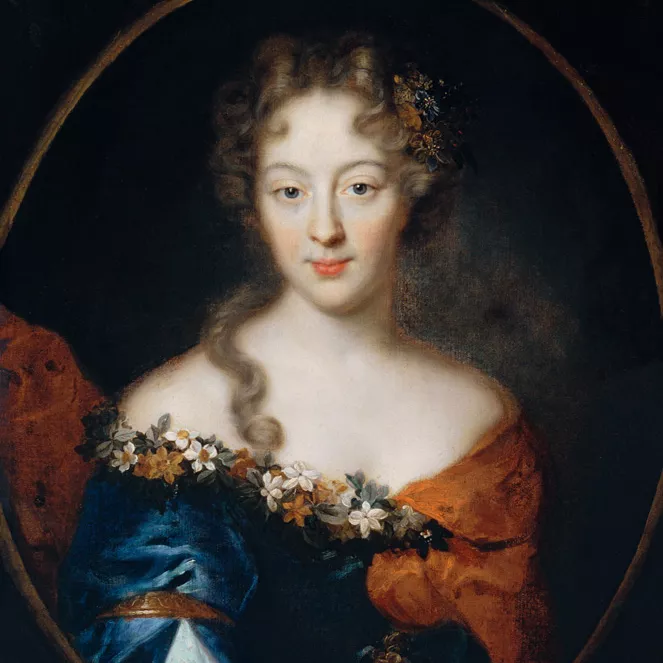

The Life of Pierre Mignard
Cultural Context
Pierre Mignard was born in 1612 and developed his artistic career within the context of 17th-century French Classicism, a period marked by the emergence of an official art form closely linked to monarchical power.
After receiving his initial training in France, he spent a long time in Rome, where he studied the masters of the Italian Renaissance and Baroque—an experience that was pivotal in the development of his pictorial style.
His work is characterized by a high degree of mastery in portraiture and by refined decorative painting, combining clarity of composition, soft modeling, and chromatic harmony.
He is particularly noted for his depictions of idealized aristocratic and female figures, which contributed to the visual representation of elegance and social prestige in France during the Grand Siècle.
Artistic and Intellectual Circle
His artistic career unfolded within a cultural climate dominated by the figure of Louis XIV, whose artistic policies shaped the kingdom’s monumental and decorative output.
He maintained a notable rivalry with Charles Le Brun, the King’s chief painter and a central figure in the Academy of Painting and Sculpture.
After Le Brun’s death, Mignard rose to a major institutional position by becoming director of the Royal Academy of Painting and Sculpture, thereby cementing his role in French artistic life at the end of the 17th century.

The Artist's Techniques
The Style of Pierre Mignard
Pierre Mignard was a major 17th-century French painter, active within the context of Classicism during the reign of Louis XIV. His training in Italy was marked by the influence of Bolognese painting and Roman Classicism.
He specialized in portraiture and history painting, characterized by refined elegance and an idealization of the figures. His draftsmanship is precise and his modeling soft, emphasizing the grace of the faces and the delicacy of the skin tones.
His palette is luminous and harmonious, often dominated by warm tones and subtle chiaroscuro effects. He placed great importance on expression and the gentleness of poses, in contrast to the more rigorous monumentality of some of his contemporaries.
He also made a significant contribution to monumental decorations and the court’s iconographic programs.
Spotlight on a Key Work
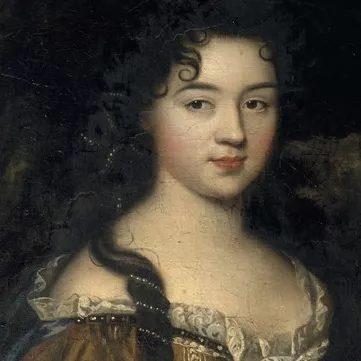
Portrait of Madame de Maintenon, c. 1694
This composition centers on the figure of the subject, depicted with calm dignity and measured elegance. He renders the face and hands with delicate care, highlighting his mastery of modeling and skin tone.
The drapery is fluid and meticulously rendered, contributing to the nobility of the portrayal. His warm and luminous palette accentuates the portrait’s gentleness. Her demeanor is reserved and her gaze introspective, conveying the character’s psychological depth.
This work is representative of portraiture at the court of Louis XIV, where idealization is combined with a subtle characterization of the subject.
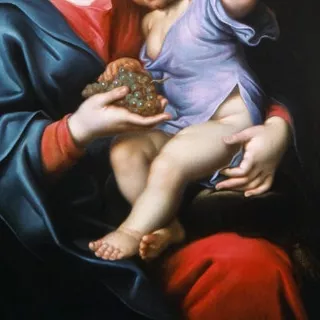
FAQ – How do you appraise a work by Pierre Mignard?
1) What is the first step in appraising a work by Pierre Mignard?
The appraisal begins with a precise identification of the work’s nature (portrait, religious composition, mythological scene, or preparatory drawing), along with an examination of the medium, painting technique, dimensions, any signature, and date.
2) What stylistic criteria specific to Pierre Mignard are key?
For Pierre Mignard, the analysis focuses on the softness of the modeling, the delicacy of the skin tones, the fluidity of the drawing, and the elegance of the composition—characteristics of his style, often associated with the refined and harmonious aesthetic of the French Baroque.
3) How important is the period of creation in the appraisal?
Dating allows us to distinguish between works created during his stay in Italy and those produced in France after his return, as certain phases of his career are particularly sought after due to their stylistic maturity and historical significance.
Market Segmentation
Prices of Artworks
Pierre Mignard was a leading history painter during the reign of Louis XIV. He occupies a high-end segment of the market for French Old Masters, supported by demand for 17th-century aristocratic portraits and religious compositions.
Historical paintings and religious compositions generally sell for between €50,000 and €150,000. Aristocratic portraits constitute the mid-range segment of the market, often selling for between €30,000 and €100,000.
Drawings and preparatory studies occupy a more accessible market segment, ranging from €1,000 to €4,000.
Factors Affecting Value
The price differences between artist-signed works, workshop productions, and works by associates can range from a factor of 4 to 10, due to the high volume of portrait production in his workshop.
Idealized portraits of women, portraits of the court of Louis XIV, and ambitious religious compositions are the most sought-after segments, while more conventional works fall at the lower end of the price range.
The market is relatively narrow, dominated by auctions specializing in Old Masters, with moderate auction frequency but strong competition for works with excellent provenance.
Recognizing the Artist’s Signature
Pierre Mignard does not always sign his canvases, and many works on the market are attributed to his followers (which does not mean the paintings have no value). In any case, for this artist, the involvement of a dedicated expert is essential.
Have Your Pierre Mignard Work Appraised
If you own a work by Pierre Mignard or attributed to him, an appraisal will help you assess its value on the current market.
Using our online form, our experts and certified auctioneers will conduct a free appraisal and provide you with a reliable estimate of your artwork’s market value.
If you’re considering selling it, we’ll guide you through the process to ensure you get the best possible price.
Estimate in less than 24h
Discover in the same theme

Rating and value of sculptures, bronzes and marbles by Stefa...
Stefano Maderno is a 17th-century Italian Baroque sculptor whose works are highly prized at auction.
Learn more >

Rating and value of paintings by Jacques Fouquier
Jacques Fouquier was a Flemish artist and court painter to Louis XIII. Today, his canvases are highly prized at auction.
Learn more >

Rating and value of drawings and paintings by Nicolas de Lar...
Nicolas de Largillierre is a classical and Baroque painter who produced numerous portraits that command high prices at auction.
Learn more >
Nos records d'enchères à l'hôtel Drouot

Estimated 10.000 - 15.000 €
Ebridge Ayer BURBANK(1858-1949), Young African-American boy, Oil on panel.

Estimated 20.000 - 30.000
EXCEPTIONAL LARGE OVAL DISH IN VINCENNES SOFT PASTE PORCELAIN FROM THE "BLEU CÉLESTE" SERVICE OF KING LOUIS XV AT THE CHÂTEAU DE VERSAILLES

Estimated 20.000 - 30.000
MANUFACTURE ROYALE DE SÈVRES, 18th century "L'Empereur de la Chine" - Portrait of the Emperor Qianlong, Hard porcelain bisque, 1775

Estimated 1.500 - 3.000
HERMÈS, "Kelly" 32 saddle bag in black box calf

Estimated Between €5,000 and €8,000
KRACHKOWSKY (1854-1914), Before the storm, oil on canvas

Estimated 40.000 - 80.000
Alexandre ROUBTZOFF (1884-1949), Portrait of Arbia, oil on canvas

Secure site, anonymity preserved

Auctioneer approved by the State

Free and certified estimates
Frequently asked questions
-
Who is Pierre Mignard, and what is his historical context?Pierre Mignard (1612–1695) was a leading French painter of the 17th century, active during the reign of Louis XIV. Trained in Italy, where he absorbed the styles of Bolognese and Roman painting, he returned to France to establish himself as a central figure of French Classicism. Toward the end of his career, he became director of the Royal Academy of Painting and Sculpture, succeeding Charles Le Brun as First Painter to the King.
-
What is the price range for Pierre Mignard's paintings on the art market?Pierre Mignard’s paintings and drawings sell for between €50,000 and €150,000 at auction. Historical paintings and religious compositions generally fetch between €50,000 and €150,000, while portraits of aristocrats range from €30,000 to €100,000. Drawings and preparatory studies are more affordable, ranging from €1,000 to €4,000.
-
How can a work attributed to Pierre Mignard be authenticated?Authenticating a work by Pierre Mignard requires the expertise of a specialized appraiser, as the artist does not always sign his paintings and many works are attributed to his followers. At Auctie’s, our state-certified auctioneers provide a free, no-obligation appraisal based on an examination of the support, painting technique, dimensions, signature, and provenance, with a response within 48 hours.
-
What are Pierre Mignard's distinctive stylistic characteristics?Pierre Mignard’s work is characterized by the softness of his modeling, the delicacy of his skin tones, the fluidity of his line work, and the elegance of his composition. His color palette is luminous and harmonious, dominated by warm tones with subtle chiaroscuro effects. He specializes in idealized portraits of the aristocracy and history painting, emphasizing the grace of the faces and the psychological expression of his subjects.
-
How do I sell a work by Pierre Mignard through Auctie's?If you own a work by Pierre Mignard, Auctie's will guide you through the process from appraisal to auction. Start with a free appraisal using our online form: our experts will assess the market value of your piece. We’ll then advise you on the best terms of sale and manage the entire process to ensure your artwork fetches the highest possible price.
